I’ll be taking my son to the Maker Faire for the third year in a row this weekend. It’s a great Father & Son festival where you see what happens when you throw together technology, imagination, dedication, and passion into a big pot and mix it up together.
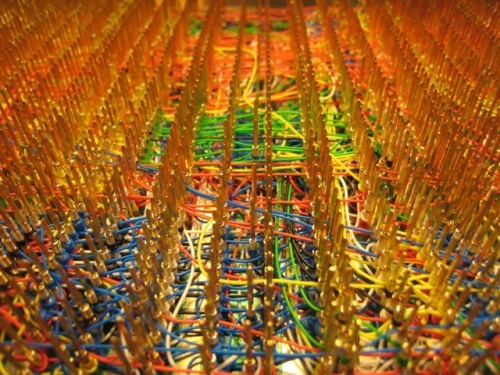
On display will be Steve Chamberlin’s hand-built CPU which he built in 18 months using $1000 worth of parts and 1,200 pieces of wire hand-wrapped around gold wrap posts mounted to a board that he bought off of eBay. In the end, he re-created a large version of something the equivalent of the Apple II CPU. He nicknamed it, Big Mess of Wires. Full details on Steve’s blog.
I look forward to seeing Steve’s homebrewed CPU along with many other pet projects that are sure to inspire.
A common problem with the mobile web is that pages are not optimized for the mobile browser. Browsers are getting better but sidebar widgets and other social networking cruft often get in the way of viewing sites efficiently on a small screen over a wireless connection.
Combining both a URL shortening service and a service that optimizes pages for the mobile browser, Delivr makes it dead easy to bring pages over to the mobile web.
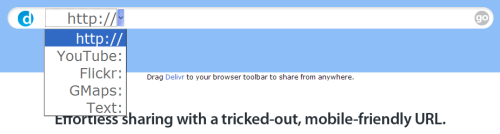
On the home page, a drop down gives you access to a number of options depending on the type of page you wish to share with your mobile friends. Choosing an option drives what data Delivr captures to create a mobile-optimized page.
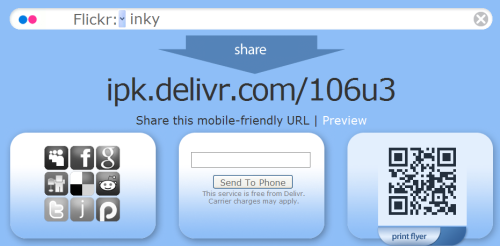
Sharing a flickr photo? The dropdown asks for a flickr username and Delivr will give you a gallery of the latest photos. Select the photo you want, add a title and message and off it goes the link as a text message (currently supports US numbers only) along with the shortened url.
Other content-specific options include a YouTube video, a map of an address on Google Maps (a great way for a business to shorten those long GMap urls), and the “text” option which gives you a whole slew of formatting options to create a mobile-optimized page. I hear from Deliver that more are options are on the way.
Besides texting a link, you also have options to send the link to a variety of social networking sites and (this I really like) they’ve even added a “print flyer” option to create a full page PDF with four postcard-sized cards complete with a QR Code that links directly to the page you’re sharing. Send this PDF off to the printer and you’ve now got a nice postcard to hand out to customers or prospects at the next conference.
Delivr strives to makes things as easy as possible. If you think logging into a site is too much of a pain, they have a bookmarklet that you can add to your browser bar. If even that is too much of a hassle, you don’t even need to have an account to check out their latest trick. Just add “delivr.com” in front of any url to transform it into a mobile ready page.
That’s all it takes to throw a URL over the transom an create a mobile-friendly version of that page that can be shared with all your cellie-toting friends. As with other URL shortening services such at bit.ly, delivr also provides analytics around each link you share, tracking where traffic is coming from (web, the unique print URL, or QR Code). Marketers are already playing around with the service to analyize where they can be most effective in getting the word out with Green Day currently running a promotion for their upcoming release on May 15th.
Every aspect of this service has been thought out carefully, the simplicity of the site is deceiving. Delivr has created a simple platform that can be extended any number of ways; into the virtual space through their series of mobile-optimized landing pages and into the physical space via the QR Coded PDF postcards. If you think that URLs are the currency of the web – Delivr is in a great position to be the central bank for URLs on the mobile web.
Promoting new features of the Nokia E71 with Taiwanese magician Liu Qian performing a little street art. I can’t wait for the SMS-a-pigeon feature when it comes out.
Cookie Consent
We use cookies to improve your experience on our site. By using our site, you consent to cookies.
ID used to identify users for 24 hours after last activity
24 hours
_gat
Used to monitor number of Google Analytics server requests when using Google Tag Manager
1 minute
_gac_
Contains information related to marketing campaigns of the user. These are shared with Google AdWords / Google Ads when the Google Ads and Google Analytics accounts are linked together.
90 days
__utma
ID used to identify users and sessions
2 years after last activity
__utmt
Used to monitor number of Google Analytics server requests
10 minutes
__utmb
Used to distinguish new sessions and visits. This cookie is set when the GA.js javascript library is loaded and there is no existing __utmb cookie. The cookie is updated every time data is sent to the Google Analytics server.
30 minutes after last activity
__utmc
Used only with old Urchin versions of Google Analytics and not with GA.js. Was used to distinguish between new sessions and visits at the end of a session.
End of session (browser)
__utmz
Contains information about the traffic source or campaign that directed user to the website. The cookie is set when the GA.js javascript is loaded and updated when data is sent to the Google Anaytics server
6 months after last activity
__utmv
Contains custom information set by the web developer via the _setCustomVar method in Google Analytics. This cookie is updated every time new data is sent to the Google Analytics server.
2 years after last activity
__utmx
Used to determine whether a user is included in an A / B or Multivariate test.
18 months
_ga
ID used to identify users
2 years
_gali
Used by Google Analytics to determine which links on a page are being clicked
30 seconds
_ga_
ID used to identify users
2 years
You can find more information in our About Me and .
![Reblog this post [with Zemanta]](http://img.zemanta.com/reblog_c.png?x-id=d23d522a-2a01-4e8a-87ee-eaa5b187c4dd)