The promotional drumbeat grows ever louder as we get closer to the release of Nokia’s new handset, the Nokia N8. Nokia’s marketing machine is a wonder to see in action. Two promotions I thought particularly clever are both world record breakers and nicely bookend the catchphrase for the device, It’s not technology, it’s what you do with it.
Dot, the world’s smallest stop motion video. Commissioning the folks behind the Wallace and Gromit movies (Aardman Animations), the Dot short is made up thousands of frames shot on a mounted N8 using its 12-megapixel camera. Painstakingly, the team managed about 4-seconds of footage a day. When they were done, these were stitched together into a minute and a half stop motion movie.
Rosengård, the world’s largest projection screen. Going from micro to macro, a nine-story screen hoisted between two cranes served as the screen for an HD video signal projected from four massive projectors. Over 2,500 people (1,000 from the comfort of their balcony) were able to enjoy Prince of Persia, the Sands of Time fed by the HDMI port on an N8.
My Grandmother passed away earlier this month and although I could not make it to her memorial service in upstate New York, I did send along the following anecdote to share with those attending. I will miss her but she lived a very full life and lives on in her stories.
Grandmother
Laura Kennedy, my Grandmother, was a great storyteller. She told her stories in such a way that you knew they were perfected over time, improved with each telling. They were so good that when you knew she was about to launch into one, you took it in and let it wash over you, knowing that you would hear something new and were guaranteed to be entertained. Here is one of my favorites.
Trans-Siberian Railway
I’m not sure when this story takes place. I do know she was in Europe and on her way to Japan so maybe it was when she set out to meet my mother’s parents for the first time before Dad married Mom. This would put us in the early 60’s.
Of course, traveling from Europe to Japan by airplane was way too efficient. My Grandmother lived in a different age. An age of steam and fur coats. Efficient modernity caused her nothing but trouble. I remember my uncle gifted her a new refrigerator once her old hulk gave out. This new fridge was gleaming and featured amenities such as water dispensed chilled from the doorway and an automatic ice machine that kept the bin in the freezer topped up. When Uncle Peter called a few days later to check in on his Mother to see how she liked the new gadget, she asked him exhaustively to get rid of the “infernal device” as she couldn’t get a wink of sleep. Probed further, she explained that she had to come downstairs at least every three hours to empty the ice bucket because she feared the freezer would overflow and jam up and the “thing just wouldn’t stop!”
No, a stratocruiser from Paris to Tokyo would not do. She preferred to travel under steam on the Trans-Siberian Railway out of Paris to Vladivostok and connect with a cruise ship to taker her around Honshu over to Yokohama. It was two weeks but she had time and probably was secretly looking forward to some time alone to indulge herself in some reading. In preparation, she brought along a boxes of books.
Two Weeks! She was going to improve her mind during the trip and I could imagine that she shoved in several weighty tomes, maybe she even had that entire series of Arabian Nights books that she had in the Blue Room. There was probably an Olivetti in a trunk somewhere as well just in case an inspiration struck her while rolling across the steppes. You know, no less than fifteen pieces of luggage, steamer trunks, probably several hat boxes. That’s how Grandma rolled. All steam and romance.
Of course, with the kind of convoy required to move such material, unless you were a logistical genius, you would be delayed getting from Point A to Point B. Grandmother was most definitely *not* a logistical genius. We’re talking about the lady that kept her manuscripts in the oven because, if there was ever a fire, “that would be the *one* place something wouldn’t burn. Creative, yes. But not very practical.
So of course she was late getting to the station in Paris and almost missed her train. She got there just in time, all flustered, found her carriage and eventually her compartment and began to arrange her things.
She was about to settle into her seat when she popped back up and thought about pulling down her first book. Like starting a delicious feast, where to begin? As she was about to sit back down when the train lurched and she dropped her glasses, which she had been holding in her hand, on the bench in front of her. As she fell forward, she spun around and landed with a plop into her seat, her legs thrown out from under her. She then heard a multi-faceted *crack* and *crinkle* and instantly knew what happened. She had sat on her glasses!
As she rose slowly to survey the damage and it was evident that the lenses were beyond repair. They were utterly destroyed, not just cracked but actually ground down, tiny shards of plastic, powder, and bent wire was all that remained. There was nothing that could be done. The train was now gaining speed and headed towards the outskirts of Paris, two weeks, fourteen days, 336 hours of rolling boredom lay before her.
The days dragged on. The green countryside of France gave way to the grey potato fields of Poland. In the evening it grew cold and she discovered there was a small crack up by the window that let the air in. Laura found that by chewing the rough Russian bread, she could soften it into a rough ball and use it to stuff the hole and stop the breeze. During the day, when it got hot, she would take out the bread dough to let some air in, and then repeat the process with some new bread each evening. Days went by as they rolled over the tundra – the image of Grandmother, staring at the fake wood-grain paneling on the walls of her train compartment, unable to see more than a grey smudge of sky over frost-covered fields, the sole highlight being the daily “filling of the hole” exercise still sticks with me as some kind of Kafka-esque punishment. Grandmother had hoped to read Russian novels during her trip, instead, she was living one!
Eventually, she fumbled her way to some of the other compartments. Realizing that her First Class cabin was really an isolation tank that would drive her insane. She made her way to the second and third class cars and ran across what she describes as a raucous carriage full of Russian cossacks. The trip was eventually salvaged by playing drinking games with the soldiers.
She may have been exaggerating. She always stretched the truth a bit. Maybe they weren’t really cossacks, maybe the glasses weren’t really broken. Who knows. I never really pushed her on it. It was the story and her joy in telling it that counted. And that’s the message.
Two concepts floated around in the past year envision the future of print on connected tablets such at the iPad.
Future of the Book, a video by IDEO, suggests three designs for an interactive book. Co. Design has some thoughts and link to an interview with some of the designers behind this concept.
Mag+ is a concept by Berg. The video was released in December 2009, a version of was released for Popular Mechanics in April and is available for the iPad.
Both of these concepts illustrate the power of additional information deep-linked into the text. These links can lead to interactive graphics as in the Mag+ example or discussion boards as in the IDEO example. Yet, each of these experiences, despite being more interactive than ink on paper, still feel packaged. One vector not explored in either of these concepts is that of reader’s context which is increasingly available via mobile devices. More and more apps are leveraging things such as location to customize the experience. What other contexts can be added to the reading experience and how would it change the reading experience?
The new Facebook gift cards will be available in values of $15, $25 and $50 at all of Target’s 1,750 retail stores and at Target.com. Two or three more national retailers will start selling the cards in coming months.
The article goes on to report that cards for online games such as Farmville are already available and that the overall market for gift cards was $80.6 billion last year.
I wonder how the gift card economy works. Does facebook get to book revenues for gift card sales before they are re-deemed? How are gift card sales classified for taxes? If you sell gift cards in other currencies, does the gift card revenue get counted towards the US GDP?
The depths of Pokémon gamer knowledge are beyond my reach. My kids, on the other hand, have gone deep and are using the internet to expand their learning further. I helped connect their Nintendo DS to Wifi so they can explore virtual worlds. Now they are connecting with other players around the world to trade characters. We have conversations around their gaming world but I am totally lost at sea.
Today, my son pointed me to Serebii.net which is, as far as I can tell, the wikipedia for the Pokémon fan. Here’s an entry for Shiny Pokémon and how one might obtain one.
You have probably heard or seen a picture of them. Pokémon that are different colors than normally seen with. An example of that could be a Metagross with a silver coating and a golden X on it, a dark green Zubat, or a black Rayquaza. The Torchic you may have obtained from Professor Birch may be a lighter colored orange and you may think the game is glitched up, but it isn’t. As you can imagine, these occurences are very, very rare. Not very many people even have a shiny Pokémon to begin with. So how do you get them?
It depends on very, very good luck to get a shiny Pokémon. You can find shiny Pokémon in the wild, in eggs, and in the battle tower, which is basically everyplace you can catch a Pokémon save for the Battle Tower in which you won’t be able to catch the shinys there. Needless to say, you wont be very lucky if a shiny ends up there. People have said that you can also meet a shiny when in your first battle against the wild Poochyena and Wally’s Ralts as well. Basically, like I said, it revolves around how lucky you are. Now the bad thing is that the odds of finding a shiny Pokémon in the wild are 1 in 8,192 battles…all the time, meaning after 8,191 battles it’ll still be 1 in 8,192 and not a dead cert that you will get one i.e. not 1 in 1 battles. If you already have a shiny Pokémon and think you’ll have a higher chance of getting another shiny if you breed with it, think again. It’s still going to have the same odds.
Now you’d think with a Pokémon this rare, it has to have good Individual Values and such. That’s no longer the case. Shiny Pokémon are always going to end up with the same odds of good stats as normal Pokémon. They used to have set IV’s in the Metal generation, but not in this one.
In the fourth generation, a variety of things have changed in order to allow for the obtaining of Shiny Pokémon. First is a method commonly known as the Masuda Method, named after the game developer and the person who revealed it; Junichi Masuda. This method has you breed two Pokémon. However, one of the Pokémon must be of a different nationality than your game (such as a Japanese Pokémon on an English game). This will lower the chances of hatching a shiny Pokémon from 1 in 8,192 to 1 in 2,048 cutting it by 75%.
The second method of obtaining shiny Pokémon is through the method called “chaining”. This method has you carry on a chain on the PokéRadar. As you battle the Pokémon and your chain increases, the chances of seeing a Shiny Pokémon also increases up until you’re on the 40th chain where it levels out. Continue the chain and you may see the grass glow instead of shaking. If this occurs, there is a shiny Pokémon there. To get this far, I suggest you use many Repels so your chains are less likely to be broken.
And that’s everything on Shiny Pokémon.
Got that? Good, ’cause you never know the next time an 11 year-old is going to quiz you.
Miss Kazakhstan is always easy to find at a crowded party.
I had no idea that there was a National Costume portion of the Miss Universe pageant. I need to tune in next time. Excellent collection of snarky one-liners over at Tom & Lorenzo’s blog. Part One & Part Two.
Hope you all had a chance to tune into Radio Helsinki at 4:30 pm and boogie down. For some virtual fun, click play on all three links below at the same time.
It’s all part of Happy Helsinki and the Helsinki Festival.
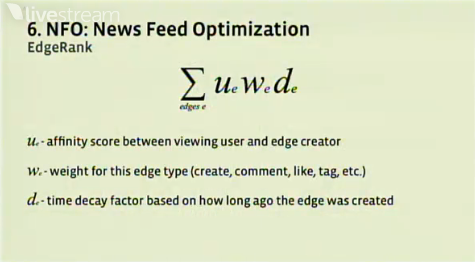
Michael Berstein, a researcher at MIT, posts a snapshot of the algorithm used to calculate what is shown to you in the Facebook Top News feed.
The algo is called EdgeRank and he describes it as such:
I’ll cut through the math using words. Whenever somebody interacts with a news feed item, they create an edge to that item. So if I comment on a friend’s new puppy photos, I’ve created an edge to your photos. When trying whether to show the photos in your news feed, Facebook looks at how closely you interact with everyone who has an edge to the item. So, with the puppy photos, it considers your affinity to the friend who created the photos, and then me because I commented on them.
This all comes down to — initialization matters. If my high school friends are the first to comment on a news feed item, the EdgeRank of that item for other high school friends is high. So, other high school friends will see the item. If grad school friends are the first to comment, then other grad school friends are likewise going to see it.
I had no idea that the elapsed time between a posting and when you interact with the object had something to do with future relevance calculations but now that I think of it, it makes sense. The same has happened to my twitter usage – since I’ve shifted timezones, I mostly see tweets and posts from friends in the European timezone so, in a self-fulfilling way, any service looking to see which content I engage with the most will most likely determine that it’s things coming from my European friends.
More details about Faebook’s EdgeRank algorithm and a link to the full video which was presented at f8 over on TechCrunch.