Long post by Tim O’Reilly on the current state of the Internet as an Operating System. Many key developments that see this idea coming together and Tim connects the dots in a compelling way to complete the picture. The key piece for me is Social. The Internet OS still does not usefully recognize that we have multiple social graphs that depend upon application and context. Current solutions such as Facebook Connect currently assume a universal “friend’s list” which doesn’t address this subtlety.
Whoever cracks this code, providing frameworks that make it possible for applications to be functionally social without being socially promiscuous, will win. Platform providers are in a good position to solve this problem once, so that users don’t have to give credentials to a larger and larger pool of application providers, with little assurance that the data they provide won’t be misused. (Emphasis mine).
This is a key problem that needs to be solved. Location-based services and mobile devices are pieces of the puzzle but more synapses are needed to make it work effortlessly.
Sometime in the near future, district heating in Helsinki will be supplemented by heat thrown off by local data centers. This will enable them to cut back on greenhouse gases produced by more traditional methods to heat the water that is pumping through radiators across town.
In a first of its kind experiment, the city of Helsinki will look at piping the waste heat produced by a data center, specifically the underground Academica Data Centre, to run under buildings and provide much needed heat for the residents. In a further move to enhance the greenness of this data centre, it is also going to be cooled by the icy waters of the Baltic Sea. This is one of the unique features of this system – the pump can both heat and cool water. This efficacy means that the output energy is five times more than the input energy. This directly translates into five times cheaper power. . . They can heat around 500 houses [and also save] around $ 563,000 annually for the company in power bills.
A recent editorial in the New York Times spoke of how internet commerce is eating into the US Postal Services’ bottom line.
The Postal Service made a profit until 2006. Since then, declining mail volumes — as more Americans use e-mail and pay their bills online — and the demands of its retiree health benefit system have dragged it deeper and deeper into the red. Last year, it delivered 17 percent fewer pieces of mail than in 2006 and reported losses of $1.4 billion, this year it expects to lose $7 billion. Postmaster General John Potter warns that unless the service takes major steps to bring its costs into line, it will lose $238 billion over the next 10 years.
Some of the suggestions include ending Saturday delivery and closing lesser used branch offices and replacing them with ATM-like kiosks in supermarkets or malls. While these may make sense to cut costs, if there was more flexibility for the postal service to expand into new businesses, they would stand to gain from the growth in other areas where they have suffered such as online, electronic invoicing.
Here in Finland I was surprised that the Finnish Postal Service has a strong online presence (NetPosti) that is an integral part of everyone’s life.
Receiving e-invoices in NetPosti does not carry a fee.
An e-mail notification and/or SMS message of e-invoices received in NetPosti
Pay for the e-invoice in any online bank from any account using the virtual barcode.
The e-invoice is convenient to attach to an e-mail as a PDF file.
E-invoices can be read and archived in all online services that offer the NetPosti service.
A free-of-charge archive for seven years (instead of the previous six years)
Netposti has not only everyone’s physical address (they get a feed of all address changes from the Finnish government), but they also provide an account for everyone tied to your social security number and an email address that you can provide.
I get my paychecks delivered electronically as a PDF and I can neatly archive them into folders for future reference. As it says above, I can receive my bills via NetPosti and pay them online via my bank’s website. All for free.
Why doesn’t the US Post Office partner with PayPal, Visa, Amex, etc and deliver invoices electronically and take part in the 21st Century?
It’s a different experience when you’re a world away. I watched the commercials on the special YouTube channel but the spot for the Late Show featuring Jay Leno, Oprah Winfrey, and Dave Letterman was my favorite.
Backstory on how it all came together was written up in the New York Times.
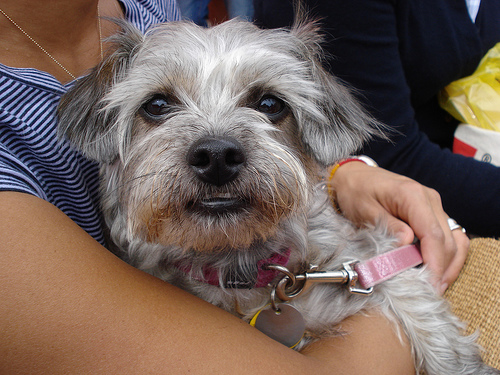
On our last trip to Japan, we decided to take our dog, Mimi, along to meet the rest of the family. We moved to Finland from the United States so we knew that travelling with pets involves a lot of paperwork. Avoiding a lengthy quarantine for Mimi coming to Finland required the signature and stamp from a man in a windowless office next to San Francisco Airport with a poster that said, and I’m not making this up, “1,000 reasons to say No.” We knew there was some paperwork so shortly after arriving in Finland, started to research what it would take to get little Mimi through customs without a hitch. I’m glad we did because, next to buying a home and getting married, this was one of the more stressful things I’ve ever done.
First stop was the Japanese Animal Quarantine Service (AQS) website where we learned that you need (besides teaching your dog how to email) several shots and certification that your dog is free of rabies. To prove your dog is free of rabies, you need to give them a rabies vaccination then take a blood test and send it off to get tested. In Finland, this is done by Evira. For some reason this test needs to be done at least six months before your departure. Thankfully we read all this in time but only just. For those wondering why we stuck around Helsinki until Christmas Eve, that six month window was the reason.
Over the next six months, I traded at least twenty emails with the Animal Quarantine Service. We went back and forth on the specifics of their requirements, what shots, when, by whom, etc, etc, etc. Paperwork went back and forth, each time I had to scan various documents and send them via email because it’s such a pain to find a fax machine these days. In Japan, the signature is still important so the facsimile is paramount.
As the date of our arrival to Narita drew closer, AQS helpfully sent an email reminding me what paperwork was required. They also asked for my flight details. I had been back and forth quite a bit with the folks at Section One so I think I replied to them on a first name basis that we were arriving on a Finnair flight and gave them my flight number.
Panic ensued when AQS replied the next day that since Finnair comes into Terminal Two that we’d have to get clearance from Section Two. I was rattled because it concerned me that the relations built up over the past six months now meant nothing and I’d be starting with a fresh file so to speak. At least the paperwork transferred over cleanly and luckily, one phone call later, things were back on track. I was still nervous though. Our trip to Japan was for 10 days. The standard quarantine period is 90-days. If we got off the plane and our paperwork was for some reason out of order, I was resigned to getting back on the plane to take Mimi back to Finland.
We were entering a tricky window where we had to have a shot for echinococcus, which was good for 30 days, and a final health inspection. We got the shot and then made a date to go back again for a health inspection which had to be done within a 24 hour window of our arrival. We were also required to get this inspection validated by an “official veterinarian” which our private vet and I struggled to interpret. Eventually the vet gave us the number of the City of Helsinki vet, an All-Creatures-Great-and-Small kind of man when we met him
Because we were leaving on Christmas Eve, and the city pretty much shuts down, we got a reprieve from AQS to get the health check done on the 22nd. It’s a good thing too because when I emailed AQS with the City Vet’s signature, they told me I needed his official seal too. Then, while we were visiting with the him the next day for his seal, we got a call on my wife’s cell from Japan that the City Vet is not official enough, that either the State or Federal Vet is needed and that we needed their stamps as well.
This is not a a knock on the folks at AQS but it was getting a bit ridiculous. Their site is very vague and there is not enough definition around what actually makes a Vet “official.” Only after a phone conversation were we sent a document listing the 30-odd people in the entire country that are official enough to authorize a dog to travel unhindered to Japan.
All these shots, tests, stamps, and signatures. When you think of it, it’s more paperwork than you need for a child. Just wave a passport and you’re good to go. Just to be safe, I made appointments with both the Southern Finland regional Vet and the Finnish National Vet who happened to be in Helsinki that day. It was a blizzard on the 23rd but, GPS in hand, I made these two appointments and got our stamps.
Form C
We arrived in Japan after a 10 hour direct flight from Helsinki. No problems in customs, we had all the stamps and seals we needed. In Japan, usually over Summer vacation, the train lines all hold Stamp Rallies in which they give kids a booklet with a box for each station’s stamp. The kids then can travel the lines with their friends and collect the stamps from each station. Presenting not one but three official stamps I felt like I deserved some sort of award.
Each stamp and signature were compared carefully with master reference list so they could be sure that we had everything right. We came bearing the news that all the stamps in Finland were going to change in a few weeks so that, of course, threw the office into disarray. Anyone thinking of using the images above for counterfeiting, sorry to spoil your plans.
So it can be done. It’s a pain but, like anything, it gets easier each time you do it. We’ve got a rabies vaccine and test validation that will last us for another year or so and all we need is another echinococcus shot and we know where to go for our official stamps. It was totally worth it. Mimi had a blast in Japan.
Mike Manos has joined Nokia as VP of Service Operations and has been tasked to build the cloud infrastructure for our Ovi services. The New York Times calls him a “data-center celebrity” and reading his blog certainly shows the knowledge and experience he brings to the table. His initial post gives a hint of his methodology which I really like.
I recently spent a good part of a weekend putting together deck furniture for my home. It was good quality stuff, it had the required parts and hardware and not unlike other do-it-yourself furniture it had directions that left a lot to be desired. In many ways its like IT Infrastructure or running any IT shop. You have all the tools, you have all the raw components, but how you put it all together is where the real magic happens, and the directions are usually just as vague on how to do it.
One of the common themes across all steps of the deck furniture pieces was a common refrain, ‘Do Not Tighten Bolts”. The purpose was to get all of the components together, even if a bit loose, to ensure you had the right shape, all components were in the right place, and then and only then do you tighten the bolts.
If you really want to know the secret to putting together solutions at scale, remember the “Do Not Tighten Bolts” methodology. Assemble to raw components, ensure you have the right shape and that all components are in the right place, and then “Tighten it down.” This can be and is an iterative process. Keep working to get that right shape. Keep working to find the right component configuration. Tighten bolts. As I built my first deck chair, there was significant amounts of trial and error. The second deck chair however was seamless, even with the same cruddy directions. Once you learn to ‘Not Tighten’ technique the assembly process is quick and provides you with great learnings.
After looking at the video below, which shows off the signature Apple User Interface, it’s very clear to me what Apple is doing here. The iPad is not a computer, it’s not a replacement for your netbook, notebook, or desktop. The iPad is a $500 entry into book publisher’s most lucrative category, the coffee table book.
Pay particular attention to the UI gestures that drive the photo album app. Forget those old photo albums you have lying around. We’ve all gone digital anyway and it was always awkward to hand a visiting relative a laptop to look at photos of their grand-kids. Projecting them onto the TV, despite the good intentions, always felt like the 21st century equivalent of the dreaded carousel projector slideshows that neighbors used to inflict on each other to back in the Sixties.
Early media tech media coverage panned it and I don’t blame them, the iPad is no replacement for your computer. This device, as the iPod before it, was not designed for the techie. The iPad is not a computer, it is an animated book, an upgrade to the static kind. The iPad is going after the coffee table, photo album, scrapbooking markets all rolled into one. It’s appeal is to those that like to curate and display. It’s a glass showcase for your memories which are, more often than not these days, in digital format.
More pretty infographics via Focus.com’s 2009 State of the Internet report. What is it about the internets up here in the Nordics. Norway, Sweden, Finland are the top three for internet penetration (I believe that’s number of households). In terms of speed Finland is quite a bit shy of Japan and Korea but still pulls in at a respectful 22 mbps average broadband speed with Sweden next at 18.2.