My father (who started his own blog) shares what you need to do to get a gun in Japan.
To get a gun in Japan, first, you have to attend an all-day class and pass a written test, which are held only once per month. You also must take and pass a shooting range class. Then, head over to a hospital for a mental test and drug test (Japan is unusual in that potential gun owners must affirmatively prove their mental fitness), which you’ll file with the police. Finally, pass a rigorous background check for any criminal record or association with criminal or extremist groups, and you will be the proud new owner of your shotgun or air rifle. Just don’t forget to provide police with documentation on the specific location of the gun in your home, as well as the ammo, both of which must be locked and stored separately.
And remember to have the police inspect the gun once per year and to re-take the class and exam every three years.
Oh, pink assault rifle? Yes, it’s real – in California.
UPDATE: A helpful rundown on what you need to do to buy a gun in several other countries. It’s amazing how easy it is here in the US. How to Buy a Gun in 15 Countries
Yo La Tengo previewed a track off their upcoming album, Fade, on YouTube. The track in the video above is Ohm and features a tree from Overlook Park in Portland, Oregon that is also on the album’s cover. Fade will be released in January.
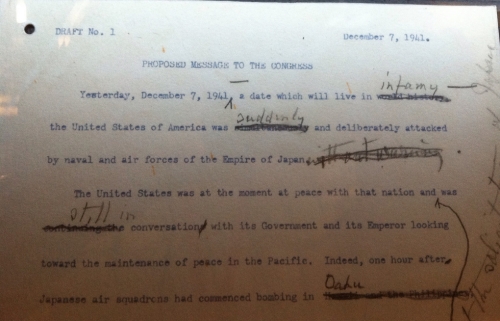
At Pearl Harbor there is an exhibit of the events leading up to the Pacific War. Inside is the original draft of the speech FDR gave to congress on the day following Japan’s attack. The document is a fascinating glimpse into the mind of FDR. Several changes you can see include:
Replacing, “a date which will live in world history” with the much stronger “a date which will live in infamy.”
A tentative attacked “without warning” is struck out. There are theories that FDR did have warning.
Also at the exhibit is the full text of a telegram which FDR sent to the Emperor of Japan the day before Pearl Harbor. In it he says that he is willing to cede what is today Vietnam to the Japanese as long as they withdrew the build up of forces in Vietnam which were gearing up to invade the Philippines, Thailand, and Malaysia (which they eventually did).
There is absolutely no thought on the part of the United States of invading Indo-China if every Japanese soldier or sailor were to be withdrawn therefrom.
I think that we can obtain the same assurance from the Governments of the East Indies, the Governments of Malaya and. the Government of Thailand. I would even undertake to ask for the same assurance on the part of the Government of China. Thus a withdrawal of the Japanese forces from Indo-China would result in the assurance of peace throughout the whole of the South Pacific area.
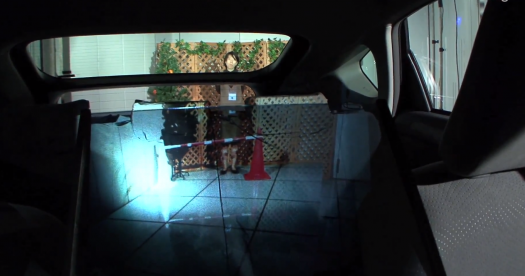
Using principals of Optical Camouflage, researchers at Keio University project the image from a camera on the back of a car onto a recursive reflector which looks like one of those glass screens politicians use for their teleprompters. The mirror sits at an angle to project an image right where the backseat would be,essentially making the back seat disappear.
As you can see in the video, it’s really useful when backing up your car to see all the objects behind you in context and in the proper size, lined up with everything else you see out of the rear view mirror.
The Art of Flight was released last year and is one of the best snowboarding movies I’ve ever seen. If you like the Warren Miller skiing flicks, this one is for you. It’s got Red Bull branding all over it but if you can get past that it’s an amazing bit of filmmaking. It is like the Endless Summer for the snowboarding crowd. But instead of touring the world looking for the perfect wave, they visit places like Alaska and Patagonia in search of untouched “first descents.” Oh, and instead of hitchhiking their way around, they get a rides from their sponsor’s helicopters.
I have to thank the folks at Red Bull for underwriting the whole adventure and capturing it all on high-end Red Digital cameras because what they produced is truly amazing. The locations are amazing, the tricks are incredible, the cinematography top notch, and soaring, full Dolby music by M83 & The Naked & Famous is worth listening to on a good set of headphones. Watch it and get ready for winter.
In the US, an undergraduate education used to be an option, one way to get into the middle class. Now it’s a hostage situation, required to avoid falling out of it. And if some of the hostages having trouble coming up with the ransom conclude that our current system is a completely terrible idea, then learning will come unbundled from the pursuit of a degree just as as songs came unbundled from CDs.
Digitization and distribution via the internet is a great unbundler, disrupting every industry it touches. A great unbundling is coming to education and will overtake it’s institutions, altering them forever, just as it did to the music industry. It may not happen as rapidly as it did to the record labels, academic institutions are much older, but it will happen. As long as a four-year education sets students back $250,000 and saddles them with a crippling, non-forgivable loan that leaves them no better off than an indentured servent of old, the alternatives will continue to chip away at the established institutions such as private universities.
Just as MP3s and Napster were originally dismissed by the labels as poor quality alternatives to records and CDs, the tidal wave of enhancements to the production and distribution of digital music improved the ecosystem to where we have iTunes and Spotify as serious alternatives to the traditional methods of how to acquire and consume music.
The same will happen to education. The core nugget of a university class, the lecture, is online(Kahn Academy, iTunes U, Udacity). Tests can be taken online. Class discussions are taking place over email, on wikis, in forums. Bit by bit, the elements of a formal education are being replaced with lower cost, asynchronous alternatives. It’s the Napsterization of Education.
Over 200,000 have enrolled in Introduction to Computer Science on Udacity. There is a course on how to build a start-up taught by Steve Blank. Everything on Udacity is completely free, shared, re-shared, and improved as each student makes their way through the courses. It’s not just introductory stuff either, check out CS373 on Udacity where a Sebastian Thrun, a Google VP & Fellow, will teach you all you need to know to program a self-driving car.
My sister noticed that a recent photo I uploaded to Instagram looked familiar. The photo I uploaded below is of my two kids on a recent trip to Mt. Shasta.
The next photo is from a hike in Yosemite with my sister when I was a student at UC Berkeley.
As I grow older, I have come to appreciate the power of stories. I collect them as I go through life, sometimes seeking out experiences because a good story may come out of it. I was invited this past week to join the staff of The Long Now Foundation to share a story that I have been telling for years but never took the time to add to this blog.
Back when I was living in Tokyo, I had a several university mates that stopped by to visit. Like any host living overseas, I had gotten things pretty well wired where I could suss out what they wanted to see and could arrange from a number of “module” walks that could be strung together to make for an interesting day. But there was one visit, by an old fraternity brother, that really stood out. Mike was legendary for living life to the hilt, his laugh was infectious and he always went for the most extreme just to see what it was like. While most people traveled through Europe in between high school and college, Mike went to Africa. He was that kind of guy.
Golden Gai
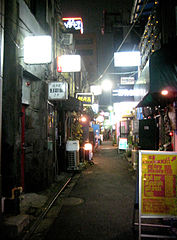
When Mike said he was coming to Tokyo, I of course planned an epic evening of carousing. We started at Shimokitazawa at around 4 pm and hit Ginza, Shibuya, Harajuku, and finally, at around 2am, stumbled into Shinjuku where I planned to show him Golden Gai. It’s hard to describe this area except to say it’s about the size of a city block but houses over 200 tiny little bars piled all up on top of each other. It’s been described as Ridley Scott’s inspiration for the street vendor scene in Blade Runner if you want to put an image into your mind. The place hasn’t changed since the war and each bar there has it’s own story and storied clientele.
Remember, it’s 2am and Mike and I have been drinking since the afternoon so we’re basically stumbling around leaning on each other but I feeling good, knowing whichever bar we pick it’s going to be weird. In a good way. I’d been here several times and each time, it’s kind of like a Disneyland for adults. Go into one bar and you might meet a bunch of John Wayne fans where the bar stools are saddles, the drinks are burbon, and music is strictly C&W. Hit another place and it’s all old Zero fighter pilots drinking sake and telling tales from the war. Another place is a haunt for movie buffs that have a weakness for Fellini. Each bar is tiny, they only have 6-10 seats so they are real cozy. But in the wonderful openness of Japan, each bar will welcome anyone that joins them with the proper deference and curiosity.
So I was feeling pretty good and turned fate over to Mike. I slurred out to him to, “Pick any one you’d like, they’re all fantastic in their own way!” and asked him to choose where to go. He spun on a heel and waved his left arm and pointed to some rickety stairs that went up the side of corrugated steel, painted a shade of faded blue.
We made our way up the stairs and stumbled through the door into a place that was amazingly elegant compared to the jumble outside. It was dark but lighting under the bar and via colored sconces on the wall gave the place a very sophisticated feel. There was some jazz playing, something like Miles Davis’ Kind of Blue – very cool. There was only one other patron, off in the corner with his whiskey and the “master” or owner of the bar. He’s there, beard and glasses, slowly polishing a shot glass with a linen napkin.
Mike & I stumble in and made a bit of ruckus but quickly quieted down and settled into the open seats in front of the bartender. He keeps looking at me, slowly studying my face over his glasses. Finally he says,
“Moshikashitara, Kennedy-san no musuko jyanaidesuka,” which is the basically, “If I’m not mistaken, you’re Kennedy’s son aren’t you?”
I look up, incredulous. How does this guy know me? And my father? I have been to a few bars around here but have no recollection of this place. He tells us to wait a minute and then goes into a back room where we hear the clinking and clanking of bottles. He returns holding a bottle aloft like a prize-winning catch. It’s a whiskey bottle with about 1/3 left in it and as he places it on the counter I can see my handwriting on the side of it.
It all comes back to me then. A couple of nights before I went away to boarding school, leaving my parents at 13 to fly halfway around the world to Concord, Massachusetts, my father took me to this bar to have a drink with his son. He bought a bottle and we wrote our names on the side and, as is the tradition in most Japanese bars, the owner would then keep it there for us whenever we returned. This is the Japanese tradition of “bottle keep.” Only in this case, I had not been there in over 10 years and not only had the bartender somehow recognized me, he also had been hanging on to this bottle in case either my father or myself would return.
It was at that moment that my friend Mike fell off his chair. He could not believe that such a thing was possible. That you could have a relationship with an establishment over such a long arc. The funny thing about this story is that the bar was called “Gu” which is the word for “closed fist” as in the closed-fist from scissors/rock/paper. Basically hanging on, determination.
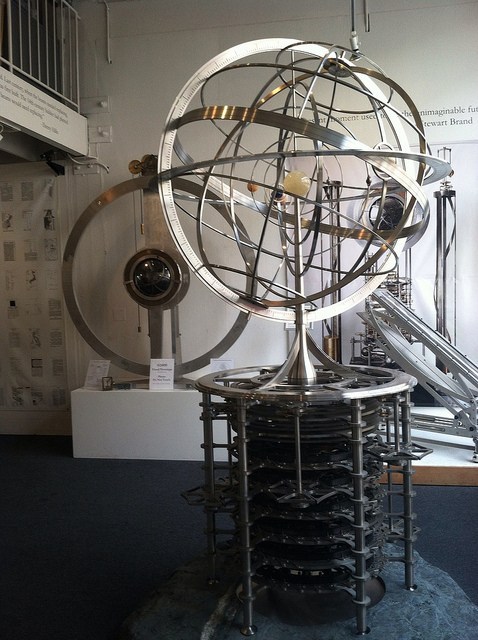
So full circle back to The Long Now. A friend, Mikl-em not only heard me tell this tale but remembered it as something that might interest the folks from The Long Now Foundation. Their mission is to help people think about the long term and one of their more famous projects is the 10,000 Year Clock which, if you don’t know about it, you must read more about as it will change your perspective on technology and human permanence.
The reason my Bottle Keep story is relevant is The Long Now Foundation is opening a Salon and will stock it with a special batch of gin distilled by the folks at St. George’s Spirits using juniper berries for the 5,000 year old bristle cone pines that happen to grow on the side of the mountain in Texas where they are building the 10,000 year clock. The idea is that for a donation, The Long Now Salon will hold your bottle for you on site so you can come at any time and enjoy it with your friends. As my sister says, “With bottle keep, no need to ‘buy’ someone a drink and all that implies.”
I’m happy to hear that they are bringing the bottle keep concept to San Francisco. It’s the perfect thing for The Long Now Foundation to do and they are going about it with the same sense of care and craftsmanship as they are with their other projects. Indeed, my visit was part of their learning. The staff took in my story and weaved in their own experiences and asked questions for more details. The conversation was relaxed and philosophical. It was a beautiful day outside and their offices in Fort Mason look out over the San Francisco Bay and Golden Gate. We drank tea. Before I knew it, I had lost track of time and realized I had to get back to work.
I have a good excuse for being late to my next meeting. I was meeting with the Long Now Foundation.
While everyone spoke of New York Times blogger, Nate Silver’s uncanny, almost witchlike ability to call the election last night, the big winner was the triumph of big data and smart algorithms over gut feel and egos.
Those in tech that have been following Nate Silver’s FiveThirtyEight blog at the New York Times broke out in collective high-fives when FiveThirtyEight finished the evening correctly calling 50 out of 50 of the states (besting his 2008 call of 49 out of 50). A baseball statistics geek, Mr. Silver turned to politics and the aggregation of state and national polls as a playground of data ripe for his insights. Traditional polling agencies such as Gallup accuse Nate Silver of standing on their backs and taking all the glory (1 in 5 visits to nytimes.com stopped by to visit FiveThirtyEight). Their complaint is one we’ve heard before, that without their original polling data, Nate would have nothing to aggregate.
Sounds like the what the newspapers used to say about Google News.
But in reality it’s more than just aggregation. Nate Silver and others like him (Votamatic,Princeton Election Consortium) rigorously analyzed what they pulled together and revealed patterns that let the data speak for itself. The accuracy of this approach is a huge wake up call to any pundit that did not take into consideration a data driven approach.
While Nate Silver has put the Science back into Political Science, the data-driven approach to politics is also transforming the sell side, the people that run the campaigns. Time magazine has a fascinating piece on the team that would use modern data aggregation techniques borrowed from online advertising exchanges and e-commerce funnel analysis to segment and target potential supporters of the Obama campaign.
As one official put it, the time of “guys sitting in a back room smoking cigars, saying ‘We always buy 60 Minutes’” is over. In politics, the era of big data has arrived.
With the use of data to predict a winner or run a campaign, it is only natural that news organizations too use data as a way to make a point. Data visualizations are one way to convey information that is now becoming de riguer for any self-respecting newsroom. The Guardian started the Data Blog and the New York Times launched beta620 to experiment with data. Some of the best coverage of the local and state elections (such as the image below) came from the Los Angeles Times’ Data Desk which I think is a great idea for any media organization, anything that raises data literacy.
Data can be the source of data journalism, or it can be the tool with which the story is told — or it can be both. Like any source, it should be treated with scepticism; and like any tool, we should be conscious of how it can shape and restrict the stories that are created with it. – Data Journalism Handbook
Cookie Consent
We use cookies to improve your experience on our site. By using our site, you consent to cookies.
Contains information related to marketing campaigns of the user. These are shared with Google AdWords / Google Ads when the Google Ads and Google Analytics accounts are linked together.
90 days
__utma
ID used to identify users and sessions
2 years after last activity
__utmt
Used to monitor number of Google Analytics server requests
10 minutes
__utmb
Used to distinguish new sessions and visits. This cookie is set when the GA.js javascript library is loaded and there is no existing __utmb cookie. The cookie is updated every time data is sent to the Google Analytics server.
30 minutes after last activity
__utmc
Used only with old Urchin versions of Google Analytics and not with GA.js. Was used to distinguish between new sessions and visits at the end of a session.
End of session (browser)
__utmz
Contains information about the traffic source or campaign that directed user to the website. The cookie is set when the GA.js javascript is loaded and updated when data is sent to the Google Anaytics server
6 months after last activity
__utmv
Contains custom information set by the web developer via the _setCustomVar method in Google Analytics. This cookie is updated every time new data is sent to the Google Analytics server.
2 years after last activity
__utmx
Used to determine whether a user is included in an A / B or Multivariate test.
18 months
_ga
ID used to identify users
2 years
_gali
Used by Google Analytics to determine which links on a page are being clicked
30 seconds
_ga_
ID used to identify users
2 years
_gid
ID used to identify users for 24 hours after last activity
24 hours
_gat
Used to monitor number of Google Analytics server requests when using Google Tag Manager
1 minute
You can find more information in our About Me and .