Month: August 2021

  • The week that was

    The week that was

    Trump’s $20 billion border wall, that has been circumvented by $5 ladders, is now partially washed away by torrential rains along the Arizona border.

    Spencer Elden, who was was posed as a baby swimming after a dollar bill on Nirvana’s Nevermind album, is suing the band for child pornography.

    The famous leaning tower of San Francisco shifted dramatically just as a massive shoring up project was started. Engineers are regrouping to figure out their next move.

    A Russian man defected to Japan by swimming.

    The drought in the Western United States is so bad they are airlifting water to animals by helicopter.

    Someone is building a near-earth space station but the company contracted to build the life-support system will not say who.

    A Swedish firm announced they have successfully figured out how to produce carbon-free steel, a huge step forward to cleaning up the environmentally unfriendly steel industry. The first customer? Volvo.

    Someone pranked Newsmax and called in to an interview about the Afghanistan situation posing as Former Deputy Secretary of Defense Paul Wolfowitz to say “The next time we have two trillion dollars lying around, let’s spend it on something useful like health care or education.”

  • The week that was

    The week that was

    Tesla announced they are building humanoid robots to be used for unsafe, repetitive or boring tasks. “In the future, physical labor will be a choice,” said Elon Musk.

    Disney announced they are developing “sentient” robots and will have them wander their parks free amongst the guests.

    Robotics firm Boston Dynamics demonstrated how their Atlas robots can now jump, flip, and do parkour.

    Westworld, the dystopian thriller where sentient robots take over and kill their masters, resumed filming for Season 4.

    Roblox, the virtual world software marketed towards kids, is having a tough time stamping out recreations of mass shootings built on their platform.

    The Peacock network thinks it’ll be fun to watch humans play a “live-action real-life” version of the Frogger video game. Thankfully the gameshow takes place in a studio and not on the streets of NYC or Vietnam.

    A burned out shell of a home in Walnut Creek sold for $1 million. “The potential is limited only by imagination,” the listing gushed.

    Sensing rough waters ahead, the secretive big data analytics company Palantir loaded up on $50 million in gold bars.

    A 1909 baseball card was auctioned off for $6.6 million, smashing the previous record of $5.2 million. Major League Baseball, sensing greater profits ahead, announced an end to their 70-year deal with Topps in favor of the sports apparel company, Fanatics.

    A Wisconsin woman accidentally shot a friend while using the laser sight on a handgun to play with a cat.

  • The week that was

    The week that was

    Australian canoeist Jessica Fox found a perfectly stretchy, waterproof material to fix the tip of her kayak at the Tokyo Olympics: a condom.

    After asking the UK government to ban its cigarettes, Philip Morris is pivoting to asthma inhalers which it views as a growth market.

    London Bridge may not be falling down but it did get stuck.

    In a sign that we have completely saturated terrestrial advertising, a Canadian startup is sending a satellite into orbit and is selling space on it for advertisers.

    Two North Carolina men who were mourning the loss of their brother at the spot where their brother was struck by a train, were killed when they were struck by a train.

    In a plot twist that didn’t surprise anyone, Batman’s sidekick Robin came out as bisexual.

    The Mesa County officials responsible for maintaining the security of elections are under investigation by the Colorado Secretary of State’s Office for a breach in security of its election system.

  • The week that was

    The week that was

    Due to the drought, the Northern California town of Mendocino is running out of water and is considering bringing it in via a tanker train. Greenville, another NorCal town, was reduced to ashes by the Dixie fire, the third largest in the state’s history.

    While the Yankee Stadium grounds crew was busy cornering a cat in the outfield, Washington Nationals center fielder Victor Robles somehow managed to play much of an inning with a praying mantis on his hat.

    An owl was hit by a maintenance vehicle in Central Park and New Yorkers are in mourning.

    65,000 rubber ducks were dumped into the Chicago River to raise money for the Special Olympics.

    Quick-thinking trash workers in Ohio reunited a grandmother with $25,000 in cash that was thrown out by her grandchildren who were clearing out expired items from the refrigerator. Why was grandma storing hard currency in the freezer? Maybe you should ask my grandmother who stored her manuscripts in the oven.

    Somebody thought it would be fun to post a cover of rapper Flo Rida’s Low, also known as “Apple Bottom Jeans. ” They invited others to post their versions as well. The internet delivered.

    That is all 😀

  • The longest marathon

    The longest marathon

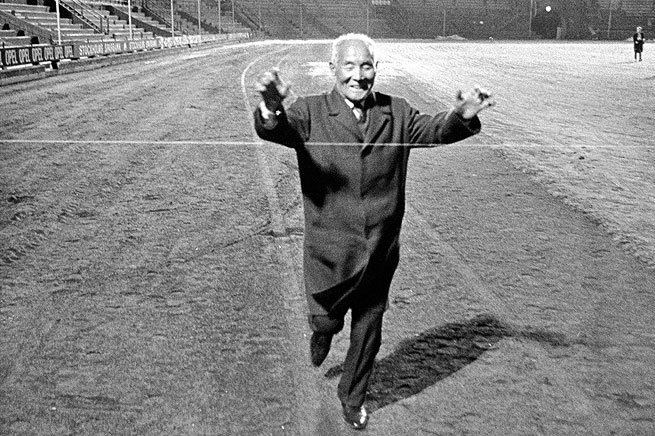
    On March 20, 1967 Japanese runner Shizo Kanakuri crossed the finish line on a marathon he started over 50 years prior with a time of 54 years, 246 days, 5 hours, 32 minutes, and 20.3 seconds. Guinness World Records recognizes this as the longest time to complete a marathon.

    But I’m getting ahead of myself.

    In 1912 Japan sent its first team to the Olympics, held that year in Stockholm, Sweden. Japan’s team consisted of only two athletes, a sprinter named Yahiko Mishima and Shizo (this year Japan’s squad has 552 athletes).

    Back then, the road from Japan to Sweden took weeks. First on a boat then aboard an arduous weeks-long train trip across the steppes of Siberia. By the time Shizo and his teammate arrived in Sweden, they were not only exhausted but also out of training. The only time they could workout was by running around station buildings during brief stops along the way.

    When race day arrived in Stockholm on July 14, 1912 it was an unseasonably warm 32°C (89.6°F). Long distance running as a sport had not evolved to where it is today so the preparations were, shall we say, unorthodox. Nike’s famous waffle sole had not yet been invented. Shizo wore Japanese tabi on his feet and the cloth was all that protected him from the gravel path. And because it was thought that perspiration contributed to fatigue, he refused to drink any water while running.

    As you can imagine, Shizo passed out from heatstroke and took refuge at a nearby villa to recover. After spending some time recuperating there, he decided to drop out of the race and caught a train back to his hotel and eventually returned back to Japan.

    Because he never informed race officials that he dropped out of the race, Olympic officials marked him down as missing.

    Meanwhile, back in Japan, Shizo went on to run in the 1920 and 1924 Olympics, established the famous Tokyo-Hakone-Tokyo College Ekiden race and is known as the father of the Japanese marathon.

    Fast-forward to 1962 when a Swedish journalist happened upon Shizo and informed a very surprised Swedish National Olympic Committee that the missing marathoner was very much alive. As a marketing promotion, several Swedish businessmen invited Shizo to Sweden in 1967 to finish his marathon at 76 years of age. That’s the photo above.

    Upon Swedish Olympic Committee representatives reading out his official finish time to the gathered press- 54 years, 8 months, 6 days, 5 hours, 32 minutes and 20.3 seconds- Kanakuri was asked if he’d like to say a few words about breaking a world record for slowest marathon ever run. Thinking for a moment, the elderly athlete shuffled to the microphone and said,

    “It was a long trip. Along the way, I got married, had six children and 10 grandchildren.”

    THE CURIOUS CASE OF SHIZO KANAKURI’S 1912 OLYMPIC MARATHON RUN

    Hat tip to Tyler Kennedy for the pointer to this wonderful story.

  • Human Pictograms

    Looking back at the human pictograms used to illustrate 50 Olympic sports in 5 minutes I realized the inspiration is from an Japanese game show I wrote about earlier, Kasou Taishou.

    via NBC Sports