Tesla stock had a good week and is now more valuable than all other car manufacturers combined. Elon Musk, a majority shareholder, is now the richest man in the world.
A French sailor is gearing up to take a run at breaking the speed record for a sailboat. The last record was 65 knots using foiling boards. Alex Caizergues, is hoping to break 80 knots with a kite pulling a surface-skimming trimaran.
A man spent over $57k on a single Pokémon card. The Justice Department news release was stingy on details. The man was getting hauled in because that money was most of his Covid business loan.
The Taiwan Army is building mechanical exoskeletons for their soldiers so they can “run faster and carry heavy objects with ease.” The gear should also come in handy if they have to fight with the People’s Liberation Army who apparently also is giving exoskeletons to its troops too.
Walmart recalled bottles of the Better Homes and Gardens Essential Oil Infused Aromatherapy Room Spray with Gemstones because it contains a “rare and dangerous” bacteria that causes “a condition that is difficult to diagnose and can be fatal” and also killed two people.
City officials in Austin attempted to mow a man’s lawn and were met with aggression and firearms. SWAT was called in, the man’s home caught on fire, he was shot and later died.
University of Pennsylvania’s Wharton School of business is now offering an Economics of Blockchain and Digital Assets program and, yes, you can pay tuition in crypto.
Some defendants charged with storming the U.S. Capitol are representing themselves in court. One said the law didn’t apply to her and another presented the court with a schedule of fees for his services.
Kellogg’s is being sued because the fruit filling in Kellogg’s Whole Grain Frosted Strawberry Toaster Pastries does not have enough strawberry.
A fake startup in the UK hired influencers to promote it, created t-shirts and swag, held a party, “launched,” then vanished with $500k from its swindled investors. The company was called, CryptoEats.
Details of Jonathan and Diana Toebbe’s spycraft spilled into the news including details of how they passed secrets on an SD card hidden in a peanut butter sandwich. The criminal complaint is worth a read.
A man travelled to Germany to pick up his brand new Lamborghini Huracan and excitedly drove it back to his home in Norway. He was clocked by Danish police doing almost 150 MPH. His car was confiscated.
Another court document revealed that criminals used machine learning technology to deepfake the voice of a company executive and trick a bank into transferring $35 million to fraudulent accounts.
The shine is off as scientists who measure the glow of the Earth by looking at the light reflected off of the moon. Our planet has dimmed as climate change has “essentially scuffed up our planet.”
That 70s Show is getting a re-boot. The new show will be called That 90s Show.
Researchers at Bangor University in Wales have discovered high levels of cocaine and MDMA in a stream that runs near the site of the Glastonbury Festival. They concluded the seasonal spike is from festival goers urinating in and around the stream and that it is affecting the local fish population.
Netflix has been forced to edit out a few frames from the hugely popular Squid Game series. The scene includes a shot of business card with a Korean phone number. The hapless owner on the other end of that number has been getting upwards of 4,000 calls a day with his cellphone’s battery draining before he can use it.
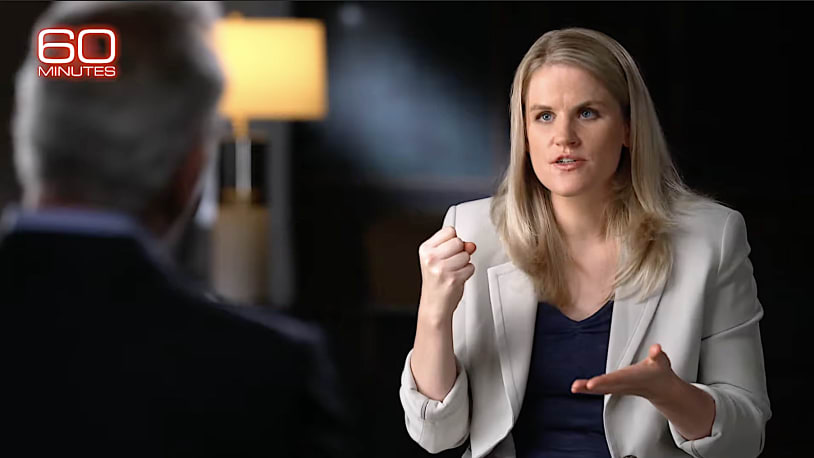
Last night 60 Minutes scored an interview with Frances Haugen, the Facebook whistleblower behind the document leak that led to last month’s “bombshell” Facebook Files investigation. She shared internal research that confirms what we’ve known all along. Feeding users polarizing content works great at engaging people and converting them into repeat visitors and that the revenue from those engaged users is intoxicating.
For a humorous TL;DR, check out this 2018 clip from The Daily Show.
What if Facebook were a Real Place?
Engagement is a metric used by social networks to measure how often someone uses your app or visits your website. Each service counts an engaged user in different ways, new user or old, daily visitor or monthly, but it all boils down to repeat visits. An engaged user is someone who comes back, repeatedly.
If your service is ad-supported, repeat visits generate cumulative ad impressions and revenue. If you track your users and personalize your ads, the more engaged a user is, the higher their value to advertisers. It’s the old “eyeballs” metric of Web 1.0 but with higher definition. In the mobile app world, it’s called ARPU, Average Revenue Per User.
The thing I saw at Facebook over and over again was there were conflicts of interest between what was good for the public and what was good for Facebook. And Facebook, over and over again, chose to optimize for its own interests, like making more money.
If your company’s “true north” metric is engagement, what happens if you optimize for that and run a business that, above all else, keeps your users coming back and staying longer? If you discover that inflammatory content is the nectar that keeps users coming back aren’t you then measuring the level of a post’s ability to provoke a reaction? This is what I call Enragement Metrics.
Add the quarterly pressure for a trillion dollar public company to meet and exceed revenue targets and corporate incentives can get distorted. Responsibility is foggy in a large company of distributed teams with a shared ethos of “move fast and break things.”
The pursuit of engagement and the momentum of a market that rewards it created a Faustian Bargain that distracted the leadership at Facebook from the impact it was having on not only its users but, as a source of traffic and revenue for its publishing partners, the entire media ecosystem.
“There is a perfect reverse correlation where the angrier you are, the more traffic leaves Facebook and goes to your publishing site.”
Haugen will testify before Congress where she is hoping they will regulate Facebook because, in her view, Facebook is unable to regulate themselves.
“Facebook, over and over again, has shown it chooses profit over safety,” she said. Haugen, who will testify before Congress this week, said she hopes that by coming forward the government will put regulations in place to govern the company’s activities.
The tech and media world will be watching. As with newspapers, radio, and television, before it, a touch of regulation can build trust and improve a technology and balance the pursuit of profit with the benefit for the public good. But if there is stumbling and uninformed regulation, it will either hobble innovation or, in the worst case, favor those with deep pockets for lobbyists that will lock in their client’s dominance.
When the Haugen testimony picks up on Tuesday and they haul in someone from Facebook to explain themselves, I hope there is substantive discussion on a way forward and not the brow-beating grandstanding we so often see on Capitol Hill. I optimistically believe that no one at Facebook set out to poison the public well on purpose but that runaway algorithms and market forces drove them there.
Just as the publication of Silent Spring helped lead to the establishment of the Environmental Protection Agency in 1970, I hope these hearings on the adverse effects of social networks will lead to intelligent discussion of the role these products and the algorithms that power them in our society.
Environmental and safety regulations give businesses a framework against which to justify expenditures that take away from profits. We need an EPA-like independent organization for social networks and machine learning algorithms to regulate an industry and create best practices and guidelines for what they can and cannot do.
Social Networks and machine learning algorithms are powerful tools that can stimulate, motivate and transform society. As with all new technology, they can be put to good use or bad. It’s up to all of us, working together to understand their power and harness it for good.
Together we can create social media that brings out the best in us. We solve problems together – we don’t solve them alone.
A Dutch artist was given $84,000 and commissioned to make a statement about people’s relationship with work. He delivered an empty frame and called the work, “Take the Money and Run.”
A Turkish man believed to be lost in the forest stumbled into his own search party and helped them for awhile until he heard them calling his name. “I am here” he said to the startled rescue party.