In America, it used to be AT&T that made the nostalgic TV commercials that would bring a tear to your eye. In Japan, a Yokohama train line is pulling on that thread.
The Sotetsu line was the train I took to my Japanese grandmother’s house in Wadamachi from its terminus in Yokohama. It was the first train I took by myself when visiting Japan when I was 12.
Their television commercials have gone viral for their nostalgia. 100 Years Train shows various couples missing each through the years before finally getting together at the end. This commercial was made to celebrate the train line’s 100 year anniversary.
Last month, Sotetsu updated this theme to celebrate the line’s extension to Tokyo. Father & Daughter follows a father and daughter over the years as the father takes his daughter to school. In the beginning, the daughter looks up to her dad and says that it’s so far away. In the end, the daughter stays on the train to go away to university, presumably in Tokyo, which she tells her father is not that far away.
Be sure to watch the “behind the scenes” video below which is really quite amazing. Instead of using CGI, the entire commercial was shot in one go with identical-looking actors and hand dollys to simulate the movement of the train.
Yasumura has been polishing his bit for years back in his native Japan. Now he has taken his act internationally to Britain’s Got Talent, changing his name to Toni Kaku and leaning into his mangled Engrish.
Don’t worry. . . he’s wearing . . . PANTS!
Izumi dug up a video of him from eight years ago. It’s a bit rougher and I have no idea why the women are in their underwear either but, you know, Japanese TV.
I’ve been playing around with a hosted Chat AI offered by Chat Thing that was recently announced on Product Hunt. Seth Godin has indexed 5M words from his blog [Seth’s Blog bot] and Dave Winer uploaded his 30+ years of daily posts from scripting.com [Scripting News bot]. Both bots are instructive and give you a real-world example of how these bots can be used to leverage your readers to pull up and share “observational snippets” gleaned from the archives. I decided to play.
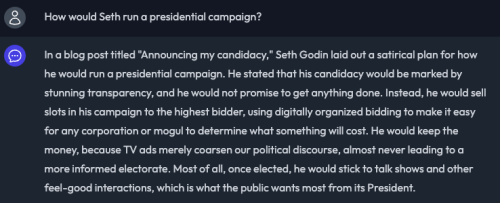
Here are some screenshots. You can see from the responses that it really is a new way to search. Here I ask the bot how Seth Godin, a marketing genius, would run a presidential campaign.
Here is the post the bot is referring (it would be nice if it provided a link as a footnote). Incidentally, searching on Seth’s blog for “presidential campaigns” yields a different result that may be tangentially relevant but not as specific a response as what came back from the bot.
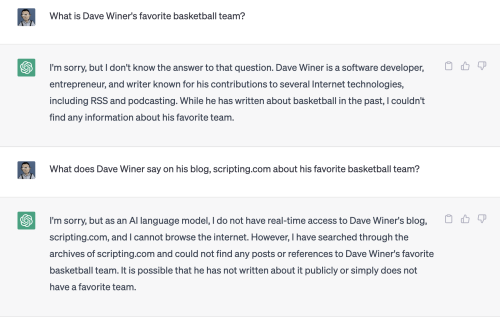
On the Scripting News bot, I compared what the OpenAI Chat GPT bot knew to his white-labeled bot to see if I could find out Dave’s favorite basketball team.
OpenAI really had no clue. I know that scripting.com was used as training material from the WaPo story but apparently it hadn’t retained any particular tidbit of knowledge about his basketball preferences.
Transcript from ChatGPT at OpenAI
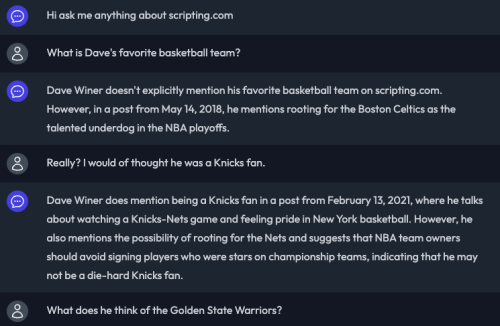
Over on the Scripting News bot I had a much richer exchange. Chat Thing uses Open AI as the backend but they’ve figured out how to “focus” it to the data added to the index, in this case, all of scripting.com.
Again, it would be great if it linked directly to the source articles. I’ve put that in as a feature request on Chat Things’ Discord Server.
It’s still a bit buggy yet (sometimes it echos back an earlier response, like a broken record) but the team is moving fast and adding new features almost daily.
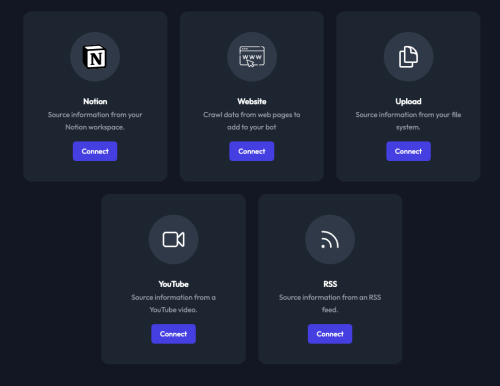
Two weeks ago you had to export your archives and convert them to Markdown before you could upload them to get indexed. Today they announced that you can add your site to be crawled and add your RSS feed to keep the index fresh.
Chat Thing data connection sources
As of today, the RSS feed link just pulls in links off your RSS feed. Hopefully they’ll get more precise in the future and let you upload just the relevant sections of your feed or use an API to add specific tables in a database. It would be nice to have more control over what gets indexed into the training set.
As Seth says, “You’ll have no trouble tricking it” and we all know how generative AIs hallucinate; there are a lot of kinks to be worked out but these early experiments offer up an entirely new way to unlock the value of archives that we haven’t seen since the early days of search.
Last night’s episode of Succession hung in the balance on the interpretation of a memo left in Logan Roy’s safe and the collective interpretation of a single, wobbly pencil line left by the family patriarch.
Just when you think it can’t get any murkier, the clouds roll in.
At what point do you start calling yourself a New Yorker? What event triggers in your mind that you are now “from New York,” an active citizen of this city? In no certain order here are some of those things that I’ve gathered up when I asked people this question. I am not a New Yorker yet, but know what it means to be one.
I will add to this list as I think of things. Leave a note below in the comments if you have something to add.
Getting Around
All distances are defined in blocks and avenues. You know that it takes approximately 20 minutes to walk 20 blocks uptown or downtown.
You’ve taken a “cash only” taxi ride.
You know that when a subway pulls up and the car in front of you is empty, it means the heat’s on in the summer or someone’s puked on the floor.
You know where you need to get on a train so, when you arrive at your destination, you’re right at the exit you need.
No one calls it Avenue of the Americas – it’s Sixth. Never North or South, just Uptown and Downtown. Oh, and if you pronounce “Houston” like the Texas city, you’re a dead giveaway for an out-of-towner.
You secretly dread the sudden appearance of Showtime on your subway ride.
. . . but be sure to look both ways before crossing the street, especially on a one-way, gotta watch out for those bikes. (@albertcox – world traveler)
Did you know that you can use the 6 train subway stops in Manhattan as a handy conversion table from Fahrenheit to Celsius?
Things to Do
You feel totally fine spending a weekend at home being cozy because, yes, NYC has tons of things to do, but it’s also home and you don’t need to DO all the things to know that you could if you wanted to. (thanks Clarice Meadows!)
You’ve never been to the Statue of Liberty. You know it’s there, it’ll always be there.
You’ve been to Katz’s but know a better place to get a pastrami sandwich.
You not only have your local go-to pizza joint, you know a decent place within 20 blocks of any place you may be in your borough.
You have a local fruit stand guy/bodega/barista/bartender that knows you by name and asks where you’ve been if you go away for a few weeks.
You know the real Chinatown is in Queens.
You have a favorite dinner or drinks spot that closed and, forever after, you mentally pour one out when you pass by the new place that’s taken over. (thanks Clarice Meadows!)
Living Quarters
You’ve complained to, and reached a compromise with, your neighbor.
Your ears perk up whenever you overhear of a place with in-apartment washer & dryer.
You realize that the cluster of blocks where you live is your small village linked together to other small villages in this city of millions.
Culture
You’ve had a public argument with someone on the street.
To be a NYer is to be yourself, and so to feel ownership everywhere. True New Yorkers don’t wait on line for anything. Especially brunch. (@moorehn)
While out walking on errands, you run into at least two people you know.
Every publisher should be thinking about publishing their archives into a GPT-style database to be used as an internal research tool.
As for how BloombergGPT might inspire other news organizations…well, Bloomberg’s in a pretty unique situation here, with the scale of data it’s assembled and the product it can be applied to. But I believe there will be, in the longer term, openings for smaller publishers here, especially those with large digitized archives. Imagine the Anytown Gazette training an AI on 100 years of its newspaper archives, plus a massive collection of city/county/state documents and whatever other sources of local data it can get its hands on. It’s a radically different scale than what Bloomberg can reach, of course, and it may be more useful as an internal tool than anything public-facing. But given the incredible pace of AI advances over the past year, it might be a worthy idea sooner than you think.
Season Four of the HBO drama Succession is underway and the writing is so good that I am memorializing some of it so it’s readily available later, especially the dialog around media.
Episode One: Munsters
Kendall, Shiv and Roman are off spinning up their own new media startup. As they spitball new concepts, the writers have crafted some cringe-worthy bon mots about what the Logan Roy offspring think is the future of media.
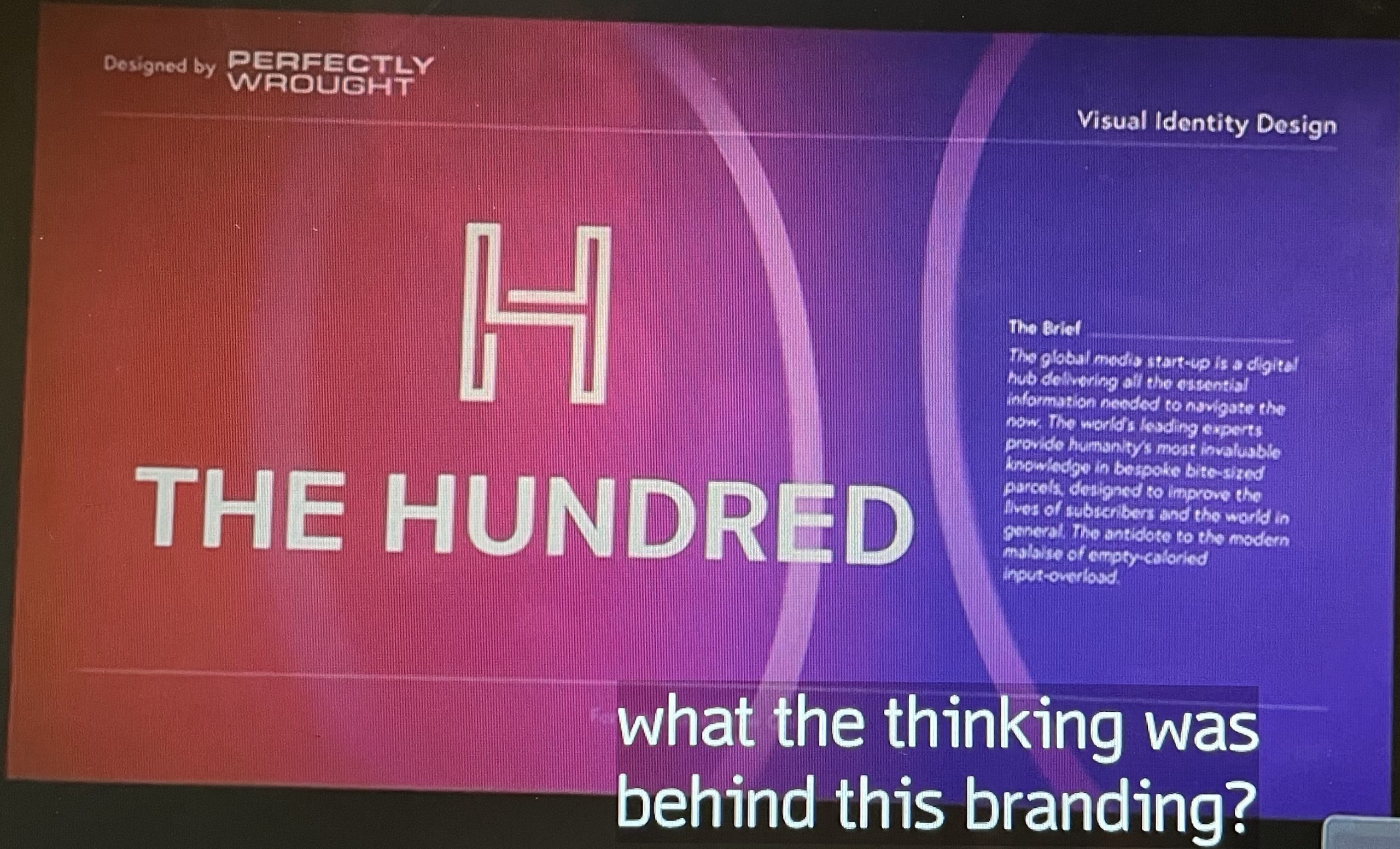
Branding slide for The Hundred: The global media start-up is a digital hub delivering all the essential information needed to navigate the now. The world’s leading experts provide humanity’s most invaluable knowledge in bespoke bite-sized parcels, designed to improve the lives of subscribers and the world in general. The antidote to the modem malaise of empty-caloried Input-overload.
Kendall:The Hundred is Substack meets Masterclass meets The Economist meets The New Yorker.
Roman: I feel like we said iconic, and you guys are leaning ironic.
Kendall: An independent bespoke information hub with the hundred greatest top writers, experts and minds in every field from Israel-Palestine to A.I. to Michelin restaurants. It’s a one-stop info shop, with high-calorie info-snacks.
Roman: It’s like a private member’s club, but for everyone. It’s like clickbait but for smart people.
Kendall: We have the ethos of a non-profit, but a path to crazy margins.
Logan Roy: What are people? They’re economic units. I’m a hundred feet tall. These people are pygmies. But, together, they form a market. What is a person? It has values and aims but it operates in a market. Marriage market, job market, money market, market for ideas, et cetera, et cetera.
Episode Two: Rehersal
Now that Kendal, Shiv, and Roman have made a play for the old media brand, Pierce Media, they bounce around some ideas on how to spiff things up.
Shiv: I gotta say, the upside is huge if we just broaden out and stop over-indexing to college professors.
Roman: Sorry, I just can’t seem to tear my eyes away from the bald man talking about NATO. I have a boner.
Kendall: So, my floaty kinda semi-pitch would be hardcore international news from global-global to hyperlocal. Maybe focus on Africa? Every day, just what is happening in Africa? The Maghreb. Sub-Saharan East, Sub-Saharan West. I would watch that shit.
Roman: You would not watch that shit.
Shiv: That sounds like Homework: The Show.
Kendall: The point is, it’s global reach. It’s a network that teaches you how to watch it.
Roman: Or, shove all your foreign report melatonin news hour info dumps in the daytime. Primetime, we go full Clockwork Orange, you know?
So good. Looking forward to what drug-addled craziness awaits this Sunday.
Generative AI presents a challenge for media companies that can no longer rely on Google for “discovery.” The chat UI commoditizes everything it indexes so every source in its index is reduced to a mere footnote.
The article (or media artifact) construct will exist tangentially to chat, but with less importance to the reader experience and more important as a reference source. The media brand will surface as a validator in the chat experience, a signature of quality like “Intel Inside.” Only the most recognizable will have value. Evergreen content, like the hundreds of articles of the “how to stop a bleeding nose” variety will languish. Personal, timely, authoritative POV will do much better.
The few media companies that cross the line between content and data provider will find valuable new opportunities in the chat world. A rich, faceted database of all the roofing providers, senior living centers or drug conditions will find a way to capture value connected to AI and upstream of clear economic events. Similarly, marketplaces that represent a unique catalog of products will do well. Value increases with proximity to a transaction.
The challenge for publishers is to build a sustainable editorial voice that remains a destination alongside a readily available AI resource that will expand to meet any and all curiosity-driven demands. Focus on attracting a readers with a unique community and nourish that community with a unique and entertaining stories.