Cloudflare sees about 20% of the world’s internet traffic cross its network. Matthew Prince, CloudFlare’s CEO, has a pretty good handle on trending internet behavior.
In the video below, he summarizes the impact of AI “answer engines” that summarize what they find in response to questions put into AI chatbots such as Google’s AI Overview or Open AI’s Chat GPT.
What he concludes is that the exchange that allowed the search engines to index a site in return for referred pageviews is no longer equitable and is growing increasingly lopsided.
The data, according to Cloudflare;
10 years ago: Google crawled 2 pages per visitor
6 months ago: Google 6:1, OpenAI 250:1, Anthropic 6,000:1
Present: Google 18:1, OpenAI 1,500:1, Anthropic 60,000:1
No one is saying is what we all know in our hearts. No one is clicking through to the footnoted sites on an Answer Engine. The AI crawlers are taking more than they are giving back.
It’s worth watching the entirety of Matthew’s talk in context of an announcement he references in the video. I expect it will be something related to their Bot Management suite. But I also look forward to hearing more about CloudFlare’s vision to remake the internet into one that rewards knowledge creation.
While the introduction of AI Answer Engines is a current and immediate threat to the online publishing ecosystem as we have known it, there is a nascent opportunity to re-build the internet on a new ecosystem built around different incentives.
Slide from a presentation on rebuilding an internet that rewards knowledge, not attention
What if we rebuilt the internet into one that rewarded Knowledge and not Attention. The “attention economy” brought us clickbait and distraction. What if we rebuilt the internet into one that rewarded publishers that gave more than they took away? Am I naive?
I am looking forward to learning more about CloudFlare’s plan.
Back then, pundits were concerned Google was taking on a whole host of potential copyright-infringement lawsuits as YouTube was chock full of pirated videos. YouTube has since built a sophisticated copyright detection algorithm that does a pretty good job of detecting not only pirated videos but also when copyrighted music is used as a video soundtrack.
Could the same be said for the potential acquisition of Perplexity? While all LLMs share an index made up of the common crawl and anything else they can find on the open internet, will Perplexity’s vectorized index of exclusively licensed news sources drive enough usage and value to a potential acquirer?
While YouTube’s pre-acquisition copyright concerns ended up being nothing more than a speed bump, it eventually started a formalized conversation around formally licensing content. Could Perplexity’s fledging licensing program be the start of a more sustainable way grow the new AI ecosystem?
tl;dr – Applications will be accepted on June 27th. The decision to approve applications will made in September by the six-member Community Advisory Committee nominated by the current administration. Those currently up for election will not be sworn in until January so they may not have influence over these important decisions but their position will be important nonetheless.
There is a 6.7 acre swampy lot in between Tudor City and East River. It’s the largest empty lot in Manhattan and the site of a former ConEd power plant.
The developer, The Soloviev Group, bought the plot (quaintly known as the First Avenue Mud Pit) from ConEd back in 2000 for $680 million.
A 2023 plan called for an extravagant design which featured a massive Ferris wheel. Later, perhaps responding to local resistance and derision, the plans were scaled back, nixing the Ferris wheel but keeping the garish, gold-mirrored building looking down on the United Nations.
To say I’m concerned is an understatement. I live in Tudor City, a rare gem of a neighborhood, that, despite being only a few blocks from Grand Central, is a peaceful eddy from the rush of downtown Manhattan. This is due to the dual dead-end streets of 41st and 43rd that do not punch through to First Avenue. This keeps traffic to a lazy minimum. It’s wonderfully quiet here with two small parks that were designated a Historic District by the Landmarks Preservation Commission in 1988.
What do those running for City Council say?
If you live in the area, you know all of the above and know that the democratic primary election is on June 24th. As I was researching each candidate running for City Council District 4, which has jurisdiction of the area, I was looking for any statement on the candidate’s website about their position on the casino. None of them had a position so I took it upon myself to email each one and share responses below to help my neighbors cast their ballots.
First, here’s what I asked:
Thank you for running for City Council. I’m trying to help residents of Tudor City understand your position on an issue very important to our community.
Can you share your position on the proposed Freedom Plaza Casino proposal on the East Side next to the UN? I live in Tudor City and am not a fan of having a casino in my neighborhood. What can you do to arrive at a compromise that will prevent a casino in our neighborhood while also allowing the Soloviev Group a return on their investment?
Here are the replies I have received, updated in the order received;
I appreciate your question and your thoughtful take on the issue. I am opposed to the casino. My background is in housing policy and when Borough President Mark Levine commissioned a study in 2022 of all the locations in Manhattan that could accommodate new housing, the Soloviev site accounted for 86% of the possible new residential space on the East Side. There are just not that many large sites in this part of the City, and we need to take opportunities for reasonably-scaled apartment buildings when we can get them. I think it would be a waste to lose that opportunity to something like a casino in a residential neighborhood. I am not insensitive to the Soloviev family’s need to make a return on their investment, and would love to work with them and the City Planning Commission to put together a plan for a residential development that includes public open green space and homes serving people at different income levels at a scale that fits the rest of the neighborhood. It may not have as large a proportion of “affordable” housing as I might like, but there could certainly be some and it would be a viable use for the property that would meet their business’s needs without a disruptive gambling license.
I’m listening carefully to the community and have heard a number of concerns that I take very seriously. Should this issue come before me, I’d want to hear from my constituents about the specific proposal and follow their lead. But I can tell you the feedback I’m hearing right now from voters is one of deep skepticism that a casino in Midtown East is in the best interest of this community. And I’m running to be the voice of the community.
That said, I want to be very honest with you that the City Council Member will likely have no control over this decision other than being a community advocate. This is going to be decided at the state level and the City Council will not vote on the project unless it ends up having an aspect of it that needs a variance or change in zoning. It is my understanding that the current proposal is “as of right,” so the City Council will not weigh in.
I am against the proposed casino at Freedom Plaza. Our community is deeply in need of affordable housing, and green spaces. I’d like to prioritize investment in those areas over a casino in Manhattan.
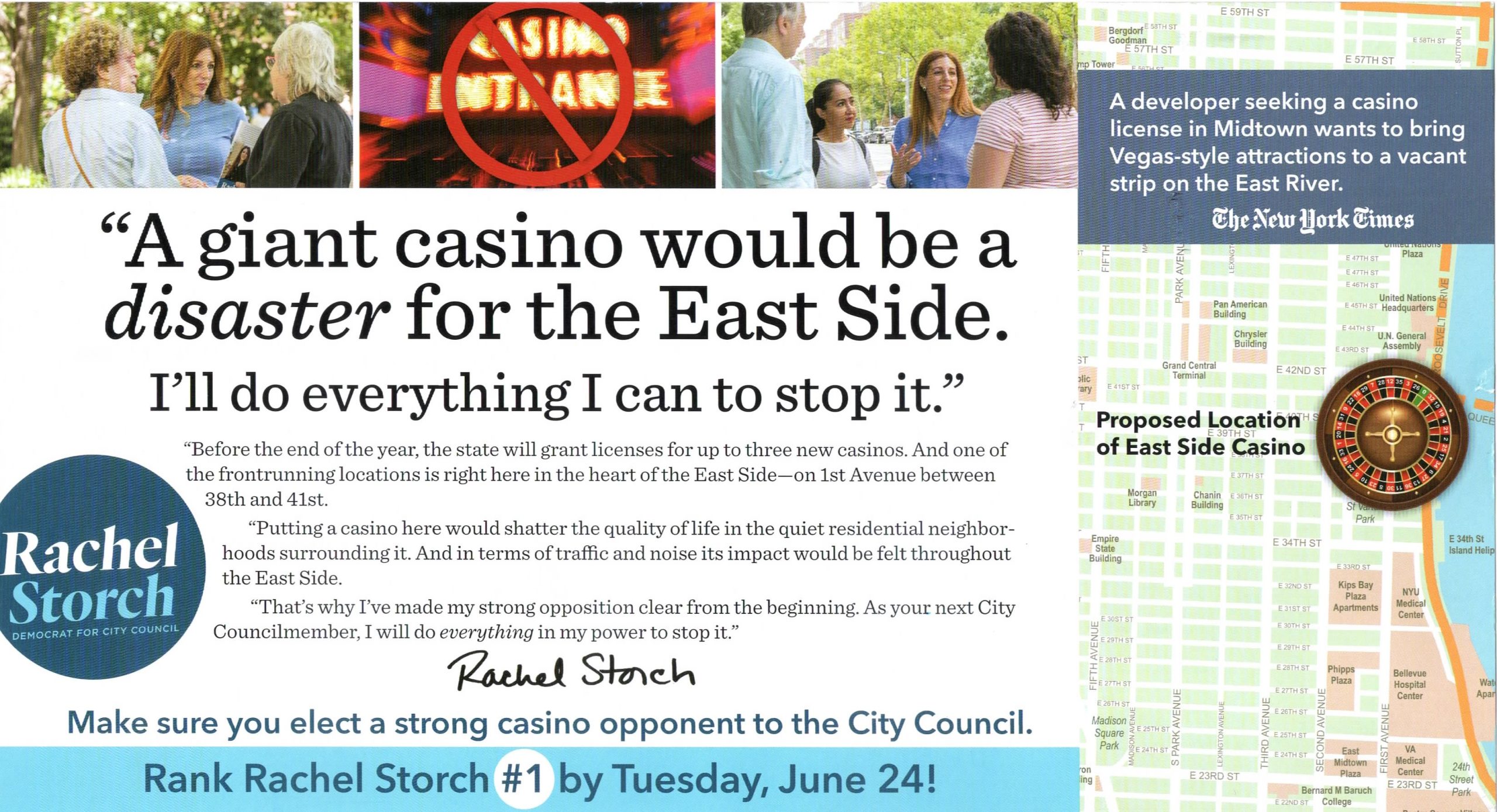
All residents in the neighborhood received the flyer below and Rachel called me personally to discuss my concerns stating the area could be put to much better use for housing, open space, and expansion of the green way.
Mailer sent to the neighborhood is pretty clearly against the casino.
I am against the casino but would be more than willing to at least view any proposal which would be beneficial for the community. So far nothing has been submitted and the Soloviev Group refuses to compromise on the casino.
No reply from candidate Faith Bondy.
Thanks to Vanessa Aronson, I now know that it’s really Keith Powers, the current District 4 City Council Member, that is in a position to push back on the Freedom Plaza casino project at this stage. He has not, pushing the final decision to the Community Advisory Committee that will be put together to asses community support.
The six-member Community Advisory Committee (CAC) needs to approve the license by a two thirds majority. The CAC members will be appointed soon after June 27th which is when applications for licenses are submitted.
CACs must vote on their respective project by September 30, 2025. Those Applicants approved by their CAC will then submit supplemental application material – including a proposed tax rate – to the Board for evaluation and consideration.
The Board expects to make decisions by December 1, 2025, followed by Commission licensure by December 31, 2025. This ensures that New York State will collect the already-booked casino license fee(s) ahead of schedule.
Watching for who is appointed to our district’s CAC in the next few weeks and attending their open meetings and hearings is key. Watch the Gaming Facility Location Board page for updates.
But input from the next District City Councilmember and Manhattan Borough president will be important. Powers debated with his opponents on May 30th and the casino issue came up right as things got started. Holyman-Sigal came down firmly against Powers deferred taking a side and Sun seemed to indicate he welcomes the potential influx of funding.
Last week NYC erupted with over 1,000 small pop-up events across the city, loosely curated by the NY Tech Week team on this calendar. I would describe this as a decentralized SXSW where the events are hosted without much central control which results in an explosion of activity and an opportunity for participants to expose themselves to a wide range of ideas while visiting workspaces all across the city.
The events begin to come together in the months leading up to the annual event. Most of them are invite-only so you need to sign up in advance. Sign-up forms on Partiful ask you to add your LinkedIn profile so the organizers can vet & curate who attends.
I only had time in my schedule to make a few afternoon or evening events but it was nice to sample a few, meet some new people and check out some cool spaces.
Here’s what I learned.
“Influencers are toast” said someone after seeing the demo of Mirage Studio an “AI-powered video generation platform that allows you to create lifelike talking-head videos without traditional production.”
Part of me is happy to bid goodbye to social media influencers shilling products they didn’t truly like, understand, or appreciate. The founder made the argument that their platform would open up access to imaginary personalities to help explain or position their product and would level the playing field for all companies allowing for smaller companies to punch above their weight.
I’m still not sure how I feel about this development, especially after seeing what people are doing with Google’s Veo 3. Further, if the key to communicating to create a sense of empathy, what happens when we give the keys to this rich protocol to a series of APIs? What becomes of human dialog and communication or, more philosophically, what is real?
Then someone leaned over to tell me about Nucleus Embryo. In their words,
When undergoing IVF, couples typically have several viable embryos to choose from.
Nucleus Embryo provides information on the disease risks and traits of each of these embryos, helping parents make an informed choice on which embryo they want to implant.
On the way to the next event, strange new world thoughts spinning in my head, David J’s song, Stop this City was playing on repeat.
Thankfully, my last event of the day was about the power of community and face-to-face collaboration at a shared workspace in an old factory in Tribeca at Fabrik.
Later, New York Governor Kathy Hochul sat down to speak about state initiatives such as Empire AI but also, about what was on everyone’s mind, the challenges of dealing with the Trump administration.
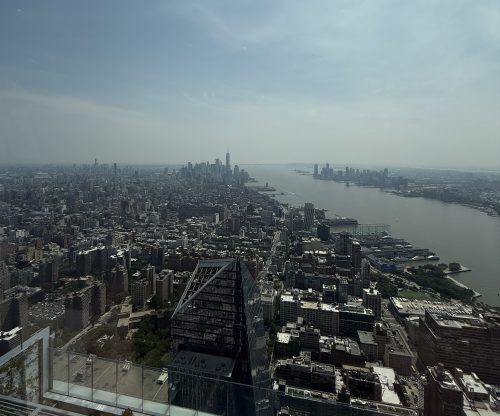
The next day, on the 82nd floor of 30 Hudson Yards, Brand Strategist George Scribner, shared his perspective of Branding in the Age of AI.
The outlook for Google is not great as they had neglected to evolve its brand beyond a functional search utility. Scribner’s view is that there is not enough brand loyalty and that people will flock to a better tool as the new conversational search experiences of the AI platforms have leveled the playing field. I would have to agree but user lock in is a powerful thing and Google’s recent push with AI Mode will work even better for those with lots of data and history stored with Google.
I also dropped by a mixer for Japanese businesses and sat in on a presentation by a representative from the City of Yokohama that has a local NY office to woo startups to Japan.
On Thursday, I dropped in on a round table with several SEO people talking about Generative AI chatbots and the future of discovery in this new world. There’s enough there for another post which will follow.
My favorite part of the NYC Democratic Mayoral Debate. Where in the five boroughs to get the best slice.
Traditionally, whomever wins the democratic primary wins the Mayor’s race in NYC so it’s a crowded field with nine candidates qualifying to take the stage Wednesday night (the second debate is on Thursday, June 12th at 7pm).
The debate was the first time for many to see Zorhan Mamdani for the first time. He is hoping to win over New Yorker’s with his progressive agenda to freeze stabilized rent, make buses free, and a Department of Community Safety to free up police to policing. It was a chance for me to see some of the other candidates such as Michael Blake who came across as a strong candidate as well.
Standing up to Trump and defending NYC is major a part of everyone’s platform. The June 24th election will be closely watched across the country for green shoots of activism as a preview to the midterms.
The question posed by “60 Minutes” correspondent Bill Whitaker in that part of the transcript was a follow-up question to a previous question-and-answer about the relationship between the Biden administration and Israeli Prime Minister Benjamin Netanyahu.
“But it seems that Prime Minister Netanyahu is not listening,” Whitaker said. “The Wall Street Journal said that he — that your administration has repeatedly been blindsided by Netanyahu and, in fact, he has rebuffed just about all of your administration’s entreaties.”
To which Harris replied: “Well, Bill, the work that we have done has resulted in a number of movements in that region by Israel that were very much prompted by or a result of many things, including our advocacy for what needs to happen in the region. And we’re not going to stop doing that. We are not going to stop pursuing what is necessary for the United States to be clear about where we stand on the need for this war to end.”
The first sentence of that answer was used on “Face the Nation”: “Well, Bill, the work that we have done has resulted in a number of movements in that region by Israel that were very much prompted by or a result of many things, including our advocacy for what needs to happen in the region.”
On “60 Minutes,” the final sentence was used instead: “We are not going to stop pursuing what is necessary for the United States to be clear about where we stand on the need for this war to end.”