Tag: Amazon

  • AI’s Dark Secret

    AI’s Dark Secret

    Behind every freakishly algorithm is a group of often underpaid and overworked “digital serfs” busy labeling and reviewing the data streams that make the technology work. Expensify SmartScan for receipts? In 2017, someone discovered some of these receipts turned up on Mechanical Turk.

    Amazon announced last week that it’s shutting down its “Just Walk Out” technology that powered the experimental Amazon Go shopping experience that removed the need for cash registers and cashiers in stores. When it was launched, Amazon claimed that an array of cameras was feeding which items which items were taken off the shelf so they could later be charged to the account of the person scanning their Amazon ID as they walked in.

    Amazon Go promo video

    As with any new technology, there was quite a bit of hesitancy to embrace this new way of shopping that didn’t quite “feel” right.

    Early Adopters in San Francisco, 2018

    Saturday Night Live even spoofed the tech as skeptical New Yorkers were again confronted with “this will never work in reality” use cases dreamed up by big tech.

    Now we learn, six years later, that the technology never got off the ground.

    The Information revealed the myriad tech problems Amazon was still having with the idea six years after the initial announcement. The report said that “Amazon had more than 1,000 people in India working on Just Walk Out as of mid-2022 whose jobs included manually reviewing transactions and labeling images from videos to train Just Walk Out’s machine learning model.

    Amazon Fresh kills “Just Walk Out” shopping tech—it never really worked

    While it’s funny to poke fun at a “fake it ’til you make it” business ideas that never reach sustainability, there is a real cost associated with a deep-pocketed company leveraging their brand and technology to launch a new way of doing business that relies on low-cost offshore labor masked behind a shiny new AI. Think of the stores put out of business during the six years Amazon was paying offshore workers to ring up purchases for Amazon Go customers. What about the poor souls doing the mind-numbing work of tagging items by watching a livestream from a camera on their monitor in the middle of the night, totally removed from human interaction?

    All of these are, separately, quite funny stories. But collectively they paint a picture of a society, and a culture, utterly unequipped to register the violence that is being done to it, merely because historical process is draped in the ribbons of “technology”. This violence is enacted simultaneously on the high street and the global stage. What makes me angry about how often we keep falling for it is not merely that we should know better, but what the costs of doing so actually are.

    So, Amazon’s ‘AI-powered’ cashier-free shops use a lot of … humans. Here’s why that shouldn’t surprise you

    Amazon has issued a statement on the news to clarify while they are shutting down the “Just Walk Out” platform, they will keep the stores cashierless but, instead, ask the shoppers to tag items as they put them in their tech-enabled Dash Cart grocery carts used in their Whole Foods stores.

    So instead of someone in an offshore facility doing the work, we’ll be doing it for them instead.

    UPDATE: offshore cashiers are still a thing

    Post by @morningbrew
    View on Threads
  • Encore Gig : Camperforce

    Encore Gig : Camperforce

    Migrant workers in 2017 now work for Amazon and live out of an RV. The Guardian reports that older workers, unable to afford rising rent and medical expenses, hit the road to work at Amazon distribution centers in exchange for a place to park their RV and water, sewage and electrical hookups. They call them the camperforce.

    In other news, Amazon appears to be working their drivers so hard they don’t have time to relieve themselves. In this one instance in Sacramento, the driver ended up delivering a very different kind of package.

    “The delivery company supervisor came out in his personal car and was not prepared for cleanup,” Bautista posted on Facebook. “He was in shock when he saw the size of ‘it.’ He ended up scooping it up with a plastic bag, but didn’t want to take it with him (it smelled really bad).”

    Amazon said in a statement, “This does not reflect the high standards we have for delivery service providers.” and gave Bautista a Amazon gift card for her troubles.

    Maybe that’s the long term play for Amazon Key.

  • Goes Around, Comes Around

    In a wonderful turn of events, we now hear that bookstores in Seattle are doing well again. It turns out, in the shadows of the world’s largest online bookseller, Amazon employees are choosing to browse the shelves at their local bookseller rather than buy online, and buying.

    Efficiency is not everything. Shopping can also be an experience.

    Bookshelf

  • Amazon’s Robot Army

    Yesterday I posted videos of two kinds of robots. One showing a driverless car that allowed a blind person to pick up some Mexican food and his dry cleaning, another, some kind of hive-mind controlled swarm of micro-quad copters that seemed to come right out of a Michael Crichton novel.

    Today, via an high school friend who works there, I found out about another type of robot, natch, a robot system, designed to be integrated into a warehouse much in the same way a circulatory system feeds nutrients, repairs damage, and removes waste from an organism. Add a self-learning neural net to the “nervous system” of this system and the singularity has pretty much arrived.

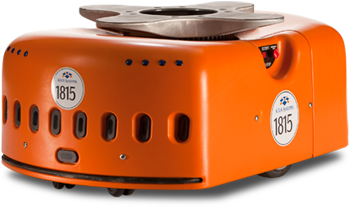
    Kiva Systems was recently acquired by Amazon for $775 million and once you learn what they do, it’s no surprise. Instead of having workers go out into the stacks to pull inventory, the Kiva bots carry shelves of inventory to the workers. It all happens in real-time with inventory being dynamically managed so that less-popular items move their way to the back of the warehouse while faster moving items come up front. The bots work both ways too. Not only do they bring items to be shipped, they also can take boxes of new items off the trucks to be stocked into inventory.

  • The Next Opportunity in Publishing

    Much to the chagrin of my wife, I took over the remote on our internet-enabled TV (old macbook hooked up via HD cable to the back of our flatscreen) to catch highlights from the Web 2 Summit taking place this week in San Francisco.

    Steven Berlin-Johnson’s “high order bit” on the early history of book “technology” and lessons it provides for opportunities for e-book publishers today was most compelling. The Kindle represents the most advanced form of electronic packaging of ideas today. Kindle books ship with a full index, mp3 sound files of the book being read, instant download and connections to related data via the web.

    What’s missing? Deep links to ideas within the book so that it can be used as a reference. The internet didn’t really  take off until (1) The World Wide Web made it easy to link to other sites and pages and, (2) Google figured out by ranking the number of links to a page and the keywords used, they could calculate PageRank.

    I wrote about two concept videos which suggested one possible Future of Print. If someone isn’t working on this now, they should.

    Amazon, are you listening?

    web20tv on livestream.com. Broadcast Live Free
  • User-Driven Development

    It’s one thing to put yourself in the shoes of your potential customers and think about how to solve their pain points but it’s entirely something else to pretend that this product already exists and think about how you would market it.

    This is the approach at Amazon and I think it’s quite effective. It’s something they refer to as, Working Backwards. This is the process of definition which helps clarify needed features (and their priority) before coding has even begun. I’m a big believer in hacking together working prototypes and tend to jump right in. This approach is more nuanced and helps shake off any geek-halo in the code-first approach. From Werner Vogal’s (Amazon’s CTO) post:

    1. Start by writing the Press Release [1] Nail it. The press release describes in a simple way what the product does and why it exists – what are the features and benefits. It needs to be very clear and to the point. Writing a press release up front clarifies how the world will see the product – not just how we think about it internally.
    2. Write a Frequently Asked Questions document. Here’s where we add meat to the skeleton provided by the press release. It includes questions that came up when we wrote the press release. You would include questions that other folks asked when you shared the press release and you include questions that define what the product is good for. You put yourself in the shoes of someone using the product and consider all the questions you would have.
    3. Define the customer experience. Describe in precise detail the customer experience for the different things a customer might do with the product. For products with a user interface, we would build mock ups of each screen that the customer uses. For web services, we write use cases, including code snippets, which describe ways you can imagine people using the product. The goal here is to tell stories of how a customer is solving their problems using the product.
    4. Write the User Manual. The user manual is what a customer will use to really find out about what the product is and how they will use it. The user manual typically has three sections, concepts, how-to, and reference, which between them tell the customer everything they need to know to use the product. For products with more than one kind of user, we write more than one user manual.

    [1] Ian McAllister, who also works at Amazon, posts on Quora about “working backwards” (it’s via this Quora post that I found Werner’s post, thank you!). He writes in more detail about how to structure the mock-press release.

    • Heading – Name the product in a way the reader (i.e. your target customers) will understand.
    • Sub-Heading – Describe who the market for the product is and what benefit they get. One sentence only underneath the title.
    • Summary – Give a summary of the product and the benefit. Assume the reader will not read anything else so make this paragraph good.
    • Problem – Describe the problem your product solves.
    • Solution – Describe how your product elegantly solves the problem.
    • Quote from You – A quote from a spokesperson in your company.
    • How to Get Started – Describe how easy it is to get started.
    • Customer Quote – Provide a quote from a hypothetical customer that describes how they experienced the benefit.
    • Closing and Call to Action – Wrap it up and give pointers where the reader should go next.

    and most importantly:

    Oh, and I also like to write press-releases in what I call “Oprah-speak” for mainstream consumer products. Imagine you’re sitting on Oprah’s couch and have just explained the product to her, then you listen as she explains it to her audience. That’s “Oprah-speak”, not “Geek-speak”.

  • The Premium Upsell

    Todd Sampson has a great take on publisher’s reaction to the text-to-speech feature on the new Amazon Kindle. Rather than view this feature as a threat to their existing Books on Tape business line, they should look at Amazon’s electronic distribution of their text as a potential channel for an upsell.

    The quality of the voice is crappy.  It’s bearable, and a major improvement, but it’s still crappy.  It simply can’t compete with the quality of a professionally recorded audio book.

    Ever the optimist, Todd challenges the book industry to charge extra to sell electronic versions of their books bundled with higher quality audio versions of their books as an alternative to the robot voice. Be confident of the quality of your goods and your true fans will support you. More simply, hold your chin up and stop whining if you want to run with the cool crowd.

    Nine Inch Nails Ultra Deluxe Set

    The band Phish has mastered the premium upsell on their site, livephish.com. In the tradition of all jambands, Phish allows their fans to tape their live concerts. They sell specially marked tickets for the tapers (as they are quaintly called) giving them access to a special section set up for them behind the soundboard where the sound is best. Despite the existence of high-quality audience recordings that are traded in a vibrant online trading ecosystem, Phish make available soundboard quality, non-DRM recordings of their concerts on their website as well.

    The band is confident that their hardcore fans will spend extra to download high-quality FLAC recordings that come complete with pdf files of cover artwork formated to fit within the standard CD case. At a certain age, the $12.95 per show is easily worth it, especially if you went to that concert and want a memento of the evening. The Phish backoffice gets that too and now that they are back on tour, your online ticket purchase comes with a link to pre-purchase a recording of the show at a 15% discount. It’s like a futures bet on the quality of your evening.

    Nine Inch Nails also understands the premium upsell. They are sold out of their $300 Ultra Deluxe Limited Edition version of their album Ghosts, an album that was available free for the download.

    Then there’s Josh Freese who has taken the premium upsell and turned it into an artform for his album, Since 1972

    $75,000 (limited edition of 1)
    * Signed CD/DVD and digital download
    * T-shirt
    * Go on tour with Josh for a few days
    * Have Josh write, record and release a 5-song EP
    about you and your life story
    * Take home any of his drum sets (only one, but
    you can choose which one)
    * Take shrooms and cruise Hollywood in Danny from
    Tool’s Lamborghini OR play quarters and then hop on
    the Ouija board for a while
    * Josh will join your band for a month … play shows,
    record, party with groupies, etc.
    * If you don’t have a band he’ll be your personal
    assistant for a month (4-day work weeks, 10 am to 4 pm)
    * Take a limo down to Tijuana and he’ll show you how
    it’s done (what that means exactly we can’t legally
    get into here)
    * If you don’t live in Southern California (but are a
    U.S. resident) he’ll come to you and be your personal
    assistant/cabana boy for 2 weeks
    * Take a flying trapeze lesson with Josh and Robin
    from NIN, go back to Robins place afterwards and his
    wife will make you raw lasagna

    For a more detailed and way more informed view into the premium upsell (complete with graphs!) check out Strauss on Crystal Ball for Studio Execs or WWJD?

  • Playmobil Security Checkpoint

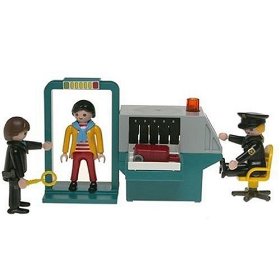
    Playmobil Security Checkpoint

    Is this for real? Amazon has it listed in stock and ready to ship. Thankfully we can count on the Amazon reviewing public to bring out the snarky truth.

    Some choice excerpts:

    Thank you Playmobil for allowing me to teach my 5-year old the importance of recognizing what a failing bureaucracy in a ever growing fascist state looks like. . .

    I was a little disappointed when I first bought this item, because the functionality is limited. My 5 year old son pointed out that the passenger’s shoes cannot be removed . . .

    I am waiting for a few accessories though, kids size jackboots and a toy Taser. . .

    Geeknews points out it’s not all just good guys. They have bad guys too.

    Thanks Todd Sampson for the Friday laughs.