Tag: augmented reality

  • Technology fades into the background

    At this year’s Google I/O developer conference, CEO Sundar Pichai spoke of how augmented reality (AR) glasses embedded with Google’s real-time translation services could break down the language barrier in face-to-face communication. While not explicitly announcing any hardware, he did show a video with a pair of glasses with a heads-up display that would show the results of Google’s real-time translation technology as “subtitles for the world.”

    Google Translate + AR Glasses = Subtitles for the World

    Taking another run at the ill-fated Google Glass vision is a game-changer and speaks to the maturity and deep pockets of Google as a corporation. Taking lessons learned from Google Glass 1.0 the company has improved the technology to a point where it’s less interruptive (and doesn’t make you look like a cyborg) and ready for more widespread adoption.

    We are tiptoeing into the post-computer world where “technology fades into the background” and allows us to push away the unnatural hardware interfaces and interruptive notifications from the human-to-human interaction and realize the true vision of AR – to augment the world around you.

    Combine this “subtitles for the world” mentality to another Google Lens enhancement, Scene Exploration and now you have useful metadata from Google’s Knowledge Graph overlayed on the world around you. Check out the video below which jumps to the demo of how Google envisions you can use Scene Exploration to learn about the contents of items on the shelf at the grocery store.

    Google Scene Exporation demo at 7:00

    Exciting times! Caveat is, as with all real-world technology, things will be rough in the beginning. I work in a Japanese company and sometime we turn on the real-time translation AI in Google Hangouts to see if we can get a decent translation of the meeting. Let me just say the results are not quite there yet. As Pichai said, there’s a lot of work to do.

    The competition has not stood still either. We also have Facebook’s Smart Glasses focused, as you would expect, on the capture and sharing features with a light that goes on to warn you if someone is filming. Snapchat’s Spectacles (pictured below) overlay 3D filters over what you look at thru their glasses bring the Snapchat Lens experience to the world around you, leave the psychedelics at home. The future is here, we just need to improve the software.
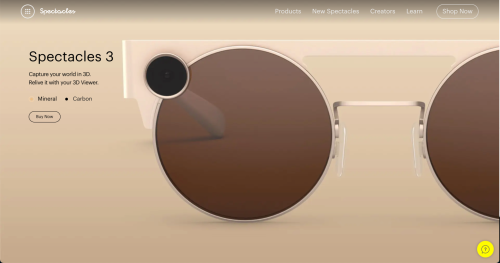
    Snapchat Spectacles 3

  • Kevin Kelly on Mirrorworld

    Kevin Kelly on Mirrorworld

    Kevin Kelly is the master of optimistic projection. Drawing a line Just as VR and AR start their decent into the trough of disillusionment, Kevin Kelly and Wired comes out with a cover story that looks beyond the immediate applications and imagines the opportunities in the great beyond.

    The first big technology platform was the web, which digitized information, subjecting knowledge to the power of algorithms; it came to be dominated by Google. The second great platform was social media, running primarily on mobile phones. It digitized people and subjected human behavior and relationships to the power of algorithms, and it is ruled by Facebook and WeChat.

    We are now at the dawn of the third platform, which will digitize the rest of the world. On this platform, all things and places will be machine-­readable, subject to the power of algorithms. Whoever dominates this grand third platform will become among the wealthiest and most powerful people and companies in history, just as those who now dominate the first two platforms have. Also, like its predecessors, this new platform will unleash the prosperity of thousands more companies in its ecosystem, and a million new ideas—and problems—that weren’t possible before machines could read the world.


    AR WILL SPARK THE NEXT BIG TECH PLATFORM—CALL IT MIRRORWORLD

    Information – People – Places & Objects. Who is going to figure out search on the mirrorworld? The social graph was the innovation that organized the social web. What will be the innovation to organize the world of places and objects? Voice UI?

  • IKEA’s augmented reality app

    IKEA’s augmented reality app

    It’s no coincidence that the Swedish home furnishing superstore IKEA timed the announcement of their AR app IKEA Place to drop shortly after Apple’s much anticipated announcement of their AR-optimized phones the iPhone 8 & iPhone X.

    First announced back in June, the final release of IKEA Place will take advantage of Apple’s ARKit to not only match the proper scale, also apply the texture of the material, proper lighting and shadows.

    “I think that augmented reality and virtual reality will be a total game changer for retail in the same way as the internet, only this time much faster” said Michael Valdsgaard, IKEA’s head of digital transformation, who leads a team of 70 that have been working the past nine weeks to load thousands of IKEA products into the app in preparation for release next week in conjunction with Apple’s iOS 11.

    Dropping a virtual chair into your living room with true to scale is the perfect broad-scale use case for AR. Browsing furniture and sharing screenshots of them in situ before you make a big purchase is what will spread this new tech to the masses.

  • Information Overlord

    Information Overlord

    What if we follow Augmented Reality to it’s ultimate conclusion. Daniel Suarez’s vision of a layer of information and meta-data transposed upon the physical world may be the science fiction of last year but we all know if Google’s Project Glass gets it’s way, it’ll be here soon enough.

    Things only once written about and mocked up by expensive design firms are now becoming commercial reality.

    But what if we took this further? What if the commercial pressure to monetize our new experience pushes the development to it’s ultimate conclusion? What would that world look like? Behold.