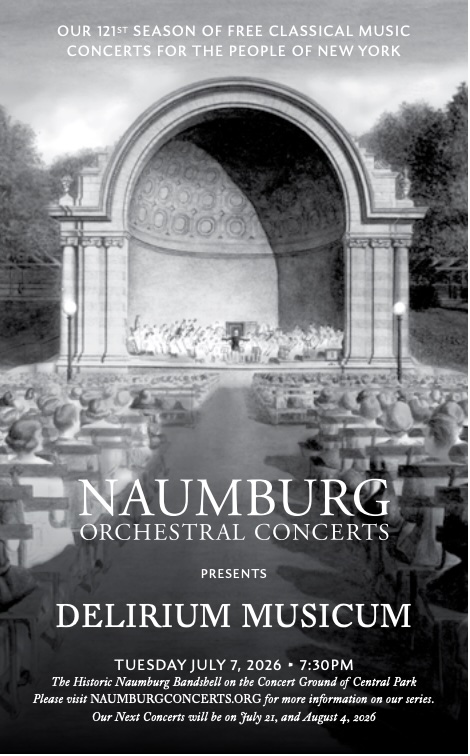
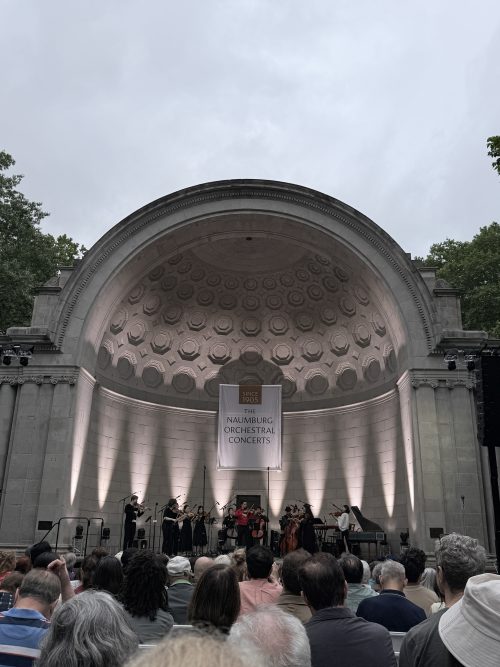
Mary Mitchell, a colleague from my days at Dow Jones, sent me an email the other day. She was inviting me to join a group of classical music fans in Central Park to experience an eclectic selection from the Los Angeles-based group, Delirium Musicum as part of the Naumburg Orchestral Concert series.
I didn’t know what to expect but I was very much looking forward to it as it had been a busy day at work and I needed to unwind. What unfolded was a beautiful selection of compositions, some original, some variations of familiar pieces, but all of them fresh and joyfully played. You can read the full program here.
You could see the orchestra was having fun and it was infectious.
Later, while listening to Erik Satie, the birds glided overhead in the dusk – seemingly dancing to the gentle, sparse melody. On the back of the program was this passage from EB White, describing the very spot where I was sitting,
Another hot night I stop off at the band concert in the Mall in Central Park. The people seated on the benches fanned out in front of the band shell are attentive, appreciative. In the trees the night wind sings, bringing leaves to life, endowing them with speech; the electric lights illuminate the green branches from the under side, translating them into a new language. On a bench directly in front of me, a boy sits with his arm around his girl; they are proud of each other and are swathed in music.
E.B. White’s Here is New York, 1949
The Naumburg Orchestral Concert series is a free concert series, perpetually funded by the late-Elkan Naumburg, a merchant banker, who established the series in 1905, “to encourage and stimulate the public’s interest in symphonic and classical music.”
Concerts are put on every summer at the Naumburg bandshell in Central Park. There are two more concerts this year (July 21st and August 4th) and I would encourage you to pack a snack, bring a friend, and enjoy the communal gathering.
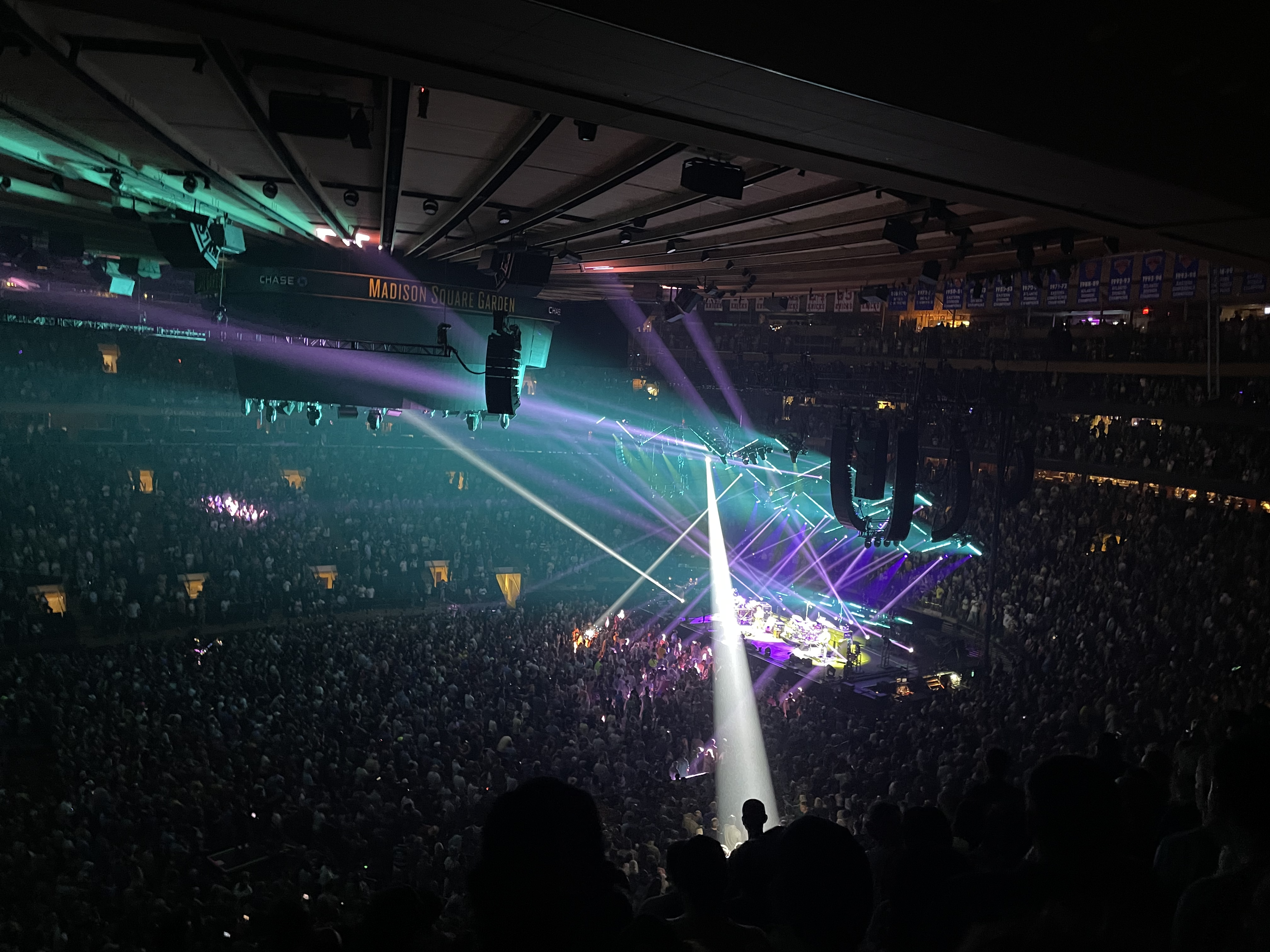
The more I learn about this crazy band the deeper I sink into the mythology. I caught the last two nights of Phish’s seven day “residency” at Madison Square Garden last week. The usual superlatives apply about how the band is playing better than ever. The guy who does the lights even had a profile piece done on him in the New York Times. Phish has now played the Garden 88 times, surpassing Sir Elton John and only second to Billy Joel (who probably sleeps in the tunnels below).
Phish’s 13-night run at the Garden in 2017, what is known as The Baker’s Dozen, was the stuff of legend and, like all feats remarkable that take place in this city, endeared them to New Yorkers, fans or not.
Across 13 nights — from July 21 to August 6, 2017 — the Vermont jam band performed 237 distinct songs without repetition, with each night taking on a specific donut-flavored theme. With a run time of around 34-and-a-half hours across 26 sets, the group served up 176 originals, 61 covers, 19 debuts and 23 bust outs (with a gap of 50 shows or more). To fans, Baker’s Dozen marked one of the band’s finest runs since the late-1990s. However, the run earned recognition from the outside world as well, with the quartet earning a banner in the rafters of MSG for their record-breaking residency.
This most recent run did not disappoint. There was outstanding improvisation from all five members of the band (I’m including Kuroda, the lighting guy) performing at the peak of their talent. But let me talk about Guy Forget (pronounced, in French as “gee-forjet”)
On the seventh and final night, in the middle of a long jam out of a song called Tweezer, Trey starts singing the line,
“I’ve never met a man that I could not forget except for Guy Forget”
I had no idea what I was hearing and I had to tug on this thread later to find out what that was all about. As I suspected, there was a story there and I sure wasn’t disappointed.
This is a band delights playing with words. They turned the phrase “moment ends” into Moma Dance and swapped the word “mangled” for mangos to nonsensical effect. So who was Guy Forget? A Moroccan-born pro tennis player who played in France during the 80s. Why is he the subject of a Phish song? Why not?
Of course there was much controversy within the Phish nerd-verse over exactly where “Guy Forget” ended and the Tweezer jam begin. People wanted to make sure to set the historical record straight.
I just love the fact this band can drop a one-liner, inside joke into the middle of a song and their fanbase knows exactly what is going on. It’s a privilege to have such a dedicated following and this band has certainly earned it.
I’m reflecting on the eve of a trip up to Boston to see what will most likely be the last time I will see the original members (really just Bob Weir and Mickey Hart) of the Grateful Dead play together. I’ve been seeing this band off and on over the years and have been to almost 50 shows. It’s been quite I ride and I realized I never blogged about “my first show.”
It was my freshman year at Occidental College in Los Angeles. I took a road trip up North to San Francisco with four classmates in February of 1985. Mary was from the Bay Area and and offered to show us around. I was new to California so eager to explore Northern California.
We visited Berkeley and walked Telegraph Avenue hitting up book shops, Himalayan boutiques, record stores and cafes. I picked up an East Bay Express and saw that The Grateful Dead were playing a concert that evening in Oakland. I had no idea how to get tickets or anything so just went with the brilliant idea to ask the first person I saw in a tie-dyed t-shirt. It didn’t take long.
Random stroke of good luck because the guy we asked said he had two tickets and that he’d give them to us “at cost” because he was “burnt out from last night’s concert.” We bought the pair for $30 and Alison and I decided to go together to check it out while Mary went off to do something else.
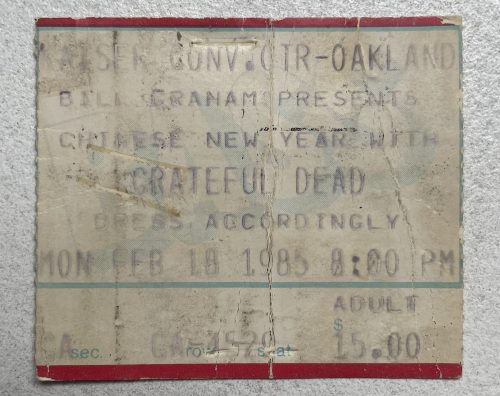
The show was at the Kaiser Convention Center a mid-sized public auditorium built in 1914 near Lake Merritt in Oakland. I’m not sure how Alison and I got from Berkeley to the Kaiser, it might have been on the BART or maybe Mary dropped us off in her car. It’s hard to make out on the ticket but I think it says that the concert started at 8pm and remember wanting to get there before then.
Ticket stub, General Admission, $15
The Grateful Dead were not that popular in 1985. This was before Touch of Grey, their big hit that brought in the stadium crowds. I remember the scene being very laid back and people being really friendly. We wandered in and walked right up to the front rail, just a few feet from the stage. I was surprised at how empty it was, people were milling around in loose groups, chatting with each other. The last concert I went to was Oingo Boingo at the Universal Amphitheater in LA and this was a totally different scene.
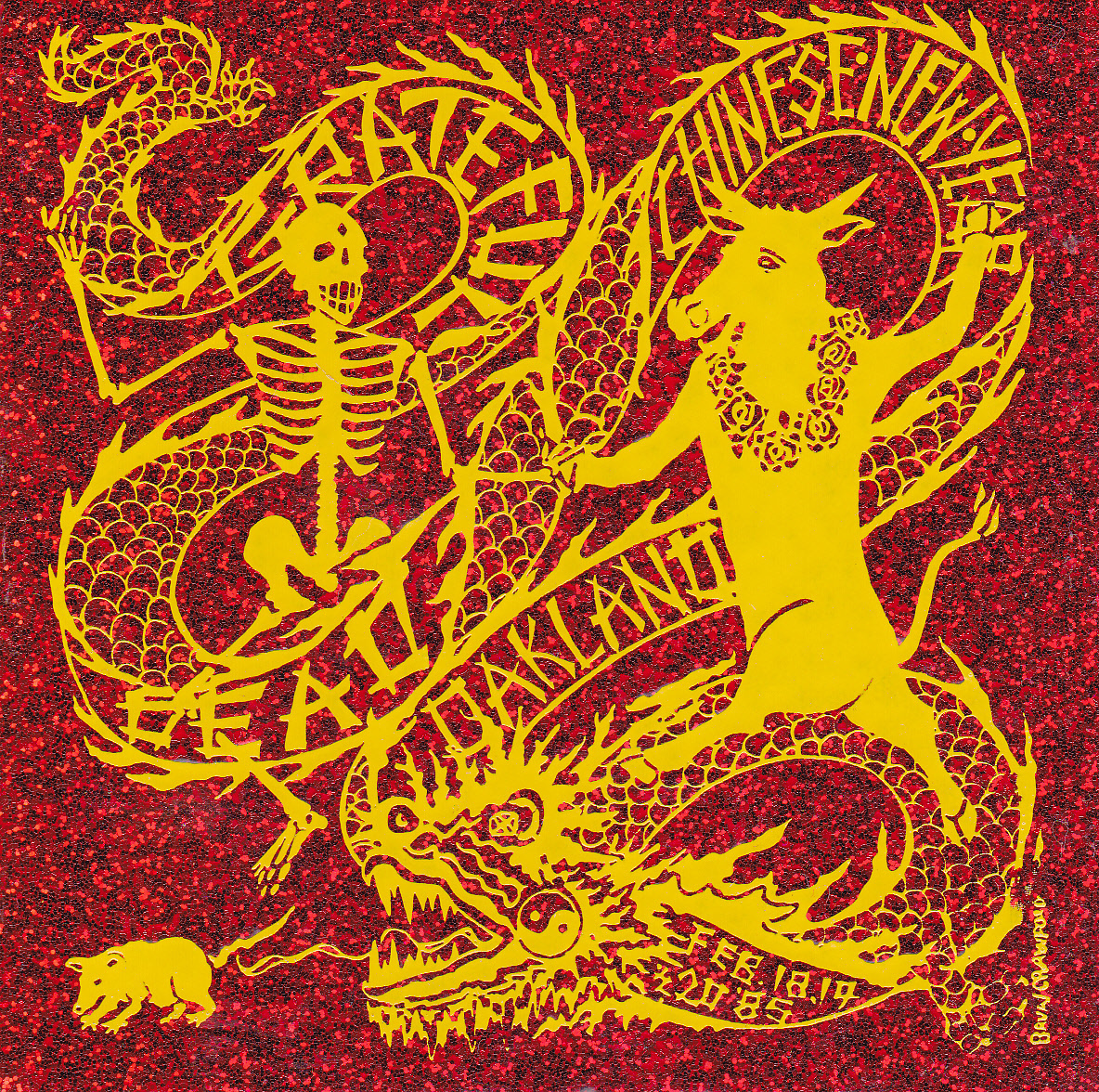
I’m not sure when the band finally came on stage but when they did, I remember everyone commenting on Jerry Garcia’s red t-shirt for the Chinese New Year. He had always worn black t-shirts and I thought it funny that this switch to red was such a momentous occasion.
I was not familiar with any of the songs but was entranced with the way the band members communicated with each other as they played. Being so close, you could see them nod and wink amongst themselves as they shifted from one part of a song to the next, a secret conversation for those in the know.
The music progressed though a number of songs that told stories about cowboys and drifters but it wasn’t until the set closer, China Cat Sunflower segued into I Know You Rider that I understood why this band was so compelling. The interplay that I saw earlier was more focused as the individual band members fused into a unit, completely in sync, driving each other, and those around us, like an unstoppable train trundling down a track.
During the set break, Alison and I got to know the people around us. Everyone was so nice and seemed genuinely happy to see us, two starry-eyed novices, just happy to be there, soaking it all in.
When the lights went down for the second set, the drummers started going right into a thumping rendition of Samson and Delilah and Bob Weir played a gospel preacher to his flock. Jerry slowed thing down with a beautiful rendition of his soulful tale of forgiveness, He’s Gone and towards the end of the song, the sound guy started messing with Jerry’s voice, throwing it back and forth from left to right and back again. Bobby then snarled his way into the old Howlin’ Wolf song Spoonful and I was again, entranced as to how skillfully the band was able to weave one song into the next and transform themselves with each transition. It was less a series of songs and more a multi-act play.
I still didn’t recognize any of the songs but when the band settled into the bubbly textures of Eyes of the World I finally latched on to a melody I recognized. My dad had a copy of Wake of the Flood that he played from time to time so I recognized this tune and its refrain.
Wake up to find out that you are the eyes of the world The heart has it’s beaches, it’s homeland and thoughts of it’s own Wake now, discover that you are the song that the morning brings But the heart has it’s seasons, it’s evenings and songs of it’s own
It was during Eyes of the World that, feeling peckish, I took an apple out of my backpack and started to munch on it. I distinctly recall looking up at Jerry, noodling his way through one of his riffs, staring down his nose through his glasses like a wise old man, he just looked straight at me and broke into a grin.
Eyes blended into a Goin’ Down the Road, Feelin’ Bad which everyone sung together before the drummers took over and shifted over to a large marimba behind the stage and a long fretboard that I would later learn was called The Beam. The jungle sound of the marimba was fed through a echo delay and started swirling around the room again, this time more rapidly, not only left to right but also front and back to the point where you could almost see the notes swirling around the room. When Mickey Hart started to play the deep ripples of darkness from The Beam, all I could think of was the scenes of napalm dropped at dawn during Apocalypse Now. I later learned that this instrument was used on the movie’s soundtrack.
I’m pretty sure when the other members of the band came back out for “Space” I thought they were just taking a long time tuning up their instruments. The notes from China Doll emerged out of the fog and the musicians slowly resolved themselves back into a band. Brent threw himself at his keyboard like a man possessed during the next number, Baby What You Want Me To Do. Spit was flying and the Hammond B3 and its Leslie was in full, warbling bloom.
The second set finished with Sugar Magnolia and we got to watch Bobby make full use of the whammy bar on his guitar, jumping back and forth and flipping his hair back and lighting up the crowd and playing to his adoring fans.
Alison and I gathered our things and started to think about how to get back to Mary’s place in Marin. I had no concept of how mass transit was laid out in the Bay Area. Natives know how ridiculous I must have sounded when I turned to the friends we had made earlier and asked at 11:30 pm, “Which BART train can get us to Marin?”
Mass transit in the Bay Area is spotty, especially late at night. It’s non-existent if you need to get over to Marin, on the other side of the Golden Gate Bridge. BART doesn’t go there and this was before Uber & Lyft and taxis were out of the question. You need to hop two bridges to make it back to Marin, it’s at least a 40-minute drive.
In hindsight I realize how extremely lucky we were when our friend turned to us and replied, “There’s no BART to Marin but I’m driving over there, where do you need to go?” It was at that point that I realized we didn’t really get an address from Mary. All we could remember was that they lived in a development called “Enchanted Knoll” which sounded ridiculous as soon as I uttered it. This was the before cell phone times so there was no referencing Google Maps or even texting Mary to ask.
Lucky again, our friend replied matter-of-factually, “Oh yeah, I know where that is.” We hopped into the back of her car and at 1 am or so we were skipping up the driveway of Mary’s parent’s house.
Every time I look back on this concert and how the stars aligned to get me there (and back) that night, I learn something new that makes it even more special. Remember the guy in the tie-dyed t-shirt that sold us the tickets because he was burnt out from the night before? Turns out this was the first concert of the year. The last time the band played was on New Year’s Eve!
Postscript: Many years later I found out that Joseph Campbell was in the audience the night of my first show. Here’s how the famed professor of comparative mythology described what he experienced.
I had a marvelous experience two nights ago. I was invited to a rock concert. I’d never seen one. This was a big hall in Berkeley and the rock group were the Grateful Dead, whose name, by the way, is from the Egyptian Book of the Dead. And these are very sophisticated boys. This was news to me.
Rock Music has never seemed that interesting to me. It’s very simple and the beat is the same old thing. But when you see a room with 8000 young people for five hours going through it to the beat of these boys … The genius of these musicians- these three guitars and two wild drummers in the back… The central guitar, Bob Weir, just controls this crowd and when you see 8000 kids all going up in the air together… Listen, this is powerful stuff! And what is it? The first thing I thought of was the Dionysian festivals, of course. This energy and these terrific instruments with electric things that zoom in… This is more than music. It turns something on in here (the heart?). And what it turns on is life energy. This is Dionysus talking through these kids. Now I’ve seen similar manifestations, but nothing as innocent as what I saw with this bunch. This was sheer innocence. And when the great beam of light would go over the crowd you’ d see these marvelous young faces in sheer rapture- for five hours ! Packed together like sardines! Eight thousand of them! Then there was an opening in the back with a series of panel windows and you look out and there’s a whole bunch in another hall, dancing crazy. This is a wonderful fervent loss of self in the larger self of a homogeneous community. This is what it is all about!
It reminded me of Russian Easter. Down in New York we have a big Russian Cathedral. You go there on Russian Easter at midnight and you hear Kristos anesti! Christ is Risen! Christ is Risen! It’s almost as good as a rock concert. (laughter) It has the same kind of life feel. When I was in Mexico City at the Cathedral of the Virgin of Guadeloupe, there it was again. In India, in Puri, at the temple of the Jagannath- that means the lord of the Moving World- the same damn thing again. It doesn’t matter what the name of the God is, or whether its a rock group or a clergy. It’s somehow hitting that chord of realization of the unity of God in you all, that’s a terrific thing and it just blows the rest away.
The first time I heard David Lindley was when he came out on stage as the warm up act for Santana and The Grateful Dead in the Sierra foothills in California. It was a hot August day and it was still early afternoon so the sun was blazing down on the crowd. We had just watched an airshow above our heads with prop planes tearing up the skies above us so everyone’s face was hot and necks were sore. David came out on stage in a polyester body suit and went into a version of Twist and Shout (2nd track on the player below) that sounded like nothing I’d ever heard before.
He was ripping it up and within minutes started sweating so much that his long hair immediately grew straggly and stuck to his face. I was worried he would spontaneously combust in the heat but Lindley and the band soldiered on and launched into fast ska version of Papa Was A Rolling Stone (5th track) that immediately got everyone on their feet. He jumped through several genres and also showed off his mastery of the slide guitar on Mercury Blues (10th track)
I saw him again in Tokyo, many years later, as he toured with Ry Cooder and both their kids. I had heard that Lindley was playing the World Music scene with Henry Kaiser, capturing field recordings in Madagascar for A World Out of Time. When he came to Tokyo, Lindley and Cooder brought all sorts of instruments I had never heard before, explaining each before playing them. They played in a small theater in Gotanda and I felt lucky to see them.
The final time I saw Lindley was at the invitation of a friend (thanks Rick!) who said he’d be playing at a birthday party in the Berkeley hills. As when I saw him in Tokyo, he was chatting up the crowd and explaining each of the instruments he had with him, their origins and he learned about them and where he got the one he was holding before us. Lindley was a musicologist (his bushy mutton chops accentuated his professorial air) but he played each of his instruments with a passion and soul that would make the instrument, designed for another type of music, sound new.
Listen below to David play the old blues tune Minglewood Blues on a Middle-Eastern Oud. Playing an old American folk tune on an ancient instrument from Northern Africa connects the two cultures in a weird way that makes you rethink all your preconceptions of the song and rediscover its story in a new light. Then you look up and see the guy playing for you is in a Hawaiian shirt and is sporting yellow patent-leather loafers and you smile at the wonderfully diverse world around us that makes it all work.
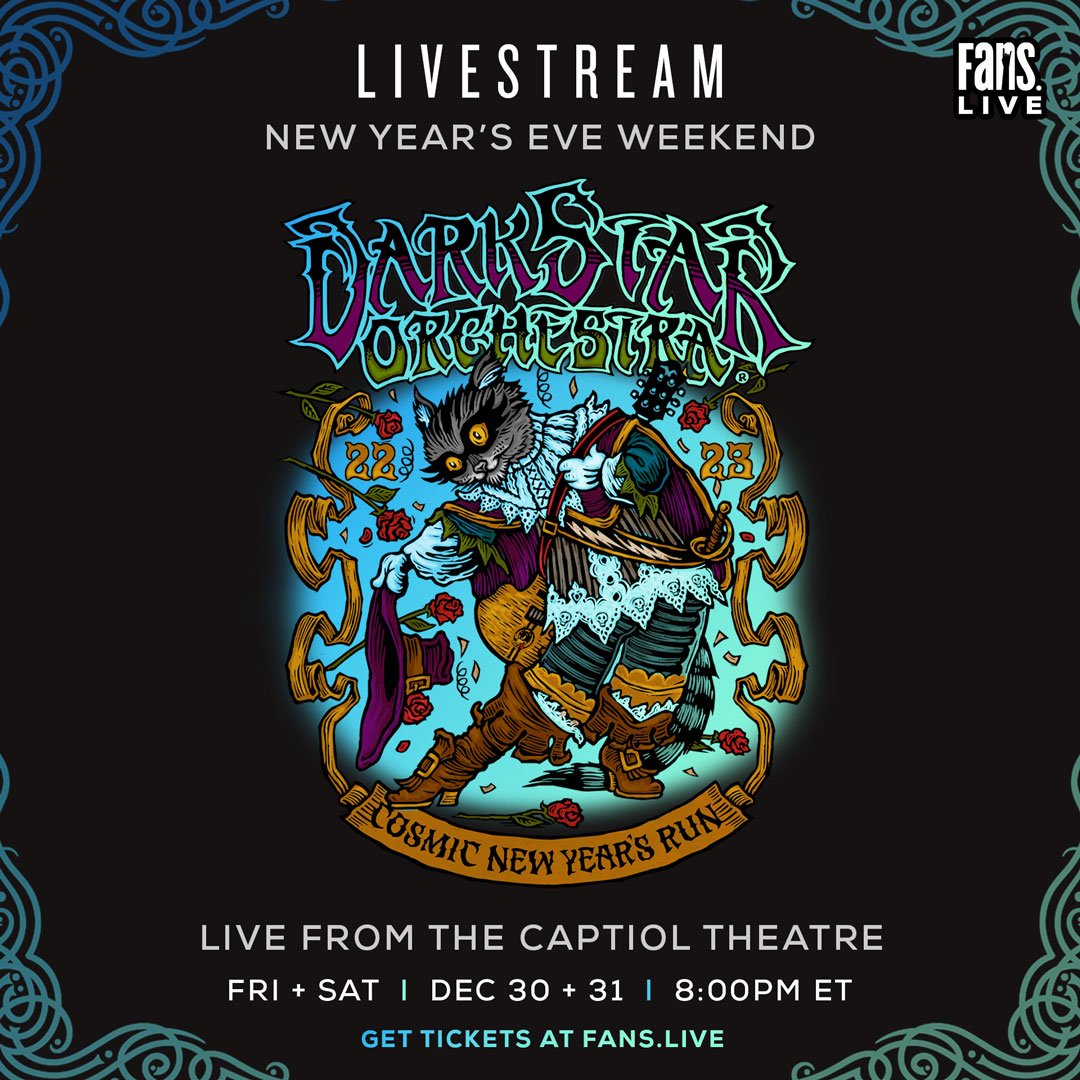
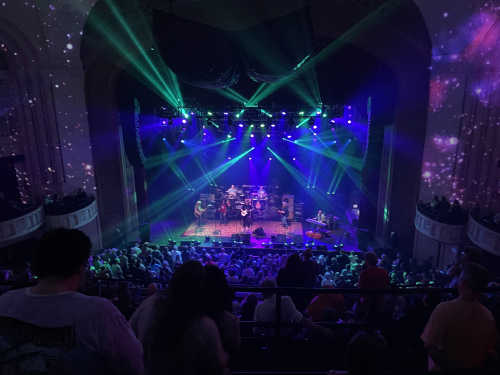
After catching an epic Phish concert at MSG on 12/29, I took the MetroNorth from Grand Central to meet my cousin to see Dark Star Orchestra at the famed Capitol Theater in Port Chester. I’ve never been to the Cap but have heard numerous tapes of legendary shows from this venue so I was looking forward to seeing it in person.
The concert did not disappoint, the sound was amazing and the band played some of the songs even better than when I heard them played by the Grateful Dead. (DSO played a setlist from 12/27/78 from San Diego)
Dark Star Orchestra at The Capitol Theater, December 30, 2022
The Capitol Theater is just a block or two away from the Port Chester train station but, after 11pm, the train only comes once/hour so a bunch of us were keeping our eye on our watch just to make sure I got out in time to catch the 12:15am train.
I stuck around to see what the encore would be and once I heard the open notes of US Blues, I figured it’s better to try and make the 12:15 rather than risk waiting around on a freezing platform for an hour so made my way outside and down to the station. Turns out I didn’t really miss the encore because you can hear it from the train platform!
Anyway, there were about 20 people on the platform that did the same thing as I and were waiting for the 12:15 train. There was an electronic sign on the platform but it only listed the 1:15am train, no 12:15. Amidst much murmuring, I took out my phone to check the MTA TrainTime app to settle the debate.
This is what I saw.
We all couldn’t believe it so others downloaded the app to check for sure and debates started to break out, do you believe the sign on the platform, do you think the app is just flaky or is something else wrong? Groups formed into the believers and non-believers. Tempers flared a bit and one guy from Austria suggested that I stop refreshing the screen and turn off my phone when it shows a 12:15am train because, maybe my app had the power to summon the train itself.
It came down to faith. Did you have faith in something you couldn’t see, classic epistemology, how do you know you know? One guy on the non-believer side was hedging his bets and noisily making alternative plans, asking his buddy with a car not to leave just in case the train didn’t show up. I joked with him for not believing and chastised him gently as a doubter and others joined me, “that’s right, you’re scaring the train away. . .” He gave us a look that said, “Yeah, whatever buddy, I don’t believe in that mumbo jumbo. I’m going to take care of me and my wife and get my ass home regardless.” He was firmly in the not believe category but when his wife leaned over to see if she could see the light of the train in the distance, he told her to get back away from the edge of the platform in case the train comes. “So you DO believe!” someone said and all of us had a laugh.
The the train did show up. Right on schedule at 12:15am and we all hopped on to the warm train and we sank into our seats. I rolled into Grand Central about an hour later at 1:15am and popped out the side to walk up 43rd to my apartment but not before stopping by for a slice of pizza where the friendly proprietor wished me Happy New Year and gave me a cola at the “Happy New Year price”
Satiated after two incredible nights of live music, I ambled home to a warm night’s slumber. Ready for a quiet New Year’s Eve, the way I like it.
In honor of tonight’s Dark Star Orchestra concert at the famous Capitol Theater in Port Chester, NY (which I’ll be visiting for the first time), here’s a list of Robert Hunter lyrics that I found in an old notebook.
If you’ve listened to the Grateful Dead, you’ve heard these lines over and over again, embedded into their songs but taken out of context, can you guess which songs each of these lines are from?
Comes a time when the blind man takes your hand, says “Don’t you see?”
Without love in a dream, it will never come true.
Sometimes the cards ain’t worth a dime if you don’t lay ’em down.
Anyone who sings a tune so sweet, is passing by.
The trouble with you is the trouble with me
Must be getting early, clocks are running late
Honest to the point of recklessness
Thinking a lot about less and less
You can’t close the door when the walls caved in
Small wheel turning by the fire and rod, big wheel turning by the grace of God
The grass ain’t greener, the wine ain’t sweeter, either side of the hill
Once in a while you can get shown the light in the strangest of places if you look at it right.
If all you have to live for, is what you left behind, get yourself a powder charge and seal that silver mine
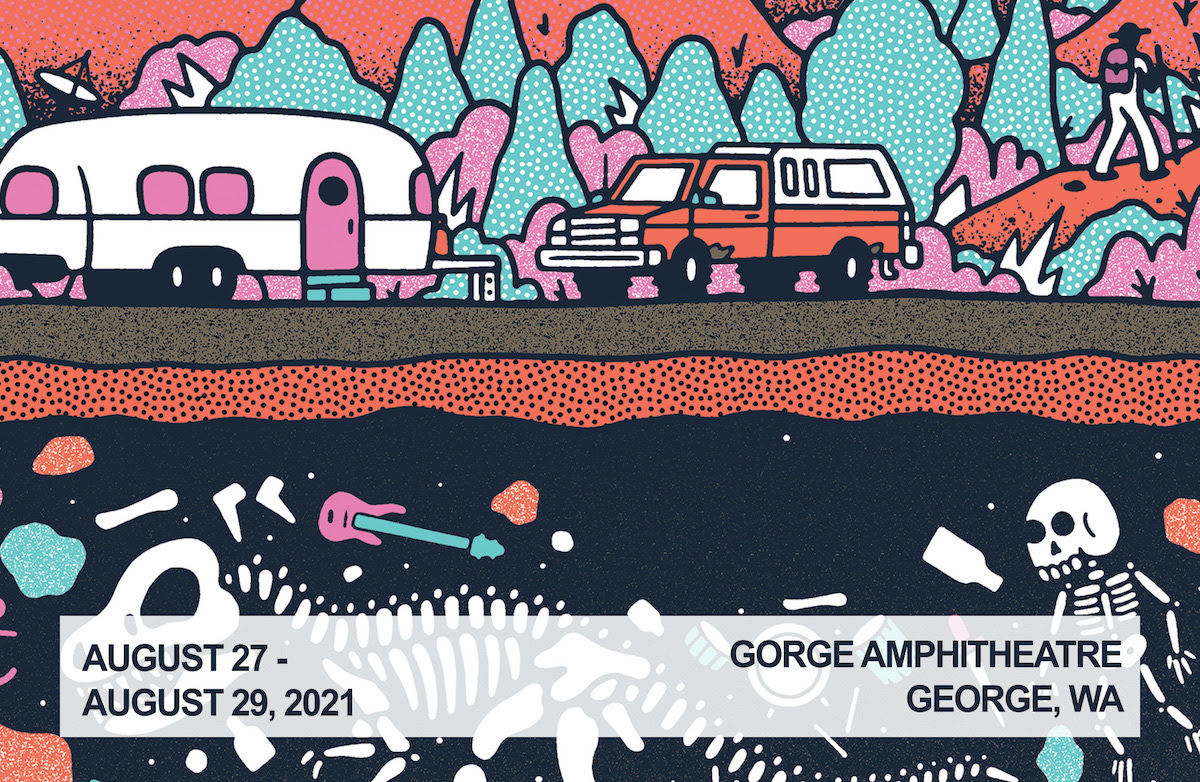
I’m writing this in case I’m asked why I took nearly a week off to attend a three-day concert all the way on the other side of the country in central Washington. I want something I can send out that satisfies and hopefully inspires people to dig in to learn a little more about this band that drew me there, Phish.
I enjoy improvisational instrumental music. Not anything too rigid such as classical, nor as completely loose as avant-garde jazz. The attraction of jam bands like the Grateful Dead and Phish is that they have set structures that, after multiple listens, lay out the confines so you can appreciate how skillfully the band can diverge, explore, then return to a song’s structure.
While the music is the language of the conversation between the band and its fans, there’s also the atmosphere of a live concert that must be experienced in person to appreciate. I’ve been to many Grateful Dead shows between 1985 and the early-90s but stopped seeing them after the crowds became unwieldy with too many fans showing up for the party scene, less interested in the music or even musicians.
After Jerry Garcia passed away, a friend took me to see Phish play in Sacramento. The music sounded frenetic to my ears so used to the loping strut of so many Dead songs but I was intrigued and could see there was something to explore.
The next time I saw the band live was several years later for two dates in Tokyo. The fans that rolled into Japan brought an energy and joy of life with them that was palpable and infectious. While it was misty during the beginning of an outdoor concert in Hibiya, the clouds later parted and (I’m not making this up) a rainbow appeared.
It’s the lore passed down over the years by the wise elders to the newly arrived that sustain the fan culture. Phish “phans” are refreshingly welcoming and positive about what life sends their way. Yet their philosophy is not blindly optimistic, they know you also need a quirky sense of humor to roll through an unfortunate setback and come out with a good story that finds the silver lining or lesson learned.
The band feeds this quirky sense of humor. What other band would spend Halloween playing entire albums as their costume? Over the years they have covered classics such as the White Album, Quadrophenia, the Talking Heads’ Remain in Light and many more. Then, after that became too routine, the band set up an elaborate Halloween prank by playing a fictional album by a fictional Scandinavian rock band complete with a backstory outlined in a pamphlet handed out at the show, fake music reviews, and fan sites to dupe their audience further.
I’ve only begun to dig into the lyrics of Phish’s music. There’s a lot of play on words, a song’s chorus of “moment ends” transforms into the song’s curious title, Moma Dance. NICU comes from the phrase “and I see you.” Finally there is The Mango Song, which I heard this past weekend. Why is an entire crowd of 30,000 belting out at the top of their lungs, “Your hands and feet are mangos, you’re going to be a genius anyway!” and what the heck is that about? Look it up.
There are so many threads to pull on in their music it’ll take a lifetime to unpack it all. During a 13-night residency at Madison Square Garden, Phish played 237 songs, no repeats. Like the stat nerd baseball fans, there’s an entire stat culture around Phish’s music that goes as deep as you want. Most of it lives on phish.net where the complete setlist of every concert and side project lives in its fan-built database. Register an account and tick off the concerts you attended and you’ll get a complete set of stats showing you how long it’s been since you’ve heard Ocelot or the probability of seeing Bouncing Around the Room at your next show.
During each tour, there’s a fantasy-football type game around trying to guess which songs will open or close out a set and phans post their picks and tally up their totals in a master google doc. While all this existed with pen and paper while I was seeing the Grateful Dead, usenet and basic websites is all we had to exchange information.
There is a robust community of traders who upload and share digital recordings and an app from which to stream the collective archive hosted generously by the Internet Archive. There are song-by-song analysis of each concert in a podcast and even a guy on YouTube having a good time doing the rundown of each night in the style of NBC’s political stats guy, Steve Kornacki.
As for official channels, there is the Live Phish site and its premium version which unlocks the entire soundboard archive. The band also uploads the soundboard recording of every show and gives away to everyone at the show with an individualized download code on each ticket so people can re-live the concert afterwards and the band can register new fans and convert someone who bought a ticket into a fan who starts to explore their music.
As with any experiential business, there are tiers built into their business model. For those that could not afford the time or money to tour to each city the band plays on a tour, you could listen along in the premium Live Phish+ and hear each concert the following day to hear how the band worked through their sets over the course of their tour as they made their way to where I was to see them at The Gorge this past weekend.
Reviewers of the tour spoke of “couch touring” which is, as it sounds” experiencing the tour from the comfort of your home. This is made possible by a package of video streams the band has been teasing on their YouTube channel and making available in full with a special $440 package.
When I asked someone about the lengths you can go to experience the band I learned about annual Mexico dates they started to play a couple years ago down in Cancun. For anywhere from $3000 – $12,000 a head you can spend a week at an all-inclusive resort where waiters will come and deliver your margarita to you as you dance on the beach. And I thought renting an RV and parking in the Gold Lot was bougie!
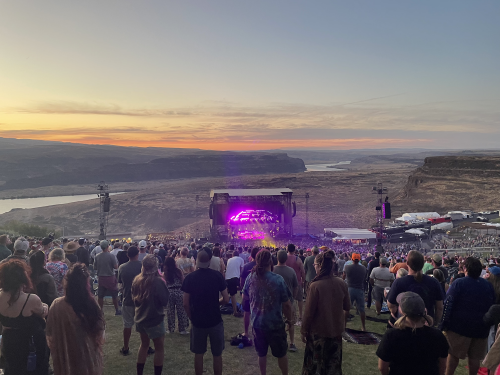
So back to the original question – why three days and why fly all the way to Seattle? First off, I bought the tickets pre-pandemic when the flight from the Bay Area was just a quick hop. Second, the plan was to meet a couple friends who were flying in from Japan that I hadn’t seen in years. Finally, I’ve heard that the venue, The Gorge, is life-changing and something that needs to be experienced in person to appreciate.
The Gorge at sunset
The journey out here isn’t easy which thins out the crowd to the committed. Most are here for the entire three-day run and experience the rhythms of the days together, as a community. There’s a crowd-sourced online guide to help newbies plan ahead and know what to expect and bring. I’ll add that the walk into the Gorge to swim in the Columbia River is totally worth it and that you should figure out where you want to situate yourself on the first night and return there every night as those around you will become your tour friends.
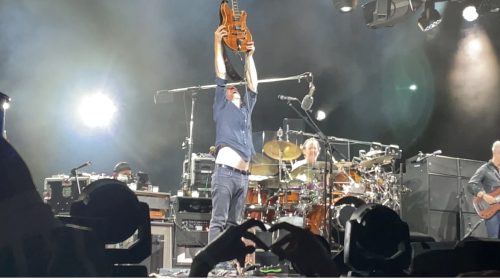
After a couple of songs on the lawn, where we experienced the fantastic view and lightshow, I found a walkway around behind the soundboard that let out on the left side of the stage where it was relaxed enough to get down in front, just a few rows back. It was a dancing audience so there was not a lot of conversation as the crowd just focused on the music.
The view down front
Occasionally the band would build into a tremendous crescendo of sound like they did with Scents & Subtle Sounds, Bathtub Gin or Saw it Again and banks of lights would descend until they were just over the stage like a giant transformer. While we were too close to fully appreciate it, the upgraded lighting rig has been the talk of the tour and the interplay of LED stripes and real-time adjustment of the rig adds a whole new dimension to what can be done.
CK5, Phish’s fifth member
With the recent passing of Charlie Watts, the band opened with Torn & Frayed on the first day. This band has an on-going conversation with their fans. There is no, “Hello Seattle!” shout out. They know you know who they are so there is no need for frivolous introductions – they are there like an old friend, picking up the conversation where you last left off. This is, after all, a band that had an ongoing chess match during a tour where fans voted on the next move during the gap between each show.
There’s a respect of the audience’s attention that allows the band to dive deep and explore each song, turning it inside out, giving them the courage to try something new every night. During several extended jams, as the tempo of the song completely shifted, I would forget what song was being played until it was brought back, like a wayward spaceship, and landed back onto the original melody.
Because of this relationship, there are moments where the crowd will break out and do something unexpected and wonderful that, if anything, gives you an excuse to start a conversation. So why does everyone throw tortillas in the air when they play Carini and do you really bring a stack of tortillas to each show just in case they play it? The band speaks through its song selection and there are endless conversations around trying to decipher the message in the music of each night.
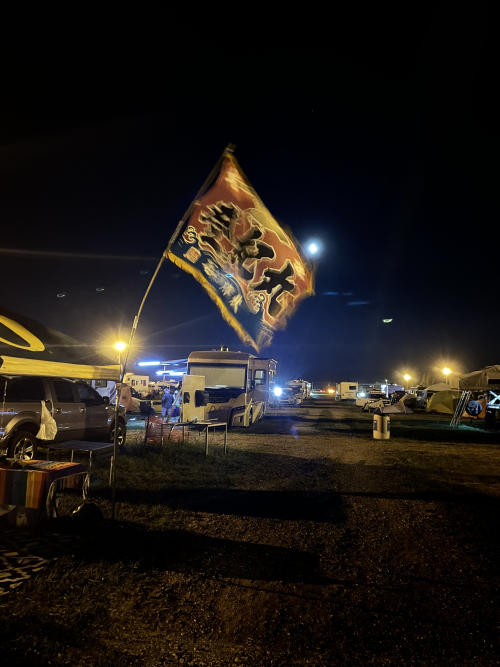
As with other multi-day festivals such as Burning Man you orient yourself by the campsites around you – the guy with the Japanese fishing flag, the Montana flag we couldn’t make out because we were reading it in reverse, and the family we met at the RV place. This becomes your mental map for the next three days and the people in your neighborhood are there for the same reason so you might as well chat with them.
Japanese fishing flag was our marker on the way home
All this meeting and getting to know new people exercised mental muscles that had atrophied during lockdown so by day three I was tired. I’ve done a weekend of shows before but three nights in a row is something you need to pace yourself for. At one point we realized we had walked over 20kms in the two prior days (maybe that river is further than I realized) so we were ready to take it easy. I was content to drift off while sitting in the shade, eyes closed while the high desert winds blew gently, carrying with it distant and faded conversations, laughter and music.
Charged up after a relaxed day, we headed in for our final night of music. Sunday night seemed more crowded than the previous two so lines were longer to get in. The “still waiting” line from the Talking Heads song Cross-eyed and Painless was a nod by the band to the crowd and the band wove that line into other songs in the set just for kicks.
After saying, “Some people deserve two songs” the band broke out Shine a Light for an encore as another nod to the late Charlie Watts and sent us on a way.
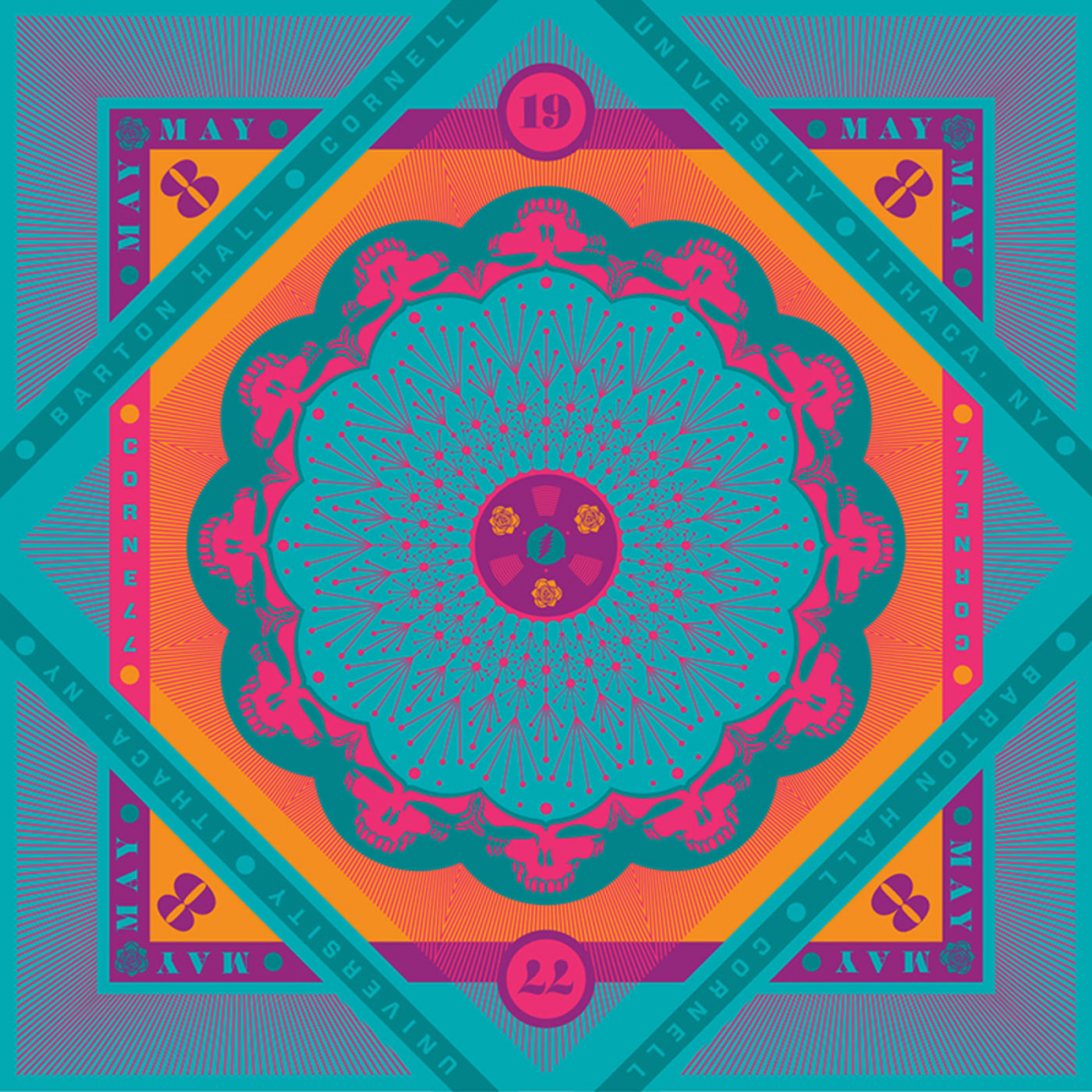
When Deadheads try to explain their appreciation for the Grateful Dead, they will probably point you to a concert at Cornell University in 1977, in particular the sequence from Scarlet Begonias to Fire on the Mountain.
YouTuber Michael Palmisano has built up his channel, Guitar Teacher REACTS around the deconstruction of live music jams. To celebrate his 100,000th subscriber, Michael deconstructed Scarlet > Fire from 5/8/77.
I’ve listened to this version many times but following the Guitar Teacher through his hour-long analysis revealed flourishes that I knew all along were there but never fully appreciated or had the vocabulary to explain. From Scarlet’s “mixolidian lick” to Keith’s arpeggiating progressions – he calls out all the shiny bits and holds each one up to the light like its own little gem.
At the transition into Fire at around 21 minutes, Michael breaks down how each musician transitions over “step-by-step” until the band collectively agree it’s time to jump over. Watching him walk you thru the magic, painted in real-time as only a band that plays together, night after night, can do is infectious.
ID used to identify users for 24 hours after last activity
24 hours
_gat
Used to monitor number of Google Analytics server requests when using Google Tag Manager
1 minute
_gac_
Contains information related to marketing campaigns of the user. These are shared with Google AdWords / Google Ads when the Google Ads and Google Analytics accounts are linked together.
90 days
__utma
ID used to identify users and sessions
2 years after last activity
__utmt
Used to monitor number of Google Analytics server requests
10 minutes
__utmb
Used to distinguish new sessions and visits. This cookie is set when the GA.js javascript library is loaded and there is no existing __utmb cookie. The cookie is updated every time data is sent to the Google Analytics server.
30 minutes after last activity
__utmc
Used only with old Urchin versions of Google Analytics and not with GA.js. Was used to distinguish between new sessions and visits at the end of a session.
End of session (browser)
__utmz
Contains information about the traffic source or campaign that directed user to the website. The cookie is set when the GA.js javascript is loaded and updated when data is sent to the Google Anaytics server
6 months after last activity
__utmv
Contains custom information set by the web developer via the _setCustomVar method in Google Analytics. This cookie is updated every time new data is sent to the Google Analytics server.
2 years after last activity
__utmx
Used to determine whether a user is included in an A / B or Multivariate test.
18 months
_ga
ID used to identify users
2 years
_gali
Used by Google Analytics to determine which links on a page are being clicked
30 seconds
_ga_
ID used to identify users
2 years
You can find more information in our About Me and .