Wow. I was really excited to blog about Evan & Luke’s Williamsburg apartment studio based on a May 1st story that just popped up in my feed from Yahoo.
When I followed some of the links to find out more, I discovered that the video below was from 8 years ago and that the last video in their YouTube channel was from 5 years ago (victim of the pandemic?).
Curious why Yahoo would revive a story written so long ago and timestamp it from today. I suspect an old RSS feed was reconnected and sprung back to life w/o the proper meta-date to filter it out as old. Yet another case of why good data hygiene is important.
Nice story anyway – wonder what they’re up to today?
Once a month, roommates Evan and Luke transform their tiny Brooklyn apartment into a full music studio. Sometimes they manage to cram an entire orchestra complete with brass, strings, and percussion into every nook and cranny and, in the process, spark something rare these days, a uniquely human in the experience.
It’s been over a year since The Messenger closed down and the lessons are even more stark today. The meltdown precipitated from a number of out-dated expectations. Social media algorithms are shunning general news content, Google has been re-calibrated to favor original, niche content and news consumption habits have changed considerably.
It’s kind of like running a restaurant on a busy street. If your goal is to touch as many consumers as possible (as The Messenger sought to do) the easiest way to achieve that is to make food quickly and throw it at passing cars hoping that people will 1.) have their window rolled down, 2.) will be hungry and 3.) will like what you’ve made. If your goal is to build an enduring business with a foundation of repeat customers your best bet is it invite them in, speak with them and hope they stay a while.
News articles are a no longer a commodity that is profitable at scale. The age of infinite personalization (via AI) is upon us. Publishers that understand Liquid Content, information that can be adapted to it’s consumer, will prevail. The new moat will be unique archives of well-formatted content, rich with meta-data stored in dynamic data structures that can re-combine on-demand to meet a specific need. Adaptability is key because in this new world it is impossible to know if your growth will come from text snippets, short-form vertical video, interactive graphical representations of data, or audio summaries translated to Chinese.
In this world, the inverted pyramid is but one way to present what you have.
I was fortunate to be invited last week to the kick off meeting for an IAB Tech Lab task force dedicated to establishing a framework for Monetizing the Open Web in the age of AI.
The accelerated use of tools such as OpenAI’s Chat GPT, MSN’s CoPilot and Google’s AI Overview has precipitated a re-thinking of how publishers are compensated for their work. While the conversation is only just beginning, this group outlined concrete suggestions to the challenges ahead.
Publishers must work together to stem the flow of unlicensed content.
As long as information is readily available and free, there is no incentive to drive demand. Unless you limit supply, you cannot derive value. Content Delivery Networks (CDN) such as CloudFlare and Fastly are on the front lines as they see the majority of requests & responses across their networks. They have noted the sharp increase in AI-bot traffic and have the expertise in the blocking and tackling of the thousands of bots and spiders.
TollBit is keeping track of the AI crawlers with their quarterly State of the Bot reports
Publishers in the room are anticipating a world where the value of a search result on Google is less than the value of licensed access from an AI Agent. In such a world, it would be prudent to default to denying access to all crawlers in favor of direct access by verified, registered readers or licensed partners.
Old methods such as robots.txt and user-agent/IP address blocking filters are readily ignored or spoofed by long-tail startups scrambling to serve their users. More secure methods are necessary. “Get a better lock on your door.” says Jon Roberts, Chief Innovation Officer at DotDash Meredith.
Establish a marketplace for publisher information that can scale to serve AI Agents.
While CloudFlare’s Cost-Per-Crawl implementation redirects crawlers to a 402 HTTP error page to redirect AI developers to licensing information, TollBit and Dappier are building the first marketplaces for publisher libraries as a proof-of-concept as a bridge from the search engine results of the past to the marketplace of the future.
A search for the past 25 years returned 10 blue links of which a human might read 1 or 2 links. This referral traffic was the currency of the old internet. This attention could be monetized any number of ways.
Google owned this marketplace.
Now imagine a world where a query by an AI Agent may spawn 20-50 queries of which *every* article is scanned and synthesized into a single response. Ads and subscription funnels on these pages are ignored. There needs to be a different pricing model for this traffic. Source material will not be a “page” but could be a snippet of video, a schematic blueprint, a sound bite, or a product spec. The pricing model in this “marketplace of everything” needs to recognize and support dynamically pricing requests based on who is requesting it and in what format, all in real-time.
The programmatic advertising ecosystem which has been the engine driving the growth of online publishing for the past 25 years was subsidized by advertisers bidding for a reader’s attention on a web page. An entire tech-stack was built to serve up the right ad for the right audience at the right time, all in under 500 ms.
With AI Agents, you have readers paying directly for content with their subscriptions (Chat GPT Pro is $200/month) and the AI Agent is acting as a proxy on their behalf. Once publishers have successfully shut off the free flow of their content, accurate, reliable, and up-to-date information will accrue value. In this world, there will be need for a real time marketplace to handle the access and metering of content and this system will need to be built to the same scale and performance of the programmatic advertising platforms of today.
No one owns this ecosystem.
Tokenization – core components to a market
The final step, once you have established a way to meter (cost-per-crawl, cost-per-query or some other subscription model) access to a publisher’s library, is to establish a standardized way to track and count content as it travels through the ecosystem from a publisher to the AI platform.
Tokenization is this final step. Once an AI has asked for something, the response needs to be tokenized in such a way to properly attribute credit as well as track the usage of that content not only to the initial query but in all future derivative uses.
ProRata has a working implementation of this tracking in their Gist Answers, distributed search widget. “If you can track it, you can charge for it.” they say as their IP is focused on the attribution of AI responses from their network of publishers.
TollBit has one-time use tokens for access and are setting up a system where an AI Agent can query for information, inquire about pricing, and generate and receive a token to retrieve the information as needed, on demand.
All these are approaches to the same problem and my company, SimpleFeed, aims to participate in the delivery of publisher content, whether it be tokenized, vectorized (to assist in discovery), or otherwise value-added with filtering and meta-data augmentation as we have been doing for 20+ years.
I look forward to staying engaged with the individuals and companies that were gathered for this workshop. AI summarization is rapidly tearing down a business model that has worked for decades. Unless there is an agreed upon business model that is accessible to all players including small publishers and long-tail AI startups, we may lose the diversity of opinions and perspectives that have given us the open web we currently enjoy.
It makes sense that IAB, an industry group that helped establish standards around online advertising, is taking the first steps to establish standards around the AI Agentic web of the future. I thank them for taking this first important step of getting all the players in the room together and publishing the first framework for publisher content monetization and brand content management for LLMs and AI agents.
Publishers underwrite new projects based on forward-looking financials. If nothing is done to improve the economics of publishing online today, the investigative reporting of the future will not be funded and we will all be poorer for it.
Last September, I gave a talk at the Media Party conference in New York to propose a method to track the origin of text as it travels through a Large Language Model (LLM). Tracking provenance is important because to evaluate reputation and assign credit to properly allocate licensing revenues to publishers that provide source material to an LLM.
What follows are the slides from the talk with some annotations to help explain.
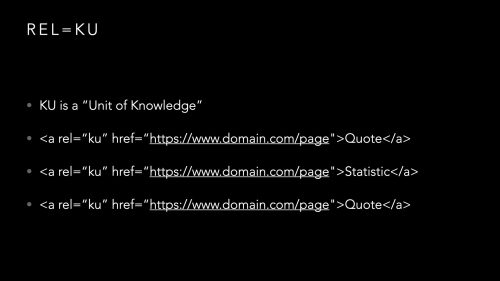
The rough outline of the proposal is a simple type of HTML markup which allows the publisher or author of a page to mark unique phrases, facts, quotes or figures for which they would like to retain credit. This markup, if retained along with the indexed text, would allow the LLMs to store and trace the origin of these unique phrases back to the originating url or domain tracking the “knowledge” as it travels from the originating website to an LLM and then back out via a genAI chatbot in the form of an “answer.”
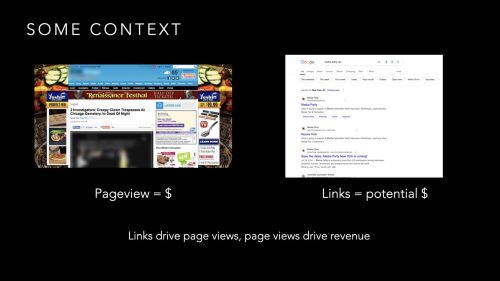
Setting some historical context, I explained how incentives can shape ecosystems . The pageview & advertising economy of online publishing incentivizes publishers to seek out traffic and has given rise to an ecosystem that put Google and their “ten blue links” at the center. A link drives traffic and traffic drives ad impressions which equals revenue in this ecosystem.
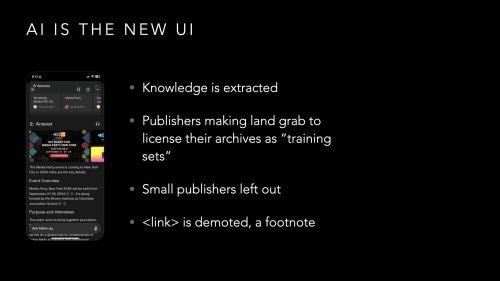
This well-established ecosystem is being upended by AI chatbots which efficiently extract knowledge from a page and serve it back to the user without generating a pageview. This cuts out an important way for publishers to make money, grow audience, and promote their brand.
To get a jump on this new ecosystem, large publishers are cutting deals with the AI companies but only the biggest will have the resources to benefit from such arrangements. Smaller publishers will be left out.
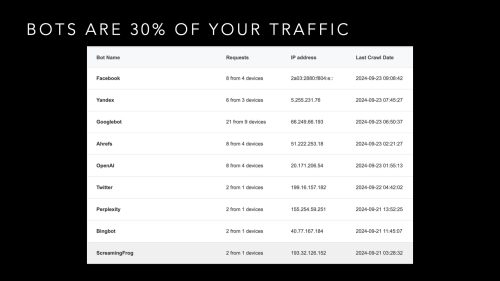
SimpleFeed (where I work) released a simple WordPress plugin that monitors your site to see who is crawling your site and allows the site admin to block selected bots. The idea is to educate smaller site owners how much indexing is going on and build awareness of how the LLMs are interacting with their content.
According to CloudFlare, bots make up 30% of a site’s traffic and this figure will surely increase.
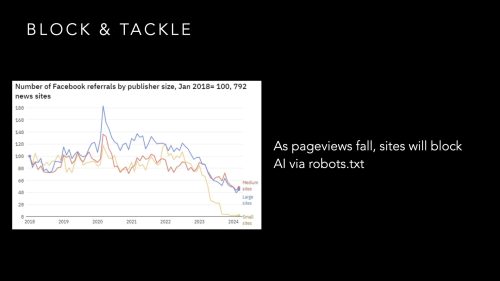
Referrals from social networks are falling. This puts pressure on site owners who wish to control who comes to crawl their site. Who do you let in, who to block? The act of publishing something is to distribute your information far and wide but, right now, many are defending their sites from aggressive crawlers strip-mining their sites without compensation.
If we plot this situation to it’s conclusion, the largest publishes will survive off of whatever licensing terms they can secure while the smaller sites get starved of traffic and miss out on any significant licensing revenue. The result is that we lose the diversity of the web. This leads to the gentrification of anything going into and coming out of the LLMs. This is what is called, an ecosystem collapse.
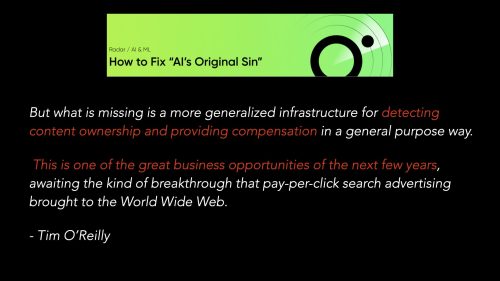
Tim O’Reilly is my North Star when it comes to understanding technological tectonic shifts. Much of my thinking here is inspired by an O’Reilly piece, How to Fix “AI’s Original Sin” in which he writes about how incentives can influence ecosystem design and how pageview incentives of past result in the block & tackle behavior of publishers towards the LLM platforms today.
The challenge for the LLMs to break out of this cycle is to create a system for “detecting content ownership and providing compensation” so that LLMs can share the enormous, untapped potential everyone anticipates for the LLM platforms. In O’Reilly’s words,
This is one of the great business opportunities of the next few years, awaiting the kind of breakthrough that pay-per-click search advertising brought to the World Wide Web.
In the world of digital art (audio, photos, videos), the people and companies behind Content Credentials are already hard at work in creating this system.
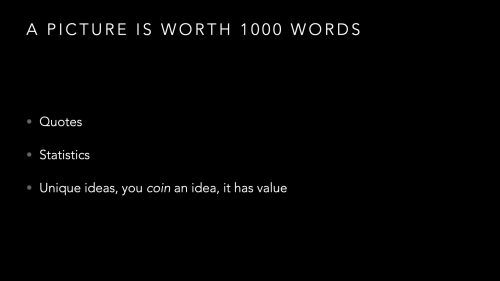
If a picture is worth 1,000 words, there must be value assigned to text. If something has a value, it’s worth tracking. I propose a few elements worth tracking. Quotes, Statistics, and even unique phrases.
The next few slides told the story of how, when blogs and blogging were just getting started, there was a huge problem with comment spam. This was largely the result of incentives to get a high reputation site to link back to the commenter’s website to help improve their ranking in Google’s search results.
Over the course of a few days (the internet was a smaller place back then), engineers at Google and Six Apart (where I worked at the time) agreed to negate the relevance of the link back to the commenter’s site on a comment and dealt a blow to the comment spam problem. A small group of engineer’s extended the web and, in a very simple way, removed the incentives that rewarded bad behavior.
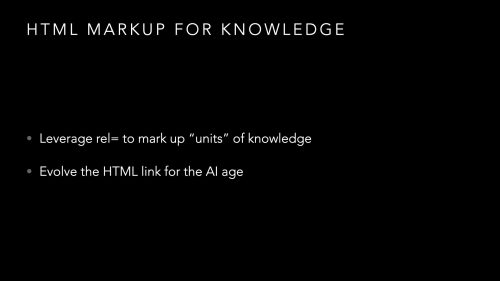
I told this story because I see the rel= link qualifier as something that could be used to markup text and prove provenance. I proposed something called a “knowledge unit” or KU for short.
The syntax of the markup worked alongside HTML, just bracket anything you want to track in the rel=ku markup and, as long as the consuming LLM keeps that markup intact, that text will be tagged as something originating from the url cited in the markup.
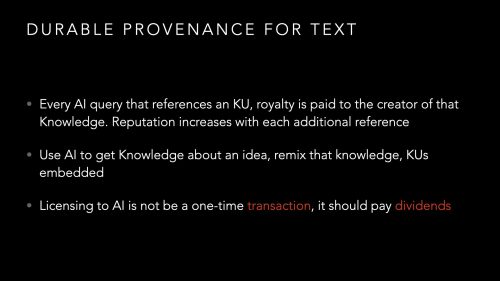
This provenance can be used to track the number of times a particular knowledge unit is mentioned in an LLM’s response. This enables a fundamentally different ecosystem from that of pageviews in that there is no need to constantly re-post something you wrote years ago to keep it fresh, relevant, and trending in Google’s search results. Hard work to produce durable knowledge should pay dividends on into the future.
More akin to the Wikipedia reputation model, a good, unique fact can continue to be cited over time and, in fact, revenues should flow towards durable knowledge units and will hopefully reward those that gather and present unique knowledge rather that the hot takes and re-writes that are rewarded in today’s pageview economy.
Taken a step further, we will then return to a web before ad targeting and enragement metrics to a world where we reward those that teach us something new.
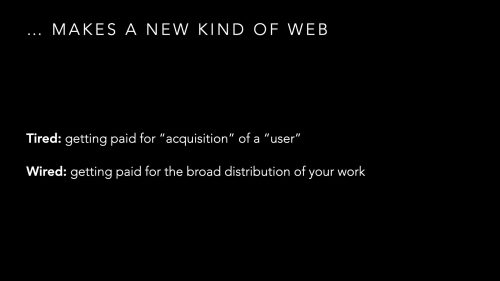
This new internet no longer drives you to “acquire” a “user” to package up and sell to an advertiser. Publishers no longer need to lock their stories behind a paywall to prevent non-monetized access. In this new ecosystem, the incentive is to share knowledge, getting paid directly for the broad distribution and citation of your work.
This is just the germ of an idea that may well be totally naive. While I do like the bottoms-up, simplicity of the markup approach, it requires everyone to adopt and trust each other to collectively make it work.
What is to keep bad actors from hijacking Knowledge Units and claiming something as their own? Page index timestamps will need to be the arbitrator of provenance I suppose but how do you guarantee delivery of your post over others?
Also, why would LLMs adopt such a system that would fundamentally make their indexes more complex and expensive? My hope is that the LLMs eventually see that strip-mining the web is unsustainable. Just as in agriculture, an ecosystem that does not replenish it’s resources, both large and small, is not a diverse, healthy, and long-lasting ecosystem.
If you’ve made it this far, I’m super-interested in your thoughts and encourage you to get in touch.
Every publisher should be thinking about publishing their archives into a GPT-style database to be used as an internal research tool.
As for how BloombergGPT might inspire other news organizations…well, Bloomberg’s in a pretty unique situation here, with the scale of data it’s assembled and the product it can be applied to. But I believe there will be, in the longer term, openings for smaller publishers here, especially those with large digitized archives. Imagine the Anytown Gazette training an AI on 100 years of its newspaper archives, plus a massive collection of city/county/state documents and whatever other sources of local data it can get its hands on. It’s a radically different scale than what Bloomberg can reach, of course, and it may be more useful as an internal tool than anything public-facing. But given the incredible pace of AI advances over the past year, it might be a worthy idea sooner than you think.
Generative AI presents a challenge for media companies that can no longer rely on Google for “discovery.” The chat UI commoditizes everything it indexes so every source in its index is reduced to a mere footnote.
The article (or media artifact) construct will exist tangentially to chat, but with less importance to the reader experience and more important as a reference source. The media brand will surface as a validator in the chat experience, a signature of quality like “Intel Inside.” Only the most recognizable will have value. Evergreen content, like the hundreds of articles of the “how to stop a bleeding nose” variety will languish. Personal, timely, authoritative POV will do much better.
The few media companies that cross the line between content and data provider will find valuable new opportunities in the chat world. A rich, faceted database of all the roofing providers, senior living centers or drug conditions will find a way to capture value connected to AI and upstream of clear economic events. Similarly, marketplaces that represent a unique catalog of products will do well. Value increases with proximity to a transaction.
The challenge for publishers is to build a sustainable editorial voice that remains a destination alongside a readily available AI resource that will expand to meet any and all curiosity-driven demands. Focus on attracting a readers with a unique community and nourish that community with a unique and entertaining stories.
The title of this post is from last week’s People vs. Algorithms newsletter. What starts with a grim evaluation of BuzzFeed’s latest earnings leads into a grim prospectus of the online media industry in a world where platforms such as TikTok and Chat GPT upend established publishing business models.
In this world, publishers that have built their reputation on listicles curating the best posts from Reddit lose out to TikTok accounts scratching that same itch but wrapped up in bite-sized, personality-driven, 20-second video clips. People don’t go to BuzzFeed for random amusement, they go to TikTok.
Then there’s search. When you know what you’re looking for, you realize that Google’s search results page is no longer that efficiently clean place that it used to be. There are more distractions on a a Google SERP than a suburban strip mall lined by used car inflatable air guys and their flailing limbs.
Search for the best hotels in NYC and you’ll notice that not only the first couple of results are sponsored, the embedded map, People Also Ask box and other remaining links are also heavily SEO’d and lead to pages that are either full of sponsored links as well. Anyone who has searched for a recipe knows that the actual list of ingredients is buried down on the bottom of the page, after you’ve scrolled past the history, entomology, and evolution of the dish, all while generating impressions on the accompanying advertisements that may or may not be related.
Conversational AI interfaces harken back to the utility of early Google as they cut right through all this. I have to admit that 80% of my ChatGPT use is asking for the ingredients of a cocktail. The response is wonderfully refreshing with its “just the facts” presentation.
The web starts to look different, half chat box, half vertical video.
Lifestyle publishers that get their revenue via ads running on their site need to prepare for this new world. If curation of the social web is no longer seen as a value add and the “How to. . .” or recipe post just becomes raw material for a ChatGPT response, then how does this publisher, who is paid to introduce advertisers to their audience, get paid?
The arc of the internet is long and unpredictable but bends toward user empowerment and ever increasing fidelity. An endless stream of algorithmically sorted vertical video is the current endpoint. Robots that do much of the work to make sense of things for you are coming faster than you can say “human augmentation.”
John Battelle, who wrote the book on search, the last technical innovation, has some ideas. The first two (affiliate and subscription) are the logical continuation of existing business models but the second two are more interesting.
“NPR-style” underwriting – There’s an opportunity for a specialized AI to be sponsored by a brand in the same way you see certain brands feature prominently in certain magazines. Going back to my search for a cocktail recipe, does adding a classy, relevant brand ad to an AI search that’s been specifically trained on a curated dataset for the purpose can not only help pay for the experience, if done tastefully but also add to it.
Building programmatic search ads “at scale” ruined the curation of high-end brand advertising. To make a good conversational search experience takes time and expertise. Great care should go into curating training sets and iterating continually to produce quality results. Hopefully the same care will be given to accompanying advertising.
The branded agent – this brings to mind something that was pondered but never came to be when search became a consumer product. Search can go both ways, there’s the retrospective search where we search the past and then there’s prospective search that is like a standing search that only notifies you when there’s a new “hit” in the future. Prospective search is familiar to anyone who’s played around with a financial news service, Google Alerts, or services such as IFTTT or Zapier.
If I think of it, I have multiple standing search queries across multiple services that vie for my attention when they get a hit. Spotify lets me know when an artist that I have on repeat is coming to town, American Express tells me every week how much I’ve spent on my card, and ESPN is laughing at me right now because my NCAA bracket is a mess.
These are better known as push notifications and, if you’re like me, you get too many of them. Maybe this is where conversational AI will provide help. Notifications are like a one way conversation – various services trying to start a conversation, most of them failing. Apple has attempted to offer user controls but it’s so complicated to set up that entire articles are written about how to configure the Notification Center.
World War I U-boat controls
Maybe notification management is where we’ll see sponsored conversational AI agents provide value. Allow an AI access to your notifications to get filtered or enhanced notifications and chat conversations informed by your lifestyle and interests.
Invite The New Yorker AI, sponsored by Calm to manage your weekend notifications and allow you uninterrupted time with their long-form journalism partners.
Let Bicycling‘s AI, sponsored by Peloton look at health-related notifications and suggest that you take your indoor training on the road with the upcoming Five-Borough ride.
Use the Eater AI sponsored by Resy to look for food & drink recommendations and get access to a branded conversational AI module that has a history of not only where you’ve been but also all the places you have “on your list.”
We give Google access to our retrospective search, are we prepared to give an AI access to our prospective search in return for personalized AI?
Imagine asking your personal AI when that Italian restaurant your friend texted you about last week is open for a Friday evening reservation. You then ask it to check which of those days works for your date and, when you hear back, you ask the AI to secure that reservation with your credit card. Skip a few beats and then your Peloton AI pipes in to suggest a longer than normal ride for you the following day to work off all that pasta. Respond “sure” and then it’s on your calendar for Saturday morning.
Is this a dream come true or a nightmare you want to avoid? We’ve been here before. What privacy will you give up in return for convenience? It comes down to trust. We’ve been burned by the platforms who took our trust and used it to spam us with irrelevant messages in pursuit of CPCs at scale.
Would things have been different if we opted in to brands we trust to broker our preferences. What if publishers such as The New Yorker, Bicycling, or Eater managed our privacy and brokered it to its advertisers. Wouldn’t you feel differently if you were putting your trust in an editorial voice that you identified with as a subscriber and reader and not some faceless technology stack that only sought to harvest your clicks?
Now is the time for publishers to jump in front of conversational AI development and use their editorial expertise to craft experiences that cater to their readers. Use this Precambrian period to establish a reputation for quality and avoid disintermediation by the platforms again.
I never got to say goodbye to my colleagues and friends. My Slack access was cut off just minutes after getting my severance notice.
I never had time to hand over any of my ongoing tasks to those left behind. I could also not inform any of the hundreds of partners that I’ve worked with over the years. I lost access to my email as well.
I think it could have been done more gracefully but what’s done is done. I’ve posted on the socials (Twitter, Linkedin, Facebook) and will now turn my focus to the next thing. I’m open and interested in many things but here are three things I’m currently thinking of:
The online publisher subscription problem. Scroll had an innovative approach but they got bought up by Twitter and Elon shut things down. Apple News is doing this but it seems too much like a restrictive bundle (see below). There has got to be a way to build a more inclusive model for subscriptions that satisfies both users and publishers, It’s time for publishers to realize they can’t charge $25/month for their content and users need to realize they need to pay something to avoid aggressive surveillance capitalism.
Cable TV’s choke hold on local sports. I will not install basic cable & the extra YES network add-on just to watch local sports. It’s just not worth it just for one game every few days. I cut the cable years ago and would pay for a streaming service for local games alone without basic cable. Just as Kazaa and Limewire were used to allow music fans to pick and choose the songs they wanted from an album, sports fans are jumping through hoops to pick and choose what they want from the cable TV bundles. Why won’t the leagues embrace their role as media companies and sell direct to their fans?
ChatGPT and services like it are going to be transformational. Sure, it’s early days and there are obvious limitations. Ask it to tell you about Pelé and it will tell you everything except the fact that he’s dead. The algo is not connected to the news and I think that’s a conscious decision. I’m sure they are still supervising the training so the news needs to be filtered for quality, accuracy, and context, by knowledgeable humans. The intersection of generative AI services such as ChatGPT and the news is fascinating.
I have much to learn and I look forward to meeting as many people as possible to educate myself on the puzzles above and opportunities within.
I enjoyed Brian Morrissey’s Digiday podcasts which featured interviews with various media executives. His experience in publishing and advertising brings out a level of detail in his conversations that goes deeper than most but still accessible even for a trade publication.
His The Rebooting newsletter is his attempt to branch out on his own and share his findings each week via text. In this week’s issue he writes about the recent optimism in digital publishing startups due to several high-profile individuals setting up shop to try something new. In the last round, the large platforms (Facebook, Google) sucked up all the investment and called the shots, this time, he says, it’s different.
The long term opportunity lies in smarter bundles. New publishers like Defector Media, Every and Puck are building these models. Newsletters have always been a reaction to an industrialized content industry that uses distribution hacks to vacuum up attention data in the service of advertising. These new models allow for the content creators to share in the value they create. That’s only right, and the publications that try to hoard the upside will mostly lose out. More egalitarian ownership is a key part of Web3 but also the future of publishing businesses.
I am a fan of smart aggregation and bundles. With all the newsletters and small media start-ups, the pendulum will swing back towards discovery. Modern machine learning technology and new subscription/rev-share models should provide an opportunity for innovators in this area.
Maybe this time, Lucy will let Charlie Brown kick the football.
Cookie Consent
We use cookies to improve your experience on our site. By using our site, you consent to cookies.
ID used to identify users for 24 hours after last activity
24 hours
_gat
Used to monitor number of Google Analytics server requests when using Google Tag Manager
1 minute
_gac_
Contains information related to marketing campaigns of the user. These are shared with Google AdWords / Google Ads when the Google Ads and Google Analytics accounts are linked together.
90 days
__utma
ID used to identify users and sessions
2 years after last activity
__utmt
Used to monitor number of Google Analytics server requests
10 minutes
__utmb
Used to distinguish new sessions and visits. This cookie is set when the GA.js javascript library is loaded and there is no existing __utmb cookie. The cookie is updated every time data is sent to the Google Analytics server.
30 minutes after last activity
__utmc
Used only with old Urchin versions of Google Analytics and not with GA.js. Was used to distinguish between new sessions and visits at the end of a session.
End of session (browser)
__utmz
Contains information about the traffic source or campaign that directed user to the website. The cookie is set when the GA.js javascript is loaded and updated when data is sent to the Google Anaytics server
6 months after last activity
__utmv
Contains custom information set by the web developer via the _setCustomVar method in Google Analytics. This cookie is updated every time new data is sent to the Google Analytics server.
2 years after last activity
__utmx
Used to determine whether a user is included in an A / B or Multivariate test.
18 months
_ga
ID used to identify users
2 years
_gali
Used by Google Analytics to determine which links on a page are being clicked
30 seconds
_ga_
ID used to identify users
2 years
You can find more information in our About Me and .