Tag: social networks

  • Enragement Metrics

    Enragement Metrics

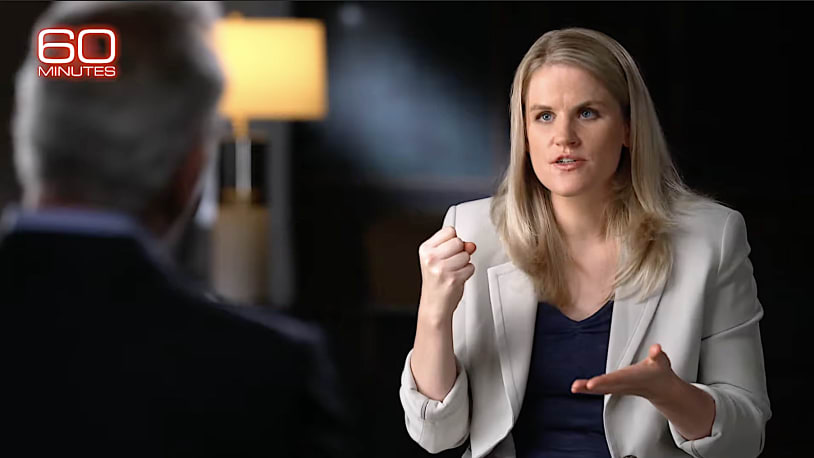
    Last night 60 Minutes scored an interview with Frances Haugen, the Facebook whistleblower behind the document leak that led to last month’s “bombshell” Facebook Files investigation. She shared internal research that confirms what we’ve known all along. Feeding users polarizing content works great at engaging people and converting them into repeat visitors and that the revenue from those engaged users is intoxicating.

    For a humorous TL;DR, check out this 2018 clip from The Daily Show.

    What if Facebook were a Real Place?

    Engagement is a metric used by social networks to measure how often someone uses your app or visits your website. Each service counts an engaged user in different ways, new user or old, daily visitor or monthly, but it all boils down to repeat visits. An engaged user is someone who comes back, repeatedly.

    If your service is ad-supported, repeat visits generate cumulative ad impressions and revenue. If you track your users and personalize your ads, the more engaged a user is, the higher their value to advertisers. It’s the old “eyeballs” metric of Web 1.0 but with higher definition. In the mobile app world, it’s called ARPU, Average Revenue Per User.

    The thing I saw at Facebook over and over again was there were conflicts of interest between what was good for the public and what was good for Facebook. And Facebook, over and over again, chose to optimize for its own interests, like making more money. 

    Whistleblower: Facebook is misleading the public on progress against hate speech, violence, misinformation

    If your company’s “true north” metric is engagement, what happens if you optimize for that and run a business that, above all else, keeps your users coming back and staying longer? If you discover that inflammatory content is the nectar that keeps users coming back aren’t you then measuring the level of a post’s ability to provoke a reaction? This is what I call Enragement Metrics.

    Add the quarterly pressure for a trillion dollar public company to meet and exceed revenue targets and corporate incentives can get distorted. Responsibility is foggy in a large company of distributed teams with a shared ethos of “move fast and break things.”

    The pursuit of engagement and the momentum of a market that rewards it created a Faustian Bargain that distracted the leadership at Facebook from the impact it was having on not only its users but, as a source of traffic and revenue for its publishing partners, the entire media ecosystem.

    “There is a perfect reverse correlation where the angrier you are, the more traffic leaves Facebook and goes to your publishing site.”

    Haugen will testify before Congress where she is hoping they will regulate Facebook because, in her view, Facebook is unable to regulate themselves.

    “Facebook, over and over again, has shown it chooses profit over safety,” she said. Haugen, who will testify before Congress this week, said she hopes that by coming forward the government will put regulations in place to govern the company’s activities.

    Ex-Facebook manager alleges social network fed Capitol riot

    The tech and media world will be watching. As with newspapers, radio, and television, before it, a touch of regulation can build trust and improve a technology and balance the pursuit of profit with the benefit for the public good. But if there is stumbling and uninformed regulation, it will either hobble innovation or, in the worst case, favor those with deep pockets for lobbyists that will lock in their client’s dominance.

    When the Haugen testimony picks up on Tuesday and they haul in someone from Facebook to explain themselves, I hope there is substantive discussion on a way forward and not the brow-beating grandstanding we so often see on Capitol Hill. I optimistically believe that no one at Facebook set out to poison the public well on purpose but that runaway algorithms and market forces drove them there.

    Just as the publication of Silent Spring helped lead to the establishment of the Environmental Protection Agency in 1970, I hope these hearings on the adverse effects of social networks will lead to intelligent discussion of the role these products and the algorithms that power them in our society.

    Environmental and safety regulations give businesses a framework against which to justify expenditures that take away from profits. We need an EPA-like independent organization for social networks and machine learning algorithms to regulate an industry and create best practices and guidelines for what they can and cannot do.

    Social Networks and machine learning algorithms are powerful tools that can stimulate, motivate and transform society. As with all new technology, they can be put to good use or bad. It’s up to all of us, working together to understand their power and harness it for good.


  • Michael Menchaca

    A Cage without Borders

    It was soggy out on Saturday so I took a look my NYC Museums twitter list to see what was going on. Izumi and I settled on visiting the Museum of New York City uptown and with our admission came a free pass to check out El Museo del Barrio which has an exhibit of Latinx contemporary art next door.

    There were many thought-provoking exhibits, you can read about them here or here, but the one that captivated me was Michael Menchacha’s video installation, A Cage Without Borders.

    Image credit: Michael Palma Mir

    From the artist:

    A Cage Without Borders hijacks the commercial appeal of motion graphics on social media platforms in order to critique the US carceral state. This three-channel video installation runs a synchronized HD animation on three TV’s that are vertically oriented, mimicking the visual presentation of mobile devices. This installation addresses the ways in which Big Tech is currently operating as a de facto neo-colonial project enabling racialized state surveillance to oppress the most vulnerable communities.

    Michael Menchacha

    The video (see embed up top) is overwhelming but that is the intent. I dare you to keep up with the commentary while assaulted by glittery animations that scroll by on the screen like a digital slot machine. Little snippets jump out at you and lodge in your brain like morsels of insight, something to chew over and ponder later in your day.

    • State-sanctioned bias bots
    • Your behavior is now their private property
    • The truth does not generate surveillance profits
    • Facebook has created a political whitelist which has exempted over 100,000 officials from fact-checking in order to maximize user engagement
    • A digital caste system
    • Digital re-incarnation
    • Become a digital vegan

    With those thoughts jangling around in our heads, we sought refuge across the street and discovered the Conservatory Garden in Central Park, the perfect digestif to the technological assault we just experienced.

    Another weekend adventure in our new home.

  • China testing Black Mirror episode IRL

    You know that Black Mirror episode about how your social network ranking has a direct impact on your access to an apartment, preferred rates, a spare seat on an airline?

    Nosedive is a chilling tale of a dystopian world connecting the trend lines of the technology evolving all around us. What if your online behavior and relationships had real world consequences? That is in fact what is happening today in China.

    Mara Hvistendahl details in Wired how mobile payments providers are working with the Chinese government to integrate subscriber payment history, connections, and other behaviors are harvested and used to calculate a version of social credit that governs access and mobility.

    The State Council has signaled that under the national social credit system people will be penalized for the crime of spreading online rumors, among other offenses, and that those deemed “seriously untrustworthy” can expect to receive substandard services. Ant Financial appears to be aiming for a society divided along moral lines as well. As Lucy Peng, the company’s chief executive, was quoted as saying in Ant Financial, Zhima Credit “will ensure that the bad people in society don’t have a place to go, while good people can move freely and without obstruction.”

    Inside China’s Vast New Experiment in Social Ranking

    Chilling.

  • Fun with Google Social Search

    Google Social Search is now available in Google Labs. Danny Sullivan has the most in-depth coverage out there but it’s worth turning on yourself because you’re going to be the best judge of how well this feature performs for you.

    Be sure to dig deeper than the default two results Google throws timidly down at the bottom of your search results. Click Show Options and click on the Social category in your sidebar. Check out the results you get for People and you’ll get a feel for the power of this feature.

    You have the full index of Google quickly filtered by names that should be familiar to you. In a stroke of genius, Google has re-labeled this extended network your, “social circle” which a much better label than “friends” (which didn’t sound right) or “social graph” which no one really understood.

    The screenshot above is my aha moment – I had no idea that Caterina ever was in Finland and certainly didn’t know that she took the time to blog about suggestions of things to do in Helsinki. This is a post from 2003 which most certainly have been lost to the sands of time if it were not for this feature which surfaced this gem in just a few clicks.

    And now for a feature request. As you can see, this is a great feature for retrospective searches which makes the foggy past plainly visible.  What about adding an RSS subscribe option so that you could apply these searches to the prospective future?

    It would be great to know when any of my extended social circle also wrote about my adopted hometown. I suppose it would be easy enough to script something but why not build it in?

  • Social Discovery, Social Filtering, and other Web-Squared Shapes

    It’s hard to wrap up a major conference, especially when you didn’t attend, but viewing things from a distance sometimes helps because only the loudest messages make it all the way over.

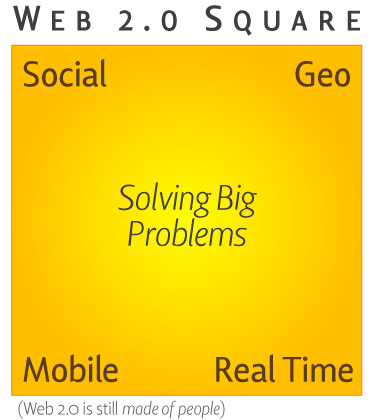
    Before the conference even started, Fred Wilson threw out a one-liner that got people thinking. He called it the Golden Triangle.

    The three current big megatrends in the web/tech sector are mobile, social, and real-time.

    To Fred, the vectors between each of these points on his triangle represented the biggest opportunities over the next few years and where he, as a technology VC, was going to focus his attention.

    Ross Mayfield, his line from the first Web 2.0 conference is still relevant, added Geo to Fred’s Triangle and posted his virtual napkin up on flickr.

    The importance of Geo cannot be ignored as the most obvious (and easiest) way to add context to information which is being harvested and sent our way in increasingly alarming rates. We talk about a world in which there are 1 billion mobile devices. Imagine what happens when each of these gets a camera, gps, and bluetooth sensor and an IP connection to pull in real-time updates. Adds a new dimension to Right Here, Right Now.

    So while HTML Page Indexers of yore were failing at finding us the best Chinese in Helsinki or plumber in London, Social Discovery became the new nectar. Facebook leads to FriendFeed leads to Twitter and now our capacity to consume and process has overloaded. Groups, Hashtags, Lists, Folders, call them what you will but this manual organization of streams is beginning to feel like e-mail folder management all over again. The Googles and Microsofts have added the Twitter firehose to their indexes but somehow I don’t see that as solving the problem unless they can filter on your social connections as well (rumor has it Google Profiles are about to play a much more important role Google Social Search is now live).

    Which brings us to Social Filters.

    Marshall Kirkpatrick has been following this topic for a long time. He bangs the Social Filter drum again in a post about Facebook’s News Feed redesign,

    Someday social networking is going to be like the telephone. Today you can’t send messages from Facebook to people on MySpace or LinkedIn but that isn’t going to last forever. Just as you can call someone who uses T-Mobile from your Sprint phone, someday sharing and messaging between online social networks will be a given.

    How will social networks retain users then? Why stick with Facebook when some smaller service offers a decentralized social networking service outside of Facebook’s control but still tied into your friends on Facebook and elsewhere?

    These services will someday have to compete on user experience, when they no longer have your social connections locked-in. The service that does the best job filtering up the most important information you have coming your way will likely be the service you stick with. That’s going to be a key area of competition between social networks.

    Yes, it’s no longer about who “owns” the social graph – it’s who provides the best services on top of a shared graph. Someone mentioned that Tim Berners Lee said at the conference that AOL was to WWW as Facebook is to distributed social networks. Just as we thought it silly that AOL wanted to put it’s famous wall around the internet, we may also look back in amazement thinking that anyone could have the audacity to think they could own the world’s social address book.

    Some historical perspective from Tim O’Reilly and John Battelle in Web Squared: Web 2.0 Five Years On

    There is a race on right now to own the social graph. But we must ask whether this service is so fundamental that it needs to be open to all.

    It’s easy to forget that only 15 years ago, email was as fragmented as social networking is today, with hundreds of incompatible email systems joined by fragile and congested gateways. One of those systems – internet RFC 822 email – became the gold standard for interchange.

    We expect to see similar standardization in key internet utilities and subsystems. Vendors who are competing with a winner-takes-all mindset would be advised to join together to enable systems built from the best-of-breed data subsystems of cooperating companies.

    Bringing it all together you can almost hear the synapses of the global brain achieve self-awareness. Not only are we moving to a web of sensors feeding real-time data into the grid, we are annotating it by injecting bits of human commentary and behaviors across an increasingly distributed social graph.

    A phone in one corner of the world sends off a snapshot which is immediately re-tweeted via the world’s largest telephone tree. More reasoned minds pick up the samples, turn it over and examine it and later conclude that no, the calculated mass of the balloon could in fact not hold a small boy aloft – rumor refuted! Lesson learned and the network becomes a little smarter, more skeptical, less knee-jerk adolescent. Sentient if you will.

    The pieces are in place, the machines are warmed up. It was fun while it lasted but it’s time to put Failblog aside and see if we can move on to tackle bigger problems. O’Reilly and Battelle wrap up with their call to arms,

    2009 marks a pivot point in the history of the Web. It’s time to leverage the true power of the platform we’ve built. The Web is no longer an industry unto itself – the Web is now the world.

  • Mobile Social Networking “up for grabs” in the United States

    Jason Calcanis has a great post on 10 things the new MySpace CEO should do. All of them are good (buy a search engine, add casual games, virtual currency) but I particularly liked his comment about the wide open space for a successful mobile social network here in the US. Japan is leading the way, the US is just not there yet.

    Let’s face the facts: Facebook is a much better platform on the Web. MySpace has a lot of work to do just to match Facebook’s offering. However, Facebook and MySpace both suck on mobile phones. Translation? Mobile SNS (social networking services) is up for grabs in the United States.

    On my recent trip to Japan, it became very clear to me that the majority of social network activity was occurring on mobile phones–not desktop PCs. No one has built the ultimate iPhone and BlackBerry social networking tools, although some folks are starting to get there. Geolocation tools, combined with the social graph, are the Holy Grail of social networking.

    The full post is here.

  • You Kids Never Had it so Good!

    You Kids Never Had it so Good!

    Getting up to speed here at Nokia after joining three days ago – lots of institutional knowledge tucked away across the intranet which features a bewildering array of internal blogs, wikis, and video archives. One thing I immediately notice is that the average age of people who work here in the Mountain View office is older than that at Yahoo. There’s a historical perspective to what they build which informs what they do so it’s sensitive to regional and generational needs and practices.

    A colleague recently passed around a link to a Wired article that lamented that modern day social networks have killed the ability to “lose touch” with a friend and let them fade into the background. Instead we have to take action and ban, block, or un-friend them which seems a bit rash (especially when services such as Qwitter tell you when someone has un-subscribed). It’s like shouting out to someone, “You’re not my friend!”

    From my perspective, Nokia is very interested in the social impacts of the tools that they build. For instance, on the drive down I was listening to Matt Locke talk about how people have collectively “hacked” social gestures for the introduction of mobile phones into society. The phone booth that we would use to exit a public space to make a phone call evolved into a “hood” structure. With cell phones we used to cup our mouth or duck our head to indicate we were on the phone but now have evolved (?) into talking freely in the clear while sporting a blinking Bluetooth headset. It is still early days with regards to social networks. We haven’t evolved a similar set of shared gestures beyond perhaps the @reply which is really only understood by a tweetist.

    Later I ran across the following passage from Reprise Media’s excellent Search Views blog:

    When I was a kid we had to network socially by punching a random bunch of digits into a keypad, (or twirling a dial with your finger – a dial!) picking up a big clumsy plastic thing attached to a squiggly wire, and speaking into it. If you were lucky your buddy was on the other end. Worse, it was done one person at a time! You kids never had it so good!

    Updating my Facebook profile to reflect my new employer, I notice that I know no one here at Nokia. I have a list of people my manager recommend that I sync up with to soak up the lay of the land – should I use the phone, email or maybe Facebook?

    Further Reading: How Mobility Will Change Social Networking