I wanted to share something which I think is lost on today’s web, the art of the hyperlink. The decision to link to something using the web should be more than just informational. There are the basic points of style such as collapsing the sentence and using the verb as the link to more information
You can find out more about the Roosevelt Island insane asylum.
But using the link to make a point, tell an inside joke you don’t get until you click the link, is a lost art. The masters of the form were the crew behind the late-90s site, suck.com.
The site is no longer online but (now replaced by an embarrassingly childish domain squatter) but I managed to pull down this passage which describes their “tertiary link” policy and what made it so engaging.
HotWired had this crazy policy where they didn’t allow tertiary links, is what they called it. A tertiary link was when you linked to something that wasn’t explicitly referred to in the text. If I said, ‘Proctor & Gamble have a policy against suffocating infants,’ and I linked on ‘suffocating infants’ to the policy page on Proctor & Gamble, and it said, ‘All our products are tested for the risk of infant suffocation, and we have a strict policy,’ that’s a primary link. If I linked ‘suffocating infants’ to Dave Winer’s column, that would be a tertiary link. That was, by policy, not allowed at HotWired.” It was absurd, with a medium so new and unexplored, to establish such rules regarding what was and was not allowed. The lack of established rules was what made the web fun.
Shit makes great fertilizer, but it takes a farmer to turn it into a meal. With that thought in mind, we present Suck, an experiment in provocation, mordant deconstructionism, and buzz-saw journalism. Cathode-addled netsurfers flock to shallow waters—Suck is the dirty syringe, hidden in the sand. You wanted feedback? Cover your ears and watch your back … it wants you too. But Suck is more than a media prank. Much more. At Suck, we abide by the principle which dictates that somebody will always position himself or herself to systematically harvest anything of value in this world for the sake of money, power and/or ego-fulfillment. We aim to be that somebody.
In the absence of HotWired strictures, they turned “tertiary links” into signature stylistic components. “It’s important to understand that up until then, to the best of my knowledge, people had just used hyperlinks in a strictly informational sense, simply as online footnotes,” says Mark Dery, author of Escape Velocity. “With Suck, you wouldn’t get the joke until you punched through on the link. Then you found out that it set the keyword to which this new source was linked in an ironic light.” Writing for Suck, Steadman and Anuff were free to link “suffocating infants” to Dave Winer’s column, or “wet dream” or “negative energy”. “Whereas every other Web site conceived hypertext as a way of augmenting the reading experience,” wrote Steven Johnson in Interface Culture, “Suck saw it as an opportunity to withhold information, to keep the reader at bay.”
San Francisco before the .com boom and my brush with Louis Rossetto and other name drops.
I read Gary Wolf’s Wired, an account of the magazine and it’s founder, Louis Rossetto. The tales within resonate even stronger than most books about this era because I have a personal connection with some of the characters within.
In 1989, just out of UC Berkeley where I had hammered out a 100+ page senior thesis on a typewriter, I felt strongly that it was time for me to jump on the high-tech bandwagon. My roommate at the time had an old IBM XT that he was given after an internship at Wells Fargo and I could see the beginnings of something there that warranted further investigation. I was completely unskilled in computers so I sought out a job where they did things using the object of my interest and begged for any position they would give me.
I’m not sure how I found Reference Software, the small startup at 330 Townsend in San Francisco. I think it was a newspaper advertisement or something posted on the bulletin board (the old cork variety) at the UC career center. At any rate, my future boss, Brian Anthony, was kind enough to let me in as a “Fulfillment Coordinator.” Reference made software that would parse word processing documents for grammatical errors with their product, Grammatik, that came in a bright yellow box (this was a time when software was still copied onto diskettes and shipped in boxes).
Fulfillment was a nice way to say Shipping. I was essentially packing boxes with styrofoam peanuts and slapping UPS 2nd Day Air labels on them to send them on their way to customers. Because we sold software, I got to hang out with the programmers and tech support guys. As a software startup, we were always trading with other companies for copies of their software so I got to play around with games like Cosmic Osmo and an early version of a graphics software package from Boeing that later went on to inspire Harvard Graphics and later inspire the genre that is now dominated by Microsoft Powerpoint.
While at Reference, I rubbed shoulders with several folks who would go on to be major players in the .com boom. We had parties and folks like RU Sirius and Queen Mu who published the Mondo 2000 magazine. I remember seeing Steve Jobs fire up the crowd at a Seybold publishing conference as he promised Apple’s desktop publishing future. Our CEO, Don Emery, had a traditional advertising background. He had a keen sense of what was needed to kick start customer demand for a product no one thought they needed with a clever campaign that ran in the airline inflight magazines. “Read it a Reap” was writ in bold on the top and there was a full page ad with an image of a type-written memo that contained several errors on it. The contest was to identify all of the errors and mail it to Reference for a prize. The errors were clever such as the repetition of a word at the end of one line and the beginning of the next; something a computer would catch but less obvious to the human eye. The campaign was a roaring success as the mailbags of orders had to be wheeled in the door each day. Our VP of Sales at the time was Jeff Mallett who went on to be president and COO of Yahoo when it went public. We would all get together for pizza every Friday and I still remember the time we debated if we should get a fax machine. We finally bought one and an entire roll of fax paper was used up over the weekend, all from new orders.
My job evolved. I became more involved with coordinating with our vendors down in Santa Clara who duplicated our software and the distributors such as Ingram Micro D who shipped it to the national chains such as Egghead. We were working with companies like Cinnamon Software and Logistix who specialized in just-in-time manufacturing. Each week I would poll the ever-optimistic Jeff to see what the numbers were looking like for the following week, cut the figure by 20% and order up pallets of our software that came in it’s trademark sunshine yellow boxes. Our master disks were at the factory as were digital files of our documentation and boxes and could be produced on demand. Production of software in a box was a fine art because you never wanted to be short but, like perishable fruit, you didn’t want to produce too much because if the software went through a rev while it was still on the shelf, that would mean shipping out expensive update disks to each customer. This was that dark and distant past children, before the internet and modems would allow people to get their own updates.
I had fun too. Commuting from Berkeley, I would walk down from the Powell Street BART stop through the SOMA neighborhood which, being a little rough around the edges, always had interesting things lying around in the streets and alley. Because I got to office before anyone else, I was able to sneak this stuff in and would deposit it on someone’s unsuspecting desk. A hubcab, a book of poems, a catalog of machine tools. Those that complained the loudest got the best stuff – a full dashboard from a 70’s Chevrolet and, my proudest find ever, the full body of stand up bass which I bequeathed to Randy who was a totally neat freak and was so beside himself it took him a whole morning to calm down.
I also came up with some creative solutions while at Reference. The office was stocked with Calistoga bottled water but we always had a problem with the empties. We’d fill a bin but no one could ever find the time to take them to the recycling center. I cut a deal with a local homeless guy that I always saw fishing for bottles & cans in the area, telling him to show up at our backdoor at 2pm every Tuesday for a windfall. Problem solved.
But the most interesting part of my job was the chance to take part in a brand new industry that was finding it’s legs around us. Part of my skill at predicting sales figures came from following the competition and reading trades like InfoWorld and CRN. Stacked onto one side of our communal bookshelf was a colorful magazine called Language Technology. This was Louis Rossetto’s hand crafted newsletter that he produced in Amsterdam. The articles were totally out there and slightly highbrow but utterly fascinating. Each issue had in depth discussions about prickly questions such as how to measure computer intelligence (Is it the byte? That base unit of data?) and machine translation (can language be broken down into component parts, cross-referenced, and put back together again without losing meaning?). Rossetto was really good at simplifying the greater significance of these questions and painted just enough of an image that readers of his newsletter could almost grasp the possibility of resolving these age old philosophical problems. I was smitten.
Subscriptions to Language Technology (which later changed its name to Electric Word) cost $450/year if memory serves. I think we got some deal through Don’s publishing connections but I eagerly awaited each issue and let everyone know that I had first dibs when it came in the mail. After a couple of years at Reference, I got restless and wanted to dive deeper into computing. I took a three week holiday and traveled back home to Tokyo to visit my parents. On a whim, I fired off a letter to Rossetto to see if he needed any help from an eager young convert who worshiped his writing and wouldn’t mind relocating to Amsterdam.
While in Japan, I spoke to a few system integrator companies to see if I could get a job setting up and maintaining computers. Being able to read an English manual was an instant advantage and Terrie Lloyd and his fledgling computer supply outfit, Linc Computer extended me an offer which I accepted.
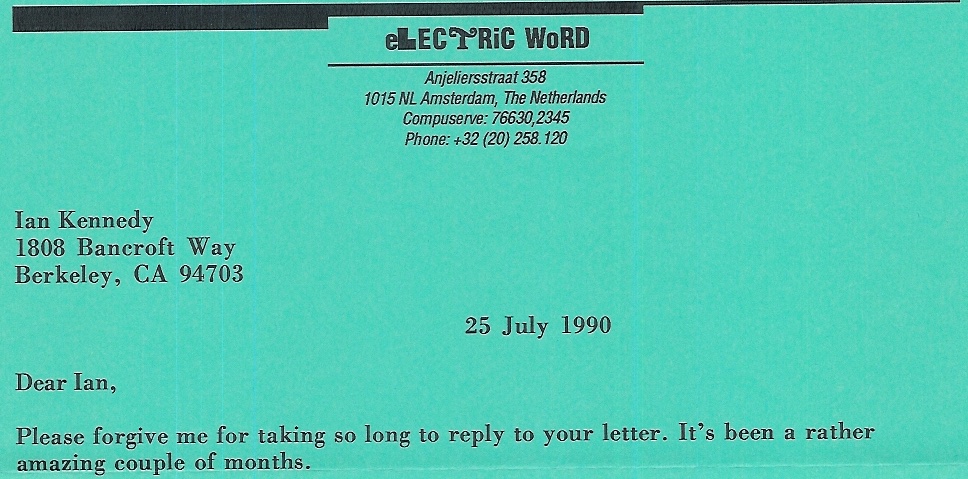
Shouda-Coulda-Woulda. By the time I got this letter, I was already bound for Japan
I still have the letter (click the image above for full size scan) from Louis Rossetto who wrote me back from Amsterdam. It was waiting for me when I came back to SF to pack my bags for Japan. It came in a blue envelope and was printed with a unique but elegant font on green paper. The letter was encouraging in it’s reply – thank you for your interest and support. We’d love to take you on but we’re going through a transition right now but let’s talk because we’re starting a new publication in San Francisco and could use your help. . . that publication went on to become Wired.
Life is full of forks in the road and, like the Frost poem, one can only wonder where the other road might have taken you. There was that time when I was flying cross-country from NYC and happend to sit next to Joey Anuff, who started suck.com while working at Hot Wired and basically defined the snarky style that you see online today. Joey gave me a ride into the city from SFO, turned me on to Tortise and Joey ended up linking to my celebrity sell out site a few days later. These forces are stronger than life itself and sometimes I think my current work situation, back in the Bay Area, working with Andrew Anker, who ran Hot Wired and the inventor of the banner ad business model, is part of some big cycle that I have yet to appreciate. The wheel turns round one more time. Where will we go next?
UPDATE: I now see that someone has kindly taken on a project to scan in back issues of Electric Word and post the pdf files online so you can see some of these issues (complete with advertisements) for yourself.