Tag: work

  • Leaving Yahoo

    Leaving Yahoo

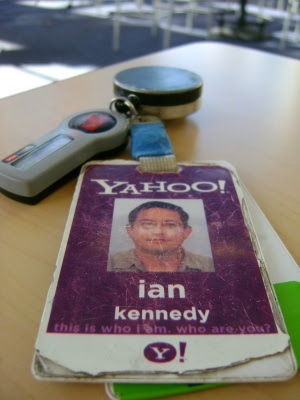
    On Friday I’ll hand over my badge, laptop, and Blackberry, finishing up three years at Yahoo. I’m leaving MyBlogLog in the good hands of Todd Sampson to drive the product vision and manage the engineering team and Tilly McLain who will look over the day-to-day care and feeding of the site and community.

    My self-proclaimed tag line on the internal company directory is turning Yahoo inside out. This has been my personal mission since I joined Yahoo a little over three years ago. There is great stuff to be shared at Yahoo, as long as you let people get to it in a way that’s useful to them.

    I enjoyed working with people who shared my passion to transform Yahoo into to a modern platform. It hasn’t been easy – opening up programmatic access to Yahoo is fraught with many built-in conflicts. Third party content licenses, traffic guarantees, and international legal constraints all make it difficult to let services flow completely free. It’s an industry-wide problem. Much of the way the advertising industry measures the impact of their online campaigns is rooted in the pageview metric which runs counter to providing the best of what you’ve got via an API call. For folks such as ComScore (who help advertisers evaluate rates) an API call doesn’t count as a pageview or roll up into a CPM so it’s a hard to argue letting people get at data without forcing them to come to a pageview to get it.

    But consumer demand on the internet is like a natural force. If you don’t go with the flow, the market will route around until it finds what it needs. As with ripped music files, if you don’t provide your data via an API and figure out how to build a business off of that, folks will scrape your pages or go to your competitor. Yahoo gets this and there are many people working to provide a structured way to get at their data in a sustainable way that can guarantee that they will be able to continue to provide it. Pay a visit to the Yahoo Developer Network site to see what’s there and watch this space as there’s more in the queue.
    With this as a backdrop, I was invited to take my thinking to a new company and a new industry. In a few weeks I’ll be joining Nokia and working to make their devices more socially aware. The Nokia s60, iPhone, Blackberry and Android (rumored) application stores give us developer ecosystems around each device. What will the world be like when devices can communicate with each other via social networks, across device platforms, across mobile carrier networks? Much the same way the web browser has unified communication across Mac & PC, the mobile web will do the same for “broadband-enabled” cell phones. Add GPS (location), Bluetooth (proximity), integrated camera/video and a voice interface and you’ve got a whole new set of opportunities that are just too good to pass up.

    Imagine this use case. Your phone knows your alarm goes off at 6am every morning, that you drive the San Mateo bridge every weekday on your way to work at around 7:30am. It’s entirely possible for your phone to automatically check traffic conditions before you leave sometime after you awake and let you know that there is heavier than normal traffic and suggest an alternate route and read it out to you in a phone call, while you drive. If you’ve got your calendar in there, there is no reason that your phone can’t offer to call ahead and let the people in your first meeting know that you’re running late. All the pieces are in place to make this happen, automatically, right on your device. That’s the kind of service that will enhance your life, that’s the kind of service suite I’m excited to build.

    Thank you to everyone who lent an ear to my crazy talk in the early days and pointed me to others who would listen and helped me build a band of believers. A nowhere near complete list of shout outs include:

    Craig Forman, Scott Gatz, and Don Loeb who brought me in and set me lose on management to get the wheels rolling.

    Toby Coppel, Gerry Horkin, Dave Vockell, Gil Ben-Artzy, and David Katz, who took me under their wing in Corporate Development and helped me refine my message into bite-sized Powerpoint presentations and introduced me to the Harvey Ball.

    Sumit Chachra, Aaron Stein, Josh Rangsikitpho, John Lindal, Josh Blatt, Cody Simms and others who fought the good fight down in Burbank.

    Chad Dickerson, Jeremy Zawodny, Steve Spencer, Jonathan Strauss, Bradley Horowitz, Jeffery McManus, and Robi Ganguly who encouraged hackery and other inspirational corporate trickery.

    Thank you especially Todd Sampson, Eric Marcoullier, John Sampson, Steve Ho, Chris Goffinet, Saurabh Sahni, Mani Kumar, Manny Miller, Tilly McLain, Robyn Tippins, Raymund Ramos, Micah Laaker, JR Conlin, Greg Cohn, Havi Hoffman, Cameron Marlow, Matt McAllister, Kent Brewster, Ryan Kennedy, Sam Pullara and all the other MyBlogLog faithful who encouraged or help me build some of the things I was talking about – we released some cool stuff which really pushed the edge and continue to lead the way.

    Finally, thank you to my kids who taught me to look at social networks in a new light and and my wife who kept the family ticking and the home fires burning through it all.

    For those interested in peering into a subset of what inspires me, here’s a sample of my OPML file. Keep up the good work Marshall, Louis, and Mark.

    I’m going to take a week off to re-charge before the new gig kicks off at the Nokia offices in Mountain View. I’m looking forward to working with one of the original Yahoo bloggers, Russell Beattie. It’s been awhile since I’ve been a regular in the South Bay so if you’re interested in getting together, drop me a line.

  • Ambition

    takeover.jpg

    “Oh, and one more thing just before I head home today”

    This note was spotted on one of the MyBlogLog engineer’s desks. Not too ambitious is he? I like the fact that it’s on a Post-It, just a reminder in case you forgot!

  • The Walk to School

    Over on the work blog I’ve posted about switching jobs to work at Yahoo. I’ll be starting next week so I’m spending this week clearing the decks and getting ready. Tyler’s bummed because I will not be able to walk him to school anymore and it’s been the time of day when we get to talk about things mano-a-mano. Today, I took some pictures of what we see each day during our 10 minute walk.

  • 15 minutes of fame

    While I was in Japan last week, the Oakland Tribune ran a story about corporations getting into blogging. The angle they took was not quite the one I would have stressed (the first step into the blogging world can sometimes be a doozy) but it’s nice to see business blogs getting some coverage in the popular media. The author, incidently, was the same person that interviewed Mie a year ago about her moblog.

  • Back in the Day

    Back in the Day

    San Francisco before the .com boom and my brush with Louis Rossetto and other name drops.

    I read Gary Wolf’s Wired, an account of the magazine and it’s founder, Louis Rossetto. The tales within resonate even stronger than most books about this era because I have a personal connection with some of the characters within.

    In 1989, just out of UC Berkeley where I had hammered out a 100+ page senior thesis on a typewriter, I felt strongly that it was time for me to jump on the high-tech bandwagon. My roommate at the time had an old IBM XT that he was given after an internship at Wells Fargo and I could see the beginnings of something there that warranted further investigation. I was completely unskilled in computers so I sought out a job where they did things using the object of my interest and begged for any position they would give me.

    I’m not sure how I found Reference Software, the small startup at 330 Townsend in San Francisco. I think it was a newspaper advertisement or something posted on the bulletin board (the old cork variety) at the UC career center. At any rate, my future boss, Brian Anthony, was kind enough to let me in as a “Fulfillment Coordinator.” Reference made software that would parse word processing documents for grammatical errors with their product, Grammatik, that came in a bright yellow box (this was a time when software was still copied onto diskettes and shipped in boxes).

    Fulfillment was a nice way to say Shipping. I was essentially packing boxes with styrofoam peanuts and slapping UPS 2nd Day Air labels on them to send them on their way to customers. Because we sold software, I got to hang out with the programmers and tech support guys. As a software startup, we were always trading with other companies for copies of their software so I got to play around with games like Cosmic Osmo and an early version of a graphics software package from Boeing that later went on to inspire Harvard Graphics and later inspire the genre that is now dominated by Microsoft Powerpoint.

    While at Reference, I rubbed shoulders with several folks who would go on to be major players in the .com boom. We had parties and folks like RU Sirius and Queen Mu who published the Mondo 2000 magazine. I remember seeing Steve Jobs fire up the crowd at a Seybold publishing conference as he promised Apple’s desktop publishing future. Our CEO, Don Emery, had  a traditional advertising background. He had a keen sense of what was needed to kick start customer demand for a product no one thought they needed with a clever campaign that ran in the airline inflight magazines. “Read it a Reap” was writ in bold on the top and there was a full page ad with an image of a type-written memo that contained several errors on it. The contest was to identify all of the errors and mail it to Reference for a prize. The errors were clever such as the repetition of a word at the end of one line and the beginning of the next; something a computer would catch but less obvious to the human eye. The campaign was a roaring success as the mailbags of orders had to be wheeled in the door each day. Our VP of Sales at the time was Jeff Mallett who went on to be president and COO of Yahoo when it went public. We would all get together for pizza every Friday and I still remember the time we debated if we should get a fax machine. We finally bought one and an entire roll of fax paper was used up over the weekend, all from new orders.

    My job evolved. I became more involved with coordinating with our vendors down in Santa Clara who duplicated our software and the distributors such as Ingram Micro D who shipped it to the national chains such as Egghead. We were working with companies like Cinnamon Software and Logistix who specialized in just-in-time manufacturing. Each week I would poll the ever-optimistic Jeff to see what the numbers were looking like for the following week, cut the figure by 20% and order up pallets of our software that came in it’s trademark sunshine yellow boxes. Our master disks were at the factory as were digital files of our documentation and boxes and could be produced on demand. Production of software in a box was a fine art because you never wanted to be short but, like perishable fruit, you didn’t want to produce too much because if the software went through a rev while it was still on the shelf, that would mean shipping out expensive update disks to each customer. This was that dark and distant past children, before the internet and modems would allow people to get their own updates.

    I had fun too. Commuting from Berkeley, I would walk down from the Powell Street BART stop through the SOMA neighborhood which, being a little rough around the edges, always had interesting things lying around in the streets and alley. Because I got to office before anyone else, I was able to sneak this stuff in and would deposit it on someone’s unsuspecting desk. A hubcab, a book of poems, a catalog of machine tools. Those that complained the loudest got the best stuff – a full dashboard from a 70’s Chevrolet and, my proudest find ever, the full body of stand up bass which I bequeathed to Randy who was a totally neat freak and was so beside himself it took him a whole morning to calm down.

    I also came up with some creative solutions while at Reference. The office was stocked with Calistoga bottled water but we always had a problem with the empties. We’d fill a bin but no one could ever find the time to take them to the recycling center. I cut a deal with a local homeless guy that I always saw fishing for bottles & cans in the area, telling him to show up at our backdoor at 2pm every Tuesday for a windfall. Problem solved.

    But the most interesting part of my job was the chance to take part in a brand new industry that was finding it’s legs around us. Part of my skill at predicting sales figures came from following the competition and reading trades like InfoWorld and CRN. Stacked onto one side of our communal bookshelf was a colorful magazine called Language Technology. This was Louis Rossetto’s hand crafted newsletter that he produced in Amsterdam. The articles were totally out there and slightly highbrow but utterly fascinating. Each issue had in depth discussions about prickly questions such as how to measure computer intelligence (Is it the byte? That base unit of data?) and machine translation (can language be broken down into component parts, cross-referenced, and put back together again without losing meaning?). Rossetto was really good at simplifying the greater significance of these questions and painted just enough of an image that readers of his newsletter could almost grasp the possibility of resolving these age old philosophical problems. I was smitten.

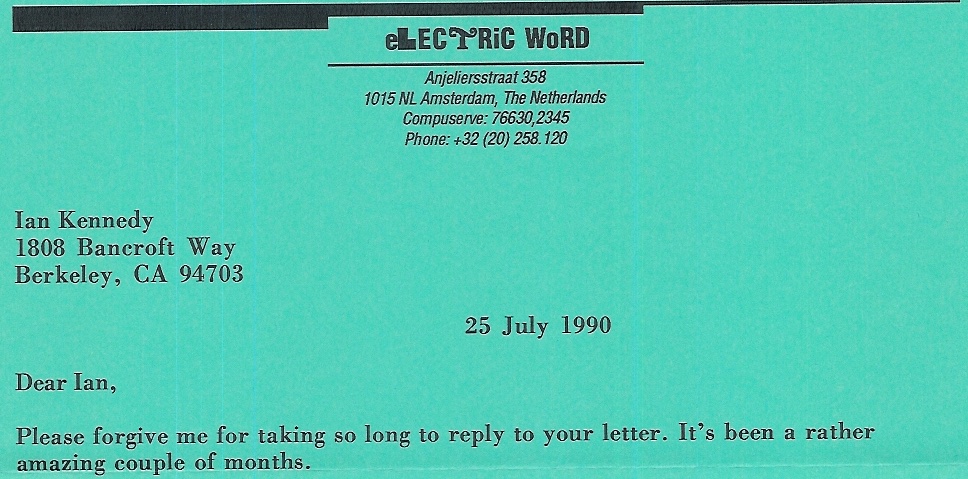
    Subscriptions to Language Technology (which later changed its name to Electric Word) cost $450/year if memory serves. I think we got some deal through Don’s publishing connections but I eagerly awaited each issue and let everyone know that I had first dibs when it came in the mail. After a couple of years at Reference, I got restless and wanted to dive deeper into computing. I took a three week holiday and traveled back home to Tokyo to visit my parents. On a whim, I fired off a letter to Rossetto to see if he needed any help from an eager young convert who worshiped his writing and wouldn’t mind relocating to Amsterdam.

    While in Japan, I spoke to a few system integrator companies to see if I could get a job setting up and maintaining computers. Being able to read an English manual was an instant advantage and Terrie Lloyd and his fledgling computer supply outfit, Linc Computer extended me an offer which I accepted.

    Shouda-Coulda-Woulda.
    By the time I got this letter, I was already bound for Japan

    I still have the letter (click the image above for full size scan) from Louis Rossetto who wrote me back from Amsterdam.  It was waiting for me when I came back to SF to pack my bags for Japan. It came in a blue envelope and was printed with a unique but elegant font on green paper. The letter was encouraging in it’s reply – thank you for your interest and support. We’d love to take you on but we’re going through a transition right now but let’s talk because we’re starting a new publication in San Francisco and could use your help. . . that publication went on to become Wired.

    Life is full of forks in the road and, like the Frost poem, one can only wonder where the other road might have taken you. There was that time when I was flying cross-country from NYC and happend to sit next to Joey Anuff, who started suck.com while working at Hot Wired and basically defined the snarky style that you see online today. Joey gave me a ride into the city from SFO, turned me on to Tortise and Joey ended up linking to my celebrity sell out site a few days later. These forces are stronger than life itself and sometimes I think my current work situation, back in the Bay Area, working with Andrew Anker, who ran Hot Wired and the inventor of the banner ad business model, is part of some big cycle that I have yet to appreciate. The wheel turns round one more time. Where will we go next?

    UPDATE: I now see that someone has kindly taken on a project to scan in back issues of Electric Word and post the pdf files online so you can see some of these issues (complete with advertisements) for yourself.

  • Pictures of the office

    Thanks to another Kennedy (not related) you can see where Mie & I work.

  • Commuting Choices

    At long last our offices are now up in San Francisco so I am no longer taking the automobile down the freeway to work each day. Now the choices of how to get to the office abound:

    1. The bus can take me from Alameda to the Transbay bus terminal. There is a stop about five blocks from my house for the morning and the return lets me off just three blocks from home. On the San Francisco end, it’s a good 15 minute walk to the office through a dreary (in the rain at least) fringes of the warehouse district. There are three different bus routes to choose from, including a fancy coach-like bus (The “OX” Express) that has cushy seats and nice lighting.

    Cost? $3/each way, $100/month if you buy a monthly pass.

    Pros? Can drop Tyler off at school on the way to the bus stop if we motivate early enough. It’ll be nice to walk with him to school each morning when the weather gets better.

    Cons? The folks that ride the bus seem a bit ground down – usually clutching crumpled up and slightly damp newspapers. With fogged up glasses and overstuffed shoulder bags, these are the worker bees.

    2. There are two ferries, one from the West End of the Island and the other over in Harbor Bay. I’ve only taken the Harbor Bay but it certainly is a treat. A 15-minute bike ride along a bike trail (no traffic lights, beautiful views of the bay) takes you to the ferry dock where boats leave on the half-hour. The riders are definitely the movers and shakers, overheard conversations are of family vacations in the tropics and visits to ivy league alumni events.

    Cost? Pricy at $5.50/each way, includes a “gasoline surcharge”, $150 if you buy a monthly pass.

    Pros? If you absolutely must ignore the views, they have wireless. They sell coffee in the morning and beers at the bar for the ride home.

    Cons? There’s a sign up for an emergency email list which indicates to me that this service is not totally reliable. At $150/month you’re talking about a $1800/year commitment.

    3. I could still take a car to work and most likely will on days when I have to drive somewhere later in the day. It’s a real grind but do-able if you go either *real* early or after 9 am. Trouble with going after 9 am is that all the good city parking spots are gone so you end up paying for it on the other end. Going home is a drag too b/c of the traffic on the bridge, bring good music for the radio!

    Cost? $3 going into the city on the tolls or you can go free in the carpool lane if you pick up 2 riders on the way over. Parking is the kicker – some places advertise an “early bird special” of $8/day but you need to get there fast. Usually it’s more like $10 – $15.

  • Field Trip

    Field Trip

    Today everyone in the office loaded up into a bus and headed up to San Francisco to see our new office into which we’re moving in January. Everyone was in high spirits, the offices in San Mateo are fine but the area has absolutely no character and the commute has been wearing thin for most of us who all live up in the city or East Bay.

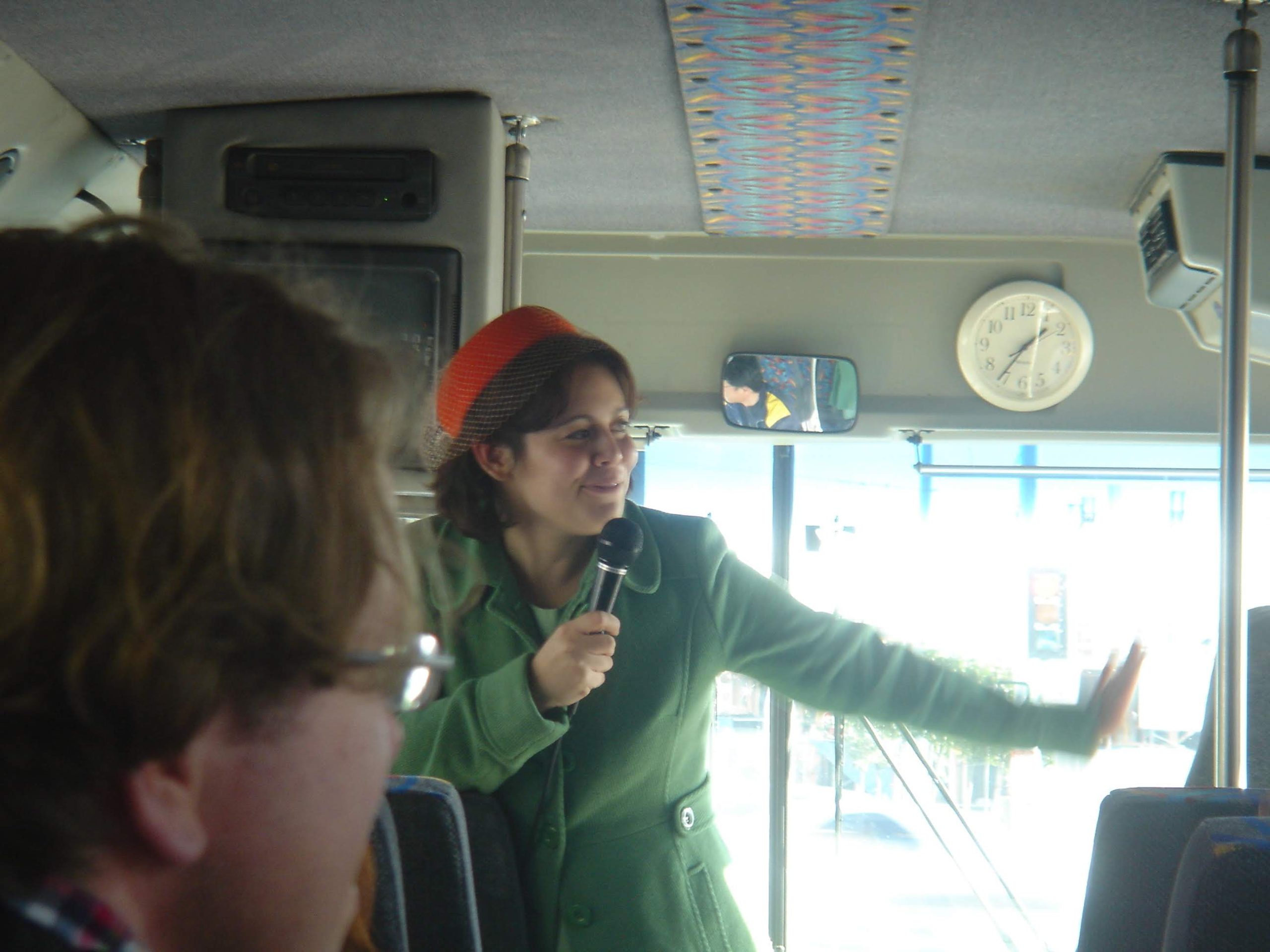
    We have all hands meetings every Friday but for today’s meeting we were in our new office and gathered around a conference table to hold our usual meeting, albeit, in our new space. After the normal status updates, we got a little giddy and our Mena hammed it up on the way back acting as a tour guide for us all, pointing out Candlestick Park, the It’s It factory, and other attractions.