Category: Current Events

  • Polaroid-o-nizer – creating an online version of a classic offline medium

    All sorts of fun this week with image manipulation. The Image-Rich Blogroll got a fair bit of play but there was some grumbling on that it was too manual. Yes, it would be good to automate this stuff I dream up – that’s a project for a rainy day.

    Next on the agenda of cool web services that could be used in interesting ways is B3ta’s Polaroid-o-nizer service. Point it to any image file URL, type in some text and then hit the “Onize” button and they’ll generate a realistic looking Polaroid of the image.

    There’s even a check box if you want to upload the image to Imageshack to have them host your image for you.

    So if earlier this week the project was a graphical representation of your blogroll, how about using Polaroid-o-nizer to become your annotated feed of images you come across on the web?

    – found while reading Pacific IT

  • Undocumented “spouse-finder” feature in Facebook

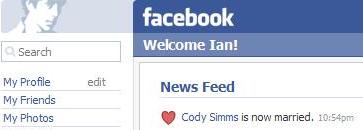
    With all the hoohah over Facebook’s mini-feed feature, one new service was exposed that I didn’t see in the documentation anywhere. Rather than setting up a simple match-making service, the folks at Facebook have pushed the envelope with their online, add-a-spouse feature.

    I was about to send off a hearty congratulations to my colleague when I realized that it was an odd hour to hitch up (unless you’re in Vegas) and that this strange, out of context blip on my social news channel was more likely the result of Cody beginning to fiddle with his newly minted profile.

    Intrigued, I decided that I too would like to announce my marriage of eight years in the dark of night just for a laugh. I set out to edit my profile and look for the section where one might identify one’s marital state. There it was, on the under the basic tab, “Married to. . . ” The ellipses drifting off in the distance, just waiting for you to type your spouse’s name. Yet, instead of taking a random string and saying, “Thank you, and good day,” Facebook assumes that your bride, is also on Facebook and that that what you really want to do is find her profile and link to it. So instead of being able to identify my wife’s name and introduce her to my budding community – I’m shunted off to a list of ladies also named Izumi that I might like to, and this is really one of the great moments in interface design, “Add as Spouse”

    I have no doubt Facebook is a great place to meet people but there’s something unsettling about seeing a list of 79 alternative wives that can be “added” with the click of the mouse. I haven’t had the nerve to actually click on any of these links for fear of what would happen at the other end. Would the alternative Izumi get a coldly worded confirmation notice from me asking a few terse questions about how we hooked up and to indeed confirm that we are joined ’til death do us part? Does it send flowers?

    Clearly this is just a glitch in their UI desgin where another feature just got ported over without really thinking about the impact but it does point to another thing that has been bugging me about Facebook, it’s all about feeding stuff in but never letting it out. The ability to add an RSS feed to your profile is a cool trick. I don’t actually hang out in Facebook too often so this is a way to let my off-network vitality drive my Facebook profile. Funny thing is, none of the links drive back to my site which is spawning all this activity! From Facebook’s perspective, it’s all about keeping users tied into a self-referential experience on the Facebook servers.

    This, keep ’em on our servers, perspective is why I’m given a list of Izumi’s to marry from Facebook’s community. It’s about “user lock-in” – a term I’ve come to loath. Heck, I’m given more freedom when I choose my interests on my profile! Here I’m given a blank, white box in which to enter books and music I like – here I could have actually *used* some direction as to what other people are calling things they call “interests.” I just realized, upon review, that identifying “kids” as one of my interests could probably be interpreted differently. A little direction here as to the best way to say you spend a lot of your time hanging out with your offspring would have been welcome a couple of months ago when I set things up. Hope I’m not on any kind of watch list anywhere.

    Ok – keep the, “hey old-timer” comments to a minimum. These UI bugs are still whacked and they’re going to need to get these straight before opening up to the general public which does include people that are married with kids.

    Come on Facebook – you can do better than this!

  • Sony Mylo


    Forgive the commercial break – Sony Mylo is pretty cool though – just testing video embedding on a post.

  • 1K Project

    The 1K Project overlays 1,000 replays from the PC game Trackmania and composites them into a single video. A lesson in automotive physics and combustion driven liquid dynamics. No one knows who made this video or where it came from.

  • Legalese down your throat

    As someone who played around with Google Video shortly after launch I got an email last night letting me know that Google will start running advertisements on selected content. At the end of the email it asks you to login to agree to a new Terms of Service. Is it just me or does this line sound strange?

    If you don’t agree to the new TOS, we will assume you acknowledge and accept these changes, and will include your content in Google Video, as it is today.

    I would have thought that legally, they need to assume that not reviewing a revised TOS means defaults to not agreeing and opting you out. What if I was hiking Kilimanjaro and just didn’t have a chance to check my email?

  • The Power of the Web

    TechCrunch covers teambuy.com.cn, a “group buying” site based in China,

    co-ordinate large numbers of consumers interested in buying the same products. People agree on a place and time to meet, then enter the store in crowds of up to 500 people at once. The crowds tell the store owners that they all want to buy, say a TV or a stereo, but everyone wants 10 to 30% off the retail price.

    I remember Stewart Brand writing about this concept being applied to groups of people interested in buying the same model car in his book about the MIT Media Lab.  

  • Media Consumption in Middle America. TV still king but web not far behind.


    I attended the presentation of the Online Publisher’s Association latest research report on media consumption at the Four Seasons in San Francisco this morning. Details on the report can be found within the OPA press release. The research was interesting in that it was unlike most reports which (a) are limited to what participants report in and, (b) usually are limited to a single media type such as web (ComScore) or TV (Neilsen) and rarely multiple types.


    In this study, conducted by the Ball State Center for Media Design was observational. What this means is that researchers sat with 350 subjects for, on average, 13 hours a day tracking with a PalmOS powered handheld, every 15 seconds, what their subjects were looking at. Yes, every – 15 – seconds.


    Some highlights:


    Cross media study surfaced concurrent media use and how online & offline media compliment each other.


    TV still rules in terms of reach (90%) and duration (300 minutes) but there is a large variation in duration across age groups with young males spending the least amount of time on TV.

    If you look at reach over the day – TV rules the evening but throughout the day, the web is only 15% behind TV in reach and less than half the amount of time.

    It’s come a long way though, used to be less than an hour/day in 1995 (remember, this is before flat rate internet access)


    16% of all web use occurs while watching TV.

    4% of all web use is immediately before or after TV viewing.


    Combining the web with TV or print media ads significantly to an advertiser’s reach. Imagine the impact of an integrated campaign that runs a spot on the Lost TV show and then, runs sponsership across the thelostexperience.com web site.


    Web has an at-work presence that exceeds all other media (not many people get to watch TV at work) but radio is a surprising second. I guess if you’re an auto mechanic in Muncie, IN, then yeah, radio would make sense.


    Online drives offline and offline drives online. One of these days I’m going to count the number of times my local NBC affiliate news program says, “for more information on this, go to our website”


    Offline media brands bring consumers online. The qualitative research videos mention The New York Times, USA Today, Sports Illustrated as the sites that cause people to go to their computers in the first place. No one said they went online specifically to watch YouTube, etc. I would imagine this would be different if they were covering those under 18 which were not part of this study.


    Best Question of the presentation was from someone questioning if the researchers impacted their subject’s viewing habits in any way. Having someone with a clipboard peering over your shoulder and tapping something into a palm pilot every 15 seconds is bound to have some impact after all.


    Dr. Michael Holmes, the coordinator of the research project, said that their figures are within just a few percentage points of other research findings so they feel they are accurate. While Dr. Holmes did confirm that the good people of Muncie, Indiana are good, clean folk, he did think it odd that in over 6,000 hours of data there was not a single observation of pornography media. That’s for another study I guess.


    UPDATE: OPA posted the slides from their presentation.