Category: Work

  • What I learned at ad:tech

    What I learned at ad:tech

    What a difference a year makes! Last year is seemed as if blogs were only given a polite nod and tolerated as something vaguely interesting but mostly for the geek fringe. The majority of the attention was given over to the SEO black arts. This year blogs are a given while the social media darlings of YouTube & MySpace are the focus of everyone’s attention.

    Worth the price of admission alone was one of the panelists (I think it was Dave Evans of Digital Voodoo) who defined Social Media as, “communication and media that doesn’t require interruption.” That is so true! Successful advertising in social media is not a pop-up ad for an irrelevant product – it cannot get in the way of what I want to do or who I want to reach. Successful integration of a brand into social media is going to facilitate the conversation. It’s going to be that funny clip that I can use to reach out to someone, it’s going to be images that I want to associate with by adding them onto my blog sidebar, it’s going to be a service that allows me to connect or communicate in a way that I couldn’t before.

    Other notables:

    Garrick Schmitt from avenue a/razorfish said that, “the tag cloud will become the mullet of web 2.0.”

    This was funny because I ran into the father of the term “folksonomy” a couple of days earlier and he was going off on how tag clouds are overrated (he’s now posted about it).

    Shawn Gold from MySpace on perspective, “To us, the refrigerator is the refrigerator. To our grandparents it was technology.”

    It may seem strange to call MySpace a messaging platform but that is exactly how it’s being used. I heard of one music promoter who has so many friend requests that he has hired someone to manage his profile for him. This doesn’t sound so strange if you think that people hire others to answer & screen phone calls as well. I also met someone who has a 500 friend profile and he was asked if he would sell his profile. This did seem odd to me – I never thought I’d see a social network commoditized as if it was a World of Warcraft character being sold on e-Bay.

    Shocking stat of the show: World of Warcraft has 5 million users as of Sept. 2005 and currently something north of 6 million today. The typical user plays 27 hours/week and most of these users will stay on the platform for over two years.

    Cool mobile app: Mobot – turn your camera phone into an image recognition device. I saw a demo where a guy took a picture of a Coke can and it recognized the logo and went to a special landing page on the phone’s browser.

  • Video editing fun with Remixer

    ss_main.jpg

    Check out the latest out of Yahoo Research Labs. Save & edit your favorite clips from the SF International Film Festival, re-arrange, lay down a soundtrack and share.

    . . . developed in collaboration with Yahoo! Research Berkeley and the Institute for Next Generation Internet at San Francisco State University. Besides the online gallery, a selection of the best remixes will screen at Edinburgh Castle.

    I really look forward to coming back and seeing what people put together. Totally amazing! Remixer.

  • TechCrunch on Mapping Services – Yahoo “by far the best”

    Ok, a little shameless high-fiving all around for the folks behind Yahoo Maps. Here’s Frank Gruber on TechCrunch after comparing Ask, Google, Mapquest, Windows Live, and Yahoo:

    Its fast Flash interface, multipoint directions, live traffic information, and easy send-to-mobile feature make it the hands down winner. It also features the most robust API options.

    Check us out at maps.yahoo.com/beta

  • Using Sprint’s Power Vision Network

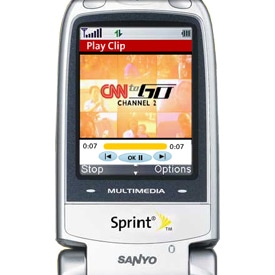
    A couple of months ago, Sprint graciously given me a Power Vision-enabled phone to use gratis as part of their Ambassador Program. I’ve been generally pleased with the service and showing streaming video on your cell phone makes for a neat demo when the conversation in the room turns to the mobile internet.

    Sprint Power Vision

    A few weeks ago, Sprint sent the Ambassadors (I wonder how many of use there are out there?) an email reminding them that they can use the USB cable that came with their phone to connect to a laptop and experience broadband speeds over wireless. I downloaded their software which essentially acts as a broadband modem for your laptop.

    Sprint announced today that they are significantly upgrading the capacity of this network. They’re calling this new rollout “EV-DO Revision A” which is an upgrade to the current “Revision O” network. You can ask Sprint how they do their alphabet.

    With Revision A technology, peak download data rates increase to 3.1 Mbps (from 2.0) and peak upload data rates increase to 1.8 Mbps (from 144 kbps). Average download speeds improve to 450-800 kbps (from 400 -700) and average uplink speeds become 300 – 400 kpbs (versus 70 – 144 kpbs). The faster data rates can enable richer applications and services such as high-speed video telephony, music on demand, video messaging, large file uploads and high performance push-to-talk capability.

    From the press release:

    Goody. I promptly connected via my Sprint phone and hit dslreports.com/tools to check out my speed as well as what others are reporting.

    It was not quite what they promised but hopefully the upgrade will take care of that. Although I really don’t have a need for wireless broadband (Yahoo’s on campus wifi is great and I’ve rigged up wifi at home), the install was dead-easy and I can think of a couple instances where broadband wifi would be a godsend:

    1. Field sales, consultants, or repair staff.
    2. Anyone attending a conference. Everyone at eTech complained about the wifi and one session would have been a wash had not Jason Calcacanis not volunteered his wireless broadband.
    3. Anyone with a long commute on a train.
    4. Anyone living within New Orleans needing to communicate to the rest of the world.
  • Google Analytics has overlays

    Google Analytics has overlays

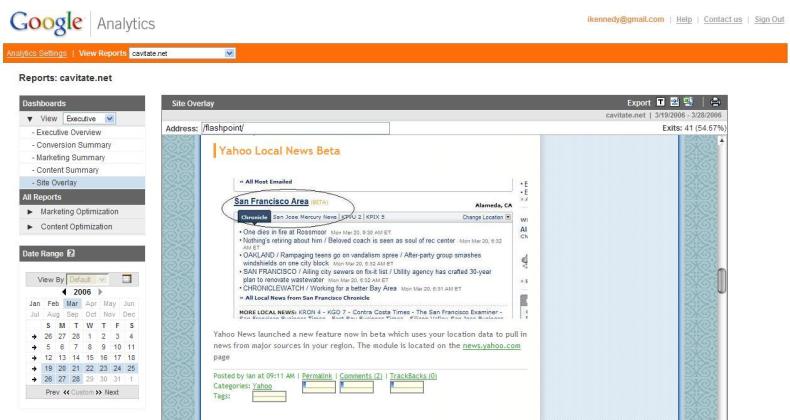
    I was playing around with Google Analytics today and noticed that they slipped in a new feature which is pretty cool. Each link on your page has an overlay on it which, with a little relative progress bar, shows the frequency of clicks. Nice way to visualize how effective your links are if URLs don’t mean anything to you.

  • Stump Tom Cruise

    So there was quite a bit of hoopla when Mr. Cruise flew into town on his P-51 to pay us a visit. We got to see exclusive clips of the upcoming Mission Impossible 3 and Terry Semel announced that there would be more collaborations with the actor in the future.

    Today, Yahoo Answers has an open question where anyone can try and stump Tom Cruise with a trivia question about any of his movies. Check it out. Can you stump me in one of my own movies?

  • Job Requirement : Level 60 World of Warcraft Guildmaster

    By John Seely Brown and Douglas Thomas write in Wired that contrary to popular perception, multi-player online games are a good training ground for junior management.

    . . . the process of becoming an effective World of Warcraft guild master amounts to a total-immersion course in leadership. A guild is a collection of players who come together to share knowledge, resources, and manpower. To run a large one, a guild master must be adept at many skills: attracting, evaluating, and recruiting new members; creating apprenticeship programs; orchestrating group strategy; and adjudicating disputes. Guilds routinely splinter over petty squabbles and other basic failures of management; the master must resolve them without losing valuable members, who can easily quit and join a rival guild. Never mind the virtual surroundings; these conditions provide real-world training a manager can apply directly in the workplace.

    – from You Play World of Warcraft? You’re Hired!

    They write about Stephen Gillett who was hired by Yahoo as a Senior Director of Engineering.

    Joi Ito, who’s gone deep into World of Warcraft, talks about how he gets together with VCs to talk shop much like business folk from the previous century (I love saying that) would do deals over a round of golf.

    What’s next? Books in the business section titled, How to Level Up Your Character and Influence People.

  • Is it cool to be accessible?

    Two posts that came together on the same riff but from different angles. Do communities scale?

    First Danah Boyd on “coolness”

    “Coolness” is about structural barriers, about the lack of universal accessibility or parsability. Structural hurdles mean people put in more effort to participate. It’s kinda like the adventure of tracking down the right parking lot to get the bus to go to the rave. The effort matters. Sure, it weeds some people out, but it makes those who participate feel all the more validated. Finding the easter egg, the cool little feature that no one knows about is exciting. Learning all of the nooks and crannies in a complex system is exhilarating. Figuring out how to hack things, having the “inside knowledge” is fabu.

    – from Friendster lost steam. Is MySpace just a fad?

    Then today I read Seth Godin on “authenticity”

    Here’s the problem: The moment you take your special, authentic, limited-edition product and leverage it, make it widely available and normal, the very people who loved it inevitably rebel. “Starbucks isn’t what it used to be,” they tell you. The tastemakers who made you successful in the first place turn on their heels when they smell that you’re not authentic anymore.

    When a product is everywhere, when it’s hyped in the media and advertised on the sides of buses, sometimes it seems as if the product exists and succeeds because it is everywhere. Before ubiquity, when it seemed as if the product (or its creator) wasn’t in it just for the money, somehow that felt more real, more wonderful, more authentic.

    – from Tom Chappell sell out

    It’s a trick to get this balance right. The quote from Seth was spurred by the news that Tom of Tom’s of Maine toothpaste sold to Colgate for $100 million. News that struck a similar chord are last week’s announcement that L’Oreal bought the Body Shop for over $1 billion, Six Apart’s acquisition of LiveJournal, and the buyout of Ben & Jerry’s ice cream by Unilever back in 2000.

    In each case, the story was painted as a faceless corporation trying to usurp the community built up around a product to serve it’s short term commercial objectives. Yahoo has sailed through these rough waters as well when it acquired flickr, upcoming, and delicious. The point often missed in the hysteria is there is absolutely no benefit to a large company coming in and sucking the life out of a young and vibrant community. Why bother to set aside capital for an acquisition only to quash it and rob it of it’s value?

    I think Yahoo has shown that it can take a community such as flickr and give it a good home (servers, bandwidth, and other resources) and also learn from that community and internalize the best things about it (tags, open apis, ui design).

    There’s lots of talk about scaling an application to serve a larger audience. The one sold out session at the recent eTech conference was Flickr developer Cal Henderson’s tutorial, “Scaling Fast and Cheap – How we built Flickr” One thing that is not discussed as often is the other side of growing which is scaling the community. What are some of the best practices around taking a small, home grown community and scaling it out to serve millions?

    The posts above identify the problem. Are there any examples of successful communities that have managed to retain their “coolness” and “authenticity” while at the same time becoming “universally accessible” and “ubiquitous” or are the two mutually exclusive? Religion comes to mind – are there others?

  • Yahoo Local News Beta

    local.JPG

    Yahoo News launched a new feature now in beta which uses your location data to pull in news from major sources in your region. The module is located on the news.yahoo.com page