San Francisco before the .com boom and my brush with Louis Rossetto and other name drops.
I read Gary Wolf’s Wired, an account of the magazine and it’s founder, Louis Rossetto. The tales within resonate even stronger than most books about this era because I have a personal connection with some of the characters within.
In 1989, just out of UC Berkeley where I had hammered out a 100+ page senior thesis on a typewriter, I felt strongly that it was time for me to jump on the high-tech bandwagon. My roommate at the time had an old IBM XT that he was given after an internship at Wells Fargo and I could see the beginnings of something there that warranted further investigation. I was completely unskilled in computers so I sought out a job where they did things using the object of my interest and begged for any position they would give me.
I’m not sure how I found Reference Software, the small startup at 330 Townsend in San Francisco. I think it was a newspaper advertisement or something posted on the bulletin board (the old cork variety) at the UC career center. At any rate, my future boss, Brian Anthony, was kind enough to let me in as a “Fulfillment Coordinator.” Reference made software that would parse word processing documents for grammatical errors with their product, Grammatik, that came in a bright yellow box (this was a time when software was still copied onto diskettes and shipped in boxes).
Fulfillment was a nice way to say Shipping. I was essentially packing boxes with styrofoam peanuts and slapping UPS 2nd Day Air labels on them to send them on their way to customers. Because we sold software, I got to hang out with the programmers and tech support guys. As a software startup, we were always trading with other companies for copies of their software so I got to play around with games like Cosmic Osmo and an early version of a graphics software package from Boeing that later went on to inspire Harvard Graphics and later inspire the genre that is now dominated by Microsoft Powerpoint.
While at Reference, I rubbed shoulders with several folks who would go on to be major players in the .com boom. We had parties and folks like RU Sirius and Queen Mu who published the Mondo 2000 magazine. I remember seeing Steve Jobs fire up the crowd at a Seybold publishing conference as he promised Apple’s desktop publishing future. Our CEO, Don Emery, had a traditional advertising background. He had a keen sense of what was needed to kick start customer demand for a product no one thought they needed with a clever campaign that ran in the airline inflight magazines. “Read it a Reap” was writ in bold on the top and there was a full page ad with an image of a type-written memo that contained several errors on it. The contest was to identify all of the errors and mail it to Reference for a prize. The errors were clever such as the repetition of a word at the end of one line and the beginning of the next; something a computer would catch but less obvious to the human eye. The campaign was a roaring success as the mailbags of orders had to be wheeled in the door each day. Our VP of Sales at the time was Jeff Mallett who went on to be president and COO of Yahoo when it went public. We would all get together for pizza every Friday and I still remember the time we debated if we should get a fax machine. We finally bought one and an entire roll of fax paper was used up over the weekend, all from new orders.
My job evolved. I became more involved with coordinating with our vendors down in Santa Clara who duplicated our software and the distributors such as Ingram Micro D who shipped it to the national chains such as Egghead. We were working with companies like Cinnamon Software and Logistix who specialized in just-in-time manufacturing. Each week I would poll the ever-optimistic Jeff to see what the numbers were looking like for the following week, cut the figure by 20% and order up pallets of our software that came in it’s trademark sunshine yellow boxes. Our master disks were at the factory as were digital files of our documentation and boxes and could be produced on demand. Production of software in a box was a fine art because you never wanted to be short but, like perishable fruit, you didn’t want to produce too much because if the software went through a rev while it was still on the shelf, that would mean shipping out expensive update disks to each customer. This was that dark and distant past children, before the internet and modems would allow people to get their own updates.
I had fun too. Commuting from Berkeley, I would walk down from the Powell Street BART stop through the SOMA neighborhood which, being a little rough around the edges, always had interesting things lying around in the streets and alley. Because I got to office before anyone else, I was able to sneak this stuff in and would deposit it on someone’s unsuspecting desk. A hubcab, a book of poems, a catalog of machine tools. Those that complained the loudest got the best stuff – a full dashboard from a 70’s Chevrolet and, my proudest find ever, the full body of stand up bass which I bequeathed to Randy who was a totally neat freak and was so beside himself it took him a whole morning to calm down.
I also came up with some creative solutions while at Reference. The office was stocked with Calistoga bottled water but we always had a problem with the empties. We’d fill a bin but no one could ever find the time to take them to the recycling center. I cut a deal with a local homeless guy that I always saw fishing for bottles & cans in the area, telling him to show up at our backdoor at 2pm every Tuesday for a windfall. Problem solved.
But the most interesting part of my job was the chance to take part in a brand new industry that was finding it’s legs around us. Part of my skill at predicting sales figures came from following the competition and reading trades like InfoWorld and CRN. Stacked onto one side of our communal bookshelf was a colorful magazine called Language Technology. This was Louis Rossetto’s hand crafted newsletter that he produced in Amsterdam. The articles were totally out there and slightly highbrow but utterly fascinating. Each issue had in depth discussions about prickly questions such as how to measure computer intelligence (Is it the byte? That base unit of data?) and machine translation (can language be broken down into component parts, cross-referenced, and put back together again without losing meaning?). Rossetto was really good at simplifying the greater significance of these questions and painted just enough of an image that readers of his newsletter could almost grasp the possibility of resolving these age old philosophical problems. I was smitten.
Subscriptions to Language Technology (which later changed its name to Electric Word) cost $450/year if memory serves. I think we got some deal through Don’s publishing connections but I eagerly awaited each issue and let everyone know that I had first dibs when it came in the mail. After a couple of years at Reference, I got restless and wanted to dive deeper into computing. I took a three week holiday and traveled back home to Tokyo to visit my parents. On a whim, I fired off a letter to Rossetto to see if he needed any help from an eager young convert who worshiped his writing and wouldn’t mind relocating to Amsterdam.
While in Japan, I spoke to a few system integrator companies to see if I could get a job setting up and maintaining computers. Being able to read an English manual was an instant advantage and Terrie Lloyd and his fledgling computer supply outfit, Linc Computer extended me an offer which I accepted.
Shouda-Coulda-Woulda. By the time I got this letter, I was already bound for Japan
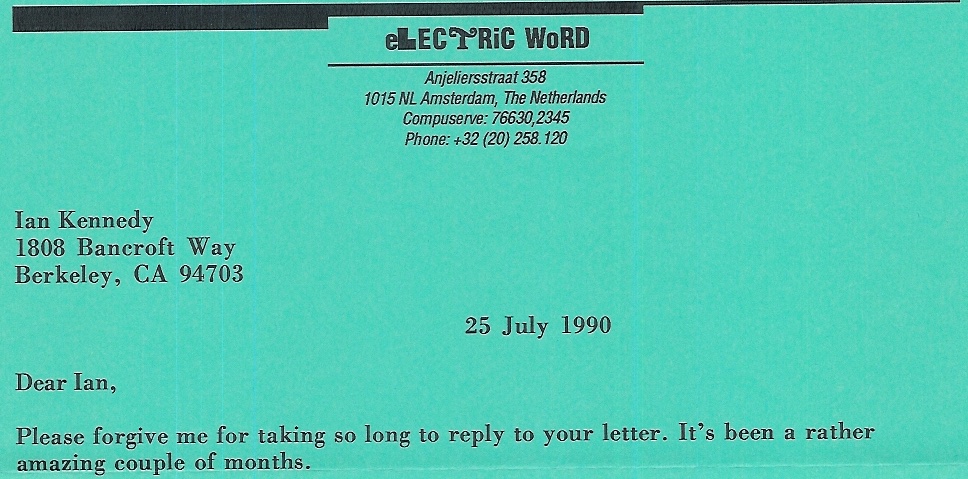
I still have the letter (click the image above for full size scan) from Louis Rossetto who wrote me back from Amsterdam. It was waiting for me when I came back to SF to pack my bags for Japan. It came in a blue envelope and was printed with a unique but elegant font on green paper. The letter was encouraging in it’s reply – thank you for your interest and support. We’d love to take you on but we’re going through a transition right now but let’s talk because we’re starting a new publication in San Francisco and could use your help. . . that publication went on to become Wired.
Life is full of forks in the road and, like the Frost poem, one can only wonder where the other road might have taken you. There was that time when I was flying cross-country from NYC and happend to sit next to Joey Anuff, who started suck.com while working at Hot Wired and basically defined the snarky style that you see online today. Joey gave me a ride into the city from SFO, turned me on to Tortise and Joey ended up linking to my celebrity sell out site a few days later. These forces are stronger than life itself and sometimes I think my current work situation, back in the Bay Area, working with Andrew Anker, who ran Hot Wired and the inventor of the banner ad business model, is part of some big cycle that I have yet to appreciate. The wheel turns round one more time. Where will we go next?
UPDATE: I now see that someone has kindly taken on a project to scan in back issues of Electric Word and post the pdf files online so you can see some of these issues (complete with advertisements) for yourself.
Like a Tour de France peleton chasing down a breakaway, the mainstream media has turned its eye to corporate blogging with a spate of new articles. They all mention the obligatory posterchild of corporate blogs done right, General Motor’s FastLane Blog. But they also dig deeper and surface some of the other excellent blogs out there (many running on Six Apart’s Movable Type software.)
The Financial Times covers the 10,000 foot view, mentioning the GM & Boeing blogs but also pointing out the perils of not having a blog to respond to criticisms as in the oft-referenced case of Krytonite. After failing to respond in a timely way to the Bic pen hack that was amplified in the blogosphere they saw sales of their locks fall off a cliff and wipe out nearly half of their annual sales in just 10 days.
InformationWeek has a piece written by Bob Lutz who writes the FastLane Blog with some sage advice:
If you filter the negatives out, you don’t have a true dialogue, so how can you hope to change anybody’s mind about your products or your business? And changing minds is priority one at GM. The blog is a great opportunity to tell the public directly about the cars and trucks we have on the market and the ones we’re bringing to market soon. It’s one of the few chances we have to get the word out without running it through the media filter. Advertising is another avenue, of course, but it has much lower credibility than the blog, where we’re engaging in a real conversation with readers. We’ve also used the blog to address specific media articles that we considered unfair, unbalanced, or uninformed.
To me, the blog is a way for GM to be culturally relevant. It allows us to be on the leading edge of new technology while getting our strong views out there about our cars and trucks. So far, response has been outstanding, with more than 5,000 visits and 13,000 page views a day. To any senior executive on the fence about starting a corporate blog, I have a word of advice: Jump.
Voce Communications who advised Yahoo on their popular Search Blog is hosting an event in Palo Alto with local law firm Cooley Godward next week. The topic will be about corporate blogging but also the legal challenges. "transparency must be balanced with purpose and responsibility" says the invite post. Space is limited so contact them in advance for an invite.
Read about this one in the paper. Steve Vaught woke up one morning tired of not being able to lose weight and concerned about how long he’d live (he was 400 lbs.). He threw everything up in the air and decided to walk from San Diego to New York. Totally bold move (he has two kids and a wife). It might have been better if he trained a bit because his progress is not as rapid as he planned. Instead of being safely North for the hot Summer months, he’s still in Arizona! Read the journal updated by his wife to follow his progress.
We, as a society, are growing larger and have become a big market for high dollar fast fixes. We are not getting the fix because it is an illusion. Don’t get me wrong, if I were given the option I would trade just about anything to be trim and fit again I have the same excuses, desires and dreams as many others in my position. I know though, that there is no other option but physical exertion to truly get back into shape.
The recent upgrade of TypePad has brought a whole host of new features that are worth highlighting. If you’ve been on the fence about getting into blogging, now is the time and TypePad’s the product!
– Doubled Bandwidth and Storage – Snazzy new themes – Moderated comments – TypeKey integration
Click on the button on the left to learn more.
If you already have TypePad, be sure to set aside some time to explore these new features in detail. One easy way of doing this without messing with your existing blog is to create a test blog.
If you don’t have a TypePad account and want to see what all the fuss is about, sign up for a 30-day free trial and check it out.
Backbone Media, an internet marketing and web development firm based outside of Boston, has published a meaty survey of corporate bloggers to try and get a sense of the motivations and best practices behind corporate blogs. Their survey, Corporate Blogging: Is it Worth they Hype? is the best piece out there today. Along with the empirical survey results are also the results of interviews with bloggers at
Annie’s Homegrown
IBM
iUpload
Macromedia
Maytag
Microsoft
Each of the studies here contain useful lessons. I particularly like the story behind Macromedia’s product marketing blogs which underscores the benefits of open channels of communication with customers to the product development process. I think IBM got a bit short-changed in this report as the blogger they interviewed didn’t seem to represent the enlightened viewpoints I’ve been reading.
What Backbone Media really is talking about is harnessing the conversations and relationships generated by well-written product blogs to drive future product development. Listening to customers shouldn’t be a revolutionary concept:
In essence blogs are learning tools, specifically a company can use a blog to learn how to improve or develop new products by communicating more effectively with their customers through the use of corporate blogs. Any company should encourage customer ideas, reward them and learn from their customer’ s example. If they do they will build more successful products, which also have ready customers who want to adopt new ideas and products because those same customers have participated in the process of product development. Such a strategy will also have additional Internet marketing benefits in the form of more backlinks and higher search engine rankings, as well as direct traffic from links on many different websites.
We all need to remember, customers, by purchasing and using a product, own the past, present, future, and ultimate success of a company and brand. A good product manager represents the customers as constituents and gains their confidence as their elected leader.