Which came first? Transformers or Dekotora?

– via Pink Tentacle
a blog by Ian Kennedy
More on this question of crowdsourced writing, (plugging wet-ware into software) comes Soylent, (yes, it’s made of people) a research project which has written a add-in to Microsoft Word.
Hooked into Amazon Mechanical Turk, this project offers three services:
Think of how something like Soylent and other outsourcing services change the game. I used to work with someone that would farm out the preparation of his expense reports to Man Friday. How soon before someone, in a moment of bureaucratic weakness, whips up a script to to outsource preparation of the weekly TPS report to management from inside Corporation X. Chances are, it’s already happening.
So the results are in from our little experiment and the view is . . . you get what you paid for.
Just to review. Textbroker.com is a service which will write for you on the topic of your choosing. They have a four levels of service and pay by the word. For our experiment, we tried two levels on the upper end of the scale. The topic was “The History of Cream Cheese,” as a control, I added a third sample for the poll in which I copied an article from wikipedia and used some software to shorten the text using an algorithm.

For those of you who read through the samples on the earlier post, here’s what we paid.
The overwhelming choice (over 80%) was for the most expensive#3 sample. It’s pretty clear that the most thought was put into this text and at a total cost of almost $20, it was by far the most expensive sample to commission.
Textbroker is a pay-as-you-go version of companies such as Demand Media which are content factories that focus on, “optimizing high-quality content” for domain squatters and publishers looking for fill to generate pageviews for their advertising partners. What was interesting about to my Finnish colleagues is the thought they could use the service for preparing rough drafts. English skills are very good here but the hardest part for many is just getting started. Many that I talked to thought Textbroker would be a great way to jump start a first draft to get beyond the blank, white page.
My father, a former editor at Random House, is weary of this trend toward mass produced content. “This way lies madness,” was his one line reaction. The business model exists, of course, at the other end of the spectrum. For those that cannot afford their own ghost writer, there is a fellow going by the name of Charles Kinbote who is offering Bespoke Art Commentary specializing in critical analysis of your child’s artwork. For 190 pounds you get a beautifully framed original.

Here’s how he pitches himself.
And you are also busy, no? You may be keen to know what modernist artists your two-year-old son is referencing in his playgroup art, or perhaps what Renaissance works your three-year-old daughter mimics in her scribbles, but you nevertheless don’t have the time, or, let’s be honest, the talent to critique your children’s artistic endeavors the way a real critic would. Explaining any work of art is not easy. Explaining why a young, immature artist — a child, if you will — chooses to be influenced by Renoir rather than Richter is an almost impossibly complex maneuver, one for which you need an expert. I am that expert. The exploration of the meaning contained in the artwork of children is my life’s pursuit. I offer you my service. My name is Charles Kinbote…
Thanks everyone. It was fun but I think I’ll stick to my own writing. I enjoy it too much.
UPDATE: Just for giggles, I copy/pasted the text from the third sample into Xtranormal to get the narration.
Jon Stewart’s closing speech at the Rally to Restore Sanity was brilliant. On mass media the most tweeted line of the day was, “If we amplify everything, we hear nothing.” Viewing the United States political process from Finland, I have to say the “fun-house mirror” through which Americans portray themselves is a bit comic. Europeans don’t know what to make of all the back-stabbing in the political races. “I am not a witch?” – Really?
My favorite part was how Stewart compares this dark time that we all think we’re going through to the Lincoln Tunnel which takes cars under the Hudson River to Manhattan. It’s a daily ritual where multiple lanes converge into two, everyone hates it but the need to do it and somehow, as divisive in reputation as New Yorkers can be, they all manage to make it. They make it through that tunnel of darkness because they know they’ll get to the light on the other side if they all work together.
I’m not doing it justice. Take 15 minutes and see it for yourself. It’s Stewart at his best, making you laugh and think at the same time.
Last week a colleague of mine tweeted about a new service that offers “exclusive written articles created to your specifications”

I replied that Udo might be stretching the definition of “professional” if we look at the quality of output. Cranking out “content” on demand for pennies a word, one has to wonder about the thought that goes into such work. Cheered on by the folks at @textbrokerUS we decided to test the results.
My kids came up with a topic general enough for anyone to judge and we figured it’d be fun to see what others would come up with too. The pricelist on textbroker.com shows a range of prices depending on the quality required. Three paragraphs follow:
Below are the results, use the poll below to pick what you think is the best quality. I’ll collect the results for a bit then share the source of each entry in a future post.
The topic was 300 words on the History of Cream Cheese.
ONE
Cream cheese (also called soft cheese) is a sweet, soft, mild-tasting, white cheese, defined by the US Department of Agriculture as containing at least 33% milkfat (as marketed) with a moisture content of not more than 55%, and a pH range of 4.4 to 4.9.
There are French references to cream cheese as early as 1651. According to the American food processing company Kraft Foods, the first American cream cheese was made in New York in 1872 by American dairyman William Lawrence. It can be a base to some spreads, such as yogurt-cream cheese topping for graham crackers, (10 oz cream cheese, and 1 cup yogurt, whipped.). It is sometimes used in place of butter (or alongside butter in a ratio of two parts cream cheese to one part butter) when making cakes or cookies, and it is also used to make cream cheese icing, which is similar to buttercream icing, (using a ratio of two parts cream cheese to one part butter) which is used to ice carrot cake. Furthermore, because cream cheese has a higher fat content than other cheeses, and fat repels water, which tends to separate from the cheese, stabilizers such as guar and carob gums are added to prolong its shelf life.
There are French references to cream cheese as early as 1651. It can be a base to some spreads, such as yogurt-cream cheese topping for graham crackers, (10 oz cream cheese, and 1 cup yogurt, whipped.). Cream cheese is difficult to manufacture.
TWO
Cream cheese, the most popular ingredient for cheesecake, is a smooth, white cheese made from heavy cream and milk.
Specifically the soft, unripened cheese is made from cow’s milk and by law must contain at least 33 percent milk fat and not more than 55 percent moisture. Light or lowfat cream cheese has about half the calories of the regular style.
Cream cheese is frequently used for spreading on bagels, raw vegetables and crackers and as an ingredient in appetizers, snacks and dips.
There are many different types of cream cheese such as Mascarpone, which comes from Italy and Quark which is a cheese from Germany that has a sharp flavor. In parts of Europe, cream cheese is called “white cheese.”
While there are French references to the origin of cream cheese around the 1650’s, the first American cream cheese was made in 1872 in Chester, New York by American dairyman William Lawrence, according to Kraft Foods. Lawrence distributed his cheese under the brand Philadelphia, now a trademark. The Kraft Cheese Company bought Philadelphia cream cheese in 1928 and still owns it today.
To make your own cream cheese, combine 2-3 cups of whole milk and 3 cups of heavy cream in a stainless pot and stir regularly. Mix 2 tablespoons of buttermilk thoroughly into the warmed milk-cream mixture and cover. Then stir in a quarter teaspoon of mesophilic starter culture, which preserves the cream cheese.
Add a quarter teaspoon of calcium chloride liquid and 2 tablespoons liquid rennet to the pot. Cover the pot and allow it to sit overnight at room temperature. The mixture will have gelled by the next morning, at which time line a large strainer with a sterile handkerchief and gently pour the product into the cloth and let drain for roughly 30 minutes. Transfer the cream cheese into a separate container and mix until smooth and creamy and then store in a refrigerator.
And while cheese can be traced back about four thousand years, the first recipe for cheesecake wasn’t recorded until 230 AD.
THREE
References to cream cheese can be found in France dating to the mid-1600s, though surely it existed long before that. The Greeks contend that cheesecake, made with a soft, creamy cheese, was served to athletes participating in the first Olympic games over 2000 years ago. From Greece, this delicacy spread to Rome and throughout Europe in the following centuries.
Neufchatel, the French soft, white cheese, was the inspiration for an American dairyman who developed what is recognized as cream cheese, the familiar, foil packaged uncured cheese. In an attempt to make a version of the French soft cheese, William Lawrence of Chester, New York, stumbled upon a unique creation in 1872, higher in fat due to the addition of cream to the recipe. The true French Neufchatel cheese is made only with whole milk; its fat content is a little over 20% while cream cheese’s is over 30%. Although controversy surrounds the invention of American cream cheese, with some saying a neighbor of Lawrence’s independently developed the same cheese, it was Lawrence’s version that evolved into today’s Philadelphia Brand Cream Cheese.
Lawrence began commercially distributing his new cheese in 1880. Wrapped in foil and named after the city renowned for quality products, Philadelphia, the cheese was manufactured by Lawrence’s own cheese factory in Chester and by C.D. Reynolds’ Empire Cheese Company in South Edmeston, New York. Philadelphia Brand Cream Cheese’s ownership passed to the Phenix Cheese Company of New York in 1903 after a disastrous fire reduced the Empire Cheese Company to ashes.
The J.L. Kraft Company merged with the Phenix Cheese Company in 1928, obtaining the rights to Philadelphia Brand Cream Cheese, still manufacturing it today. There are hundreds of other brands, but none as famous as the one originally invented by Lawrence.
UPDATE: the results are in! I’ve posted an overview.
Custom, made-to-order merchandise was a feature of the fashion industry for many years. Think Saville Row custom made suits way back or mail order catalog goods such as the L.L. Bean monogrammed tote bag or Land’s End sweater.
Recently, online sites have brought customized fashion to the footwear industry. Adidas and NikeiD sites below feature sophisticated design tools to create one of kind sneaker masterpieces.


Built-to-order computers were brought to the masses by Dell. Now the trend of built-to-order hardware has come to the cellphone industry. Here’s an outfit in the Germany that offers a custom-made phone. Synapse will start shipping built-to-order phones in Q1 2011.

Will the two trends come together? Made-to-order fashion and built-to-order hardware? We’re seeing designer phones in Japan already.

I moved my blog from a dedicated host over to Laughing Squid’s cloud service (thanks Frank and Zahaib for your help!). Some hiccups with the images coming over on the wrong directory but some delicate SQL surgery fixed that. Think of this post as a sort of Social Media isotope to make sure that what gets posted here makes it out the other end in one piece and as intended.
Oh, the image? Just want to say the move to the cloud was easier than I thought. Hopefully this post proves that it resulted in a soft landing.
Please?
It’s one thing to put yourself in the shoes of your potential customers and think about how to solve their pain points but it’s entirely something else to pretend that this product already exists and think about how you would market it.
This is the approach at Amazon and I think it’s quite effective. It’s something they refer to as, Working Backwards. This is the process of definition which helps clarify needed features (and their priority) before coding has even begun. I’m a big believer in hacking together working prototypes and tend to jump right in. This approach is more nuanced and helps shake off any geek-halo in the code-first approach. From Werner Vogal’s (Amazon’s CTO) post:
[1] Ian McAllister, who also works at Amazon, posts on Quora about “working backwards” (it’s via this Quora post that I found Werner’s post, thank you!). He writes in more detail about how to structure the mock-press release.
and most importantly:
Oh, and I also like to write press-releases in what I call “Oprah-speak” for mainstream consumer products. Imagine you’re sitting on Oprah’s couch and have just explained the product to her, then you listen as she explains it to her audience. That’s “Oprah-speak”, not “Geek-speak”.
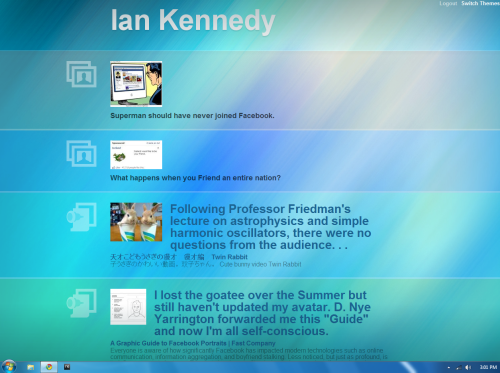
Stumbled across a quick and dirty side project that uses Facebook’s social graph api to pull your newsfeed and present an alternate display. Try it yourself at Facebook-me.com.