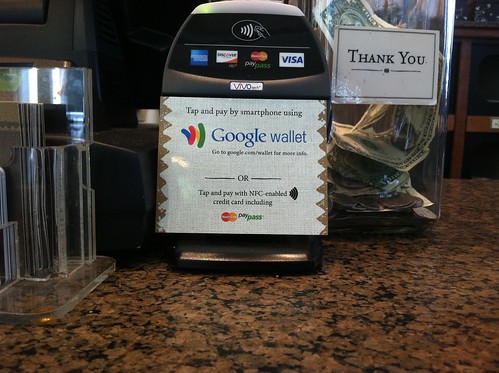
OK, call me an idiot if I missed something but I just saw a headline speculating on rumors about a launch date for Google Wallet. Everyone’s searching around online for leaked memos for clues but meanwhile, in the real world, at the Peets in downtown SF, I already see a Google Wallet reader right there at the register.
I snapped the photo above on Friday but saw it on Thursday as well. I asked the barrista and he said they were put in on Thursday but were still waiting for instructions.
Over the weekend I saw the film, Bill Cunningham New York, a documentary about the New York Times street fashion photographer. It’s been years since I’ve wandered into to the Style section of the Times where Bill’s weekly On the Street photo-scrapbook lives (this week’s column, Reality Check). The film is an inspiration to those who live to work at their craft which Mr. Cunningham has been doing at the New York Times for many years.
Those who seek beauty, will find it is a quote from a charming speech Bill gave when accepting the chevalier dans l’ordre des Arts et des Lettres from the Ministry of Culture in France.
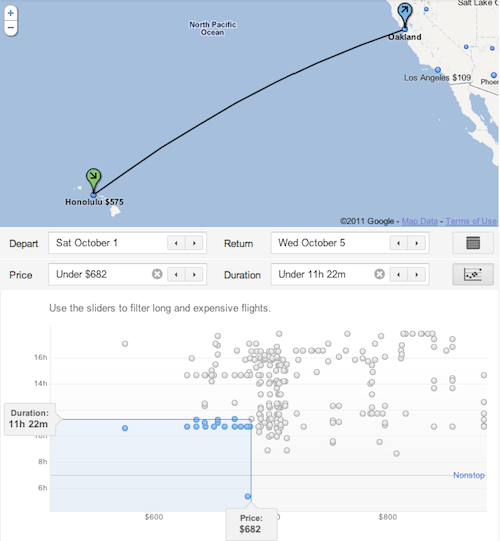
Google’s Flight Search scatter plot visualization of fares is brilliant. Word is that fare data is still light (they don’t have any international, non-US fares) but the UI has put all other travel comparison sites on notice.
I’ve written a few times about the future of publishing. Once to highlight concepts by Bonnier, another time to highlight a talk given by Steven Berlin-Johnson. I now work at a publisher, GigaOM produces reporting on the tech industry and GigaOM Pro produces long-form research reports. The long-form research reports are an interesting challenge. Because they are research, they do not lend themselves to all the digital portability that comes with a blog post coming out of a modern CMS. While it’s pretty easy to get a good discussion around a timely blog post, either on the site or across the social web, it’s harder to do so around a longer piece such as a research report.
Which is what makes the video below of a GigaOM reporter Colleen Taylor getting a demo of Inkling’s new 2.0 version of their digital textbook product.
Watching Steve Jobs introduce new technology is a wonder to behold. He doesn’t bash you over the head with hyperbole nor run circles around you with facts and figures. Instead he walks on stage in jeans and sneakers and pulls something out of his pocket like a wandering hiker might pull out a beautiful stone to share with friends around a campfire. He’s a seeker that’s come back from a journey with something wonderful to show us, he excites us to think of what’s possible and how we might join him on his journey of discovery.
Look at how he introduces the first iPod. We may laugh when we see the goofy fonts and hear about the 5 GB capacity but to hear how he casts his spell over the crowd gathered in what looks like a local high school auditorium is no different to how Steve has always delivered his latest innovation.
Flash forward to 2005 and we see him introduce the iPod Nano with what has to be my favorite Steve Jobs unveil, “Ever wonder what this pocket is for?”
Steve Jobs had a style that was all his own and I’ll miss him. The internet is awash with a collective group hug at the news of his resignation as we all reflect on the departure of a man who helped define why we enjoy tech. Here’s a sample of some of the best recollections (and one future prediction) I’ve had the chance to read:
And then there are Steve and Apple: a leader and a company not afraid to take the long view, patiently building the way to the future envisioned for the company. Not afraid to invent the future and to be wrong. And almost always willing to do one small thing — cannibalize itself. Under Steve, Apple was happy to see the iPhone kill the iPod and iPad kill the MacBook. He understands that you don’t walk into the future by looking back. – Om Malik, Steve Jobs and the sound of silence
The company is a fractal design. Simplicity, elegance, beauty, cleverness, humility. Directness. Truth. Zoom out enough and you can see that the same things that define Apple’s products apply to Apple as a whole. The company itself is Apple-like. The same thought, care, and painstaking attention to detail that Steve Jobs brought to questions like “How should a computer work?”, “How should a phone work?”, “How should we buy music and apps in the digital age?” he also brought to the most important question: “How should a company that creates such things function?” Jobs’s greatest creation isn’t any Apple product. It is Apple itself. – John Gruber, Resigned
So, who is this man? He’s the anchor baby of an activist Arab muslim who came to the U.S. on a student visa and had a child out of wedlock. He’s a non-Christian, arugula-eating, drug-using follower of unabashedly old-fashioned liberal teachings from the hippies and folk music stars of the 60s. And he believes in science, in things that science can demonstrate like climate change and Pi having a value more specific than “3”, and in extending responsible benefits to his employees while encouraging his company to lead by being environmentally responsible. – Anil Dash, What they’re “protecting” us from
It was at the iMac launch where he was showing off the modern line that is on my desk today “look at the metal on the back, isn’t it beautiful?” he told me. It was. But all the other CEOs didn’t care about the back of their products. They cared, instead, about shaving cost from them instead. – Robert Scoble, A front row seat to Steve Jobs’ carreer
We know there is such a plan — there has to be, Apple’s moves have been too deliberate, if inscrutable, to be some executive random walk. But nobody near the top has ever tried to explain where the company is going, preferring to be mysterious instead. Bill Gates had Nathan Myhrvold write his book for him, but Steve is classier than Bill. I believe Walter Isaacson’s book will also function as Steve’s technology manifesto, part of his legacy. Once we have the grand plan, then it may make more sense just who should lead that plan’s execution during what will clearly be Apple’s best quarter in its 34 year history. Steve Jobs is setting-up this (and us) for another grand reveal… just one more thing. – Bob Cringely, Cupertino Two-Step
UPDATE:
I had to include this photo I took at the iPhone launch event. Note the look of wonder and open-mouthed awe.
A friend from Finland asked how things were going at the new job which nudged me to put some thoughts down. Here are some highlights from the past two weeks,
was introduced to everyone via a broadcast message to everyone in the office as, “the guy who helped get the MSFT/Nokia deal done.”
made my first edit on pro.gigaom.com, albeit an FAQ page.
manned the live, on site chat for a few hours where I was promptly asked “how can I build a life-sized Optimus Prime out of Lego?” I suspect one of my new colleagues.
was met with stunned silence when I asked if someone could, “provision” my new work laptop – everyone sharpens their own knives here.
after reading snarky comment about a low-res version photo of contributor, contacted them in New Zealand on Skype, was given a new image, cropped and uploaded the same and fixed the issue, all in less than 5 minutes.
drove to Napa to attend VIP party for WordPress customers. Met Matt Mullenweg and his fine crew to enjoy wine, sunset, and the future of publishing.
If you’re wondering where I work, here’s a short video describing the service. I work with the dev team pulling levers and twirling knobs to keep things running smoothly.
Today is my last day at Nokia. The great mobile adventure is over. More accurately, the need to define a mobile web as something other than the internet at large has mostly vanished.
I left Yahoo for Nokia with a vision of building services to connect the social web to phones that knew more about you and the world around you than a desktop PC could ever hope to know. I built a few prototypes and white-boarded many more. The potential is rich and the rush of apps and services that are “location aware” is only the beginning of what we will see in the years to come. In many ways it feels like 1995 all over again and we’re all re-discovering developing for the web browser. All that’s missing is a “View Source” to bring in the masses.
It’s been an amazing experience highlighted by a two year assignment to Helsinki which gave me, my wife, two kids, and our little dog Mimi an experience of a lifetime. Nokia is a global brand and the multitude of languages and cultures that you bump into day-to-day in the hallways and canteen is mind-boggling. Helsinki is a global hub with many families moving in and out of Finland exposing us to a broad group of people from all over who became our friends. We hope to continue to keep in touch with as they move around the world. My Finnish colleagues too were gracious in taking in this relatively bombastic Californian, tolerating my bubbly “Good Morning!” greetings and gently instructing me in gentler, more subtle methods of salutation.
But now we’re back in California. While the new Nokia offices in Sunnyvale are beautiful, the commute is not. While I learned heaps from Nokia about the mobile phone business, particulars in mobile UI (design for the one-handed strap-hanger in Bangalore), as well as unique aspects of localization (make room for long German place names, right-to-left Arabic script, and currencies in Europe use a comma, not a decimal), the excitement for me is further up the stack with the applications.
I’ll take a few days off then start anew at GigaOm on Monday where I have accepted their invitation to be Product Manager of their premium subscription product, pro.gigaom.com. In many ways this is a return to my roots when I was a PM for Factiva.com – another premium news subscription service. Coming full circle from a time when content was screaming to be free, we are entering an age of content factories where well-edited media and curated content will be something worth paying for. Anyone can sit and read everything coming through on ReadWriteWeb, TechCrunch, and yes, GigaOm and branch out to regional tech sites such as Arctic Startup and Asiajin that do an excellent job of covering their region but who has the time to read it all? Algorithms are getting better (check out Summify) but social networks that mix up family, friends, and professional contacts are getting muddy as filters and we all run the risk of building filter bubbles around ourselves.
There is a market for summaries and curation and I want to build a platform that enables that. The internet has made infinite distribution available at little to no cost. The challenge (and opportunity) is for publishers to maximize revenues by offering ever greater premium upsells to their True Fans on a steep value curve so that everyone wins. The folks I’ve met at GigaOm totally get this and I’m psyched to get cracking on building out features to meet the demand. This is going to be fun!