“Like the Mets, the Athletics are the less popular team in a two-team region — less popular everywhere in that region, based on the data from Facebook. Again, winning the World Series matters. The Giants have won two of the last four. The A’s have won none of the last 24.”
I always knew that there are a lot of East Coast transplants in the Bay Area, 6% of them being Red Sox fans sounds about right.
Casey pointed me to a fascinating post from the Flipboard Engineering blog that gives a peek into that company’s layout engine, Duplo.
We start with a set of page layouts created by human designers. Then, our layout engine figures out how to best fit your content into these layouts—considering things like page density, pacing, rhythm, image crop and scale.
The marriage of a layout engine with designer-crafted templates allows Flipboard to rapidly build each magazine, render and compress it for Flipboard readers. What’s most interesting to me is the algorithm that then varies the layouts of each magazine’s pages to provide enough variety to keep things interesting and looking less, templatized. “A designer’s guidelines for page balance and harmony can be nuanced” says the Flipboard blog post, so they use a variation of the Perlin noise algorithm to calculate the variation in layout formats to, “approximate how an editor might pace elements through magazine pages.”
We’ve all seen pretty pictures that tell a story about something we didn’t know. Truth Facts is a site that takes something we all know to be true and puts it into pictures. Here are some of my favorites:
While living in Finland, I learned of some of the Finnish idioms that give a wonderful glimpse into the Finnish mind & culture. Here are some of my favorites.
juosten kustu translates literally as, “pissing while running” which, if you’re a man and have ever had to do this, results in a wavy line in the snow. It means something done half-assed. Related but different is kusee hunajaa which means that you’re happy because you are “pissing honey.”
laittaa hanskat naulaan translates as, “hang up your mittens” which means you give up or, more specifically, are quitting your job. Because we all know that if you’re not wearing your mittens in sub-zero weather, you’re not going to be working.
irtoaa kuin mummon hammas or “comes loose like a grandmother’s tooth” is something that goes very easily. This is the opposite of kiven alla which is difficult to obtain because it is, “under a stone.”
joka kumartaa yhdelle, pyllistää toisille “when bowing to one person you show your ass to those behind you” could be cynically translated as standing on other peoples heads to get to the top.
juopon napit when you mis-match the buttons on your shirt, you have “drunkard’s buttons”
lukea kuin piru Raamattua translates as, “like the devil reads the Bible” or someone who reads something carefully to look for a loophole.
What came off as a completely natural off-cuff quip of the moment was actually the product of a well-scripted social media command center prepared to jump on the opportunity. Imagine a room with representation from marketing, creative, legal, and the “VP of Cookies” huddled around a table on Super Bowl Sunday, laptops open, ready to pounce on the latest conversation.
It’s all about catching the wave before it crests and surfing in on the momentum. One well-timed tweet netted 15,000 retweets and 8,000 new followers of @oreo on twitter and 20,000 likes on Facebook.
The Smithsonian Magazine shares a trend that any American who has spent anytime poking around the back alleys of Tokyo knows in their bones. The Japanese have a loving appreciation of American culture that runs deeper that Americans.
From burbon to jazz, denim to hamburgers, the attention to detail of the Japanese is flawless. If you have a chance to peruse the magazine racks of Kinokuniya, a Japanese book seller found in several US cities, look for magazines dedicated to fashion where issues will go into great detail on how to dress as a fixie-riding hipster or a 1920’s dandy, the Japanese have taken loving imitation to a new level of reverence.
In keeping with the “same as is ever was” theme of this blog, when new trends from Japan make it to the shores of America, we see refined American culture filtered, improved, and made better for the discerning retroactivist.
Blue Bottle Coffee and the barista culture? Think of it as the Japanese tea ceremony applied to coffee.
Moleskin notebooks? The Japanese have a deep appreciation of calligraphy and Evernote’s success in Japan as an online version of the notebook is a reflection of that. Japan’s love of stationary is legendary.
High End Audio? Only in Japan will the local record shop let you sample the inner tones of Ella Fitzgerald on a set of McIntosh tube amps.
There’s a special way that the Japanese sensibility has focused on what is great, distinctive and worthy of protection in American culture, even when Americans have not realized the same thing. It isn’t a passing fad. It’s a long-standing part of Japanese culture, and, come to think of it, as more Americans are exposed to U.S. products revived or reinterpreted by Japanese designers, the aesthetic is becoming part of American culture, too. If you ever wonder which of the reigning American tastes, sounds, designs or styles will last into the future, there’s no better place to answer that question than in the stores and restaurants, the bars and studios of Japan. They often know us better than we know ourselves.
A local friend of mine plays in a band that has depended on Facebook to connect with thier fans. Gregg asked if he could share his thoughts on the latest news feed changes and how it’s impacted his ability to reach his fans and question his dependence upon Facebook to get the word out. Read Gregg’s guest post below.
Much has been written about the changes to Facebook’s algorithm, which has dropped “organic reach” for pages to around 1%. This change has been distressing to Facebook page admins for organizations large and small. The only way the people who like your page are going to see your posts is if you pay Facebook.
I understand the move. Facebook is a public company and has an obligation to maximize revenue for it’s shareholders. In addition, Facebook has thousands of employees to pay and operational costs. As an individual, I get to use Facebook for free, so charging brands and organizations is a logical way to monetize Facebook.
I play in a Bay Area based cover band, and do most of the marketing for the band. Facebook has been a great way for our band to connect with friends and fans, and to keep them posted on upcoming shows and news. I’ve noticed the gradual changes in reach, and last summer began experimenting with promoted paid posts. The paid posts have been very successful for the band: we budget a small amount of money (usually $20) and set a very targeted audience. The posts have increased attendance at our shows and appreciation from the venues we play. A win-win.
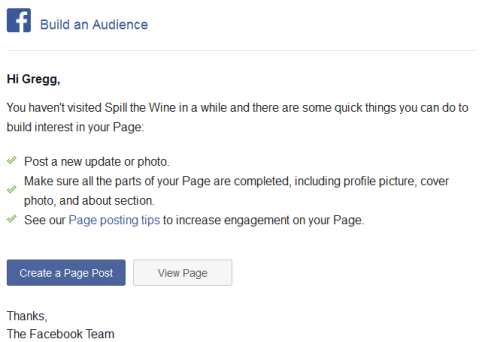
Once the news of Facebook algorithm change became public, I decided to no longer post on Facebook unless it was going to be a promoted paid post. I figured it was not worth my time and effort to post something that was only going to be seen by 1% of our fans. Since then, I receive this email every two days:
Subject: People who like Spill the Wine have not heard from you in awhile.
Repeatedly receiving the exact same email got me thinking: Why are they keep sending the same email to me? Are there other organizations who are not posting as much because they aren’t reaching anyone either?
Some organizations are trying to fight back, as is expressed in this post by a great heavy metal band, Blackwülf:
When I think of why I originally joined Facebook, and why I continue to go back, it is for community. I am able to keep in touch with friends from all parts of my life, and follow news and updates from the organizations and people that I am interested in.
I wonder if Facebook has gone too far in it’s attempt to maximize revenue. It is one thing to charge brands with massive budgets and marketing departments to reach its fans, but it is a whole other thing to include small organizations and communities to the same standard. To me, these communities are the lifeblood of Facebook. I wonder if Facebook realizes it has gone too far and are prompting people like me, who post for a cover band, to come back. As we need Facebook, Facebook needs us.
Facebook should look for middle ground. I am happy to occasionally pay to advertise on Facebook, I don’t expect to get the full benefit of having a Facebook page for free. However, our band shouldn’t be treated the same way a brand like Starbucks is. I hope Facebook realizes this and changes its organic reach algorithm for small organizations and communities.
In a wonderful turn of events, we now hear that bookstores in Seattle are doing well again. It turns out, in the shadows of the world’s largest online bookseller, Amazon employees are choosing to browse the shelves at their local bookseller rather than buy online, and buying.
Efficiency is not everything. Shopping can also be an experience.
Do you ever feel like you’re moving through a fog, going backwards? The clip from Tokyo Reverse is a highlight reel from a 9 hour video of someone who did just that, walk through the streets of Tokyo, in reverse. Ludovic Zuili, the man in the video, was filmed walking backwards and then the footage was flipped around so that he was shown walking forwards and everyone else is shown walking in reverse. The effect is strange and, trippy.
Those of you who know Tokyo will recognize Shibuya, Harajuku, and Akihabara in the clip.
Used to distinguish new sessions and visits. This cookie is set when the GA.js javascript library is loaded and there is no existing __utmb cookie. The cookie is updated every time data is sent to the Google Analytics server.
30 minutes after last activity
__utmc
Used only with old Urchin versions of Google Analytics and not with GA.js. Was used to distinguish between new sessions and visits at the end of a session.
End of session (browser)
__utmz
Contains information about the traffic source or campaign that directed user to the website. The cookie is set when the GA.js javascript is loaded and updated when data is sent to the Google Anaytics server
6 months after last activity
__utmv
Contains custom information set by the web developer via the _setCustomVar method in Google Analytics. This cookie is updated every time new data is sent to the Google Analytics server.
2 years after last activity
__utmx
Used to determine whether a user is included in an A / B or Multivariate test.
18 months
_ga
ID used to identify users
2 years
_gali
Used by Google Analytics to determine which links on a page are being clicked
30 seconds
_ga_
ID used to identify users
2 years
_gid
ID used to identify users for 24 hours after last activity
24 hours
_gat
Used to monitor number of Google Analytics server requests when using Google Tag Manager
1 minute
_gac_
Contains information related to marketing campaigns of the user. These are shared with Google AdWords / Google Ads when the Google Ads and Google Analytics accounts are linked together.
90 days
__utma
ID used to identify users and sessions
2 years after last activity
__utmt
Used to monitor number of Google Analytics server requests
10 minutes
You can find more information in our About Me and .

 I always knew that there are a lot of East Coast transplants in the Bay Area, 6% of them being Red Sox fans sounds about right.