Month: July 2024

  • Nation before Self

    Nation before Self

    In September 1796, two months before the presidential election, George Washington announced that he would not seek re-election.

    Not unconscious in the outset of the inferiority of my qualifications, experience in my own eyes, perhaps still more in the eyes of others, has strengthened the motives to diffidence of myself, and every day the increasing weight of years admonishes me more and more that the shade of retirement is as necessary to me as it will be welcome. Satisfied that if any circumstances have given peculiar value to my services, they were temporary, I have the consolation to believe that, while choice and prudence invite me to quit the political scene, patriotism does not forbid it.

    Washington’s Farewell Address to the People of the United States

    The farewell address is one of the great testaments to the founding principles of America’s democratic tradition. Founded in opposition to the monarchy founded on divine right, Washington’s voluntary retirement demonstrated through action that “Nothing could be a stronger endorsement of democracy than turning over power to someone else.”

    So powerful this tradition of promoting the nation over self that, starting in the days prior the Civil War, Congress would regularly read aloud the Washington’s Farewell Address and document it into the official record during each session of Congress until the 1980s.

    Then, over the weekend,

    It has been the greatest honor of my life to serve as your President. And while it has been my intention to seek reelection, I believe it is in the best interest of my party and the country for me to stand down and focus solely on fulfilling my duties as President for the remainder of my term.

    Joseph Biden, July 21, 2024

    For Biden to acknowledge his frailty and sacrifice self in favor of his nation starkly outlines the difference between the Democratic and Republican parties today.

    But Biden’s exit also scripts a compelling message for his Democratic successor and everyone else in the party. They can — they must — talk about the differences between what Biden is doing now, no matter how reluctant he was to do it, and Trump’s titanically selfish and epically destructive behavior in 2020, when he sought to stay in power by undermining the entire electoral process. They must emphasize the contrast between a president and party that finally dealt with uncomfortable truths and a president and party that have never stopped spinning unconscionable lies. While Trump and many of his fellow Republicans remain at war with reality, Biden and Democrats surrendered to it.

    What Joe Biden Just Did is Utterly Extraordinary

  • Mary Murray’s Tea Party: A Revolutionary Tale

    Mary Murray’s Tea Party: A Revolutionary Tale

    A war story for Independence Day, this one took place only a few blocks from where I live.

    Murray Hill is a neighborhood in Midtown Manhattan named after the farm that was on top of a hill that overlooked Southern Manhattan and the East River. 250 years ago it was called Inclenberg which is Dutch for “beautiful hill.”

    Robert Murray, a wealthy businessman who traded goods imported from England moved here in 1762. He built a large house at what is now the corner of 37th and Park Avenue.

    Map of Inclenberg in 1767
    Inclenberg – Ratzer Plan of NY, 1767

    In the morning of September 15, 1776, British General William Howe, in pursuit of the recently defeated Continental Army at the Battle of Brooklyn, waited on the Manhattan side of the East River for reinforcements. Coming across the river were four man-of-war ships loaded with British and Hessian soldiers that would bring Howe’s forces to number 8,000 men. Howe planned to march this force into Manhattan to defeat George Washington’s troops who were holed up in Harlem Heights. What the General did not know was there were about 3,500 Continental troops left behind by Washington under General Israel Putnam that were escaping North from Wall Street to join Washington’s troops in Harlem.

    From their vantage point on the hill, the Murrays could see Putnam’s troops marching North on the West side and the larger contingent of British troops amassing to the East. It was clear that both would run into each other with the British most likely wiping out Putnam’s vastly outnumbered men.

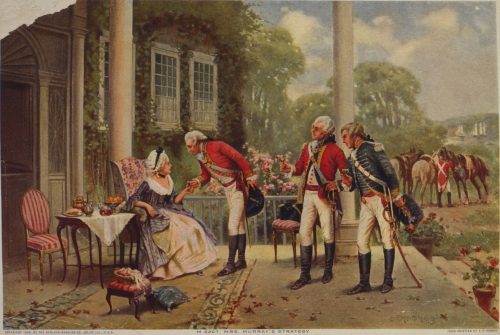
    While Robert Murray, who had loyalist tendencies (his business was being disrupted by patriots), it is said his wife, Mary, sided with the patriots. Sensing impending disaster, Mary sent out an invitation to General Howe and his entourage to join her for mid-day tea and cake.

    From a painting by E. Percy Moran, Mrs. Murray’s strategy, Murray entertaining British soldiers.

    Apparently Mary and her daughters kept Howe’s company entertained for over two hours while a maid kept watch over the retreat of Putnam’s men from an upstairs window. By stalling the British troops, some believe Mrs. Murray’s quick thinking saved a large part of the small American army.

    While I love this story, in researching it, I found there is some historical debate as to if the story has been embellished to favor Mary Murray as a quick thinking, covert patriot. The alternative history is that maybe this was just a case of British manners and tradition confounding tactical success against a scrappier opponent.

    The latest opinion on the subject, however, tends to deprive Mrs. Murray of any patriotic solicitude for the American cause; she befriended that cause without intending to do so. Her family associates seem to have been with a Tory or at least a neutral kind, rather than the contrary, and the lunch party as an act of civility toward friends in acceptance of which Howe had not the wisdom to foresee the danger. Howe’s nature was easy-going and social; the stern cards of war sat lightly on him. General Putnam, with that Yankee insight of his, early took a measure of the order of Howe’s mind when he said incisively; “How is either our friend or he is no General.”

    New York Times, July 30th, 1898

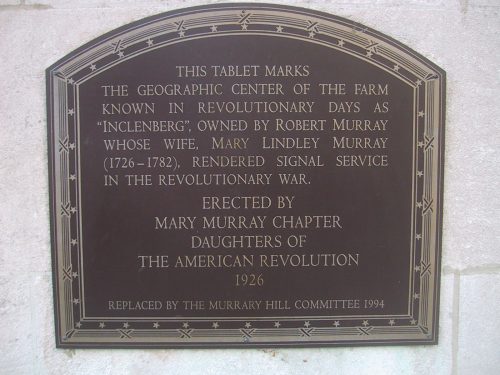
    Nevertheless, there is a plaque dedicated to Mary Murray’s heroics placed on Park Avenue by the Daughters of the American Revolution. I intend to visit to pay my respects this afternoon.

    Looking south from 37th Street, west of Park Avenue

    Further Reading: Battle of Kip’s Bay