
A war story for Independence Day, this one took place only a few blocks from where I live.
Murray Hill is a neighborhood in Midtown Manhattan named after the farm that was on top of a hill that overlooked Southern Manhattan and the East River. 250 years ago it was called Inclenberg which is Dutch for “beautiful hill.”
Robert Murray, a wealthy businessman who traded goods imported from England moved here in 1762. He built a large house at what is now the corner of 37th and Park Avenue.

In the morning of September 15, 1776, British General William Howe, in pursuit of the recently defeated Continental Army at the Battle of Brooklyn, waited on the Manhattan side of the East River for reinforcements. Coming across the river were four man-of-war ships loaded with British and Hessian soldiers that would bring Howe’s forces to number 8,000 men. Howe planned to march this force into Manhattan to defeat George Washington’s troops who were holed up in Harlem Heights. What the General did not know was there were about 3,500 Continental troops left behind by Washington under General Israel Putnam that were escaping North from Wall Street to join Washington’s troops in Harlem.
From their vantage point on the hill, the Murrays could see Putnam’s troops marching North on the West side and the larger contingent of British troops amassing to the East. It was clear that both would run into each other with the British most likely wiping out Putnam’s vastly outnumbered men.
While Robert Murray, who had loyalist tendencies (his business was being disrupted by patriots), it is said his wife, Mary, sided with the patriots. Sensing impending disaster, Mary sent out an invitation to General Howe and his entourage to join her for mid-day tea and cake.
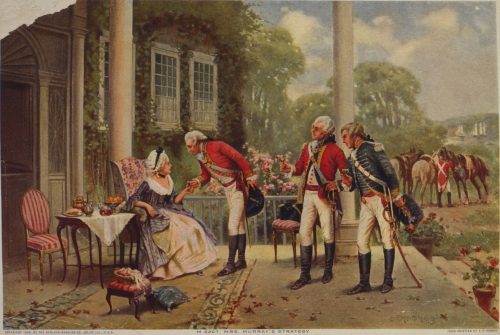
Apparently Mary and her daughters kept Howe’s company entertained for over two hours while a maid kept watch over the retreat of Putnam’s men from an upstairs window. By stalling the British troops, some believe Mrs. Murray’s quick thinking saved a large part of the small American army.
While I love this story, in researching it, I found there is some historical debate as to if the story has been embellished to favor Mary Murray as a quick thinking, covert patriot. The alternative history is that maybe this was just a case of British manners and tradition confounding tactical success against a scrappier opponent.
The latest opinion on the subject, however, tends to deprive Mrs. Murray of any patriotic solicitude for the American cause; she befriended that cause without intending to do so. Her family associates seem to have been with a Tory or at least a neutral kind, rather than the contrary, and the lunch party as an act of civility toward friends in acceptance of which Howe had not the wisdom to foresee the danger. Howe’s nature was easy-going and social; the stern cards of war sat lightly on him. General Putnam, with that Yankee insight of his, early took a measure of the order of Howe’s mind when he said incisively; “How is either our friend or he is no General.”
New York Times, July 30th, 1898
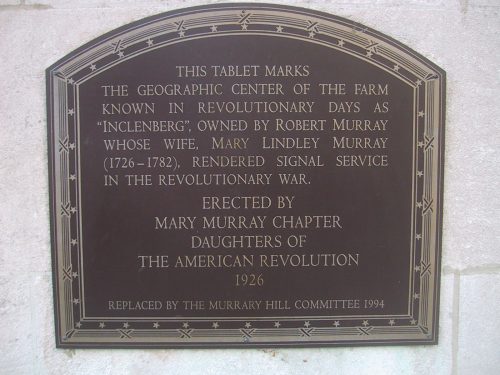
Nevertheless, there is a plaque dedicated to Mary Murray’s heroics placed on Park Avenue by the Daughters of the American Revolution. I intend to visit to pay my respects this afternoon.
Further Reading: Battle of Kip’s Bay
Leave a comment