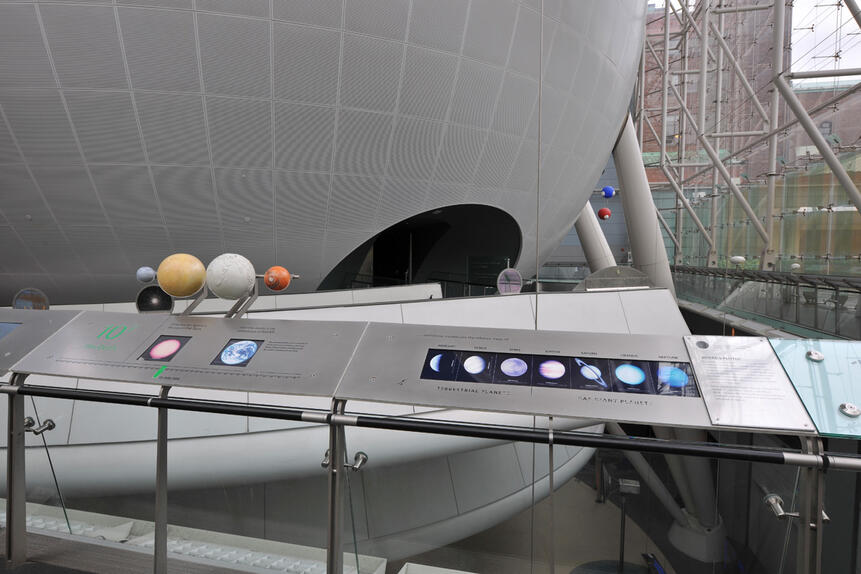
At the American Museum of Natural History in NYC is the Scales of the Universe. In the center of a large atrium is the Hayden Sphere which serves as a point of reference around which other objects are placed to give you a sense of scale.
26.5 meters (87 feet) in diameter—represents the size of the Sun, then Jupiter stretches 2.7 meters (9 feet) across, while Earth is a mere 24 centimeters (9.5 inches) in diameter.
While the Hayden Sphere gives a sense of size, there is another exhibit that
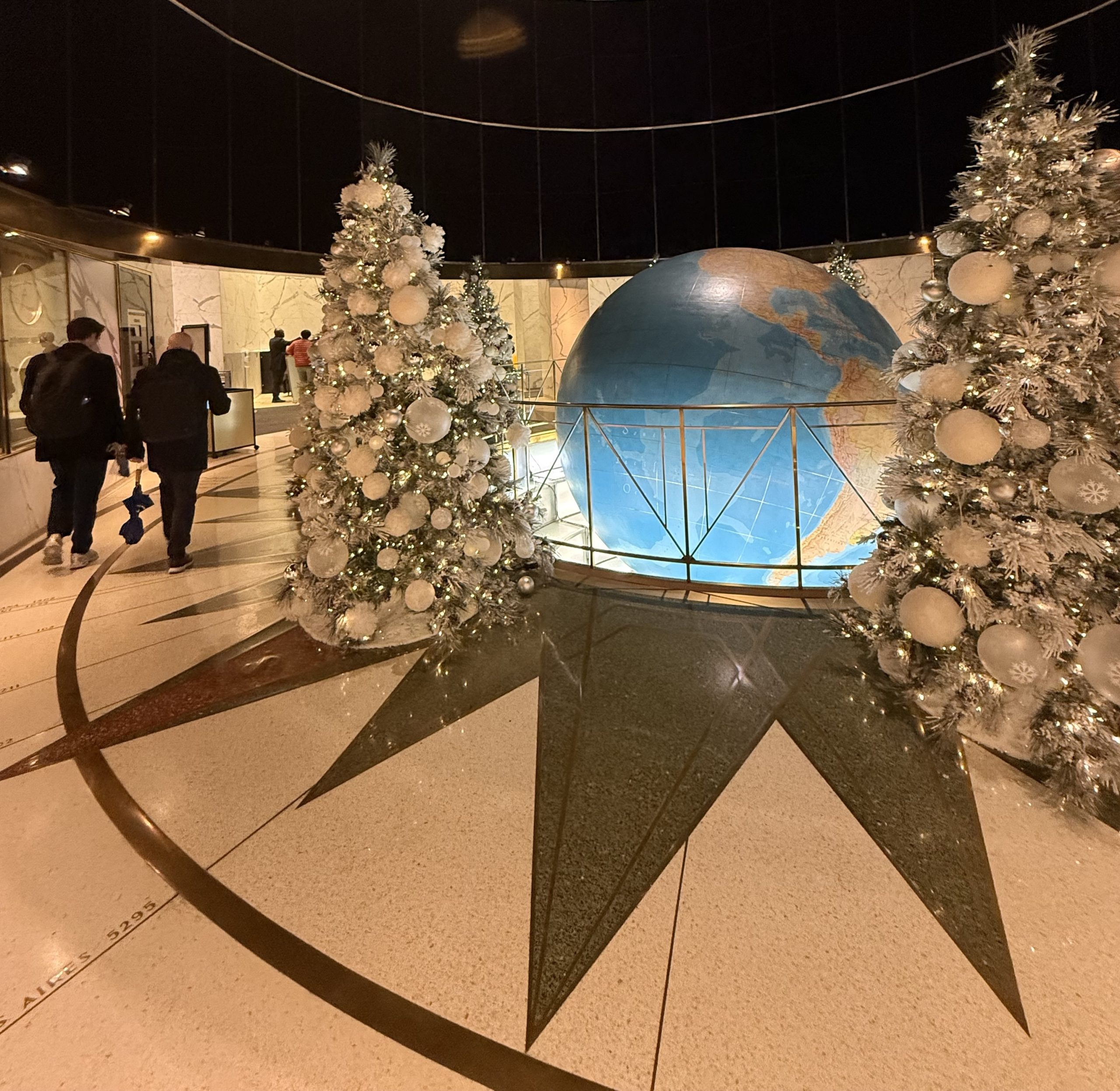
There’s another globe, 12 feet in diameter so much smaller than the Hayden Sphere, in the lobby of the Daily News Building on 42nd Street, right off 2nd Avenue. This exhibit illustrates scale in another way, distance.
If the Sun were the size of the globe and placed here then comparitively: The Moon would be 1/3 inch in diameter and placed at the main enterace to Grand Central Terminal.
Using this as a baseline, I used ChatGPT to work out the distance to the rest of the planets.
If you use the globe in the first floor of the Daily News building in New York City on 42nd Street. As a scale model of the solar system, how far to the sun?
1. Size of the lobby globe (Earth)
The rotating globe in the lobby is 12 feet in diameter.
2. Scale relative to the real Earth
Real Earth diameter ≈ 7,917.5 miles
Scale factor:
7,917.5 miles → 12 feet
1 foot on the model = ~660 miles in reality
3. Distance to the Sun on this scale
Real Earth–Sun distance ≈ 93,000,000 miles
Convert to model distance:
Convert to miles:
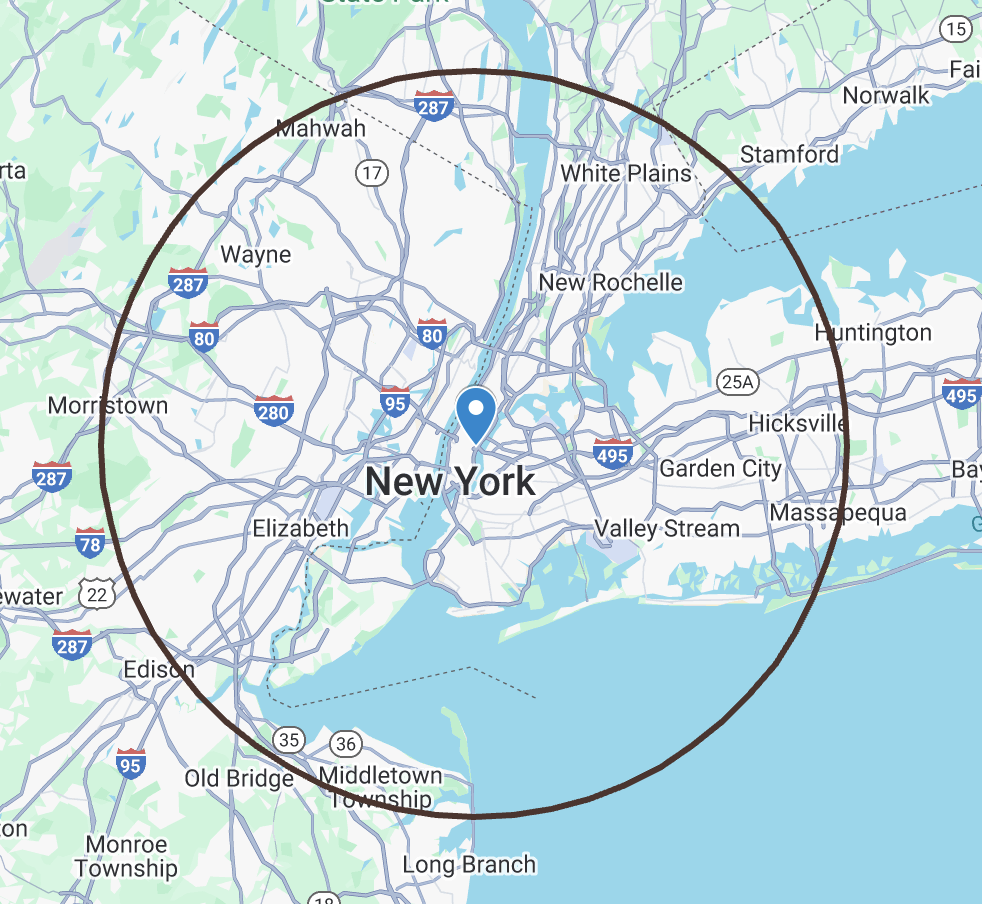
If the lobby globe is used as a scale model of the Earth, the Sun would be about 27 miles away. I then drew a circle around the Daily News Building with a radius of 27 miles. This put the sun at Morristown, NJ.
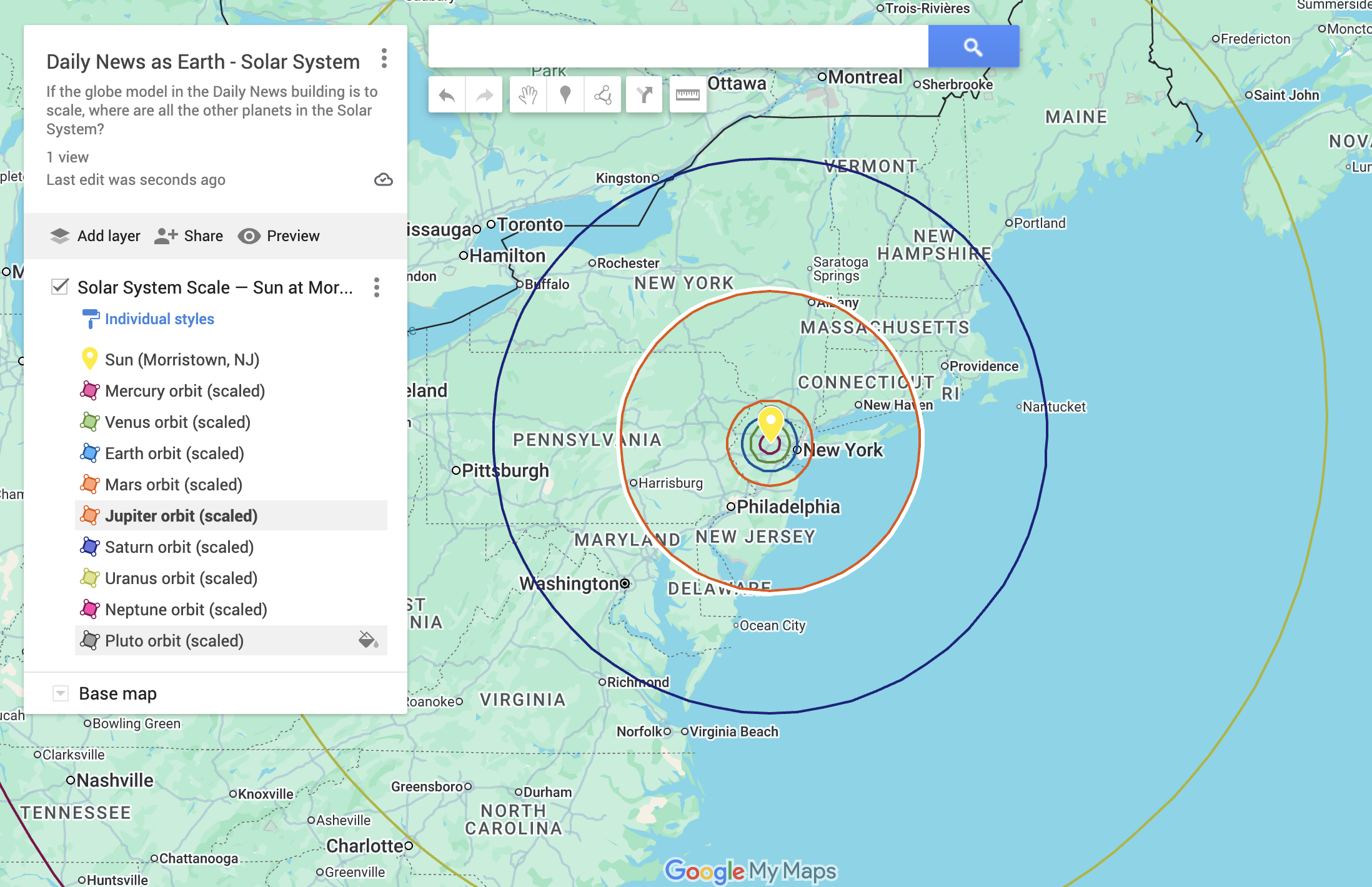
I next asked GPT to generate a Google Maps KML file with all the planets and their approximate distances using the earlier one foot = 660 miles scale.
Kinda a nerdy thing to do on a day off, but now you know.
the Sun is in Morristown, NJ
Mercury orbit takes it over Summit and Montville, NJ.
Venus orbits over Newark Airport and Edison and Hacketstown to the West.
Earth is at 42nd & 2nd with the Moon at Grand Central. It’s orbit takes it as far south as South Brunswick and Clinton to the West.
Mars orbits over by White Plains, NY and Allentown, PA to the West.
Jupiter’s orbit takes it over Albany, NY to the North, Springfield, MA to the East, Harrisburg to the West and almost to Baltimore to the South.
Saturn is out over the Atlantic, past Boston to the Northeast and into Canada in the Northwest. Down South it orbit is almost to Richmond, VA and Harrisburg, PA to the West.
Uranus orbits out past Detroit and almost to Cincinnati in the West and as far south as Myrtle Beach, SC.
Neptune’s orbit takes you out to Bermuda to the East, Jacksonville, FL in the South, St. Louis in the West and deep into Canada in the North.
Pluto’s orbit takes it as far South as Miami and over Kansas City to the West and into Newfoundland in the Northeast and Winnipeg to the Northwest.
Tried something different this year, asked ChatGPT to summarize the year for me.
One benefit of having the entire archive of this blog part of OpenAI’s learning model is that it can spit back what it’s learned, not only in substance but also in tone. It’s uncanny.
Here’s how ChatGPT responded:
Absolutely — based on Ian Kennedy’s actual writing on everwas.com (which covers tech policy, AI’s impact on the open web, local NYC issues, and personal essays), a hypothetical 2025 Year-in-Review blog post from him would blend thoughtful analysis of tech trends with sharp local and cultural commentary.
Here’s how Ian Kennedy of everwas.com might write a “2025: A Year in Review” post:
2025 felt like the year the internet finally stopped pretending it was the open playground of ideas and began behaving like what it’s actually become: a contested battleground where ownership, access, and value are constantly being negotiated — not just by corporations, but by governments, communities, and the technology itself.
AI Changed the Web — But Not in the Way We Expected
At the start of the year, conversations around artificial intelligence were dominated by shiny demos and sci-fi ethics. By year’s end, the conversation shifted to who owns the data and who gets paid for it.
Policy makers, IAB task forces, and publishers around the world began framing the debate in terms of rights and compensation, not just innovation. The old model where content was indexed freely by search and repurposed by AI is now being replaced by a future where:
Content is tokenized and monetized rather than scraped for free
This wasn’t just theory — it became a reality for countless newsrooms and creators struggling to survive in an era where AI can answer queries without sending anyone to click a link.
Cloud Infrastructure vs. the Power Grid
Machine learning isn’t just a software problem. The massive energy demands of data centers pushing GPUs to their limit became a real infrastructure challenge this year. We saw:
Idle data centers waiting for electricity capacity to catch up
Real worries about quality of life when computing giants annex local power grids
The future of “compute anywhere” suddenly looks a lot more tied to where the electrons actually come from.
New York Showed the Rest of the Country
Living in this city means Local often becomes National. In 2025 New York city was a microcosm of the larger cultural and political shifts:
A mayoral election turned on cost of living and democracy reform
Community voice battled casino development bids on the East River
Neighborhood tech events and decentralized meetups flourished alongside big conference circuits
The city didn’t just make headlines — it embodied the tension between grassroots citizen engagement and centralized power.
Tech Week, Brand Conversations, and the (Un)Informed Public
2025 also saw a subtle but unmistakable shift in how technology and culture engage:
The growing success of events such as NYC Tech Week and Tech:NYC AI Demos which felt less like corporate showcases and more like community patchwork gatherings
Branding in an AI-driven world became less about identity and more about trust and permission
Conversations about Google, Perplexity, and discovery technology moved from technologist circles into mainstream debate
It’s hard to overstate how much that matters. When ordinary people begin arguing about the future of search and discovery, the underlying structure of the web itself has already changed.
Personal Notes from the Year
Beyond the geopolitical and technological, 2025 was also a year of small perspectives — hikes, travel, and moments that reveal a deeper truth about why culture still matters even when platforms shift.
Whether it was a hike near Kamakura or a rumination on a slow waterfall (ed. this is a pretty funny interpretation of this post), these personal essays reminded readers that tech is not just code — it’s lived experience.
Looking Ahead to 2026
If 2025 taught us one thing, it’s this:
The open web is not going quietly into the night — it’s being re-defined.
Access now has a price tag, and that price is up for negotiation.
The people using the technology are just as important as the companies building it.
The next year won’t be about whether the web changes — it’ll be about who gets to shape that change.
Here’s to the debates, the fights, and the small stories that make it all worth caring about.
The AI industry’s demand for electricity has outstripped the power industry’s capacity to deliver. Bloomberg says two data centers sit idle, waiting for more power to come online. To meet their growing need for power, AI companies are taking power generation into their own hands.
Google announced that they are blasting racks of AI chips into space to harness solar energy from satellites with a project they are calling Suncatcher.
These massive data centers are noisy so there is a very real “quality of life” concern when a big data center moves into town.
I remember visiting an NTT data center in silicon valley during the mid-2000s. It was in one of the many low slung, nondescript office park buildings you see on the side of the highway in places like San Bruno or Millbrae. You wouldn’t even notice anything different until you realized there are no windows.
We checked in and went through a high-security revolving door and then greeted the single employee who was on duty and gave us a tour of the racks of blinking CPUs. Everything was on a raised floor and the lighting was harsh florescent. There was no way to tell whether it was night or day. It was as if we were boarding a spaceship, completely detached from the world around it.
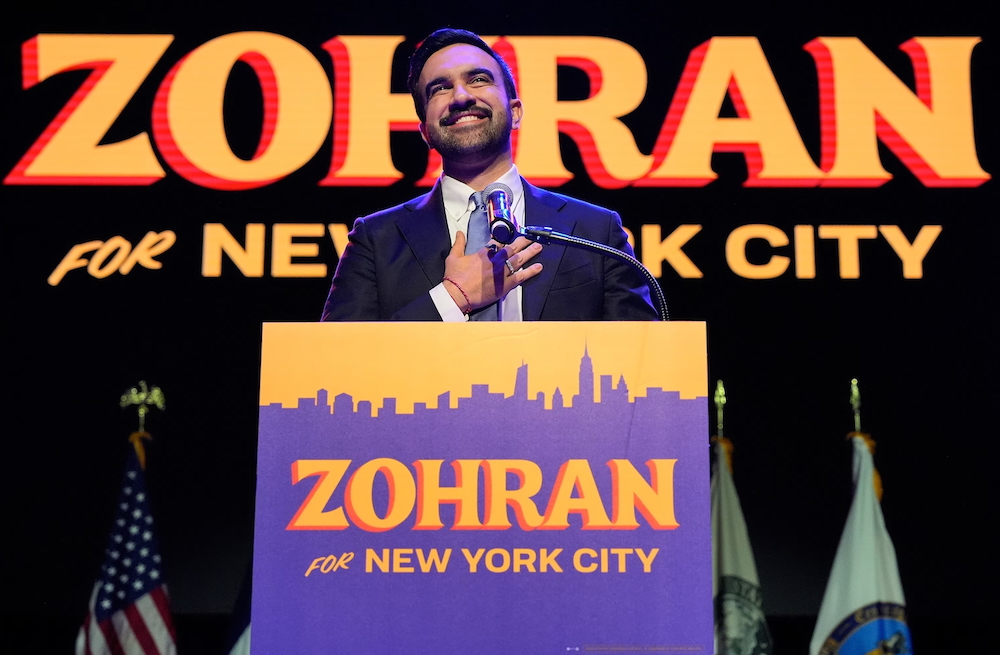
Inspired by Anil’s hope for an “easter egg breakdown” of the mayor-elect’s victory speech, I spent some time digging in. I know there’s more that I’ve missed, add your own in the comments below.
For as long as we can remember, the working people of New York have been told by the wealthy and the well-connected that power does not belong in their hands.
Fingers bruised from lifting boxes on the warehouse floor, palms calloused from delivery bike handlebars, knuckles scarred with kitchen burns: these are not hands that have been allowed to hold power. And yet, over the last 12 months, you have dared to reach for something greater.
Tonight, against all odds, we have grasped it. The future is in our hands. My friends, we have toppled a political dynasty.
I wish Andrew Cuomo only the best in private life. But let tonight be the final time I utter his name, as we turn the page on a politics that abandons the many and answers only to the few. New York, tonight you have delivered. A mandate for change. A mandate for a new kind of politics. A mandate for a city we can afford. And a mandate for a government that delivers exactly that.
On 1 January, I will be sworn in as the mayor of New York City. And that is because of you. So before I say anything else, I must say this: thank you. Thank you to the next generation of New Yorkers who refuse to accept that the promise of a better future was a relic of the past.
You showed that when politics speaks to you without condescension, we can usher in a new era of leadership. We will fight for you, because we are you.
Thank you to those so often forgotten by the politics of our city, who made this movement their own. I speak of Yemeni bodega owners and Mexican abuelas. Senegalese taxi drivers and Uzbek nurses. Trinidadian line cooks and Ethiopian aunties. Yes, aunties.
To every New Yorker in Kensington and Midwood and Hunts Point, know this: this city is your city, and this democracy is yours too. This campaign is about people like Wesley, an 1199 organizer I met outside of Elmhurst hospital on Thursday night. A New Yorker who lives elsewhere, who commutes two hours each way from Pennsylvania because rent is too expensive in this city.
It’s about people like the woman I met on the Bx33 years ago who said to me: “I used to love New York, but now it’s just where I live.” And it’s about people like Richard, the taxi driver I went on a 15-day hunger strike with outside of City Hall, who still has to drive his cab seven days a week. My brother, we are in City Hall now.
This victory is for all of them. And it’s for all of you, the more than 100,000 volunteers who built this campaign into an unstoppable force. Because of you, we will make this city one that working people can love and live in again. With every door knocked, every petition signature earned, and every hard-earned conversation, you eroded the cynicism that has come to define our politics.
Now, I know that I have asked for much from you over this last year. Time and again, you have answered my calls – but I have one final request. New York City, breathe this moment in. We have held our breath for longer than we know.
We have held it in anticipation of defeat, held it because the air has been knocked out of our lungs too many times to count, held it because we cannot afford to exhale. Thanks to all of those who sacrificed so much. We are breathing in the air of a city that has been reborn.
To my campaign team, who believed when no one else did and who took an electoral project and turned it into so much more: I will never be able to express the depth of my gratitude. You can sleep now.
To my parents, mama and baba: You have made me into the man I am today. I am so proud to be your son. And to my incredible wife, Rama, hayati: There is no one I would rather have by my side in this moment, and in every moment.
To every New Yorker – whether you voted for me, for one of my opponents or felt too disappointed by politics to vote at all – thank you for the opportunity to prove myself worthy of your trust. I will wake each morning with a singular purpose: to make this city better for you than it was the day before.
There are many who thought this day would never come, who feared that we would be condemned only to a future of less, with every election consigning us simply to more of the same.
And there are others who see politics today as too cruel for the flame of hope to still burn. New York, we have answered those fears.
Tonight we have spoken in a clear voice. Hope is alive. Hope is a decision that tens of thousands of New Yorkers made day after day, volunteer shift after volunteer shift, despite attack ad after attack ad. More than a million of us stood in our churches, in gymnasiums, in community centers, as we filled in the ledger of democracy.
And while we cast our ballots alone, we chose hope together. Hope over tyranny. Hope over big money and small ideas. Hope over despair. We won because New Yorkers allowed themselves to hope that the impossible could be made possible. And we won because we insisted that no longer would politics be something that is done to us. Now, it is something that we do.
Tonight we have stepped out from the old into the new. So let us speak now, with clarity and conviction that cannot be misunderstood, about what this new age will deliver, and for whom.
This will be an age where New Yorkers expect from their leaders a bold vision of what we will achieve, rather than a list of excuses for what we are too timid to attempt. Central to that vision will be the most ambitious agenda to tackle the cost-of-living crisis that this city has seen since the days of Fiorello La Guardia: an agenda that will freeze the rents for more than 2 million rent-stabilized tenants, make buses fast and free, and deliver universal childcare across our city.
Years from now, may our only regret be that this day took so long to come. This new age will be one of relentless improvement. We will hire thousands more teachers. We will cut waste from a bloated bureaucracy. We will work tirelessly to make lights shine again in the hallways of NYCHA developments where they have long flickered.
Safety and justice will go hand in hand as we work with police officers to reduce crime and create a department of community safety that tackles the mental health crisis and homelessness crises head on. Excellence will become the expectation across government, not the exception. In this new age we make for ourselves, we will refuse to allow those who traffic in division and hate to pit us against one another.
In this moment of political darkness, New York will be the light. Here, we believe in standing up for those we love, whether you are an immigrant, a member of the trans community, one of the many Black women that Donald Trump has fired from a federal job, a single mom still waiting for the cost of groceries to go down, or anyone else with their back against the wall. Your struggle is ours, too.
And we will build a City Hall that stands steadfast alongside Jewish New Yorkers and does not waver in the fight against the scourge of antisemitism. Where the more than 1 million Muslims know that they belong – not just in the five boroughs of this city, but in the halls of power.
No more will New York be a city where you can traffic in Islamophobia and win an election. This new age will be defined by a competence and a compassion that have too long been placed at odds with one another. We will prove that there is no problem too large for government to solve, and no concern too small for it to care about.
For years, those in City Hall have only helped those who can help them. But on 1 January, we will usher in a city government that helps everyone.
Now, I know that many have heard our message only through the prism of misinformation. Tens of millions of dollars have been spent to redefine reality and to convince our neighbors that this new age is something that should frighten them. As has so often occurred, the billionaire class has sought to convince those making $30 an hour that their enemies are those earning $20 an hour.
They want the people to fight amongst ourselves so that we remain distracted from the work of remaking a long-broken system. We refuse to let them dictate the rules of the game any more. They can play by the same rules as the rest of us.
Together, we will usher in a generation of change. And if we embrace this brave new course, rather than fleeing from it, we can respond to oligarchy and authoritarianism with the strength it fears, not the appeasement it craves.
After all, if anyone can show a nation betrayed by Donald Trump how to defeat him, it is the city that gave rise to him. And if there is any way to terrify a despot, it is by dismantling the very conditions that allowed him to accumulate power.
This is not only how we stop Trump; it’s how we stop the next one. So, Donald Trump, since I know you’re watching, I have four words for you: Turn the volume up.
We will hold bad landlords to account because the Donald Trumps of our city have grown far too comfortable taking advantage of their tenants. We will put an end to the culture of corruption that has allowed billionaires like Trump to evade taxation and exploit tax breaks. We will stand alongside unions and expand labor protections because we know, just as Donald Trump does, that when working people have ironclad rights, the bosses who seek to extort them become very small indeed.
New York will remain a city of immigrants: a city built by immigrants, powered by immigrants and, as of tonight, led by an immigrant.
So hear me, President Trump, when I say this: to get to any of us, you will have to get through all of us. When we enter City Hall in 58 days, expectations will be high. We will meet them. A great New Yorker once said that while you campaign in poetry, you govern in prose.
If that must be true, let the prose we write still rhyme, and let us build a shining city for all. And we must chart a new path, as bold as the one we have already traveled. After all, the conventional wisdom would tell you that I am far from the perfect candidate.
I am young, despite my best efforts to grow older. I am Muslim. I am a democratic socialist. And most damning of all, I refuse to apologize for any of this.
And yet, if tonight teaches us anything, it is that convention has held us back. We have bowed at the altar of caution, and we have paid a mighty price. Too many working people cannot recognize themselves in our party, and too many among us have turned to the right for answers to why they’ve been left behind.
We will leave mediocrity in our past. No longer will we have to open a history book for proof that Democrats can dare to be great.
Our greatness will be anything but abstract. It will be felt by every rent-stabilized tenant who wakes up on the first of every month knowing the amount they’re going to pay hasn’t soared since the month before. It will be felt by each grandparent who can afford to stay in the home they have worked for, and whose grandchildren live nearby because the cost of childcare didn’t send them to Long Island.
It will be felt by the single mother who is safe on her commute and whose bus runs fast enough that she doesn’t have to rush school drop-off to make it to work on time. And it will be felt when New Yorkers open their newspapers in the morning and read headlines of success, not scandal.
Most of all, it will be felt by each New Yorker when the city they love finally loves them back.
Let the words we’ve spoken together, the dreams we’ve dreamt together, become the agenda we deliver together. New York, this power, it’s yours. This city belongs to you.
It was one of those nights New York throws at you in midwinter, minus seventeen degrees, the kind of cold that silences everything. Pianist Gohei Nishikawa was home alone, the TV murmuring in the background, when he realized too late that he’d forgotten to lock his front door.
The sound came first, a soft rattle, the kind of noise that pulls you out of your half-attentive state. Then, before he could even reach the hallway, the door burst open. Two men shoved their way in, one an older, broad-shouldered African-American; the other, tall and wiry, maybe Latino, definitely younger. Neither had a gun. Instead, one held up a clear plastic case with a syringe inside, the kind of improvised threat that feels even more dangerous for its uncertainty.
Gohei froze, hands instinctively in the air. The younger man started sweeping through drawers and shelves, stuffing things into a bag, an iPad, wallet, whatever he could grab. The fear was real, sharp as the wind outside. But then, as the adrenaline began to settle, something unexpected rose in him, curiosity.
He had once studied to be a teacher before his life turned to music, early childhood education, educational psychology. He found himself wondering, what kind of childhood leads someone to walk into a stranger’s apartment with a syringe?
Against every instinct of self-preservation, he asked.
“Can I ask you something?”
The younger man barked back, “Shut up!” His voice was rough, not just angry but wounded. Gohei apologized. “I was just wondering what kind of childhood you had.”
That question hung in the air. The man froze, then finally said, almost quietly,
“You know pain?”
“What kind of pain?”
“I was four,” the man said. “My real mom used to beat me. Then I got put in foster care. My parents left me. I was homeless. You know that kind of pain?”
Gohei, who’d spent years teaching four- and five-year-olds, felt tears sting his eyes. “You’ve been through a lot,” he said softly. “Take whatever you need.”
They did, even started to haul out the TV. But watching their backs, he felt something else: not fear, but a strange tenderness. If that’s the life they’ve lived, he thought, maybe this is the only way they know to keep living.
He surprised himself again:
“Can I give you a hug?”
“Don’t come closer!” they shouted.
Then the older man, the one holding the syringe, asked,
“You Japanese?”
“Yes,” Gohei said.
“I like Japanese people,” the man said gruffly, “You all got a kind culture.”
Something about that moment — there, with his hands still raised — felt absurd and profound at once. Complimented on his culture by the man robbing him. So very New York.
And so, in perfect Japanese fashion, he made an offer.
“I have some green tea from Japan. Would you like to try it?”
To his shock, they both said yes.
He boiled water, his hands trembling so badly the kettle clattered, and brought out some rice crackers. When they smiled and said thank you, he found himself laughing too. They talked. And kept talking. For eight hours.
At some point, they noticed a poster on his wall of a Carnegie Hall performance.
“You played there?” “In the small hall.” “What’s that? There’s a small one?”
He explained, and the older man admitted he’d never been inside a concert hall, only ever seen one from the outside. The younger one said quietly, “It’s my birthday today. Play something.”
So Gohei sat down at his piano and played Happy Birthday. The man cried.
“No one’s ever played for me before,” he said.
Gohei kept playing — a full hour of impromptu recital in the dead of night for two men who’d broken into his home. When he finished, he realized it was still below freezing outside.
“You can’t go out there like that,” he said. “Why not take a hot bath first.”
That’s when the miracle happened. The two robbers, noticing his broken heater, started fixing it. Then they repaired a loose window latch, warning him, half-joking, “A thief could get in through this!”
When they finally left, they hugged him, their idea this time. The older man looked him in the eye and said,
“Yo — lock your damn door next time.”
They made two promises that night: He wouldn’t call the police, and they’d find honest work.
“If I ever get to play in Carnegie’s main hall,” Gohei said, “I’ll invite you both as VIP guests.”
They exchanged phone numbers.
A year passed. One morning, Gohei’s phone lit up with a message:
“Am I still invited?”
The sender’s name read simply: Dorobō — “Thief.”
He’d seen Gohei’s Christmas concert on TV — a solo performance at Carnegie Hall’s main stage.
“Congratulations,” the message said. “I’m still waiting for my invitation.”
Gohei called the concert organizer, explained everything. The response was pure New York pragmatism:
“You made a promise. Keep it.”
And so, he did. The two men came, wearing suits. They sat in the same box seats once reserved for presidents and royalty. Afterward, they sent a long email:
“Thank you. I’ve been working in cleaning since then, saving money. I finally bought a used car, Made in Japan. I wanted to show you.”
Gohei laughs now when he tells the story. People ask if he made it up. He didn’t.
“I don’t know if it was the right thing to do,” he says. “But I learned that night — if you try to understand someone instead of hating them, things somehow work out.”
Later, one of the men told him he was the first person ever to ask about their childhood. The first who didn’t shut him out.
Somewhere in New Jersey, one of those men, maybe both, is still out there, driving a secondhand Japanese car, cleaning office buildings. And every once in a while, a pianist in New York remembers a winter night when a robbery turned into something like grace.
This post is a translated transcription of an Instagram reel excerpt from an story told by pianist Gohei Nishikawa. I used Summary AI to transcribe the Japanese text and Chat GPT to translate the dialog into English and transform it into a blog post “in the style of Ian Kennedy’s blog everwas.com” which I lightly edited (mostly removing the em-dashes).
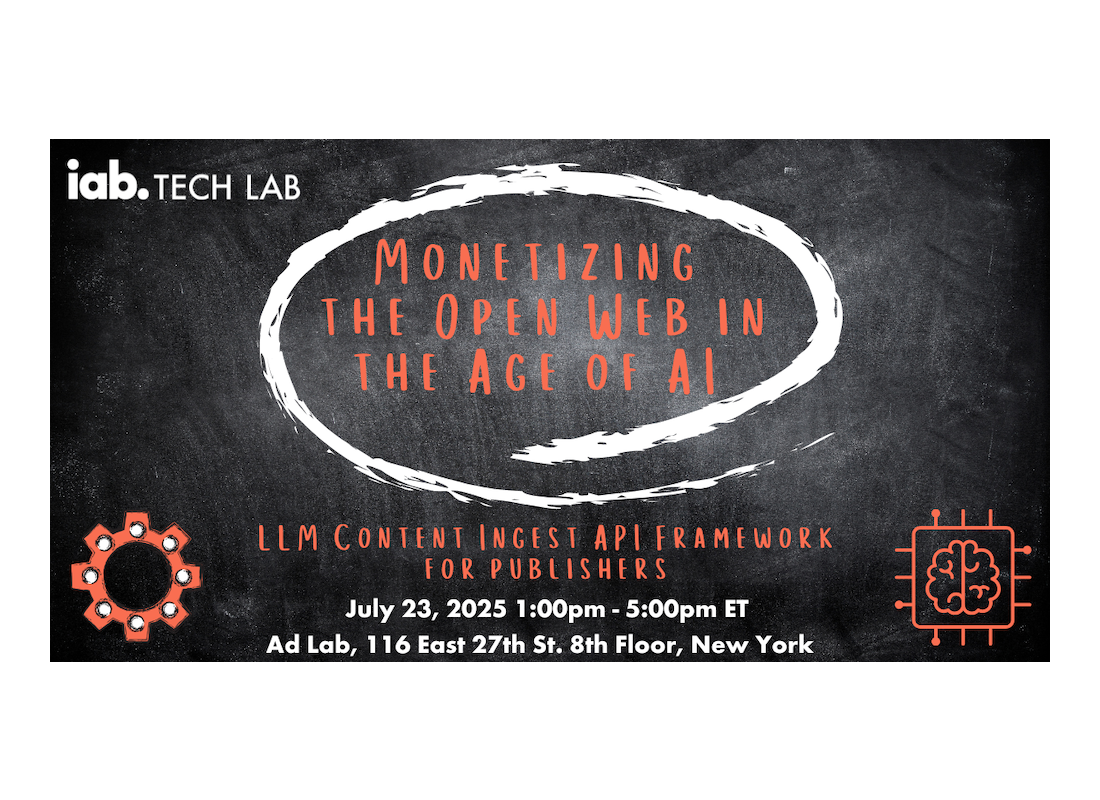
I was fortunate to be invited last week to the kick off meeting for an IAB Tech Lab task force dedicated to establishing a framework for Monetizing the Open Web in the age of AI.
The accelerated use of tools such as OpenAI’s Chat GPT, MSN’s CoPilot and Google’s AI Overview has precipitated a re-thinking of how publishers are compensated for their work. While the conversation is only just beginning, this group outlined concrete suggestions to the challenges ahead.
Publishers must work together to stem the flow of unlicensed content.
As long as information is readily available and free, there is no incentive to drive demand. Unless you limit supply, you cannot derive value. Content Delivery Networks (CDN) such as CloudFlare and Fastly are on the front lines as they see the majority of requests & responses across their networks. They have noted the sharp increase in AI-bot traffic and have the expertise in the blocking and tackling of the thousands of bots and spiders.
TollBit is keeping track of the AI crawlers with their quarterly State of the Bot reports
Publishers in the room are anticipating a world where the value of a search result on Google is less than the value of licensed access from an AI Agent. In such a world, it would be prudent to default to denying access to all crawlers in favor of direct access by verified, registered readers or licensed partners.
Old methods such as robots.txt and user-agent/IP address blocking filters are readily ignored or spoofed by long-tail startups scrambling to serve their users. More secure methods are necessary. “Get a better lock on your door.” says Jon Roberts, Chief Innovation Officer at DotDash Meredith.
Establish a marketplace for publisher information that can scale to serve AI Agents.
While CloudFlare’s Cost-Per-Crawl implementation redirects crawlers to a 402 HTTP error page to redirect AI developers to licensing information, TollBit and Dappier are building the first marketplaces for publisher libraries as a proof-of-concept as a bridge from the search engine results of the past to the marketplace of the future.
A search for the past 25 years returned 10 blue links of which a human might read 1 or 2 links. This referral traffic was the currency of the old internet. This attention could be monetized any number of ways.
Google owned this marketplace.
Now imagine a world where a query by an AI Agent may spawn 20-50 queries of which *every* article is scanned and synthesized into a single response. Ads and subscription funnels on these pages are ignored. There needs to be a different pricing model for this traffic. Source material will not be a “page” but could be a snippet of video, a schematic blueprint, a sound bite, or a product spec. The pricing model in this “marketplace of everything” needs to recognize and support dynamically pricing requests based on who is requesting it and in what format, all in real-time.
The programmatic advertising ecosystem which has been the engine driving the growth of online publishing for the past 25 years was subsidized by advertisers bidding for a reader’s attention on a web page. An entire tech-stack was built to serve up the right ad for the right audience at the right time, all in under 500 ms.
With AI Agents, you have readers paying directly for content with their subscriptions (Chat GPT Pro is $200/month) and the AI Agent is acting as a proxy on their behalf. Once publishers have successfully shut off the free flow of their content, accurate, reliable, and up-to-date information will accrue value. In this world, there will be need for a real time marketplace to handle the access and metering of content and this system will need to be built to the same scale and performance of the programmatic advertising platforms of today.
No one owns this ecosystem.
Tokenization – core components to a market
The final step, once you have established a way to meter (cost-per-crawl, cost-per-query or some other subscription model) access to a publisher’s library, is to establish a standardized way to track and count content as it travels through the ecosystem from a publisher to the AI platform.
Tokenization is this final step. Once an AI has asked for something, the response needs to be tokenized in such a way to properly attribute credit as well as track the usage of that content not only to the initial query but in all future derivative uses.
ProRata has a working implementation of this tracking in their Gist Answers, distributed search widget. “If you can track it, you can charge for it.” they say as their IP is focused on the attribution of AI responses from their network of publishers.
TollBit has one-time use tokens for access and are setting up a system where an AI Agent can query for information, inquire about pricing, and generate and receive a token to retrieve the information as needed, on demand.
All these are approaches to the same problem and my company, SimpleFeed, aims to participate in the delivery of publisher content, whether it be tokenized, vectorized (to assist in discovery), or otherwise value-added with filtering and meta-data augmentation as we have been doing for 20+ years.
I look forward to staying engaged with the individuals and companies that were gathered for this workshop. AI summarization is rapidly tearing down a business model that has worked for decades. Unless there is an agreed upon business model that is accessible to all players including small publishers and long-tail AI startups, we may lose the diversity of opinions and perspectives that have given us the open web we currently enjoy.
It makes sense that IAB, an industry group that helped establish standards around online advertising, is taking the first steps to establish standards around the AI Agentic web of the future. I thank them for taking this first important step of getting all the players in the room together and publishing the first framework for publisher content monetization and brand content management for LLMs and AI agents.
Publishers underwrite new projects based on forward-looking financials. If nothing is done to improve the economics of publishing online today, the investigative reporting of the future will not be funded and we will all be poorer for it.
At 1pm today, there is a kick-off meeting (page has a YouTube link to view remotely) to discuss the mandated public information sessions and other aspects of the Community Advisory Committee (CAC). The six member of the CAC will ultimately recommend the project to the New York Gaming Facility Location Board and help determine which three (out of eight) applicants ultimately receive a casino license.
If you have any interest in this project, I would encourage you to learn more by viewing the livestream. Work will keep me from watching but I would love to hear what you think.
I have been curating updates and collecting links to information and resources about the Freedom Plaza project to develop a casino complex on the East River, just down the street from the UN.
Cloudflare sees about 20% of the world’s internet traffic cross its network. Matthew Prince, CloudFlare’s CEO, has a pretty good handle on trending internet behavior.
In the video below, he summarizes the impact of AI “answer engines” that summarize what they find in response to questions put into AI chatbots such as Google’s AI Overview or Open AI’s Chat GPT.
What he concludes is that the exchange that allowed the search engines to index a site in return for referred pageviews is no longer equitable and is growing increasingly lopsided.
The data, according to Cloudflare;
10 years ago: Google crawled 2 pages per visitor
6 months ago: Google 6:1, OpenAI 250:1, Anthropic 6,000:1
Present: Google 18:1, OpenAI 1,500:1, Anthropic 60,000:1
No one is saying is what we all know in our hearts. No one is clicking through to the footnoted sites on an Answer Engine. The AI crawlers are taking more than they are giving back.
It’s worth watching the entirety of Matthew’s talk in context of an announcement he references in the video. I expect it will be something related to their Bot Management suite. But I also look forward to hearing more about CloudFlare’s vision to remake the internet into one that rewards knowledge creation.
While the introduction of AI Answer Engines is a current and immediate threat to the online publishing ecosystem as we have known it, there is a nascent opportunity to re-build the internet on a new ecosystem built around different incentives.
Slide from a presentation on rebuilding an internet that rewards knowledge, not attention
What if we rebuilt the internet into one that rewarded Knowledge and not Attention. The “attention economy” brought us clickbait and distraction. What if we rebuilt the internet into one that rewarded publishers that gave more than they took away? Am I naive?
I am looking forward to learning more about CloudFlare’s plan.
Back then, pundits were concerned Google was taking on a whole host of potential copyright-infringement lawsuits as YouTube was chock full of pirated videos. YouTube has since built a sophisticated copyright detection algorithm that does a pretty good job of detecting not only pirated videos but also when copyrighted music is used as a video soundtrack.
Could the same be said for the potential acquisition of Perplexity? While all LLMs share an index made up of the common crawl and anything else they can find on the open internet, will Perplexity’s vectorized index of exclusively licensed news sources drive enough usage and value to a potential acquirer?
While YouTube’s pre-acquisition copyright concerns ended up being nothing more than a speed bump, it eventually started a formalized conversation around formally licensing content. Could Perplexity’s fledging licensing program be the start of a more sustainable way grow the new AI ecosystem?
Cookie Consent
We use cookies to improve your experience on our site. By using our site, you consent to cookies.
Used to distinguish new sessions and visits. This cookie is set when the GA.js javascript library is loaded and there is no existing __utmb cookie. The cookie is updated every time data is sent to the Google Analytics server.
30 minutes after last activity
__utmc
Used only with old Urchin versions of Google Analytics and not with GA.js. Was used to distinguish between new sessions and visits at the end of a session.
End of session (browser)
__utmz
Contains information about the traffic source or campaign that directed user to the website. The cookie is set when the GA.js javascript is loaded and updated when data is sent to the Google Anaytics server
6 months after last activity
__utmv
Contains custom information set by the web developer via the _setCustomVar method in Google Analytics. This cookie is updated every time new data is sent to the Google Analytics server.
2 years after last activity
__utmx
Used to determine whether a user is included in an A / B or Multivariate test.
18 months
_ga
ID used to identify users
2 years
_gali
Used by Google Analytics to determine which links on a page are being clicked
30 seconds
_ga_
ID used to identify users
2 years
_gid
ID used to identify users for 24 hours after last activity
24 hours
_gat
Used to monitor number of Google Analytics server requests when using Google Tag Manager
1 minute
_gac_
Contains information related to marketing campaigns of the user. These are shared with Google AdWords / Google Ads when the Google Ads and Google Analytics accounts are linked together.
90 days
__utma
ID used to identify users and sessions
2 years after last activity
__utmt
Used to monitor number of Google Analytics server requests
10 minutes
You can find more information in our About Me and .