Following up on yesterday’s post about more unique uses for GPS, here’s some stuff I’m running on my Nokia E71 which I’m finding really useful.
Traffic Pilot – download the client to your phone and turn it into a traffic sensor. When running, your location is tracked and used to determine average speed. Crowdsourcing everyone who is running Traffic Pilot is then used to figure out if a road is congested or not. I’ve been using Traffic Pilot for the past few weeks and comparing it to traffic reports on NPR and KCBS and it’s often determined congestion before the incidents are reported on the radio.
Included is a link to “Traffic Report” which will read off conditions for the roads in your area with a helpful scroll bar so you can rewind back if you miss something. Coming soon, Traffic Pilot will use your daily commute patterns to learn which routes you take and send you an SMS if there’s any trouble reported on any of the routes.
Screenshot – useful tool I found to take screenshots of your cellphone screens. It’s not “signed” for the E71 so you need to use the Symbian Signed site to upload the .sis file and get a link to a signed versionThere’s no “camera” key on the E71 so you need to change the default. I use the Backspace key with the 2 second timer.
Google Maps with Streetview – it’s now out for Nokia’s Symbian OS. Figure out what that dive bar your friend told you about looks like from the street.
Skype Lite – for low-cost international dialing. I use it when connected via wi-fi.
Sports Tracker tracks your workouts and plots them on a map which you can share with your buddies. You need a MicroSD memory card (SanDisk 8GB microSD) to run it for some reason. Nokia Research is hosting a version of Sports Tracker that runs on an E71.
Be sure to check out the Solace theme which brings in all the N86 icons and adds a nice gloss to the menus.
I was going to write a post about all the amazing phones I saw last week while I was in Japan but this morning’s announcement of the latest Nokia device trumps that. Techmeme is smothered with coverage.
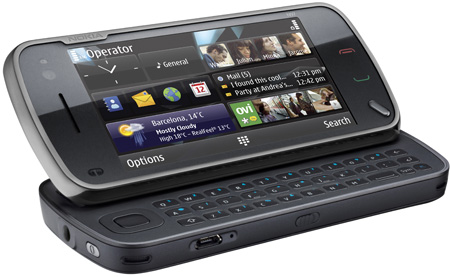
Nokia N97
I’ve been watching the convergence of the smartphone and laptop computer into a single device called a netbook. While Verizon is subsidizing Dell netbooks, Japan’s EMobile will give you an Acer netbook for $100 if you sign up with them. Instead of jamming a desktop OS into a tiny form factor, Nokia is approaching it from another angle and building from the mobile device up with a collection of swappable widgets.
The difference in approach is that a tiny laptop netbook is designed to run client software while the powerful phone netbook is designed to be an extension of web services that you run out of the cloud, optimized with GPS sensors and a camera for data capture.
“A netbook is for the coffee shop or airplane or subway ride. For watching a movie, checking email, updating Twitter, fast, mobile stuff,” writes Dave Winer. For that, I think the N97 fits the bill quite nicely.
I know nothing about the rumors swirling around Nokia launching an MVNO in Tokyo for their high-end Vertu brand but a quick poke around the vertu.com gives you a sense of what (besides diamond encrusted phones) a high end cell phone service would entail.
Check out the Services layer, here’s the text for the Vertu Fortress Contacts & Calendar backup service.
From anywhere in the world, a single click backs up your data to ultra-secure severs maintained in an ex-military underground bunker in England.
Getting up to speed here at Nokia after joining three days ago – lots of institutional knowledge tucked away across the intranet which features a bewildering array of internal blogs, wikis, and video archives. One thing I immediately notice is that the average age of people who work here in the Mountain View office is older than that at Yahoo. There’s a historical perspective to what they build which informs what they do so it’s sensitive to regional and generational needs and practices.
A colleague recently passed around a link to a Wired article that lamented that modern day social networks have killed the ability to “lose touch” with a friend and let them fade into the background. Instead we have to take action and ban, block, or un-friend them which seems a bit rash (especially when services such as Qwitter tell you when someone has un-subscribed). It’s like shouting out to someone, “You’re not my friend!”
From my perspective, Nokia is very interested in the social impacts of the tools that they build. For instance, on the drive down I was listening to Matt Locke talk about how people have collectively “hacked” social gestures for the introduction of mobile phones into society. The phone booth that we would use to exit a public space to make a phone call evolved into a “hood” structure. With cell phones we used to cup our mouth or duck our head to indicate we were on the phone but now have evolved (?) into talking freely in the clear while sporting a blinking Bluetooth headset. It is still early days with regards to social networks. We haven’t evolved a similar set of shared gestures beyond perhaps the @reply which is really only understood by a tweetist.
When I was a kid we had to network socially by punching a random bunch of digits into a keypad, (or twirling a dial with your finger – a dial!) picking up a big clumsy plastic thing attached to a squiggly wire, and speaking into it. If you were lucky your buddy was on the other end. Worse, it was done one person at a time! You kids never had it so good!
Updating my Facebook profile to reflect my new employer, I notice that I know no one here at Nokia. I have a list of people my manager recommend that I sync up with to soak up the lay of the land – should I use the phone, email or maybe Facebook?
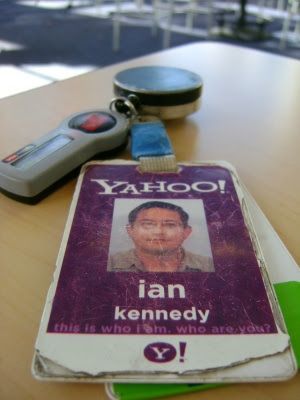
On Friday I’ll hand over my badge, laptop, and Blackberry, finishing up three years at Yahoo. I’m leaving MyBlogLog in the good hands of Todd Sampson to drive the product vision and manage the engineering team and Tilly McLain who will look over the day-to-day care and feeding of the site and community.
My self-proclaimed tag line on the internal company directory is turning Yahoo inside out. This has been my personal mission since I joined Yahoo a little over three years ago. There is great stuff to be shared at Yahoo, as long as you let people get to it in a way that’s useful to them.
I enjoyed working with people who shared my passion to transform Yahoo into to a modern platform. It hasn’t been easy – opening up programmatic access to Yahoo is fraught with many built-in conflicts. Third party content licenses, traffic guarantees, and international legal constraints all make it difficult to let services flow completely free. It’s an industry-wide problem. Much of the way the advertising industry measures the impact of their online campaigns is rooted in the pageview metric which runs counter to providing the best of what you’ve got via an API call. For folks such as ComScore (who help advertisers evaluate rates) an API call doesn’t count as a pageview or roll up into a CPM so it’s a hard to argue letting people get at data without forcing them to come to a pageview to get it.
But consumer demand on the internet is like a natural force. If you don’t go with the flow, the market will route around until it finds what it needs. As with ripped music files, if you don’t provide your data via an API and figure out how to build a business off of that, folks will scrape your pages or go to your competitor. Yahoo gets this and there are many people working to provide a structured way to get at their data in a sustainable way that can guarantee that they will be able to continue to provide it. Pay a visit to the Yahoo Developer Network site to see what’s there and watch this space as there’s more in the queue.
With this as a backdrop, I was invited to take my thinking to a new company and a new industry. In a few weeks I’ll be joining Nokia and working to make their devices more socially aware. The Nokia s60, iPhone, Blackberry and Android (rumored) application stores give us developer ecosystems around each device. What will the world be like when devices can communicate with each other via social networks, across device platforms, across mobile carrier networks? Much the same way the web browser has unified communication across Mac & PC, the mobile web will do the same for “broadband-enabled” cell phones. Add GPS (location), Bluetooth (proximity), integrated camera/video and a voice interface and you’ve got a whole new set of opportunities that are just too good to pass up.
Imagine this use case. Your phone knows your alarm goes off at 6am every morning, that you drive the San Mateo bridge every weekday on your way to work at around 7:30am. It’s entirely possible for your phone to automatically check traffic conditions before you leave sometime after you awake and let you know that there is heavier than normal traffic and suggest an alternate route and read it out to you in a phone call, while you drive. If you’ve got your calendar in there, there is no reason that your phone can’t offer to call ahead and let the people in your first meeting know that you’re running late. All the pieces are in place to make this happen, automatically, right on your device. That’s the kind of service that will enhance your life, that’s the kind of service suite I’m excited to build.
Thank you to everyone who lent an ear to my crazy talk in the early days and pointed me to others who would listen and helped me build a band of believers. A nowhere near complete list of shout outs include:
Toby Coppel, Gerry Horkin, Dave Vockell, Gil Ben-Artzy, and David Katz, who took me under their wing in Corporate Development and helped me refine my message into bite-sized Powerpoint presentations and introduced me to the Harvey Ball.
Sumit Chachra, Aaron Stein, Josh Rangsikitpho, John Lindal, Josh Blatt, Cody Simms and others who fought the good fight down in Burbank.
Finally, thank you to my kids who taught me to look at social networks in a new light and and my wife who kept the family ticking and the home fires burning through it all.
For those interested in peering into a subset of what inspires me, here’s a sample of my OPML file. Keep up the good work Marshall,Louis, and Mark.
I’m going to take a week off to re-charge before the new gig kicks off at the Nokia offices in Mountain View. I’m looking forward to working with one of the original Yahoo bloggers, Russell Beattie. It’s been awhile since I’ve been a regular in the South Bay so if you’re interested in getting together, drop me a line.
In the shadow of today’s G-Phone and Android news, there’s some great stuff being posted over at Nokia’s Conversations blog about their annual The Way we Live Next conference in Finland. I’ve been thinking a lot about the potential of mobile lately. With the addition of location contexts and mobility, the benefits of a true mobile internet look to me to be as quantum a leap for society as when we all first plugged a modem into our PC and jacked in to the web.
Here’s some cool stuff in the labs:
Traffic Works – 100 GPS-enabled phones used to monitor real-time traffic conditions. After a successful field trial in Northern California, next step would be to integrate smartphone schedule to, “tell you about a traffic problem before you leave the house.” It’s similar to Dash but this is software that works on a standard, GPS-enabled phone. How about applying the same distributed network to monitor and predict the weather?
What about using built-in stress sensors which look at things like pulse to determine the stress levels in different areas of the city? You could use it to track crime hotspots (or surly Starbucks baristas). Happy City Map anyone?
Nokia adds 10 million new subscribers a month (works out to something like 14 phones/second!), much of it in places such as Africa and India where they don’t call them cellphones, they call them Nokias. As the networks grow to support them, these devices become the gateway to the internet for low income communities. Did you know that there are generator trucks that roll into town in rural India to provide phones with their weekly charge? To these folks, the cellphone is the internet. What kind of bridges can we build when your child, who has a class report on Kenya, can actually message with someone there?
Nokia’s Point and Find service is something my father, a city guide living in Tokyo, could use. Point your camera phone at an object and a combination of image recognition and GPS goes to work to give you more details about that object. It’s like using QR Codes in terms of ease-of-use but with real world objects and a rich content database on the backend.
How about taking advantage of wi-fi positioning to map out the inside of a building? Looking for a particular meeting room or where to find your seat in a football stadium? Indoor Positioning is something that could help.
Let’s not forget the obvious stuff either. John Battelle asks in the wake of the Chatsworth train wreck why there isn’t a simple speech > text, text > speech translation layer for phones.
Why I can’t simply say to my phone: “Text Michelle” and the phone gets ready to send a note to Michelle. Then I say “Mich I’d rather hit Left Bank than Ambrosia for din love you bye” and the damn text goes to Michelle?
Say Michelle is driving. Her phone buzzes with a text. She’s driving, so she says to no one in particular “Listen text”. There’s my voice! Is this too complicated to make happen? Please. It’s not.
All powerful stuff. With the bluetooth headsets everywhere, we are not too far off from the world of Arthur Dent’s babel fish.
I see that Nokia’s shipping a piece of software that in hindsight is so obvious, it’s amazing no one thought of it earlier. As onboard storage gets larger and larger (the new Nokia’s have 4GB!), the viability for the phone to double as an iPod substitute makes more and more sense. Sony played around with their memory stick but it’s a pain to have to copy files from your PC over to the stick in what’s basically a glorified floppy disk.
While I have a pretty steady collection of favorites in my Nano, I primarily listen to podcasts. Basically, updating my podcast subscriptions & recharging are the only reasons I synch up my iPod on a daily basis. What if we were able to break the cord?
MobileCrunch reports that Nokia announced development of new software that will pull down podcast subscriptions into the phone. We all have cell phones charging up on our bedside table. What if you could set it up to make a call in the middle of the night (when bandwidth is cheap and fast) to download your multi-megabyte podcast subscriptions? The phone companies are going to be psyched because they can put their excess bandwidth to use while using up your minutes and you’re going to be happy because maybe you can leave your iPod behind every now and then.
Used to determine whether a user is included in an A / B or Multivariate test.
18 months
_ga
ID used to identify users
2 years
_gali
Used by Google Analytics to determine which links on a page are being clicked
30 seconds
_ga_
ID used to identify users
2 years
_gid
ID used to identify users for 24 hours after last activity
24 hours
_gat
Used to monitor number of Google Analytics server requests when using Google Tag Manager
1 minute
_gac_
Contains information related to marketing campaigns of the user. These are shared with Google AdWords / Google Ads when the Google Ads and Google Analytics accounts are linked together.
90 days
__utma
ID used to identify users and sessions
2 years after last activity
__utmt
Used to monitor number of Google Analytics server requests
10 minutes
__utmb
Used to distinguish new sessions and visits. This cookie is set when the GA.js javascript library is loaded and there is no existing __utmb cookie. The cookie is updated every time data is sent to the Google Analytics server.
30 minutes after last activity
__utmc
Used only with old Urchin versions of Google Analytics and not with GA.js. Was used to distinguish between new sessions and visits at the end of a session.
End of session (browser)
__utmz
Contains information about the traffic source or campaign that directed user to the website. The cookie is set when the GA.js javascript is loaded and updated when data is sent to the Google Anaytics server
6 months after last activity
__utmv
Contains custom information set by the web developer via the _setCustomVar method in Google Analytics. This cookie is updated every time new data is sent to the Google Analytics server.
2 years after last activity
You can find more information in our About Me and .