Tag: OneTrueFan

  • MyBlogLog → OneTrueFan

    MyBlogLog → OneTrueFan

    Remember those subscriber cards you found tucked into magazines that asked questions about your income, education, sports you liked, where you traveled or what newspapers you read? The editors and advertisers of that magazine were trying to find out more about their readers. Except for the folks that took the time to write in, an editor of a print magazine knew very little about the people who read their magazine.

    Imagine if Henry Luce had access to a tool which could give him an insight to the readers of Time Magazine? What if he knew not only who was reading his magazine but also which particular articles were hitting a chord? Not only that, what if he knew what else they were reading in other magazines? Which articles did his most faithful readers found elsewhere that his reporters did not cover? This type of data would have been pure gold to the late Mr. Luce.

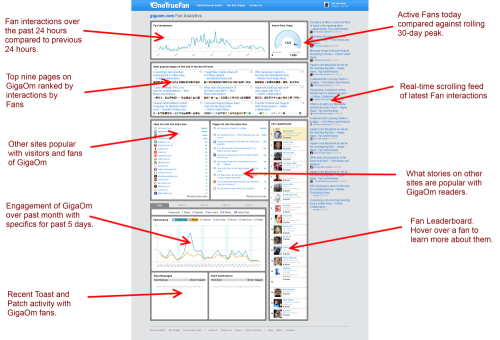
    Click for full screen image

    MyBlogLog had some of this data but it was site-specific and the service has been since scuttled by Yahoo.  The team has re-grouped and pulled another rabbit out of their hat launching Live Fan Analytics (aka: Fan-alytics) as a new approach to site metrics. MyBlogLog required site owners to install a widget on their site to reveal users that have opted in to showing up on the MyBlogLog sidebar. OneTrueFan spins that approach around and asks the readers to add an extension to their browser in order to send back their browsing behavior on any site for aggregation and show a bit of extra love for the sites they frequent.

    What’s in it for the Fans? Browse the web and have at your disposal an instant view of the last 10 fans who visited the site and articles on that site that have been shared by those readers. Also look at the top fans who visit the site the most often and see what they have shared on the site. As you browse, your history (minus any sites you choose to exclude), is fed into the OneTrueFan “panel” that helps site owners and other OTF users find interesting content. It’s like being a Nielsen family for the modern age. But there’s a bit of fun too as you’ll find yourself on the leaderboard for your favorite sites vying for the title of the OneTrueFan of that site.

    What’s in it for the site owners? Real-time reading behavior. If you install the widget, (as I do on this site) the activity of your readers is aggregated from not only browsers hitting your site but also sharing activity on social sites such as twitter and facebook. You get a more complete view of how your content is shared beyond your site and a sample of what your most avid readers like to read, in real-time.

    If your site is publishing multiple stories a day and, as editor you are always looking for the next trending story to cover, the OneTrueFan analytics dashboard is an invaluable tool to help drive your daily editorial calendar. Most blog packages allow you to “pin” a story to the top, above the fold. The dashboard will quickly tell you which ones to push to the top and which ones to let slide down on the scroll.

    As social sites begin to drive a greater portion of traffic to your site, it is vital to understand which topics resonate with your readers enough to drive them to share via these networks. OneTrueFan gives you not only quantitative stats but also the qualitative insights that you can only get from browsing the names, faces, and twitter & facebook profiles of your most avid readers. Author Kevin Kelly has a theory that any business is sustainable provided it knows how to take care of it’s most avid fans. He calls it the “1,000 True Fans” rule. OneTrueFan is a tool that will help you cultivate your true fans.

  • MyBlogLog Memorial Screenshot Gallery

    MyBlogLog Memorial Screenshot Gallery

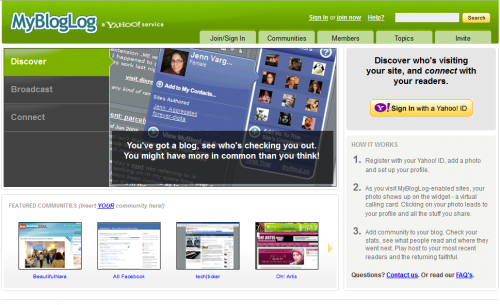
    A couple of weeks ago I grabbed a bunch of screenshots off of MyBlogLog.com. MBL is one of the services on the infamous “sunset” slide and today there is a notice on the site saying that Yahoo will pull the plug on the service on May 24th. I worked on the service before coming to Nokia and much of what I know about Activity Streams and Context Filters is informed by the work done by the excellent team there.

    The gallery below is mostly for my personal notes but I figured I’d share it as a walk down memory lane. I’ve annotated the screenshots to explain what’s going on for future reference.

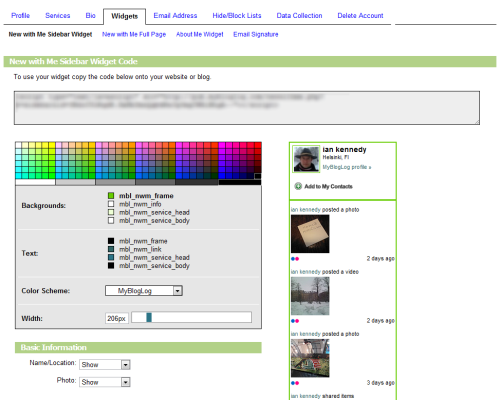
    The core of MyBlogLog was its sidebar widget that you could put on your site. When a registered user visited the site, their profile photo would show up in the widget. As you visited different sites, you’d start to see familiar faces on sites that you shared an interest making the web a much smaller, more personal, place.

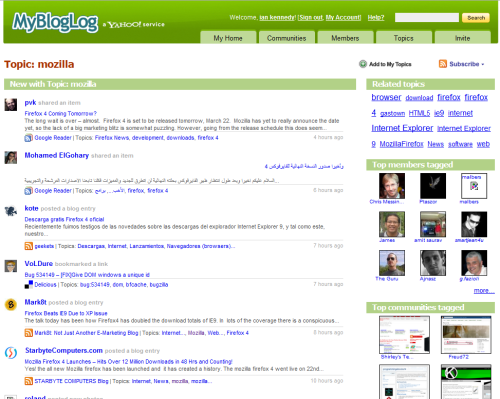
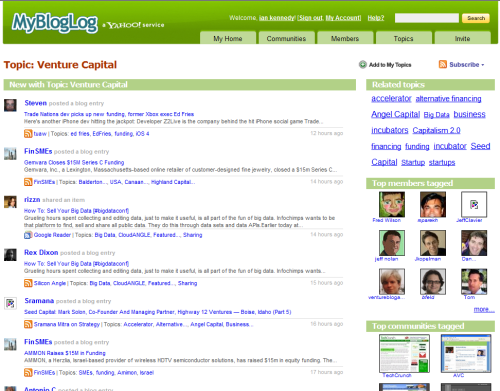
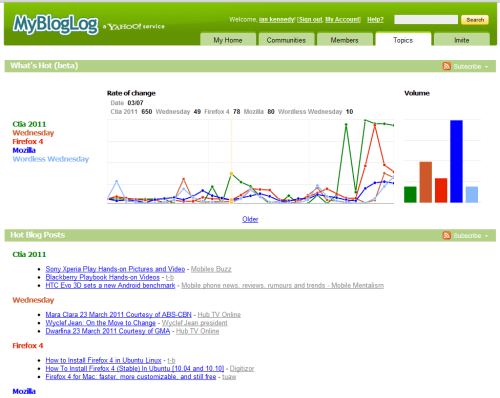
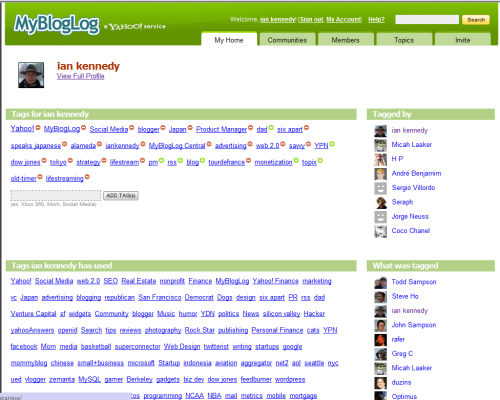
    MyBlogLog users would add their RSS and social network feeds to their profile and we would pull the tags off of each post and gather them together into profiles that would also feature a “tag cloud” of related topics, a list of bloggers and blogs that posted about the topic most often. We also experimented with ways to visualize which tags were trending across everything we were seeing.

    The end result of gathering all this data was a data rich profile page that gave us the idea for the tagline, You are what you Feed. On the profile, which was public, you could see all your social network activity gathered together in several newsfeeds.

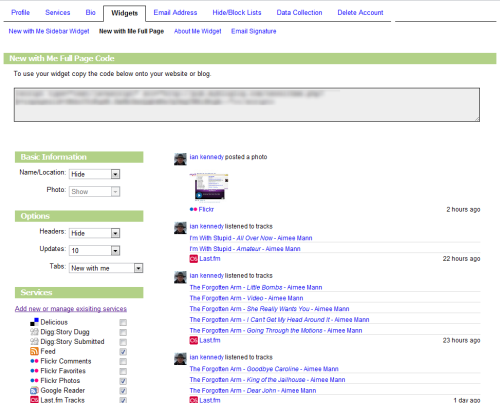
    New with Me was all your own activity, New in My Neighborhood was an aggregation of all your friends and New in My World was an aggregation of the collective posts from the entire MyBlogLog network filtered by tags that were trending in your latest posts.

    Going to other people’s pages and seeing what was New in their Neighborhood or their World was a great way to “look over the shoulder” of people you followed to see what they were reading.

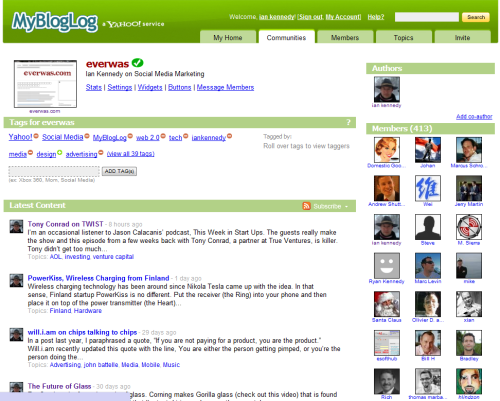
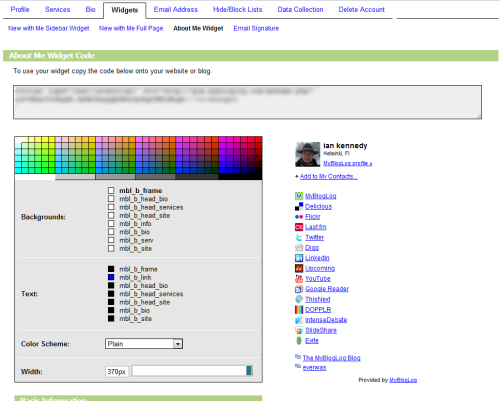
    Other elements on the profile included a list of my connections on MyBlogLog, links to my blogs and social network profiles, and blogs I visited frequently.

    We played around with the profile quite a bit and built out a page for your blog and your profile which allowed any MyBlogLog user to attach and vote on free form tags as a user-generated “folksonomy” that was all the rage back then.

    There was surprisingly little problem with spam or harassment. The web was a kinder/gentler place back then. These tags were used to build a WordPress plugin which would dynamically suggest content on a site related to your interests. For example, if Harley Davidson motorcycles was a stated interest of yours on the profile page, posts tagged with Harley Davidson would show up in the widget when you visited a site. We called it Just for You.

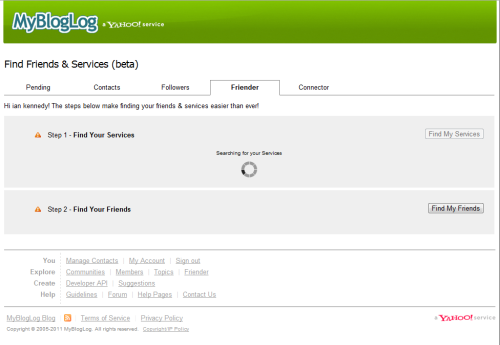
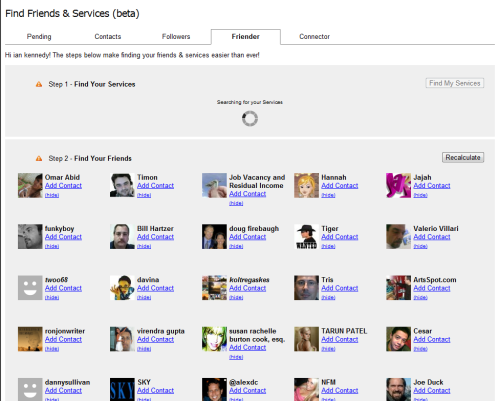
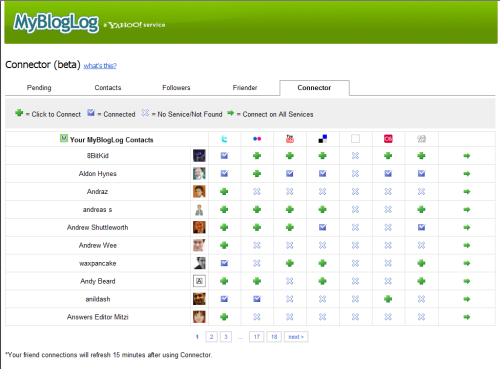
    One of the cooler things we built (and only possible when these services were more open) was the Friend Finder. If you added all your social network IDs it would then you the social graph of the service to look up your friends across services. For example, if you and Bob Jones both added all your social network IDs, it would show where you were connected and invite you to connect on other services where you were not.

    We also fully embraced the distributed web with sidebar and full-page widgets which you could embed on your site to display portions of your MyBlogLog profile that you might want to share on your site.

    As a Yahoo acquisition, we had to convert all our users to use the YahooID which took a lot of time an effort. We did get to feature our API on the Yahoo Developer Network, build a retro 404 page, and have a little fun with the opt-out page.

    Tired of twirling in stasis while Yahoo re-org’d itself, the team disbanded to go their different ways with me getting lured to Finland by Nokia and the others kicking around on their own projects (Gnip, Zentact, The DJ List to name a few).

    The team has now come back together on OneTrueFan, a browser plug-in that is similar to MyBlogLog but turned inside-out. Instead of tracking who visits your site and leaving a trail of avatars in sidebars across the web, OTF tracks which sites you visit and collects other peoples’ avatars into your browser bottom-bar so you can see who else has been to the sites you visit. I owe the guys a post on my thoughts but in the time being, check out Louis Gray’s write-up.

  • Are you a Hacker or a Hustler?

    Micah Baldwin has a great post on what it takes to make a successful startup. One of the first questions you need to ask is if you have both a Hacker and a Hustler.

    A Hacker is more than a code monkey, who can quickly build software and find interesting ways to hack together code. Thats a developer. Thats someone who is definitely an important part of a startup, but not critical to its success. A Hacker is someone who looks the problem, and solves it in a unique and special way. A Hacker finds the process of problem solving exciting and interesting, and spends the majority of their time looking at the problem in multiple ways, finding many potential solutions.

    <snip>

    A Hustler on the other other hand is a relationship builder. Someone who can build direct relationships with their customers. They arent really promoters, although they do a lot of promotion. They arent salespeople, although they do a lot of selling. They are passion people. They have the ability to articulate their passion clearly and in a way that gets other people equally passionate.

    Micah also writes about the current Posterous campaign, releasing a blog import service every few days, building buzz over the weeks. Bold and audacious the campaign has certainly generated its fair share of buzz, shaking a mostly complacent blog platform industry into reaction. The snarky headlines of each announcement are targeted perfectly towards the users of each platform and leave you wondering where they will aim next.

    Riffing ideas like two jazz musicians

    Todd Sampson and Eric Marcoullier of MyBlogLog fame are a classic Hacker & Hustler pair. It was great working with them and to see how these two childhood friends bounced ideas off of each other. Eric (the Hustler) was brilliant at latching MBL on to the latest meme trending on Techmeme as a way to garner attention and Todd (the Hacker)  never ceased to amaze me with his unique insight on the problems of the day. If you haven’t had the chance to try out their latest idea, definitely check out OneTrueFan, the browser plug-in that talks back.

    So which one are you? The Hacker or the Hustler?