Google released an amazing video showing one of their driverless car taking a blind man out to get tacos and pick up his dry cleaning. This is good.
In a tweet the other night, Twitter CEO Dick Costolo pointed to a swarm of programmable Nano Quadrotors and mused, “It’s with confidence and dread that I’m guessing the future of warfare is going to involve lots and lots of these” This is bad.
When you’ve been around long enough, you start to see old ideas, re-invented.
These guys have managed to crack the nut of how to monetize social media by charging $35 to print your twitter stream onto toilet paper which you can then use in the restroom. More details from Laughing Squid.
Roll back seven years to when RSS was all the rage and you have the following which, somehow, stuck in my memory as something I blogged about way back when.
This was slightly more ambitious because they would print the stuff right in your bathroom and offered a marketplace which allowed advertisers to buy ad space. No, I never did figure out what “biometric user identification” meant.
Twitter extended it’s partnership with American Express and building on the campaign to tap into support for local businesses with the rollout of Twitter Promoted Products. It’s a pay per-click model which can be limited by daily spend so there will be no surprises.
The video is one of the nicest product videos I’ve seen. It’s clear, concise, and speaks directly to the potential customer. The video assumes a certain familiarity with twitter so will attract only the well-versed merchants that will get the most from the program. It also has been pointed out that the video shows a bias for iPhone users as all the audio cues are prom the iPhone.
Interested? Registration is open to American Express cardholders and merchants today and if you get picked, they’ll throw $100 your way to get started.
I had a great day yesterday at the GigaOM Roadmap conference. The agenda had a number of great speakers including Brian Cheskey of AirBnB and Tony Fadell of Nest, the red hot company that is re-defining what a thermostat should look like.
The thesis the conference explored is one that Om Malik (now my boss) has put forth a number of times. If you think of the steam engine as the PC of our age and the portable version of this technology, the locomotive, as the mobile phone, what does increasing bandwidth and the enabled mobility mean for society and businesses going forward?
Each speaker chipped away at this thesis with their own slant but Jack Dorsey, as he described how Twitter has enabled empathy on a global scale and how Square has removed the barriers of a Point-of-Sale system and the, “massive counter” that sits between a customer and the vendor, more than anyone else opened my eyes to the incredible transformation going on around us.
Yet, in light of all these incredible transformations, Dorsey challenged us to maintain a balance between the “sleek, modern perfection and the rustic, zen-like chaos” and to build products that maintain this “balance in-between”. He referenced the Japanese design aesthetic of wabi-sabi (if you want to read a great book about the topic, I highly recommend Wabi-Sabi: for Artists, Designers, Poets & Philosophers).
In the end, Dorsey advised all product managers to guide themselves with these two principles.
Simplification, work real hard to get technology down to its essence (of an interaction). Take away the “conceptual debris”
Make things fun, remember to be human, relate, “have some whimsy” in your application and make it human.
The whole interview is worth a listen.
[There was a video embed below but it’s been lost to the sands of time. You can find a short transcript of the interview on this Forbes article.]
From a site called @peanutweeter which combines tweets with stills from Peanuts, updating the 1950’s comic strip to a commentary of our time.
“The site arose from the concept that the amusing and sometimes outrageous tweets out there would be even funnier or sometimes darker if they came from someone that everyone could identify with,” site creator T. Jason Agnello told Wired.com by e-mail.
I spent the year end holidays in Tokyo with family and friends. As with every visit I was blown away by the pace and energy of the city and came away re-charged with optimism. I am especially happy when I hear about new companies such as Twitter coming to Japan and finding a fit. Not only is there a television drama centered around characters that tweet to each other, corporate twitter handles are regularly mentioned on advertising and the mass media assumption is that everyone knows what twitter is and how it works.
The latest proof point of twitter’s growing popularity (Japanese make up 16% of all twitter users compared to less than 10% in the US) is a post on the twitter blog. Almost 7,000 tweets per second which is more than double their last record of 3,000 during the World Cup.
It’s hard to wrap up a major conference, especially when you didn’t attend, but viewing things from a distance sometimes helps because only the loudest messages make it all the way over.
Before the conference even started, Fred Wilson threw out a one-liner that got people thinking. He called it the Golden Triangle.
The three current big megatrends in the web/tech sector are mobile, social, and real-time.
To Fred, the vectors between each of these points on his triangle represented the biggest opportunities over the next few years and where he, as a technology VC, was going to focus his attention.
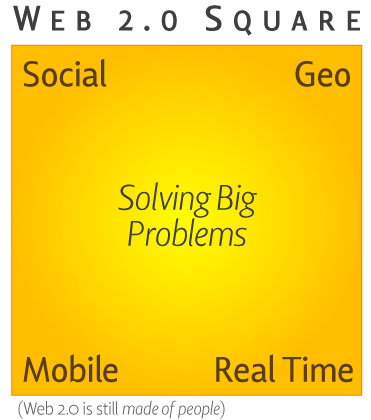
Ross Mayfield, his line from the first Web 2.0 conference is still relevant, added Geo to Fred’s Triangle and posted his virtual napkin up on flickr.
The importance of Geo cannot be ignored as the most obvious (and easiest) way to add context to information which is being harvested and sent our way in increasingly alarming rates. We talk about a world in which there are 1 billion mobile devices. Imagine what happens when each of these gets a camera, gps, and bluetooth sensor and an IP connection to pull in real-time updates. Adds a new dimension to Right Here, Right Now.
So while HTML Page Indexers of yore were failing at finding us the best Chinese in Helsinki or plumber in London, Social Discovery became the new nectar. Facebook leads to FriendFeed leads to Twitter and now our capacity to consume and process has overloaded. Groups, Hashtags, Lists, Folders, call them what you will but this manual organization of streams is beginning to feel like e-mail folder management all over again. The Googles and Microsofts have added the Twitter firehose to their indexes but somehow I don’t see that as solving the problem unless they can filter on your social connections as well (rumor has it Google Profiles are about to play a much more important role Google Social Search is now live).
Which brings us to Social Filters.
Marshall Kirkpatrick has been following this topic for a long time. He bangs the Social Filter drum again in a post about Facebook’s News Feed redesign,
Someday social networking is going to be like the telephone. Today you can’t send messages from Facebook to people on MySpace or LinkedIn but that isn’t going to last forever. Just as you can call someone who uses T-Mobile from your Sprint phone, someday sharing and messaging between online social networks will be a given.
How will social networks retain users then? Why stick with Facebook when some smaller service offers a decentralized social networking service outside of Facebook’s control but still tied into your friends on Facebook and elsewhere?
These services will someday have to compete on user experience, when they no longer have your social connections locked-in. The service that does the best job filtering up the most important information you have coming your way will likely be the service you stick with. That’s going to be a key area of competition between social networks.
Yes, it’s no longer about who “owns” the social graph – it’s who provides the best services on top of a shared graph. Someone mentioned that Tim Berners Lee said at the conference that AOL was to WWW as Facebook is to distributed social networks. Just as we thought it silly that AOL wanted to put it’s famous wall around the internet, we may also look back in amazement thinking that anyone could have the audacity to think they could own the world’s social address book.
There is a race on right now to own the social graph. But we must ask whether this service is so fundamental that it needs to be open to all.
It’s easy to forget that only 15 years ago, email was as fragmented as social networking is today, with hundreds of incompatible email systems joined by fragile and congested gateways. One of those systems – internet RFC 822 email – became the gold standard for interchange.
We expect to see similar standardization in key internet utilities and subsystems. Vendors who are competing with a winner-takes-all mindset would be advised to join together to enable systems built from the best-of-breed data subsystems of cooperating companies.
Bringing it all together you can almost hear the synapses of the global brain achieve self-awareness. Not only are we moving to a web of sensors feeding real-time data into the grid, we are annotating it by injecting bits of human commentary and behaviors across an increasingly distributed social graph.
A phone in one corner of the world sends off a snapshot which is immediately re-tweeted via the world’s largest telephone tree. More reasoned minds pick up the samples, turn it over and examine it and later conclude that no, the calculated mass of the balloon could in fact not hold a small boy aloft – rumor refuted! Lesson learned and the network becomes a little smarter, more skeptical, less knee-jerk adolescent. Sentient if you will.
The pieces are in place, the machines are warmed up. It was fun while it lasted but it’s time to put Failblog aside and see if we can move on to tackle bigger problems. O’Reilly and Battelle wrap up with their call to arms,
2009 marks a pivot point in the history of the Web. It’s time to leverage the true power of the platform we’ve built. The Web is no longer an industry unto itself – the Web is now the world.
I’m not so sure how the whole Facebook namespace landrush is going to work out for me (cheeky of them to have us all sit around camped out facebook.com on a Friday night!) but for now I’m going with this twitter card as a way to get my social media dialtone for now. To make you’re own, just edit the source at twitter.com and crop to fit. Or, if you’re lazy, you can use the Twitter Meishi Generator.
There’s been good debate around how the source of traffic to sites is changing, shifting from the search engines to social sites such as Facebook and Twitter. I confirmed that I too am seeing a greater percentage of traffic come in via links shared on social sites and shared a colleague’s theory about what this would mean for Google’s advertising revenues. Fred Wilson also posted about this topic here and here.
What about attention? How does the average visitor from a social site compare to someone from a search engine? Niall Kennedy tweeted the following stats from his referral logs:
Twitter: 7 seconds
Digg: 20 seconds
StumbleUpon: 40 seconds
Facebook: 52 seconds
Delicious: 82 seconds
Here are my stats for the past year:
StumbleUpon: 40 seconds
Digg: 42 seconds
FriendFeed: 53 seconds
Facebook: 60 seconds
Twitter: 86 seconds*
Delicious: 110 seconds
Techmeme: 114
MyBlogLog: 176 seconds
Compared to the attention span of those coming from the major search engines we get:
Live.com (MSFT): 21 seconds
Yahoo: 35 seconds
Google : 40 seconds
Ask: 46 seconds
It would be interesting to see figures from other sites, especially online shopping sites which are the ones most interested in getting (and therefore likely to pay for) traffic. While it’s clear that visitors from social sites are more engaged with my blog because they tend to hang around a bit longer, that may not be the case with a shopping site where there is less intent to purchase than if they come from a search engine but Mark Essel thinks otherwise.
Increasingly, the flow of web links is being made between individuals via social media sites. Your good fishing buddy who knows the Bay area, shares a link to his favorite supply store. As focused communities become populated across geographic barriers, local quality referrals become more likely. But what if you want to know what store fishermen prefer in San Francisco? You could simply use twitter search for fishing san francisco. In real time you could send a message to several individuals who are interested in fishing in that region.
Shared links are compelling but they need to be matched with impulse buying or discoverable when you’re looking for it. I’m thinking of O’Reilly’s flash discount shared via twitter (44% off to celebrate the 44th president) which was effective in bumping registration at the recent Web 2.0 Expo. The other way to generate business via shared links is to make them searchable so you can find what you need when you want it – but then we’re right back at sending traffic via search again. Yes, you can search twitter but you can find this stuff on Google too.
The jury’s still out as I think this will be a slow shift of behavior that will take a long time to impact existing business models. The real prize is back to social search which would combine the best of the recommendation trusts of social networks with the ability to find what you need when you’re looking for it.
Facebook recommendations married to Google ‘s structure and ranking? That’s the subject of another post.
—o—
* I dug into the Twitter figures because they’re so out of whack with what Niall is seeing and it looks like there are a few visitors that hung out for a long time that are pushing that average higher than it should be.
Cookie Consent
We use cookies to improve your experience on our site. By using our site, you consent to cookies.
ID used to identify users for 24 hours after last activity
24 hours
_gat
Used to monitor number of Google Analytics server requests when using Google Tag Manager
1 minute
_gac_
Contains information related to marketing campaigns of the user. These are shared with Google AdWords / Google Ads when the Google Ads and Google Analytics accounts are linked together.
90 days
__utma
ID used to identify users and sessions
2 years after last activity
__utmt
Used to monitor number of Google Analytics server requests
10 minutes
__utmb
Used to distinguish new sessions and visits. This cookie is set when the GA.js javascript library is loaded and there is no existing __utmb cookie. The cookie is updated every time data is sent to the Google Analytics server.
30 minutes after last activity
__utmc
Used only with old Urchin versions of Google Analytics and not with GA.js. Was used to distinguish between new sessions and visits at the end of a session.
End of session (browser)
__utmz
Contains information about the traffic source or campaign that directed user to the website. The cookie is set when the GA.js javascript is loaded and updated when data is sent to the Google Anaytics server
6 months after last activity
__utmv
Contains custom information set by the web developer via the _setCustomVar method in Google Analytics. This cookie is updated every time new data is sent to the Google Analytics server.
2 years after last activity
__utmx
Used to determine whether a user is included in an A / B or Multivariate test.
18 months
_ga
ID used to identify users
2 years
_gali
Used by Google Analytics to determine which links on a page are being clicked
30 seconds
_ga_
ID used to identify users
2 years
You can find more information in our About Me and .


 ).