Tag: twitter

  • Calacanis on Value of twitter

    twitter-logoJason Calacanis expands upon his offer to pay twitter to get his Mahalo account onto twitter’s suggested user page. It’s the distribution channel and potential click-thru traffic he’s looking for, and click-thrus to his site equals registered users and a lifetime relationship with Mahalo that can be monetized over time.

    The top 20 slots on Twitter are actually worth–to some people–2-10x what I offered. If Southwest, Amazon, eBay or Zappos were to get their hands on one of these accounts, they could easily make one uber-compelling tweet a week. 50 tweets from Amazon with things like “Top 100 Science Fiction Movies of All Time–as rated by George Lucas” would garner a two to 10% CTR. A Zappos tweet with “Back to school: Buy two pairs of shoes get one free” would get a huge response on August 20th.

    A JetBlue daily notice saying “The first 1,000 folks to respond to this alert get $25 off their next flight” would mean never having another empty seat.

    The point is that Twitter has the ability to unleash a direct marketing business the likes of which the world has NEVER seen. I predict they will, and when they do, they will make the Twitter nay-sayers look like the donkeys they really are. (Note: you ever notice the folks who have the most to say about making money are the ones who’ve never made any? Exactly.)

    Direct marketing by mail changed retail forever, as did the Web and email.

    Twitter will take that to an entirely new level. Why? Because people *live* inside of Twitter like they have never lived inside of a product before. We have NBA stars twittering about their performance at half-time and a president who leveraged the service to get elected.

    It doesn’t take a genius to understand that there is something disruptive going on here.

    Wasn’t this the promise of SMS? A direct channel to which consumers could sign up and get notifications of local deals in their area?

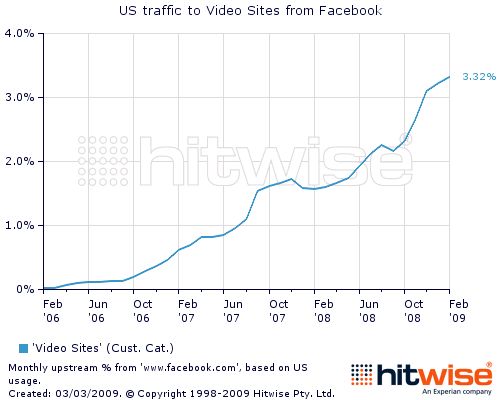
  • Facebook, Twitter send more traffic than Google

    Facebook, Twitter send more traffic than Google

    Liz Gannes posted that Perez Hilton is now seeing more traffic coming in via Facebook than Google.

    My colleague Udo Szabo at Nokia HQ in Finland has a theory that I call the Unified Theory of Interweb Economics. The theory goes something like this:

    1. Advertising is a function of your traffic volume, the more traffic that comes to your site, the higher rates you can charge.
    2. Social sites such as Facebook and Twitter have a lot of link sharing going on as friends post links to share them with each other.
    3. When Facebook and Twitter send more traffic than Google search referrals, advertising dollars will follow the source of that traffic.
    4. Google’s dominance in online advertising will be threatened.

    One would think we’re seeing the first hints of that with perezhilton.com and it will take a long time before we see this trend across the board. But in hindsight this is obvious and looking at my stats for the past month I find that 44% of my visitors are coming from search engines and 45% from referring sites with a vast majority coming from StumbleUpon, a social site for sharing links.

    The more you think about it, the shift in balance of power has already taken place.  SEO is still a big industry but now there are companies that will help you with SMO (“social media optimization”).  On twitter we’re starting to see scam artists try and insert themselves into the conversation just as they used to do with Splogs.

    And so the wheel turns round once again and there appears to be a new king of the hill – AOL Keyword > Yahoo Category Link  > Google Keyword Ranking > Social Site referral.

    The jury’s still out as to which social site will send you more links but it’s looking more and more like Facebook. We used to have the Digg effect but no one talks about that anymore. Twitter certainly has the ability to send you a bunch of traffic in short order but the audience is still mostly the early-adopter set and any traffic will most likely be short-lived as the re-tweets scroll into the past.

    Facebook, with 175 million users, certainly has the right broad-based distribution to broadcast a link and send back traffic. They have added new features such as FriendFeed’s “like” feature to make quick sharing easy. The Facebook Connect and Comments widgets also will help insert new links into Facebook for redistribution.

    But while it’s great to get an influx of new visitors via a social site, it’s no good if it’s not a lasting reference. Has the pendulum swung to far the other way? There are some searches that work great on the real-time web, the latest viral video comes to mind, but others such as the listing for your local plumber just don’t work on something like twitter. Not that it’s worth anything but I still get a regular influx of traffic because I’m the #2 listing for insulting british slang even though the post is over three years old.

    I think it’s fair to say that the social sites such as Facebook and Twitter will erode Google’s monopoly on online advertising. Google’s never been really good at building social sites and have shared in the growth of social networking in the past by providing the advertising engine for the most popular social sites. What happens with these sites start to go direct to the advertisers? Will Facebook advertising revenues come from traditional cost-per-click/auction model or is some other type of model required to succeed in a social networking site?

  • Do Social Gestures a Business Model Make?

    Is twitter a directory or a utility? This is the question that Charles Hudson raises in his post The Database of Intentions is More Valuable than the Database of Musings. While investigating prospective business models, he raises good questions about the ability of a collection of “accumulated musings” to determine intent which is what is most valuable to advertisers.

    But maybe advertising  is not the great revenue driver of the next generation of startups after all, at least not advertising as we know it. Maybe it’s just me but I feel a need to make sense of all the stuff we share with each other. There seems to be value in tapping into the pulse of the “now web” but the methods of pulling meaning out of the noise seem crude. Keyword searches? Is that the best we can do?

    Something went wrong with the Intense Debate comments on last night’s post on Keywords and Meaning. It’s unfortunate because there were some really thoughtful responses to the post which I’ll repeat in this post because they are worth reading.

    Todd writes:

    Keyword extraction from Twitter could be cool, but may kill of serendipitous discovery, my favorite aspect of Twitter. If keywords or meta-categories are predetermined truly unique hawtness, unprecedented new things ( a Twitter specialty ) will just get deleted? That would be FAIL.

    I wonder if more of a “people with attributes” are really what’s needed. Example, I do want to know what’s going on with the latest developments for Symbian operating system, particularly activity streams and address book stuff. Rather than rely on keyword extraction, I could just assign an attribute to your tweets…

    twitteruser:iankennedy=novi

    …I can be fairly assured news filtered by real humans, THEN assigned an attribute of my choosing will bring me some good results. A tag cloud of all tweets containing “symbian, activity stream, address book” would be noisy ( pollute with people asking each other for tech support? ), difficult to pull meaning from while drinking beer at my favorite bar.

    Jonathan Strauss writes:

    The TechCrunch post you cite was inspired by John Borthwick’s very interesting essay on how Google’s approach to content filtering breaks in the realm of what he calls the ‘Now Web.’ Like you say above: “Google’s PageRank, while valueable in sorting out the reputation and tossing the hucksters, is no good when applied to real-time news which is too fresh to build up a linkmap.”

    In the (relatively) static web, the network nodes are pages and the endorsement actions are the links between them which are effectively permanent as well as public, and thus crawlable. In the Now Web, the network nodes are people and the endorsements are ephemeral share actions, the majority of which are not public or crawlable (i.e. email, IM, Facebook — what I call the ‘Deep Now Web’). And so, authority also takes on a different form from the aggregate view that PageRank provides to the personal measure of how much influence an individual has with her social network on a particular topic at a given moment.

    I agree that we need to have a means of systematically capturing the newly important metadata of share actions and that it needs to be done at the point of sharing (see Jeff Jonas). But, I believe the more easily adopted (and thus ultimately more useful) taxonomy will be one of contextual metadata (i.e. who/what/when/where/why/how) rather than the more personal folksonomy/tagging approach you suggest.

    There was also reactions via twitter from Kevin Marks:

    https://twitter.com/kevinmarks/status/1213846940

    The act of sharing links, photos, or other metadata on social networks is an action, to a certain extent, that gesture is more interesting than the actual data itself. The fact that my usually dormant cycle racing friends are now extremely active on twitter these past few days as the Tour of California is on is as much an indicator of interest as the actual substance of their conversation.

    Keywords are part of the picture – the complete context around who/when/where/why/how are just as important as the tidbit of data itself. The meta-data contains more clues than the data.

    The cellphone is a rich source of meta-data which can be captured at the source, the moment of sharing. Feeding contexts captured from the cell phone would be a great way to add context to any act of sharing.  There are privacy concerns and ownership questions. There needs to be a real value demonstrated to the potential user before they give up some of this privacy. But that’s a topic for another post.

  • Keywords and Meaning

    Keywords and Meaning

    TechCrunch asks if twitter search gets us closer to being able to mine the world’s collective thoughts. We may be getting there as millions text their latest thoughts into their cellphones. With a simple text message, the hive mind has the potential for 4 billion nodes out in the real world (for comparison, the human brain has 100 billion neurons)

    News junkies of the world turn to twitter as the latest source of raw, unfiltered information. Peering over the shoulder of various members of the House and Senate who twitter is a unique view into our government. What you see is a more intimate, human view of the people that make the news. Yet, how do you harness that noise and turn it’s output into information?

    Twitter follows a long line of services which break through editorial filters, get at the source of a story so you can make your own judgements. Blogs occupied this space just a few years ago and real-time indexes such as Technorati rose to prominence as a way to get a jump on the news.

    Sidenote: Alacra, admitting important news about companies breaks on the web, is launching Pulse which applies their analytics engine to extract company names from their hand-picked collection of 2,000 RSS feeds.

    The need for speed is nothing new. Former Wall Street Journal newsman Craig Forman draws an arc that extends from the pigeons Baron Reuter used to deliver news of  Napoleon’s defeat at Waterloo to the real-time newswires used in the financial world today . If there’s a way for someone to profit from the knowing something before anyone else, there’s always going to be people looking for a way to get at a scoop and others looking for a way to deliver.

    We want to look to twitter for the scoops but we are doomed to learn the same lessons as we have in the past about authenticity. What we gain in speed and convenience, we lose in validation and measured fact-checking. Google’s PageRank, while valueable in sorting out the reputation and tossing the hucksters, is no good when applied to real-time news which is too fresh to build up a linkmap.

    Working for Dow Jones in Tokyo, I would work with bankers and reporters who would use digital newswires to deliver them the latest news from around the world. As a systems engineer setting up their workstations, I would often be asked to set up their news filters to narrow the feeds down to something reasonable (the typical newswire delivers hundreds of stories an hour, most subsribe to several newswires). In the late-90’s the tools were crude and after getting frustrated by throwing in a few keywords, I would get called in to refine things using additional tools such as company ticker symbols, or a few undocumented codes from a taxonomy of subjects that varied from newswire to newswire.

    Today the problem of information overload has spread to the greater population trying to derive value from the rushing torrent of updates coming out of twitter and facebook. How do I manage all this stuff and figure out what’s important? We use the tools we have but if you think about it, Google Trends and twitter search are just keyword searches with very crude resolution. We have a long way to go before such tools will let us tap into the collective mind.

    Perhaps it’s time for a crude taxonomy for social networks to help sort out the types of messages flowing back and forth? Imagine if all your tweets, facebook messages, and friendfeed streams came pre-tagged with the following tags or categories?

    • look at me, I’m doing something cool
    • check this out, it’s funny
    • books, movies, music, food, or sports
    • this is touching and will change your life
    • gadgets and meta, technology post about using technology
    • weather and the natural world
    • babies and kittens
    • my obscure hobby
    • breaking news, OMG!
    • make money now!

    What other categories would you add? Librarians of the world, what keywords would you put into your search filters to help grep out what goes where? Categorization is the first step towards ranking and with ranking you get useful filters.

  • Community 2.0 with Twitter

    MyBlogLog just launched an experiment and a shared account at twitter.com/mybloglog. All of us on the team have twitter accounts and have been tripping over each other using our accounts to respond to people and get the word out to our various, over-lapping pools of followers.

    The twittersphere is so noisy anyway that when we sat back and thought about it, having a central voice for MyBlogLog the product just made more sense. There are thousands of MyBlogLog users that have added their twitter accounts to their profile and rather than reaching out to them piecemeal, it just seemed to make more sense to have a single account to handle the outgoing communications.

    So a single account to broadcast the occasional shout out or service update is a no-brainer. The harder, experimental part is the listening part. We set up a script that automatically follows anyone that has added their twitter account to their MyBlogLog profile. It’s impossible to keep up with the thousands of conversations going on amongst our members so we’re taking the advice of our very own twitter ninja, Todd and are limiting our listening to just the @mybloglog replies and direct messages.

    Who knows what will happen, we’ll have to just go with it a bit and see how it goes. It’s just a few hours since we’ve announced this and the replies are already rolling in at a pretty rapid clip. I’m a little worried because we all have a product to run as well and the interruptive nature of twitter brings out my worst ADD tendencies.

    One thing is for certain, this channel is an excellent source of real-time feedback. MyBlogLog releases early and often and we thrive on input to tap us in the right direction or smack us upside the head if we’re dead wrong. The early responses to the follow script range from positive to “what took you so long?” so I think we did the right thing.

    Some of the followers have let us know about other companies that are playing around with branded twitter accounts. Here’s a running list so far:

    Ironically, it doesn’t seem like @twitter is really used in the same way. Curious.

    Update: looks like we’re headed in the right direction. Overnight reactions are almost all positive and the Stop Twitter Spam makes me realize we dodged a bullet by posting about why we were auto-following all 14,000+ that have added their twitter ID to their MyBlogLog profile.

  • Nate Ritter’s one-man band media service

    I went to a meetup sponsored by Netsquared and saw Nate Ritter talk about how he was able to fill in during the power outages during the San Diego fires and keep us all informed on what was going on. Part of his amazing story is how on the first day he worked for over 12 hours with only one 15 minute bathroom break.

    Nate’s story was covered by Wired and highlights that he quickly ran into a limitation of the Twitter API which would crash if he posted more than 70 posts/hour (he eventually moved to posting directly into twitter.com).

    Other interesting tidbits include the fact that for some residents, he was the only game in town because power was done in most of the area (with other townships borrowing power from Tijuana to the south). In times of crisis, SMS messaging rules.

    The graphic posted above is from his talk, which he outlines on his blog. It’s a very basic setup where you drop a few feeds in on one end, usually filtered to sort on specific topics relating to your crisis at hand, and then Rube Goldberg-like, mush it all together using soup.io and then pump that RSS out to twitterfeed.com which will take any RSS feed and turn it into twitter posts. This is Nate’s basic setup which he’s re-purposed several times for other situations, most recently the floods in Northern California.

    The setup described above doesn’t take more than an hour to get up and running.  Looking at it really gets the gears turning. What kind of twitter feed would you setup at the wheels of something like this?

    I can think of a few services to add to improve it.

    • Yahoo Pipes for greater filtering
    • twitter’s “track” function to track mentions by keyword
    • Dave Winer’s twittergram to allow people to phone in updates from the field

    Can you think of any others?