In an interview with a level designer for the video game, Last of Us Part 2, we learn that one part of the game took a “solid two years” to build.
Near the end of the interview, Brown asks Hill roughly how long the entire sequence took to build from scratch and perfect. “Pretty much two solid years,” says Hill. “Pretty much the big secret for all Naughty Dog level design is just iteration and work. We have some fundamentals but there were some levels in this game that were redone about 25 times.”
Brian Eno once said, “The problem with computers is that there is not enough Africa in them.” The interfaces we use to interact with computers are too digital, not fuzzy enough to sense analog inputs. We’re stuck with mouse and keyboard.
Kagura is a game that runs on a laptop and uses the camera to detect movement of the players as they interact with musical instruments projected on the screen in front of them to play along or riff on a musical track.
Part Dance Dance Revolution and part Guitar Hero, the UI is intuitive and easy and fun to pick up. All that’s required is a Windows laptop (Mac coming later) and they launched a Kickstarter today to fund the final development and release in August.
Shunsuke Nakamura, the inventor of the game, stopped by the SmartNews offices on Friday to show us how the game works. He’s been working on the concept of using your body to make music for 14 years but only now has technology reached a point where his dream could be realized.
It’s Super Bowl Sunday, one of the most controlled sporting events on the planet. While it’s not exactly rigged, every aspect of the game has been optimized for maximum viewing audience engagement. Sure, there’s a football game in there somewhere but every variable has been carefully engineered to maximize viewing enjoyment.
Some suspect that the two week media circus around Richard Sherman was a carefully planned media campaign designed to put Sherman, and his sponsor, the headphone maker Beats, into the spotlight. With all the attention on social media around the event, it’s no surprise that there are social media hashtag strategies of each brand hoping to cash in. Advertisers, eager to build up anticipation of the big event, are previewed snippets of their big 60 second spot during the playoff games. Our emotions have been conditioned to peak around mid-day today as they kick off to the fading strains of the National Anthem.
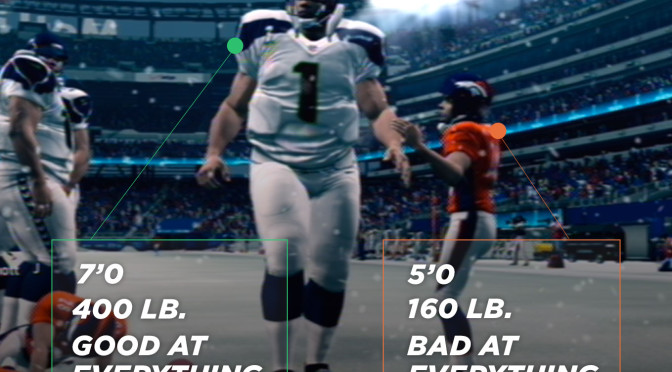
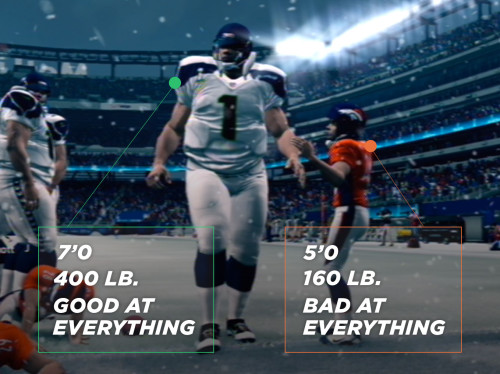
As long as people are going to control all the variables around the game, why not engineer the game itself? Jon Bois over at SB Nation has a column where he hacks around with the settings of the XBox video game Madden to come up with fantastical characters to face each other on the virtual gridiron. In this week’s finale, he puts the 7 foot 400 pound Seattle Seahawks up against the 5 foot 160 pound Denver Broncos. And he didn’t stop there. He also slides all the ability, stamina, and strength settings to “11” for the Seahawks and turns all the Broncos players settings down to zero.
He wrote about the resulting game in his column, The Machine is Bleeding to Death, a hilarious piece complete with animated gifs highlighting the best bits. It’s a distorted, comic book caricature of the contest being played out on a gaming platform designed to look as real as possible. The best sports writing is at once about the game but more broadly about society and the world around us thru the lens of the game. Jon Bois’ review of the video game of the football game which we are all about to watch is social commentary at its best.
Contains information related to marketing campaigns of the user. These are shared with Google AdWords / Google Ads when the Google Ads and Google Analytics accounts are linked together.
90 days
__utma
ID used to identify users and sessions
2 years after last activity
__utmt
Used to monitor number of Google Analytics server requests
10 minutes
__utmb
Used to distinguish new sessions and visits. This cookie is set when the GA.js javascript library is loaded and there is no existing __utmb cookie. The cookie is updated every time data is sent to the Google Analytics server.
30 minutes after last activity
__utmc
Used only with old Urchin versions of Google Analytics and not with GA.js. Was used to distinguish between new sessions and visits at the end of a session.
End of session (browser)
__utmz
Contains information about the traffic source or campaign that directed user to the website. The cookie is set when the GA.js javascript is loaded and updated when data is sent to the Google Anaytics server
6 months after last activity
__utmv
Contains custom information set by the web developer via the _setCustomVar method in Google Analytics. This cookie is updated every time new data is sent to the Google Analytics server.
2 years after last activity
__utmx
Used to determine whether a user is included in an A / B or Multivariate test.
18 months
_ga
ID used to identify users
2 years
_gali
Used by Google Analytics to determine which links on a page are being clicked
30 seconds
_ga_
ID used to identify users
2 years
_gid
ID used to identify users for 24 hours after last activity
24 hours
_gat
Used to monitor number of Google Analytics server requests when using Google Tag Manager
1 minute
You can find more information in our About Me and .