Year: 2009

  • Keywords and Meaning

    Keywords and Meaning

    TechCrunch asks if twitter search gets us closer to being able to mine the world’s collective thoughts. We may be getting there as millions text their latest thoughts into their cellphones. With a simple text message, the hive mind has the potential for 4 billion nodes out in the real world (for comparison, the human brain has 100 billion neurons)

    News junkies of the world turn to twitter as the latest source of raw, unfiltered information. Peering over the shoulder of various members of the House and Senate who twitter is a unique view into our government. What you see is a more intimate, human view of the people that make the news. Yet, how do you harness that noise and turn it’s output into information?

    Twitter follows a long line of services which break through editorial filters, get at the source of a story so you can make your own judgements. Blogs occupied this space just a few years ago and real-time indexes such as Technorati rose to prominence as a way to get a jump on the news.

    Sidenote: Alacra, admitting important news about companies breaks on the web, is launching Pulse which applies their analytics engine to extract company names from their hand-picked collection of 2,000 RSS feeds.

    The need for speed is nothing new. Former Wall Street Journal newsman Craig Forman draws an arc that extends from the pigeons Baron Reuter used to deliver news of  Napoleon’s defeat at Waterloo to the real-time newswires used in the financial world today . If there’s a way for someone to profit from the knowing something before anyone else, there’s always going to be people looking for a way to get at a scoop and others looking for a way to deliver.

    We want to look to twitter for the scoops but we are doomed to learn the same lessons as we have in the past about authenticity. What we gain in speed and convenience, we lose in validation and measured fact-checking. Google’s PageRank, while valueable in sorting out the reputation and tossing the hucksters, is no good when applied to real-time news which is too fresh to build up a linkmap.

    Working for Dow Jones in Tokyo, I would work with bankers and reporters who would use digital newswires to deliver them the latest news from around the world. As a systems engineer setting up their workstations, I would often be asked to set up their news filters to narrow the feeds down to something reasonable (the typical newswire delivers hundreds of stories an hour, most subsribe to several newswires). In the late-90’s the tools were crude and after getting frustrated by throwing in a few keywords, I would get called in to refine things using additional tools such as company ticker symbols, or a few undocumented codes from a taxonomy of subjects that varied from newswire to newswire.

    Today the problem of information overload has spread to the greater population trying to derive value from the rushing torrent of updates coming out of twitter and facebook. How do I manage all this stuff and figure out what’s important? We use the tools we have but if you think about it, Google Trends and twitter search are just keyword searches with very crude resolution. We have a long way to go before such tools will let us tap into the collective mind.

    Perhaps it’s time for a crude taxonomy for social networks to help sort out the types of messages flowing back and forth? Imagine if all your tweets, facebook messages, and friendfeed streams came pre-tagged with the following tags or categories?

    • look at me, I’m doing something cool
    • check this out, it’s funny
    • books, movies, music, food, or sports
    • this is touching and will change your life
    • gadgets and meta, technology post about using technology
    • weather and the natural world
    • babies and kittens
    • my obscure hobby
    • breaking news, OMG!
    • make money now!

    What other categories would you add? Librarians of the world, what keywords would you put into your search filters to help grep out what goes where? Categorization is the first step towards ranking and with ranking you get useful filters.

  • Open ID Design Summit – Links to coverage

    For various reasons I was unable to attend the Open ID Design Summit. Thankfully, the talks were very well covered so it’s possible for anyone see what happened and the current state of discussions around what’s being called the “open stack”

    Live-blogging the openid design summit – John McCrea from Plaxo did a great job of live-blogging the event. This is the best place to start because his post also embeds all the presentations. Thanks John!

    OpenID user experience tackled – by Carsten Pötter links to PuffyPoodles.com, an example of an OpenID pop-up form which uses remote authentication using a Google ID.

    Chris Messina just posted a bunch of video clips:


    OpenID Design Workshop Introductions from Chris Messina on Vimeo.

    More below the fold:

    (more…)

  • Leapfrog making a toy Blackberry

    Text & Learn

    I am not sure what to make of this. I’m all for making toys realistic and all but working at Nokia, we’re all about trying to make mobile mobile devices more playful and fun. So it’s weird to see a Leapfrog making a toy phone more, um, business-like.

  • No Noovo, No!

    UPDATE: Andrej from Noovo writes in the comments below that they have modified Noovo’s UI flow so that the selection of contacts for invitation to their service is now more clearly defined.  Thankfully, this post is now history and lessons learned.


    I thought about sending this feedback directly to Noovo but it’s important to warn others and also have a place to point all the people who have received Noovo’s auto-invite and replied back to me, “is this real?” If and when Noovo modifies their sign-up flow to address the concerns I’ve outlined below, I will happily update this post.

    When I sign up to test out new service, I take care to not let the service email my contacts with spammy invites. Yesterday they got me and I ended up inviting all my friends to a service I was only testing out, embarrassing me and turning me off from spending more time with the service to figure it out. Crafty placement and defaults were to blame.

    The first thing Noovo does is ask you for your Facebook credentials. There’s small text in the upper right corner says “skip” – most wouldn’t notice this making it seem like handing over your Facebook account is a requirement.

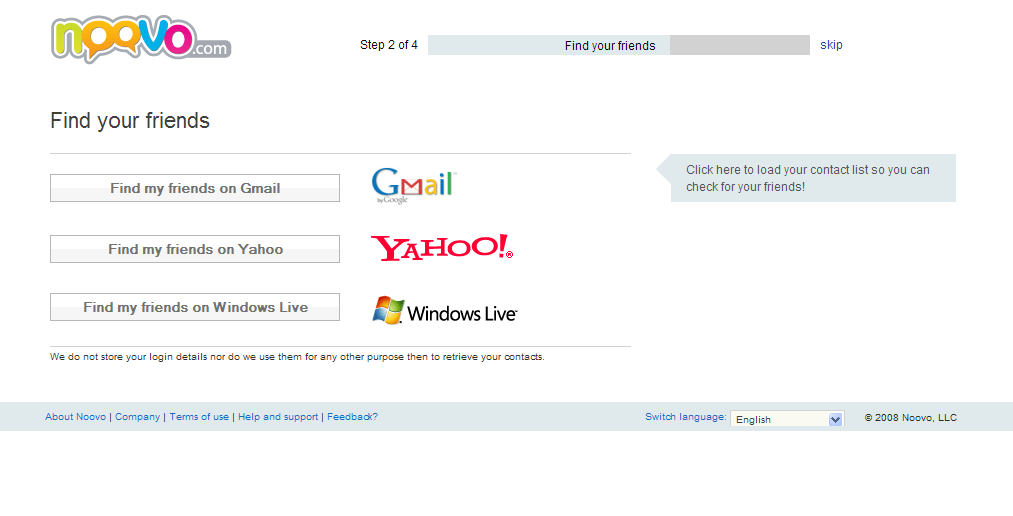
    Next they present the standard, “Login with your favorite service to see if your friends are already using us” screen. There is even some text at the bottom, We do not store your login details nor do we use them for any other purpose than to retrieve your contacts.

    This is the real sneaky one. I’ve already fallen into this trap so I can’t show you what the screen looked like before (the above is from a second account) but imagine this. I logged in with my Gmail credentials, was redirected to a page on google.com confirming that I was giving one-time access to Noovo to read my contacts file.

    I then got a version of the screen you see above that had 10 or so contacts in the blue portion, these are people already registered on Noovo that I could connect to. But, because I had several lines of people already on the service, it completely hid the contacts that were not on the service and were checked by default to be sent and invitation to the service once I clicked “Next”

    Two things.

    a. Noovo never said they would use my credentials to send out invitations, just to retrieve contacts.

    b. By hiding the list of invited contacts checked off below the screen, there is no way I would know unless I saw the scroll bar on the right of the screen.

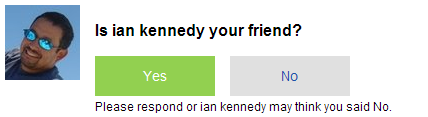
    4. The email invite was a real work of social engineering as well. Please respond or ian kennedy may think you said No. I would have deleted my account off of Noovo but I don’t want people accepting my invite only to find that I’m not there. Laying the guilt trip on me and my friends is not the way to entice people to join your site.

    Way to make my days guys. I’ve been spending all afternoon explaining to everyone what happened.

  • Is this the new Obama phone?

    Sectéra Edge

    CNN wonders if the Barak Obama’s new phone is the Sectéra® Edge™
    (love the multiple super-scripts in the product name!) by General Dynamics. Features include a “classified key” that you flip when you want to jump on the Top Sekret network for calls, email, or browsing.

    Click on the image above and check out the one-line “trusted display.”  Just the thing to check in on twitter.

    Not exactly a svelte device (it’s a little bulkier than a Palm Treo), this thing runs Windows Mobile. Goes with the territory I guess. It’s been reported that the White House PCs are running a six-year old version of Windows.

    Oh, and it costs $3,350, without a data plan 😉

    UPDATE: Turns out he’s going to get a real BlackBerry after all.

    Reblog this post [with Zemanta]
  • There is no such thing as “Social Media”

    For the past several years I have hitched my name to the phrase social media. I used it as a handle to describe the mix of blogs, photos, status updates, and other methods of personal broadcasting that I used to get the word out and solicit feedback on new ideas. In the past, there was a clear distinction between media produced this way, collaboratively, often by amateurs, and that which was popularly referred to as mainstream media.

    We’ve reached a tipping point. In my mind the lines between social media  and other types of media are so blurred that it’s not even useful to distinguish the two, just drop the “social” because all media is now social. Take these examples from just the past few weeks:

    Along with others, I first heard about the crash landing of US Airways Flight 1549 in the Hudson via twitter. I was also amazed to see the twitpic photo featured on the network news stations – quality of composition was trumped by a camera phone that was in the right place at the right time. While the first reports were from twitter, more comprehensive coverage was to come later from the professionals but the twitpic and reader comments made up an important part of the overall package.

    For the inauguration yesterday, CNN and Facebook shared a single URL. On the left side was a live video stream from CNN while on the right side was a stream of comments from Facebook.

    cnn.com with scrolling facebook comments (via Steve Garfield)

    While the video was very compelling, I have to confess that the real-time commentary from the peanut gallery on the right was absoultely captivating. If you measure media by the amount of attention given, most of my time was spent on Facebook feed. Mashable’s got more details on the numbers but it would be interesting to see a heat map of where people collectively spent their time on this page.

    A couple years ago I asked how to define social media. In that post, Stowe Boyd said that is was defined by the, “annotations or social gestures left behind by active readers, such as comments, tags, bookmarks, and trackbacks.” Based on that definition, what we saw on CNN yesterday, and the ease with which people can create, reference, and annotate all media, it’s no longer useful to segment out something called “social media.”

    There is no such thing as social media when all media is social.

  • Yes, We Did!

    satellite-inauguration

    Amazing images of today’s Presidential Inauguration from 400 miles up posted on VentureBeat.

  • Dopplr 2008

    Dopplr 2008


    I didn’t travel much in 2008 but Dopplr’s year-end summary sure makes it look pretty.

  • YouTube as a Search Engine

    My son was featured in yesterday’s Sunday New York Times in an article (At First, Funny videos. Now, a Reference Tool) about the unforeseen use of YouTube as a research tool. We all associate videos with entertainment but Tyler has taught me that with the addition of meta-data and micro-chunked content, it’s possible to use YouTube as a rich source of reference material.

    I was contacted by the reporter, who had seen a post on ReadWriteWeb about Tyler’s use of YouTube and wanted to bring the story to the New York Times’ readers.

    My father commented, “It is the inclination of succeeding generations to simplify.” Tyler is on to something. For certain things (contact juggling, macarena, or bugatti vs. fighter jet), YouTube is going to explain things to you better and quicker than plain old text search results. You can sort by not only Relevance and Date Added but also using meta-data from community actions such as Ratings and View Count. Finally, using the example from the article, if you search on platypus, embedded in the results is a pre-defined playlist of over 40 video clips all about the animal.

    Tyler was pleased to see that the article was in the “Bright Ideas” section. His comment about his pose in the photo was that after over 200 photos his head was feeling a little heavy. Strangely, the local newsstand didn’t carry the Sunday Times so we had to go to a Starbucks to get a copy for the photo above and as a keepsake.