You are either the person getting pimped, or you’re the person doing the pimping.
will.i.am’s description of how the Black-Eyed Peas negotiated a new type of advertising unit for the Super Bowl and collaborated with Marc Benioff and Salesforce to promote Chatter.com through the mini-site thebabypeas.com is a glimpse at how switched on celebrities are using modern tools to manage their brand without the help (or interference or commissions) by an agency.
But the most visionary thing and something I keep coming back to is will.i.am’s vision of the next generation internet. It’s a world where brand “alliances” pool together to subsidize content producers. A world where, “chips talk to chips” without a middleman to make the free flow of content seamless and automatic. In this new world, a collection of devices will marry themselves to a library of content and work seamlessly together.
Extended further, it’s a world in which we no longer need the internet to connect us all. When you text someone next to you, why do you need to connect to a cell tower and send the message over a network only to round trip it right back again. If you extend the chips-talking-to-chips metaphor, why not just have the phone turn itself into the modern version of a walkie-talkie and beam the message right over? Bluetooth and NFC have started this vision but taken further, why can’t cellphones self-organize into mini-networks so that a group of phones together could share information without having to connect to the cloud?
Adam Gopnik has a survey in this week’s New Yorker running down a few of the recent books about the internet and divides them into three schools of thought:
The Never-Betters believe that we’re on the brink of a new utopia, where information will be free and democratic, news will be made from the bottom up, love will reign, and cookies will bake themselves.
The Better-Nevers think that we would have been better off if the whole thing had never happened, that the world that is coming to an end is superior to the one that is taking its place, and that, at a minimum, books and magazines create private space for minds in ways that twenty-second bursts of information don’t.
The Ever-Wasers insist that at any moment in modernity something like this is going on, and that a new way of organizing data and connecting users is always thrilling to some and chilling to others—that something like this is going on is exactly what makes it a modern moment.
Seeing the title of this blog is everwas, I think you know where I come in. The arrival of the internet and hopes and fears that we collectively foist upon this new technology is something we’ve seen before.
Commuters in Tokyo, Absorbed in the Cell Phones
The printing press, the telephone, the radio, the television, the internet, and now the cell phone. Each successive wave of communications technology push and pulls our society to new behaviors. I read somewhere when the telephone was first introduced, no one knew how to start a conversation with the person on the other end of the line. For a few years, “Ahoy!” was the commonly adopted opener, choosing to go with nautical terminology maybe to acknowledge the fact that we were all sailing into new waters together.
Eventually we adopt and assimilate the new technology into our daily life much like the body develops an immunity to a new virus. We grow stronger and learn to control our tools rather than let them control us. What was once shiny and new becomes less so. Gopnik continues to draw the arc of history,
Yet everything that is said about the Internet’s destruction of “interiority” was said for decades about television, and just as loudly. Jerry Mander’s “Four Arguments for the Elimination of Television,” in the nineteen-seventies, turned on television’s addictive nature and its destruction of viewers’ inner lives; a little later, George Trow proposed that television produced the absence of context, the disintegration of the frame—the very things, in short, that the Internet is doing now. And Bill McKibben ended his book on television by comparing watching TV to watching ducks on a pond (advantage: ducks), in the same spirit in which Nicholas Carr leaves his computer screen to read “Walden.”
Now television is the harmless little fireplace over in the corner, where the family gathers to watch “Entourage.” TV isn’t just docile; it’s positively benevolent. This makes you think that what made television so evil back when it was evil was not its essence but its omnipresence. Once it is not everything, it can be merely something. The real demon in the machine is the tirelessness of the user. A meatless Monday has advantages over enforced vegetarianism, because it helps release the pressure on the food system without making undue demands on the eaters. In the same way, an unplugged Sunday is a better idea than turning off the Internet completely, since it demonstrates that we can get along just fine without the screens, if only for a day.
Further Reading (I’ve added a few books of my own, feel free to suggest more in the comments):
I love Japanese design, everything was looking great about this latest concept model from Sharp. The concept was really cool (you can read more about it on WirelessWatch Japan) until I heard the name. What’s that in your pocket again?
When it comes to Japan, they just do things different here. The video below is actually several years old but is a brilliant piece of advertising. Produced for Nike iD to promote their custom design shoe line.
comScore released their Mobile Year in Review report for 2010 which, for some reason, includes Japan for the first time this year. Japan has been years ahead of other markets for some time now and their findings, summarized in the graph above, confirm that. In their words, Japan is, “perhaps one of the most mature and sophisticated mobile markests int he world.” Other highlights:
In December 2010 (that’s just 31 days folks!) 9.8 million users in Japan made a purchase using their mobile wallet software embedded in their phone. 9.8 million!
76.8% used “connected media” vs. 46 % in the US and 41% in the EU. I have a tweet into @comscore to get details on how they define “connected media” and will update when I hear back.
I clearly have to figure out how to get my butt over to Japan.
Update : I never did hear back from ComScore but Rudy De Waele of @mtrends helpfully defines connected media as “browsed, accessed applications, or downloaded content” which basically means email, games, streaming video, and any application that pulls down bits from the network. Makes me wonder what the remaining 59% in the EU and 54% in US are doing on their phone. Voice, SMS, and Snake?
Japanese trains are the paragon of efficiency. During peak rush hour, 11-car commuter trains rumble in and out of stations at 90-second intervals. There is no room for error. Everyone needs to know where to go.
So, when the trains were fitted with interactive displays, on the inside, over each doorway, information designers set to work jamming them with useful information for their captive audience.
Yamanote Line Infographic
In the graphic above, which switches between Japanese and English, you see the following pieces of information:
Destination of train and next stop.
Car number.
Location of stairs, escalators, and elevators in relation to your car and which exit they lead to.
Which side doors will open at the next station (important if you need to start squeezing your way through the crowd to get out).
Name of other train lines served by the next station.
That’s a lot of information to absorb. The efficiency of information design has caught the eye of a blogger at Sun as well. A couple more examples below.
Showing destination and car number.
Showing destination and minutes to next station
Showing next station and minutes to each station on the line.
Showing which side doors open at the next station.
Ken Jennings graciously concedes losing to IBM’s Watson computer on the final day of the three day Jeopardy tournament. More details on the research behind the experiment on my earlier post.
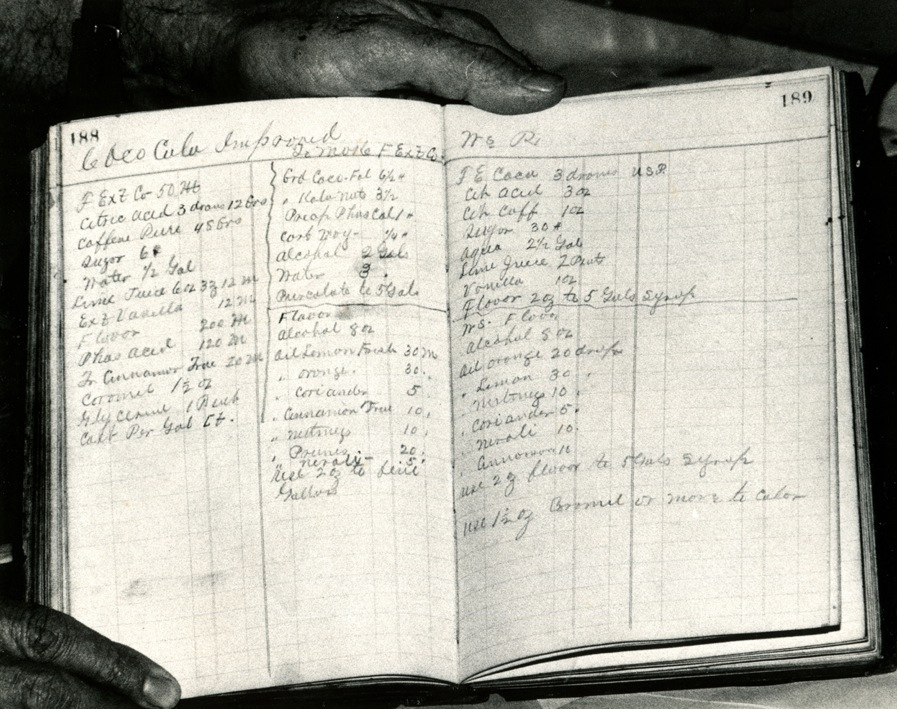
Could this be Coca-Cola’s secret recipe? NPR’s weekly radio, This American Life, show dusts off an old newspaper article from 1979 which featured the photo scanned below.
Could this be the Coca-Cola recipe?
On the episode (podcast), Ira Glass works with the folks at Jones Soda and tries to recreate the original recipe which includes things such as coriander and neroli oil. Fast Company has a post by the son of Charles Salter, the Georgia Rambler, who filed the original story and took the photo above for the Atlanta Journal-Constitution, The Secret Coke Recipe on “This American Life?” My Dad Found That.
Cookie Consent
We use cookies to improve your experience on our site. By using our site, you consent to cookies.
Used to distinguish new sessions and visits. This cookie is set when the GA.js javascript library is loaded and there is no existing __utmb cookie. The cookie is updated every time data is sent to the Google Analytics server.
30 minutes after last activity
__utmc
Used only with old Urchin versions of Google Analytics and not with GA.js. Was used to distinguish between new sessions and visits at the end of a session.
End of session (browser)
__utmz
Contains information about the traffic source or campaign that directed user to the website. The cookie is set when the GA.js javascript is loaded and updated when data is sent to the Google Anaytics server
6 months after last activity
__utmv
Contains custom information set by the web developer via the _setCustomVar method in Google Analytics. This cookie is updated every time new data is sent to the Google Analytics server.
2 years after last activity
__utmx
Used to determine whether a user is included in an A / B or Multivariate test.
18 months
_ga
ID used to identify users
2 years
_gali
Used by Google Analytics to determine which links on a page are being clicked
30 seconds
_ga_
ID used to identify users
2 years
_gid
ID used to identify users for 24 hours after last activity
24 hours
_gat
Used to monitor number of Google Analytics server requests when using Google Tag Manager
1 minute
_gac_
Contains information related to marketing campaigns of the user. These are shared with Google AdWords / Google Ads when the Google Ads and Google Analytics accounts are linked together.
90 days
__utma
ID used to identify users and sessions
2 years after last activity
__utmt
Used to monitor number of Google Analytics server requests
10 minutes
You can find more information in our About Me and .

 – Clay Shirky
 – John Brockman
 – Kevin Kelly
 – Andy Clark
 – Robert K. Logan
 – Nicholas Carr
 – William Powers
 – Sherry Turkle
 – Prof. Andrew Pettegree
 Ann Blair
 – Eric Raymond, Bob Young