Year: 2011

  • Social Decay

    Social Decay

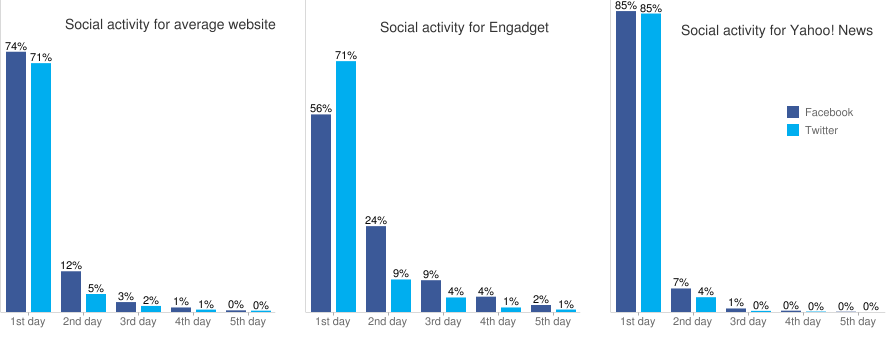
    The money shot from yesterday’s Yahoo Research’s Like Log study is the social activity graph below showing how this activity drops off a cliff after the first 24 hours.

    Looking at over 100,000 articles across 45 big media sites over the course of three months, Yahoo researcher Yury Lifshits found that a vast majority of the Facebook Like and Twitter Retweet activity. Broadly, 80% or more of the activity takes place during the first 24 hours following the posting of a story. No surprise here, News is about New.

    The conclusion from  Yury makes is that sites that put out more than one story a day actually run the risk of splitting their traffic if they can’t double it. Each additional story/day diminishes the return and may contribute to burnout of your audience. This runs counter to the leaked AOL way memo pushing for quantity over quality.

    Gawker Revisits the Front Page

    Gawker famously underwent a redesign that reinforces the conclusions made by the Yahoo research. Look at the redesign before and after and you can plainly see. The image below is their traditional “blog” output which presents the latest story at the top with newer stories pushing the older ones down the page. The default Popular Now column on the right gives some counter-weight but otherwise it’s the standard, reverse chronological layout.

    Gawker.com Old View

    Now contrast this with their new look below. Notice how much more emphasis is placed on the images. This view is called their “Top Stories” view and they’ve taken away all timestamps on the stories as that is not the point of how things are laid out. This layout has an editorial touch to it, the Gawker editors are putting stories in front of you they want you to see.

    Gawker.com New Design

    Nick Denton, the founder of Gawker, posted at length on the thinking behind the redesign.

    We need a few breakout stories each day. We will push those on the front page. And these exclusives can be augmented by dozens or hundreds of short items to provide — at low cost — comprehensiveness and fodder for the commentariat. These will typically run inside, linked by headlines from the blog column, so the volume doesn’t overwhelm our strongest stories.

    and later,

    A prominent “splash” slot on the home page — taking up the two-thirds of the page — can promote the most compelling gossip and scandal. But it also provides the opportunity to display our full editorial spectrum. The front page is our branding opportunity. It’s a rebranding opportunity, too, a way to demonstrate intelligence, taste and — yes, snicker away! — even beauty.

    Back when I was selling the idea of blogs to media companies, I remember saying to them that the front page is dead and that people were coming in the side door to their sites via shared links and pointers from the search engines. This was why it was important for them to make sure each page could stand on it’s own as its own front page for their business.

    It seems as we have come full circle with the larger blog sites now focused back on the front page, picking favorites to be their star headline stories for the day. Are we giving up on social mediation to solve the information filtering problem? Are we going back to a world where we start each day with a collection of bookmarked top sites we visit daily? Are we going back to appointment television? Do we abandon the firehose feed and stick to just the top stories?


  • Hakkapeliitta spirit

    During the Winter in Finland the ocean freezes over. Highways that normally twist around the lakes in the warmer months are re-routed to cut straight across, efficiently. GPS vendors offer Winter Packs to take advantage of these new routes, cutting Winter travel times considerably.

    But this is Finland. Not only do they keep driving at normal speeds, studded tires helping keep traction on icy roads, they also have world records to break. Which brings me to today’s headline.

    I didn’t know much about tires to begin with, nor anything about Nokian Tyres except that they are one of the original business lines for the company I work for, Nokia. The news story was interesting, bits of trivia on the challenges of designing tires for sub-zero temperatures, but what was really interesting was the section on the Nokian site which described their working spirit.

    Nokian Tyres employs over 3700 people, who have their own joys and sorrows, dreams and values. These is something that we all share: solid faith in our competence and skills, confidence in finding answers together, respect for hands-on hard work. We are there for those in need, and we never give up. This is what we call the Hakkapeliitta Spirit. it is something very tangible yet difficult to define, still natural, genuine, real. Frighteningly simple. And impossible to imitate.

    “Joys and sorrows?” This passage seemed so utterly Finnish. What American company would admit their employees are anything but joyful? My Finnish colleagues here at Nokia have tried to describe to me this acknowledgement that an honest life is a struggle.

    This is something that existed in the early days of Nokia when young Finnish engineers were sent to Singapore with a suitcase of phones and a bag of cash and asked to “set something up.”  The goal of work, for these Nokia old timers, was less about waving your flag at the top of some mountain and more about the struggle (sisu) it took to get there and how that struggle brings people together.

    Broken out into sections, the Nokian site goes on to give you a little thumbnail what it’s like to work at Nokian. Sections are titled things like, Together we can achieve more and include phrases such as, “We support each other and never leave a colleague in a pinch.” All of this comes under the header, the Hakkapeliitta spirit.

    Wikipedia gives some background on Hakkapeliitta.

    The Hakkapeliitta were well-trained Finnish light cavalrymen who excelled in sudden and savage attacks, raiding and reconnaissance. The greatest advantage of the fast and lightly-armored Hakkapeliitta cavalry was its charge. They typically had a sword, a helmet, and leather armor or a breastplate of steel. They would attack at a full gallop, fire the first pistol at twenty paces and the second at five paces, and then draw the sword. The horse itself was used like another weapon, as it was used to trample enemy infantry.

    Wikipedia

    If I’m going to be driving at top speeds on the ice, I know who I want making my tires!

  • Driving around with lasers

    I heard about this cool project from a Nokia colleague on the Maps team using some amazing hardware used by Navteq. I promised not to blog about it but I discovered today that it was shown off last year so I guess it’s OK to talk about what’s already been reported. Apparently this was all the buzz at CES 2010 but I was in Finland and Mapping isn’t really my field so I didn’t know it was public. Any excuse to blog about a car mounted with lasers!

    The image above is the output from a specially equipped car that scans the road and surrounding buildings with an array of 60 lasers on it’s roof. Think of it as an über-version of the standard camera cars you see mapping the streets today. It’s insane. Here’s how it’s described in a post by CNet.

    One big part is a LIDAR (light detection and ranging) system that uses lasers to construct 3D maps of the world out of a sea of data points. The company boasts that its True system uses 64 rotating lidar lasers, captures 1.5 million 3D data points per second from features as far as 150 meters away and works even when the data collection vehicle is traveling at highway speeds.

    There’s more that can be done with the hardware than what you see above but I better not go into that. Rest assured, it’s mind-blowing. I was joking with a colleague, combine the plane and landscape database from the Flight Simulator guys at Microsoft with the street view database from Navteq and you’ve got a hyper-realistic gaming environment.

    If you want to learn more about LIDAR and the technology about it, there’s a talk by two folks from Navteq at the upcoming Where 2.0 conference in Santa Clara, CA in April.

  • More CNN on Helsinki

    Following on the popular Helsinki Snow How piece, CNN’s Richard Quest went on to make three more short pieces about the city I currently call home.

    Helsinki’s Underground Master Plan includes a bit about an innovative new server farm I highlighted in Heating by Bytes that uses the excess heat from the computers to heat the city.

    Expanding Helsinki’s Horizon covers the on-going construction in the old harbor of the city that will almost double the surface area in downtown Helsinki via the Horizon 2030 plan.

    Helsinki’s Battle Against the Darkness is about how the inhabitants of the city cope with the dark, Winter days.

  • Conan O’Brien updates Nokia Ringtone

    Conan available online all week in Finland thanks to Team CoCo. Tonight’s segment? A rockin’ update to the Nokia ringtone!

  • Cloud Wars

    Marketing campaigns are gearing up for the major players offering cloud services as add-ons to their core products.

    Google Docs recently launched Google Cloud Connect,  a plug-in which lets  you add your Word, Excel, and PowerPoint documents to Google Docs and share with your colleagues. (Ars Technica reviews Cloud Connect and says it’s “not ready for primetime”)

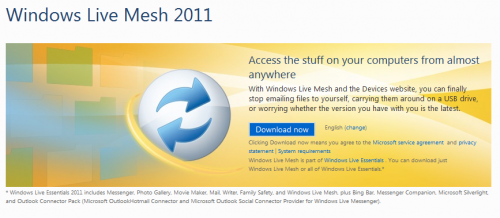
    Microsoft will be ending the beta of it’s Live Mesh service on March 31st and has announced Windows Live Mesh 2011 with the byline, “Access the stuff on your computers from almost anywhere.” It’s part of Windows Live Essentials bundle which you download and install and includes,

    Messenger, Photo Gallery, Movie Maker, Mail, Writer, Family Safety, Bing Bar, Messenger Companion, Microsoft Silverlight, and the Outlook Connector Pack (Microsoft Outlook Hotmail Connector and Microsoft Outlook Social Connector Provider for Windows Live Messenger)

    There is a custom install option in case you don’t want to take all of this in one go. You can learn more at explore.live.com

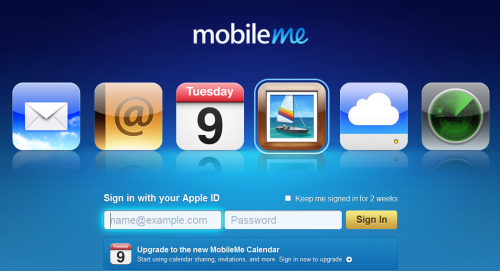
    Finally, Apple has just changed it’s tune. I took a screenshot of me.com yesterday and got the image you see above. It’s all about the services. Mail, Address Book, Calendar, Photos, Cloud Storage, and the Find my iPhone app. I just went back today and the site has been refreshed and the message is totally different.

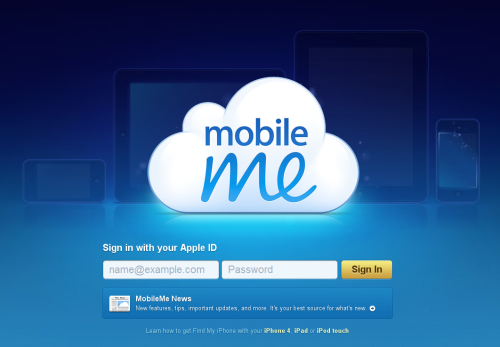
    Today, when you visit me.com it’s all about the hardware. The cloud is front and center and behind are the familiar outlines of the Apple brand of glass tablets and phones. If you wave your mouse over the cloud, you’re greeted with a pixie-dust effect adding some magic to an otherwise plain ol’ login page.

    Could this be positioning for the launch of the rumored Media Stream service or is this just a routine update now that we’ve rolled over from February to March?

  • will.i.am on chips talking to chips

    In a post last year, I paraphrased a quote, “If you are not paying for a product, you are the product.” Will.i.am recently updated this quote with the line,

    You are either the person getting pimped, or you’re the person doing the pimping.

    will.i.am’s description of how the Black-Eyed Peas negotiated a new type of advertising unit for the Super Bowl and collaborated with Marc Benioff and Salesforce to promote Chatter.com through the mini-site thebabypeas.com is a glimpse at how switched on celebrities are using modern tools to manage their brand without the help (or interference or commissions) by an agency.

    But the most visionary thing and something I keep coming back to is will.i.am’s vision of the next generation internet. It’s a world where brand “alliances” pool together to subsidize content producers. A world where, “chips talk to chips” without a middleman to make the free flow of content seamless and automatic. In this new world, a collection of devices will marry themselves to a library of content and work seamlessly together.

    Extended further, it’s a world in which we no longer need the internet to connect us all. When you text someone next to you, why do you need to connect to a cell tower and send the message over a network only to round trip it right back again. If you extend the chips-talking-to-chips metaphor, why not just have the phone turn itself into the modern version of a walkie-talkie and beam the message right over? Bluetooth and NFC have started this vision but taken further, why can’t cellphones self-organize into mini-networks so that a group of phones together could share information without having to connect to the cloud?

  • The Future of Glass

    For Corning, the future is made of glass.

    Corning makes Gorilla glass (check out this video) that is found in the Nokia N8, the LG Optimus 7 that I’m test driving and many other smartphones.

  • Three Schools of Thought on the Internet

    Adam Gopnik has a survey in this week’s New Yorker running down a few of the recent books about the internet and divides them into three schools of thought:

    1. The Never-Betters believe that we’re on the brink of a new utopia, where information will be free and democratic, news will be made from the bottom up, love will reign, and cookies will bake themselves.
    2. The Better-Nevers think that we would have been better off if the whole thing had never happened, that the world that is coming to an end is superior to the one that is taking its place, and that, at a minimum, books and magazines create private space for minds in ways that twenty-second bursts of information don’t.
    3. The Ever-Wasers insist that at any moment in modernity something like this is going on, and that a new way of organizing data and connecting users is always thrilling to some and chilling to others—that something like this is going on is exactly what makes it a modern moment.

    Seeing the title of this blog is everwas, I think you know where I come in. The arrival of the internet and hopes and fears that we collectively foist upon this new technology is something we’ve seen before.

    Commuters in Tokyo, Absorbed in the Cell Phones

    The printing press, the telephone, the radio, the television, the internet, and now the cell phone. Each successive wave of communications technology push and pulls our society to new behaviors. I read somewhere when the telephone was first introduced, no one knew how to start a conversation with the person on the other end of the line. For a few years, “Ahoy!” was the commonly adopted opener, choosing to go with nautical terminology maybe to acknowledge the fact that we were all sailing into new waters together.

    Eventually we adopt and assimilate the new technology into our daily life much like the body develops an immunity to a new virus. We grow stronger and learn to control our tools rather than let them control us. What was once shiny and new becomes less so. Gopnik continues to draw the arc of history,

    Yet everything that is said about the Internet’s destruction of “interiority” was said for decades about television, and just as loudly. Jerry Mander’s “Four Arguments for the Elimination of Television,” in the nineteen-seventies, turned on television’s addictive nature and its destruction of viewers’ inner lives; a little later, George Trow proposed that television produced the absence of context, the disintegration of the frame—the very things, in short, that the Internet is doing now. And Bill McKibben ended his book on television by comparing watching TV to watching ducks on a pond (advantage: ducks), in the same spirit in which Nicholas Carr leaves his computer screen to read “Walden.”

    Now television is the harmless little fireplace over in the corner, where the family gathers to watch “Entourage.” TV isn’t just docile; it’s positively benevolent. This makes you think that what made television so evil back when it was evil was not its essence but its omnipresence. Once it is not everything, it can be merely something. The real demon in the machine is the tirelessness of the user. A meatless Monday has advantages over enforced vegetarianism, because it helps release the pressure on the food system without making undue demands on the eaters. In the same way, an unplugged Sunday is a better idea than turning off the Internet completely, since it demonstrates that we can get along just fine without the screens, if only for a day.

    Further Reading (I’ve added a few books of my own, feel free to suggest more in the comments):

    Adam Gopnik, How the Internet Gets Inside Us, The New Yorker

    Never-Betters

    Better-Nevers

    Ever-Wasers