I picked up a book of old photographs last weekend that detailed Alameda’s railroad history. I had heard that the island where I live used to host a network of light rail lines that served the community but had no idea how extensive it was until I browsed the pages of Alameda by Rail this past weekend.
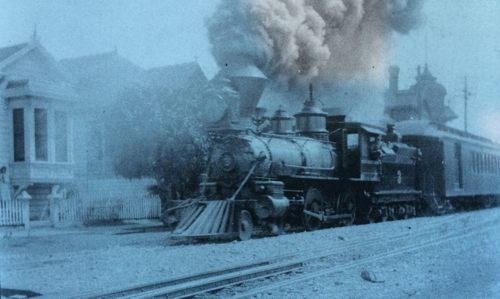
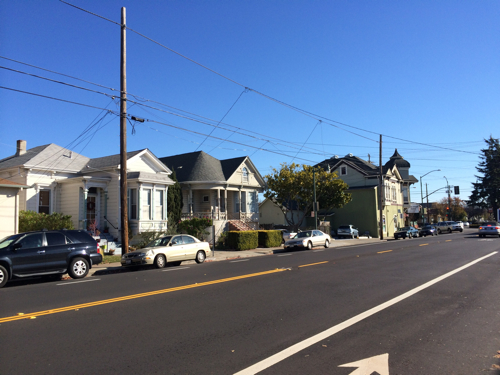
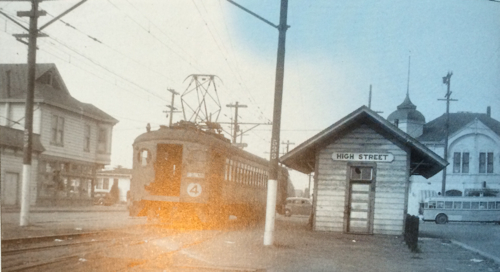
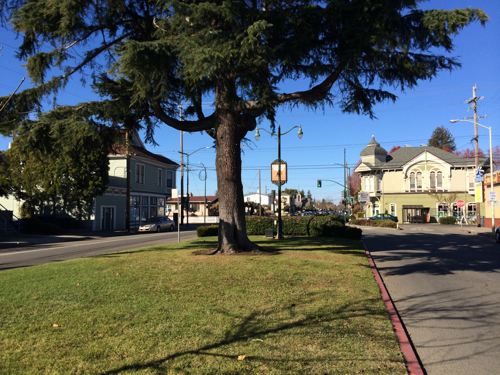
Each photo was meticulously documented with approximate location and year of the photo so I took it upon myself to locate some of the places where the photos were take to see if I could approximate what the view looks like today. The results are below.
Steam Locomotive on Encinal
Encinal Avenue today
Commuter train from the 40’s on corner of High and Encinal
High Street Station today
Having an awareness of what had once been gave me a whole new appreciation for the history of our neighborhood. Alameda today is a bit cut off from San Francisco as most drive (it takes about 30 minutes without traffic). The nearest light rail station is Fruitvale BART station which is about 10 minutes away on bicycle. Apparently trolleys raced back and forth across the stretch of the Island every 30 minutes and, if you wanted to go to the city, a ferry was waiting over on the West End that could take you directly downtown to San Francisco.
Imagine how different life would be if you could catch a train to the city by walking out your front door! Too bad the ripped up all the tracks – with the price of gas and parking today, it would be nice having those old trains back and less cars on the road.
UPDATE: If you want to try this poor man’s time travel trick but don’t have a book with old photos, check out WhatWasThere. The upload and overlay onto Google Street View is a bit finicky but if you get the alignment right, the effect is quite stunning.
Kristian Luoma from Finland pinged me yesterday, curious why I still used Foursquare. When I lived in Finland, we were one of the first people on the ground to use the app and we used to compete on who would retain the mayorship of Helsinki’s Vantaa Airport.
I no longer really care about being the Mayor of someplace but I told Kristian that I still use Foursquare regularly as a personal journal of places I’ve been. I have all my check-ins written to a Google Calendar (I use an IFTTT recipe to do this) so that I can quickly check where I’ve been when needed as a reference.
I also religiously check the recommendations left by others. I find the smaller, explorer-minded crowd on Foursquare more interesting than those on Yelp.
But what I really like about Foursquare is the collective data that you get after logging your location over time. I’ve written about them before (Timemachine, 2010 Infographic, and WeePlaces)
There’s a new one that I missed released for Foursquare day back in April.
Two tear-jerker videos illustrate the power of technology to connect over distance. Watch and marvel the world we live in. Happy Thanksgiving everyone.
Google Search services connect two old friends across political boundaries. This video was put together by the Google India team.
Skype connects two girls on opposite ends of the earth who share a disability, part of Skype’s Stay Together campaign.
Yesterday I saw this on a lightpost on the way to work. Kinda random. I walked on. There’s a link to the full image, some tumbler with links to the pdf so that people can print them out and post them on their own.
The Shinto shrines of Ise in central Japan are famous because they have been re-built every 20 years for hundreds of years (2013 is a re-building year). In an example of long term thinking, there is a special grove of cedar trees that are grown specifically so that they may be harvested in time for the next rebuilding. The same family of carpenters have been taking care of the rebuilding, each generation being trained by the one before.
But there are some even more interesting details about Ise that I only learned today. The shrine is designed in the style of old rice warehouses. One might think that any design that needs to be rebuilt every 20 years must be flawed but there is, in fact, a reason for this design.
A great deal of rain usually falls in Japan’s early-summer monsoon, and as the thatched roof absorbs rainwater it becomes heavier. The heavy roof presses down on the walls, and this closes gaps between the wall boards, keeping the inside dry. In summer, the roof dries out and becomes lighter, allowing air to pass through the building and this also keeps it dry. Thus, the roof and pillars function together like a living organism to securely protect the seed rice from moisture and pests.
It seems to me, this harmony between form and function is uniquely Japanese, uniquely Shinto.
Breaking Bad is over. I watched the final episode a couple of nights ago. I only first got into the series because I saw from our Netflix queue that my son was watching it and figured I should watch a few episodes to see what was it was about. He got bored and moved on but I got sucked in.
As I made my way through the backlog and then finally started making my way to the final shows, I came to realize that this show about an Walter White’s transformation from a high school chemistry teacher to methamphetamine kingpin was also an allegory for humanity’s decent into addiction. As I binge viewed with the rest of the country and stayed up late to watch one more episode, I realized that I was addicted to the story. As Walt, the person we all cheered for in the beginning, became more twisted, I found myself loathing him for his selfishness. Yet I kept watching.
Today I listed to the final episode of the Breaking Bad Insider podcast that has Breaking Bad’s creator, Vince Gilligan, talk about some of the story arcs including several alternative endings he proposed. The entire podcast is fascinating and well worth a listen but the bit below is particularly interesting.
In this 4 minute segment, Vince describes an alternative ending which was so disturbing that the network producers spiked it. Have a listen.
I am so proud of my sister who just worked her heart out to help her company put together two videos to describe how Evernote works with it’s partners.
Evernote started as a simple list and notes service to help you organize your digital notes. Starting with image recognition on digital photos it began to extend to the physical world and now, as you’ll see in the two videos below, it’s expanding it’s app ecosystem to include physical items such as Evernote-enabled Moleskins and scanners.
The cool behind the scenes story is that Evernote wanted the videos to be authentic and asked my sister to add some of her own items into the videos. Sprinkled across both videos are bits and pieces from her past. Family photos, my dad’s old business card for Tokyo Q, and some artwork from her daughter.
I blog to remember. This site serves as my personal parking place for things I want to share and save. I want to remember these two videos.
Dave Winer posted a call for co-remembrances of the BloggerCon conferences he held in 2003/2004 which got me thinking about how I started this blog and kicked off a series of events that brought me to California to work at a blogging company and catch a wave that I’ve been on ever since.
I attended BloggerCon II in Boston in 2004 on a hunch. I was working at Dow Jones, publisher of The Wall Street Journal, for the Electronic Publishing division (only a newspaper company would have such a division) and was working with enterprise customers integrating news into corporate intranets. Most companies at that time were using large portal software packages such as Plumtree or Microsoft Sharepoint to drive their portals so blogs for corporations were very much under the radar. At the time, I was a regular reader of John Battelle’s Searchblog and Joi Ito and was playing around with Blogger so I could see the promise. My gut told me that the blogger community was something worth investigating.
When I got to Cambridge, where BloggerCon was held, I immediately knew that I was in the right place. The unconference format was very natural to me and the sharing openness of the attendees was a welcome change from the competitive world of enterprise software. Each session included an IRC chat and seeing the IRC scrolling on the screen behind the speakers was a philosophical shift that echoed the shift of the conversation from the publisher to the community that was taking root with blogging. I think their was some kind of streaming audio for remote viewers as well. I recall someone typed something into the IRC that made the entire room erupt in laughter, that person then typed “Cool, I just made the room laugh.” It was a powerful learning moment for me, to listen and include your audience. It was a pre-cursor to what we see today when the twitter/hashtag feed serves as a back-channel commentary to the podium. The community could drive the agenda. This was in 2004, before the Kryptonite/Bic Pen video and all the other Social Media fails that were to follow.
I had been pretty much all alone in corporate-ville trying to explain the power of this new self-publishing platform but most of my talk was falling on deaf or pretentious ears. Meeting others at BloggerCon helped me put more eloquent words to what I was trying to say and emboldened me to spin up a few initiatives of my own.
I was a always struggling with the best way to get the word out to our more developer-minded customers. All communications were filtered through the Marketing and PR departments where things I wrote were watered down and stupefied to the point where they didn’t make sense. We sometimes had outages and by the time my post-mortem communications were approved and made it to the customer, it was too late and only served to remind them of something they had already forgotten about.
I launched a product blog for my product and gave the address to a small group of customers that I knew would appreciate it. On that blog I would give them a head’s up on new features and asked customers questions about future product direction. They left thoughtful comments and the knowledge shared in the commentary helped everyone who read them. It was a lightweight community, an alternative to more formal “focus groups” which cost a lot to set up and required people to travel in order to participate.
I was nervous because I was going around the Marketing Department so after a couple of weeks I mentioned to the VP of Marketing what I was up to and his response was, “Don’t tell me anything more. I don’t want to know what you’re doing but keep doing it.” From that day on the die was cast and I was off and running. Within a year, convinced of the power of this form of communication, thanks to an introduction from my sister, I had a long, animated conversation with Anil Dash who had already moved to California to work at Six Apart, an early blog software pioneer. Within a few months I joined my sister, Anil, Andrew Anker and others as the company geared up to launch Six Apart’s hosted blogging platform, TypePad.
The rest is history. Since BloggerCon, my career has always leveraged lessons that were put into motion that weekend in Cambridge. Every job I have held since has involved an appreciation of the social media community that started at BloggerCon. Thank you Dave for giving a home to the early pioneers and setting me on a path that I am still blazing down today. It’s been a glorious ride.
Cookie Consent
We use cookies to improve your experience on our site. By using our site, you consent to cookies.
Used to determine whether a user is included in an A / B or Multivariate test.
18 months
_ga
ID used to identify users
2 years
_gali
Used by Google Analytics to determine which links on a page are being clicked
30 seconds
_ga_
ID used to identify users
2 years
_gid
ID used to identify users for 24 hours after last activity
24 hours
_gat
Used to monitor number of Google Analytics server requests when using Google Tag Manager
1 minute
_gac_
Contains information related to marketing campaigns of the user. These are shared with Google AdWords / Google Ads when the Google Ads and Google Analytics accounts are linked together.
90 days
__utma
ID used to identify users and sessions
2 years after last activity
__utmt
Used to monitor number of Google Analytics server requests
10 minutes
__utmb
Used to distinguish new sessions and visits. This cookie is set when the GA.js javascript library is loaded and there is no existing __utmb cookie. The cookie is updated every time data is sent to the Google Analytics server.
30 minutes after last activity
__utmc
Used only with old Urchin versions of Google Analytics and not with GA.js. Was used to distinguish between new sessions and visits at the end of a session.
End of session (browser)
__utmz
Contains information about the traffic source or campaign that directed user to the website. The cookie is set when the GA.js javascript is loaded and updated when data is sent to the Google Anaytics server
6 months after last activity
__utmv
Contains custom information set by the web developer via the _setCustomVar method in Google Analytics. This cookie is updated every time new data is sent to the Google Analytics server.
2 years after last activity
You can find more information in our About Me and .