Underscoring the need for President Biden’s trillion dollar infrastructure bill, a bridge collapsed outside Pittsburgh where the President was scheduled to give a speech later in the day, about infrastructure.
As Beijing prepares to host the Winter Olympics, 1.2 million cubic tons of artificial snow are being sprayed onto nearby mountains so that there’s enough to host the planned events.
Amateur astronomers have determined that an errant Falcon 9 rocket stage that has been hurtling thru space for seven years will violently rendezvous with the dark side of the moon in early March.
Fourteen London Underground trains had to be diverted, causing delays, while workers coaxed a stubborn swan off the tracks.
Two excited authors of freshly printed cookbooks were crushed to learn their book release parties will be delayed. The entire print run of their books were lost at sea when a cargo ship lost over 60 containers into the Atlantic.
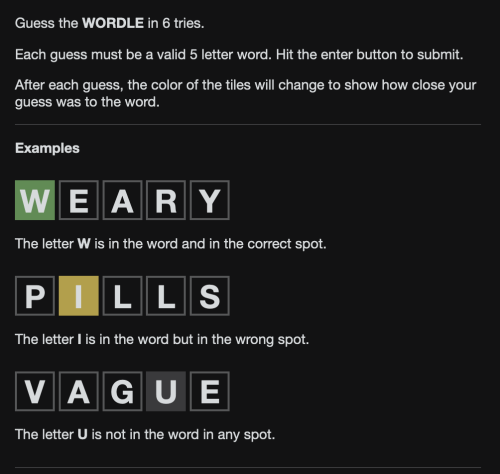
The online game of Wordle has been online since November last year but it broke into popular view in January when the yellow and green chicklet pictograms started showing up in people’s social media timelines.
The game is elegant in its simplicity.
Wordle refreshingly lacks any viral loops (players are limited to a single game each day) and there is no flashing banner ads or login requirement. Wordle is an old school, web 1.0 mobile web site that sets a cookie to see if you’re a new user or returning user, that’s it.
Most people learned about Wordle from a Jan. 3rd NYT article, Wordle is a Love Story that profiled the creator of the game, Josh Wardle. Here we learn that Josh created Wordle for his partner and that Ms. Shah helped narrow down the list of words. We also learned that Josh was an Product Manager for Reddit and was also behind two other popular “collaborative social experiments,” The Button and Place.
We also learn about Wordle’s counter-intuitive viral success.
The breakthrough, he said, was limiting players to one game per day. That enforced a sense of scarcity … which leaves people wanting more
The colored grids that have blossomed all across social media were inspired by players that were manually sharing their results using manually constructed grids using emoji (BuzzFeed digs into a group of New Zealanders who were part of this). Wardle built a way to automate the creation and sharing of the results but, again, chose to remove the normal elements that are “table stakes” on a mobile game,
If he were optimizing the game to gain as many players as possible, he would have included a link at the end of the tweet that the tool generates, he said. But after looking into it, he said it would have looked “trashy” and not as visually compelling, and he liked the grid’s mysterious air, which he felt piqued people’s interest.
The result of this manufactured scarcity and mystery has been that the game exploded into the zeitgeist.
It also resulted in people rushing to the iOS app store and pay for an 5-year old game called Wordle!. Touchingly, Steven Cravotta, the developer, contacted Josh and the two worked out a charity to donate the proceeds.
Since then, there have been hundreds of posts going into the best “start words” (I like this Wired piece). As an ultimate badge of honor, Google even added an easter egg when you search for “wordle” on the site.
Due to the open nature of the site, there are several spin-offs including (credit to @waxpancake, the /r/wordle subreddit, and #wordle on SmartNews Slack for this list)
Absurdle – “adversarial” as the word changes on each line
I enjoyed Brian Morrissey’s Digiday podcasts which featured interviews with various media executives. His experience in publishing and advertising brings out a level of detail in his conversations that goes deeper than most but still accessible even for a trade publication.
His The Rebooting newsletter is his attempt to branch out on his own and share his findings each week via text. In this week’s issue he writes about the recent optimism in digital publishing startups due to several high-profile individuals setting up shop to try something new. In the last round, the large platforms (Facebook, Google) sucked up all the investment and called the shots, this time, he says, it’s different.
The long term opportunity lies in smarter bundles. New publishers like Defector Media, Every and Puck are building these models. Newsletters have always been a reaction to an industrialized content industry that uses distribution hacks to vacuum up attention data in the service of advertising. These new models allow for the content creators to share in the value they create. That’s only right, and the publications that try to hoard the upside will mostly lose out. More egalitarian ownership is a key part of Web3 but also the future of publishing businesses.
I am a fan of smart aggregation and bundles. With all the newsletters and small media start-ups, the pendulum will swing back towards discovery. Modern machine learning technology and new subscription/rev-share models should provide an opportunity for innovators in this area.
Maybe this time, Lucy will let Charlie Brown kick the football.
Amazon engineers scrambled to update Alexa’s library of “challenges” when a concerned parent reported the AI assistant suggested sticking a penny in an electrical socket.
A meteor exploded in Pennsylvania with the energy equivalent to 30 tons of TNT.