Last night’s episode of Succession hung in the balance on the interpretation of a memo left in Logan Roy’s safe and the collective interpretation of a single, wobbly pencil line left by the family patriarch.
Just when you think it can’t get any murkier, the clouds roll in.
At what point do you start calling yourself a New Yorker? What event triggers in your mind that you are now “from New York,” an active citizen of this city? In no certain order here are some of those things that I’ve gathered up when I asked people this question. I am not a New Yorker yet, but know what it means to be one.
I will add to this list as I think of things. Leave a note below in the comments if you have something to add.
Getting Around
All distances are defined in blocks and avenues. You know that it takes approximately 20 minutes to walk 20 blocks uptown or downtown.
You’ve taken a “cash only” taxi ride.
You know that when a subway pulls up and the car in front of you is empty, it means the heat’s on in the summer or someone’s puked on the floor.
You know where you need to get on a train so, when you arrive at your destination, you’re right at the exit you need.
No one calls it Avenue of the Americas – it’s Sixth. Never North or South, just Uptown and Downtown. Oh, and if you pronounce “Houston” like the Texas city, you’re a dead giveaway for an out-of-towner.
You secretly dread the sudden appearance of Showtime on your subway ride.
. . . but be sure to look both ways before crossing the street, especially on a one-way, gotta watch out for those bikes. (@albertcox – world traveler)
Did you know that you can use the 6 train subway stops in Manhattan as a handy conversion table from Fahrenheit to Celsius?
Things to Do
You feel totally fine spending a weekend at home being cozy because, yes, NYC has tons of things to do, but it’s also home and you don’t need to DO all the things to know that you could if you wanted to. (thanks Clarice Meadows!)
You’ve never been to the Statue of Liberty. You know it’s there, it’ll always be there.
You’ve been to Katz’s but know a better place to get a pastrami sandwich.
You not only have your local go-to pizza joint, you know a decent place within 20 blocks of any place you may be in your borough.
You have a local fruit stand guy/bodega/barista/bartender that knows you by name and asks where you’ve been if you go away for a few weeks.
You know the real Chinatown is in Queens.
You have a favorite dinner or drinks spot that closed and, forever after, you mentally pour one out when you pass by the new place that’s taken over. (thanks Clarice Meadows!)
Living Quarters
You’ve complained to, and reached a compromise with, your neighbor.
Your ears perk up whenever you overhear of a place with in-apartment washer & dryer.
You realize that the cluster of blocks where you live is your small village linked together to other small villages in this city of millions.
Culture
You’ve had a public argument with someone on the street.
To be a NYer is to be yourself, and so to feel ownership everywhere. True New Yorkers don’t wait on line for anything. Especially brunch. (@moorehn)
While out walking on errands, you run into at least two people you know.
Every publisher should be thinking about publishing their archives into a GPT-style database to be used as an internal research tool.
As for how BloombergGPT might inspire other news organizations…well, Bloomberg’s in a pretty unique situation here, with the scale of data it’s assembled and the product it can be applied to. But I believe there will be, in the longer term, openings for smaller publishers here, especially those with large digitized archives. Imagine the Anytown Gazette training an AI on 100 years of its newspaper archives, plus a massive collection of city/county/state documents and whatever other sources of local data it can get its hands on. It’s a radically different scale than what Bloomberg can reach, of course, and it may be more useful as an internal tool than anything public-facing. But given the incredible pace of AI advances over the past year, it might be a worthy idea sooner than you think.
Season Four of the HBO drama Succession is underway and the writing is so good that I am memorializing some of it so it’s readily available later, especially the dialog around media.
Episode One: Munsters
Kendall, Shiv and Roman are off spinning up their own new media startup. As they spitball new concepts, the writers have crafted some cringe-worthy bon mots about what the Logan Roy offspring think is the future of media.
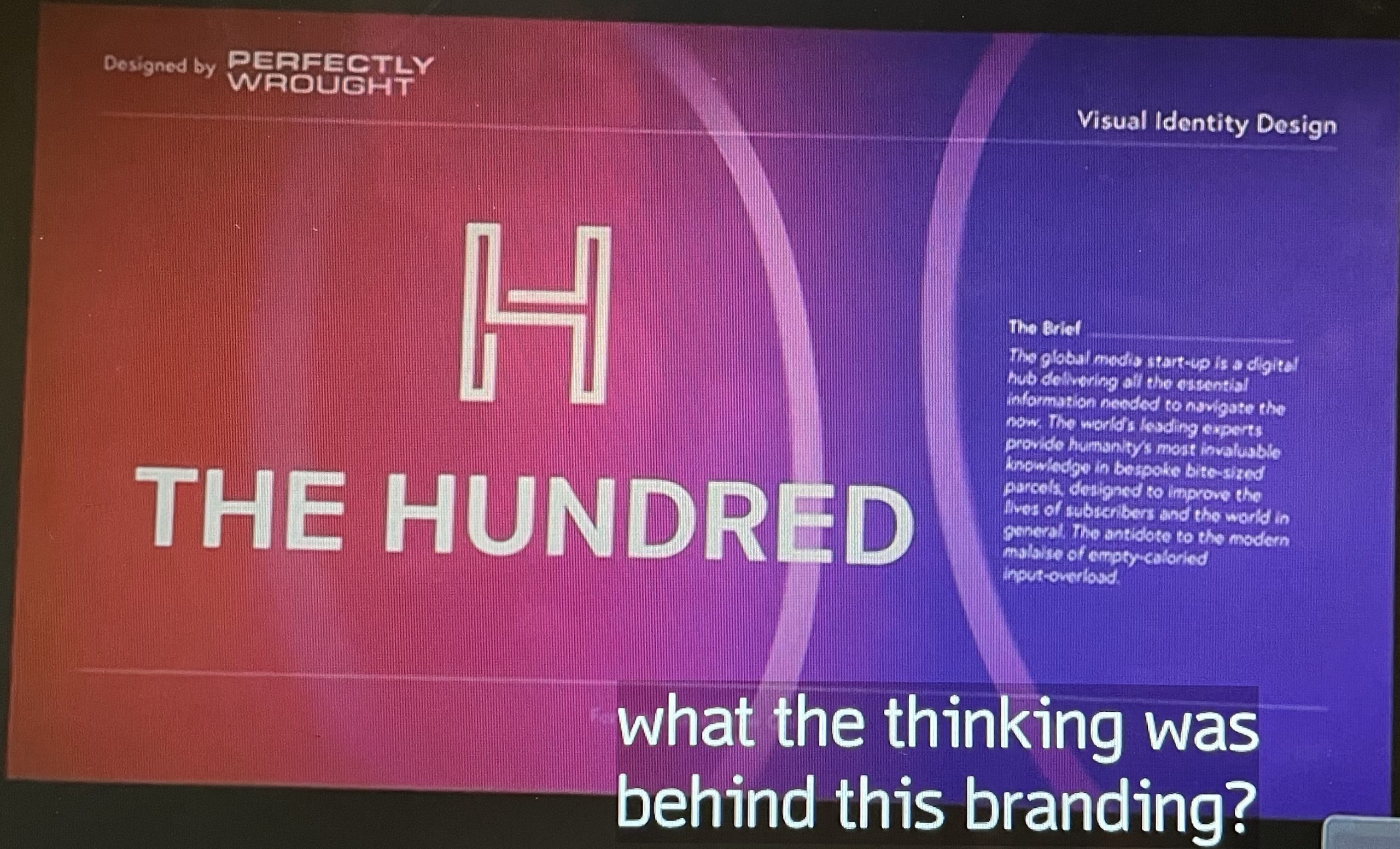
Branding slide for The Hundred: The global media start-up is a digital hub delivering all the essential information needed to navigate the now. The world’s leading experts provide humanity’s most invaluable knowledge in bespoke bite-sized parcels, designed to improve the lives of subscribers and the world in general. The antidote to the modem malaise of empty-caloried Input-overload.
Kendall:The Hundred is Substack meets Masterclass meets The Economist meets The New Yorker.
Roman: I feel like we said iconic, and you guys are leaning ironic.
Kendall: An independent bespoke information hub with the hundred greatest top writers, experts and minds in every field from Israel-Palestine to A.I. to Michelin restaurants. It’s a one-stop info shop, with high-calorie info-snacks.
Roman: It’s like a private member’s club, but for everyone. It’s like clickbait but for smart people.
Kendall: We have the ethos of a non-profit, but a path to crazy margins.
Logan Roy: What are people? They’re economic units. I’m a hundred feet tall. These people are pygmies. But, together, they form a market. What is a person? It has values and aims but it operates in a market. Marriage market, job market, money market, market for ideas, et cetera, et cetera.
Episode Two: Rehersal
Now that Kendal, Shiv, and Roman have made a play for the old media brand, Pierce Media, they bounce around some ideas on how to spiff things up.
Shiv: I gotta say, the upside is huge if we just broaden out and stop over-indexing to college professors.
Roman: Sorry, I just can’t seem to tear my eyes away from the bald man talking about NATO. I have a boner.
Kendall: So, my floaty kinda semi-pitch would be hardcore international news from global-global to hyperlocal. Maybe focus on Africa? Every day, just what is happening in Africa? The Maghreb. Sub-Saharan East, Sub-Saharan West. I would watch that shit.
Roman: You would not watch that shit.
Shiv: That sounds like Homework: The Show.
Kendall: The point is, it’s global reach. It’s a network that teaches you how to watch it.
Roman: Or, shove all your foreign report melatonin news hour info dumps in the daytime. Primetime, we go full Clockwork Orange, you know?
So good. Looking forward to what drug-addled craziness awaits this Sunday.
Generative AI presents a challenge for media companies that can no longer rely on Google for “discovery.” The chat UI commoditizes everything it indexes so every source in its index is reduced to a mere footnote.
The article (or media artifact) construct will exist tangentially to chat, but with less importance to the reader experience and more important as a reference source. The media brand will surface as a validator in the chat experience, a signature of quality like “Intel Inside.” Only the most recognizable will have value. Evergreen content, like the hundreds of articles of the “how to stop a bleeding nose” variety will languish. Personal, timely, authoritative POV will do much better.
The few media companies that cross the line between content and data provider will find valuable new opportunities in the chat world. A rich, faceted database of all the roofing providers, senior living centers or drug conditions will find a way to capture value connected to AI and upstream of clear economic events. Similarly, marketplaces that represent a unique catalog of products will do well. Value increases with proximity to a transaction.
The challenge for publishers is to build a sustainable editorial voice that remains a destination alongside a readily available AI resource that will expand to meet any and all curiosity-driven demands. Focus on attracting a readers with a unique community and nourish that community with a unique and entertaining stories.
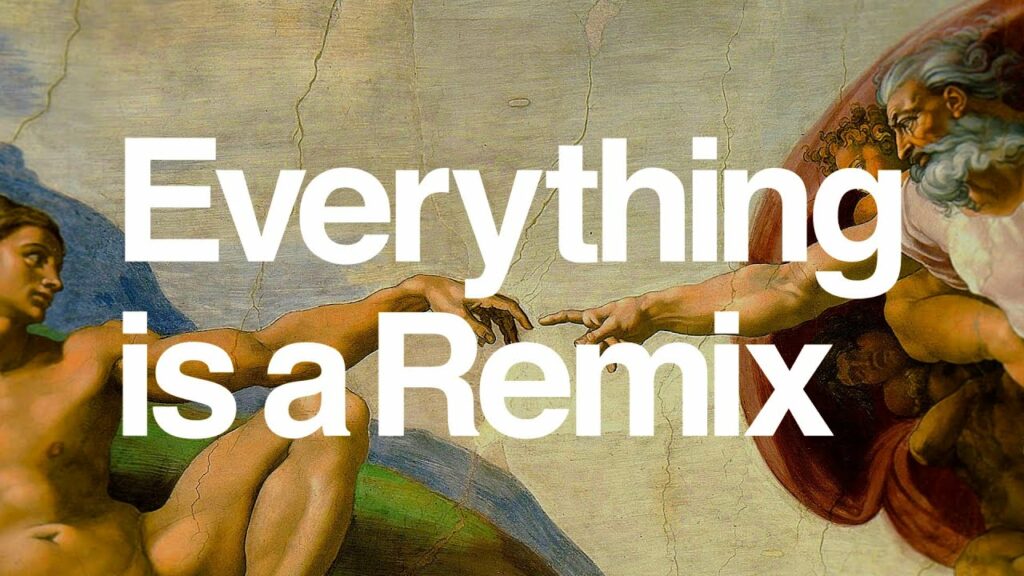
I thoroughly enjoyed the final cut of Everything is a Remix which, if you’ve seen earlier cuts, has been updated to include a chapter about AI and its impact on Art.
The conclusion is uplifting, affirming the triumph of human creativity over the robots. Kirby Ferguson completed this multi-year project, manually curating an impressive number of clips (that he readily admits was done without permission) to make this masterpiece and clearly speaks from his soul.
His concluding message in part four, about the threat of Artificial Intelligences to Art, is inspiring,
Of all humanity’s technological advances, artificial intelligence is the most morally ambiguous from inception. It has the potential to create either a utopia or a dystopia. Which reality will we get?
Just like everybody else, I do not know what’s coming. But it seems likely that these visions of our imminent demise will someday seem campy and naïve – because our imaginings of the future always become campy and naïve.
AIs will not be dominating creativity because AIs do not innovate. They synthesize what we already know. AI is derivative by design and it is inventive by chance.
Computers can now create but *they are not creative.* To be creative you need to have some awareness, some understanding of what you’re doing. AIs know nothing whatsoever about the images and words they generate.
Most crucially, AIs have no comprehension of the essence of art: living. AIs don’t know what it’s like to be a child. To grow-up. To fall in love. To fall in lust. To be angry. To fight. To forgive. To be a parent. To age. To lose your parents. To get sick. To face death.
This is what human expression is about. Art and creativity are bound to living, to feeling.
Art is the voice of a person. And whenever AI art is anything more than aesthetically pleasing, it’s not because of what the AI did. It’s because of what a person did.
The title of this post is from last week’s People vs. Algorithms newsletter. What starts with a grim evaluation of BuzzFeed’s latest earnings leads into a grim prospectus of the online media industry in a world where platforms such as TikTok and Chat GPT upend established publishing business models.
In this world, publishers that have built their reputation on listicles curating the best posts from Reddit lose out to TikTok accounts scratching that same itch but wrapped up in bite-sized, personality-driven, 20-second video clips. People don’t go to BuzzFeed for random amusement, they go to TikTok.
Then there’s search. When you know what you’re looking for, you realize that Google’s search results page is no longer that efficiently clean place that it used to be. There are more distractions on a a Google SERP than a suburban strip mall lined by used car inflatable air guys and their flailing limbs.
Search for the best hotels in NYC and you’ll notice that not only the first couple of results are sponsored, the embedded map, People Also Ask box and other remaining links are also heavily SEO’d and lead to pages that are either full of sponsored links as well. Anyone who has searched for a recipe knows that the actual list of ingredients is buried down on the bottom of the page, after you’ve scrolled past the history, entomology, and evolution of the dish, all while generating impressions on the accompanying advertisements that may or may not be related.
Conversational AI interfaces harken back to the utility of early Google as they cut right through all this. I have to admit that 80% of my ChatGPT use is asking for the ingredients of a cocktail. The response is wonderfully refreshing with its “just the facts” presentation.
The web starts to look different, half chat box, half vertical video.
Lifestyle publishers that get their revenue via ads running on their site need to prepare for this new world. If curation of the social web is no longer seen as a value add and the “How to. . .” or recipe post just becomes raw material for a ChatGPT response, then how does this publisher, who is paid to introduce advertisers to their audience, get paid?
The arc of the internet is long and unpredictable but bends toward user empowerment and ever increasing fidelity. An endless stream of algorithmically sorted vertical video is the current endpoint. Robots that do much of the work to make sense of things for you are coming faster than you can say “human augmentation.”
John Battelle, who wrote the book on search, the last technical innovation, has some ideas. The first two (affiliate and subscription) are the logical continuation of existing business models but the second two are more interesting.
“NPR-style” underwriting – There’s an opportunity for a specialized AI to be sponsored by a brand in the same way you see certain brands feature prominently in certain magazines. Going back to my search for a cocktail recipe, does adding a classy, relevant brand ad to an AI search that’s been specifically trained on a curated dataset for the purpose can not only help pay for the experience, if done tastefully but also add to it.
Building programmatic search ads “at scale” ruined the curation of high-end brand advertising. To make a good conversational search experience takes time and expertise. Great care should go into curating training sets and iterating continually to produce quality results. Hopefully the same care will be given to accompanying advertising.
The branded agent – this brings to mind something that was pondered but never came to be when search became a consumer product. Search can go both ways, there’s the retrospective search where we search the past and then there’s prospective search that is like a standing search that only notifies you when there’s a new “hit” in the future. Prospective search is familiar to anyone who’s played around with a financial news service, Google Alerts, or services such as IFTTT or Zapier.
If I think of it, I have multiple standing search queries across multiple services that vie for my attention when they get a hit. Spotify lets me know when an artist that I have on repeat is coming to town, American Express tells me every week how much I’ve spent on my card, and ESPN is laughing at me right now because my NCAA bracket is a mess.
These are better known as push notifications and, if you’re like me, you get too many of them. Maybe this is where conversational AI will provide help. Notifications are like a one way conversation – various services trying to start a conversation, most of them failing. Apple has attempted to offer user controls but it’s so complicated to set up that entire articles are written about how to configure the Notification Center.
World War I U-boat controls
Maybe notification management is where we’ll see sponsored conversational AI agents provide value. Allow an AI access to your notifications to get filtered or enhanced notifications and chat conversations informed by your lifestyle and interests.
Invite The New Yorker AI, sponsored by Calm to manage your weekend notifications and allow you uninterrupted time with their long-form journalism partners.
Let Bicycling‘s AI, sponsored by Peloton look at health-related notifications and suggest that you take your indoor training on the road with the upcoming Five-Borough ride.
Use the Eater AI sponsored by Resy to look for food & drink recommendations and get access to a branded conversational AI module that has a history of not only where you’ve been but also all the places you have “on your list.”
We give Google access to our retrospective search, are we prepared to give an AI access to our prospective search in return for personalized AI?
Imagine asking your personal AI when that Italian restaurant your friend texted you about last week is open for a Friday evening reservation. You then ask it to check which of those days works for your date and, when you hear back, you ask the AI to secure that reservation with your credit card. Skip a few beats and then your Peloton AI pipes in to suggest a longer than normal ride for you the following day to work off all that pasta. Respond “sure” and then it’s on your calendar for Saturday morning.
Is this a dream come true or a nightmare you want to avoid? We’ve been here before. What privacy will you give up in return for convenience? It comes down to trust. We’ve been burned by the platforms who took our trust and used it to spam us with irrelevant messages in pursuit of CPCs at scale.
Would things have been different if we opted in to brands we trust to broker our preferences. What if publishers such as The New Yorker, Bicycling, or Eater managed our privacy and brokered it to its advertisers. Wouldn’t you feel differently if you were putting your trust in an editorial voice that you identified with as a subscriber and reader and not some faceless technology stack that only sought to harvest your clicks?
Now is the time for publishers to jump in front of conversational AI development and use their editorial expertise to craft experiences that cater to their readers. Use this Precambrian period to establish a reputation for quality and avoid disintermediation by the platforms again.
Thank you Noam Chomsky for pointing out the key difference between generative AI and human “intelligence.”
The human mind is not, like ChatGPT and its ilk, a lumbering statistical engine for pattern matching, gorging on hundreds of terabytes of data and extrapolating the most likely conversational response or most probable answer to a scientific question. On the contrary, the human mind is a surprisingly efficient and even elegant system that operates with small amounts of information; it seeks not to infer brute correlations among data points but to create explanations.
Rather than a brute force, pattern-matching auto-correct on steroids that cannot distinguish between right and wrong, the human mind can infer and draw connections on incomplete data and generally has the moral compass to guide it to make ethical decisions that benefit the society in which we live.
As a child of two cultures, I visited Japan several times when I was still learning English. I attended Japanese kindergarten during the summer while visiting Japan with my mother (my aunt was a kindergarten teacher).
I would struggle to explain how my mind would *click* into Japanese. As native English speakers, we all intuitively “know” when something sounds right. There is a rhyme to the language and we all learn what a grammatically correct sentence sounds like even if we cognitively cannot tell you the rules that make it so. If you went to kindergarten in the US and you hear the first bars of Mary Had a Little Lamb, you all know how it finishes. I believe the grammar of a language is the same way, there is a rhyme that is picked up easily by children who can take it in and absorb it while older adults are limited because their learning is filtered by what is possible in their native language.
All this to say, no, humans are more than pattern-matchers and that there is a long way to go before we see Generalized Artificial Intelligence.