The first time I heard David Lindley was when he came out on stage as the warm up act for Santana and The Grateful Dead in the Sierra foothills in California. It was a hot August day and it was still early afternoon so the sun was blazing down on the crowd. We had just watched an airshow above our heads with prop planes tearing up the skies above us so everyone’s face was hot and necks were sore. David came out on stage in a polyester body suit and went into a version of Twist and Shout (2nd track on the player below) that sounded like nothing I’d ever heard before.
He was ripping it up and within minutes started sweating so much that his long hair immediately grew straggly and stuck to his face. I was worried he would spontaneously combust in the heat but Lindley and the band soldiered on and launched into fast ska version of Papa Was A Rolling Stone (5th track) that immediately got everyone on their feet. He jumped through several genres and also showed off his mastery of the slide guitar on Mercury Blues (10th track)
I saw him again in Tokyo, many years later, as he toured with Ry Cooder and both their kids. I had heard that Lindley was playing the World Music scene with Henry Kaiser, capturing field recordings in Madagascar for A World Out of Time. When he came to Tokyo, Lindley and Cooder brought all sorts of instruments I had never heard before, explaining each before playing them. They played in a small theater in Gotanda and I felt lucky to see them.
The final time I saw Lindley was at the invitation of a friend (thanks Rick!) who said he’d be playing at a birthday party in the Berkeley hills. As when I saw him in Tokyo, he was chatting up the crowd and explaining each of the instruments he had with him, their origins and he learned about them and where he got the one he was holding before us. Lindley was a musicologist (his bushy mutton chops accentuated his professorial air) but he played each of his instruments with a passion and soul that would make the instrument, designed for another type of music, sound new.
Listen below to David play the old blues tune Minglewood Blues on a Middle-Eastern Oud. Playing an old American folk tune on an ancient instrument from Northern Africa connects the two cultures in a weird way that makes you rethink all your preconceptions of the song and rediscover its story in a new light. Then you look up and see the guy playing for you is in a Hawaiian shirt and is sporting yellow patent-leather loafers and you smile at the wonderfully diverse world around us that makes it all work.
A new hotel going up near Times Square is proposing putting one of those vertical-drop rides on the top of the building.
In the request, Extell suggests that vertical-drop rides will pull in tourists as well as “a few jaded New Yorkers,” and pitches it as the next level for hoteliers who “must think flexibly in order to survive.”
Today is the anniversary of the war in Ukraine. The Stop Putin page is still up and the Yale School of Management estimates over 1,000 companies have withdrawn from Russia since the conflict started.
Hard to find any good news from the front this week except the boycott which seems to be having the desired effect. One Russian man chained himself to his local McDonald’s to prevent it from closing. “Closing down is an act of hostility against me and my fellow citizens!” shouted the man as police dragged him away. U.S. drugmaker AbbVie, makers of the cosmetic anti-wrinkle cream Botox, will no longer do business in Russia cutting off their most famous customer, Putin.
According to Russian media, Monotype Imaging, the license holder of popular typefaces such as Times New Roman, Arial, and Helvetica has blocked access to its catalogue for users in Russia. Twitter users joked that all diplomatic communiques from Russia will now be sent in Comic Sans.
Things are about to get real for fish & chip fans in the United Kingdom. The National Federation of Fish Friers warned that supplies of sunflower oil (Ukraine) cod, and haddock (Russia) are in short supply and may cause up to a third of “chippies” to close up shop. Starbucks finally threw in the towel and is pulling out of Russia but more remain.
Russian journalist Dmitry Muratov auctioned off his 2021 Nobel Peace Prize and raised a record $103.5 million for Ukrainian child refugees. Dmitry was editor-in-chief of an independent Russian newspaper that was shut down by the Kremlin in March.
Nothing to report, just a musical interlude for your enjoyment. Chaise Longue blew up when it was first posted on YouTube. After a Grammy nomination for Best New Artist (they lost to Samara Joy who we saw recently at the Blue Note).
Wet Leg – Chaise Longue at the BRIT Awards
“I was staying over at Hester’s house when we wrote it, and when I stay over, she always makes up the chaise longue for me. It was a song that never really was supposed to see the light of day. So it’s really funny to me that so many people are into it and have connected with it. It’s cool.”
I’ve been saving links to articles concerning the advancements & ethical quandaries related to ChatGPT, Bing AI Chat, Sydney, Bard and other Large Language Model AIs. All of this was in the hope that I’d be able to string together a cogent point of view about how I feel about the latest advancements. After doing this for about a week, each day adding to my list ever more incredulous developments, I’m still not entirely sure what I think. Hope tinged with foreboding? Cautious optimism? At this point, I think it’s better for me to just share rough notes of what I’ve gathered.
Here’s where we are:
Tom Scott is a web developer that has a sense of how these tools are put together. He knows how they work and understands that LLMs are basically more advanced versions of the stochastic parrot but, still, he is terrified.
Tom Scott is having an existential crisis
As a counterpoint to Tom’s fears of co-option, it’s helpful to remember (again) that these new AIs are trained on our written language so they are a reflection of us as a society. Put another way, we are looking at a mirror of ourselves and, while it may be tempting to project sentience on this shiny new technology, we must remember that, at its core, it’s just a really advanced version of autocorrect. That we should lean into these tools as something that will extend our abilities, a co-pilot.
In this light, we must remember, it’s just software. But, is it?
One of the strangest moments during my time at SmartNews was when we were troubleshooting why 2019 story about the New Zealand mosque shooter was categorized with “high confidence” by the algorithm as a domestic US story. To our eyes in the editorial team all the markers were there that would clearly mark it as a story out of New Zealand. The dateline on the story was Christchurch, the headline itself had “New Zealand” in it.
An engineer told us that the algorithm applied categories based on the unique words it found in the article and that “Christchurch” and “New Zealand” were only two phrases out of a several hundred word piece so not enough to swing confidence away from the other phrases such as “mass shooting,” “semi-automatic rifle”, “hate crime” and others that the algorithm had associated with the United States category.
Yes, the machine was just “doing math” but it was also telling us something about ourselves.
What we know for certain is that Bing, ChatGPT, and other language models are not sentient, and neither are they reliable sources of information. They make things up and echo the beliefs we present them with. To give them the mantle of sentience — even semi-sentience — means bestowing them with undeserved authority — over both our emotions and the facts with which we understand in the world.
I have an open bet that, before the decade is out, either a C-level executive at a publicly-listed company or a high level post in government will be run by an AI. We seem to be getting close to that moment with AI being offered to help make important decisions.
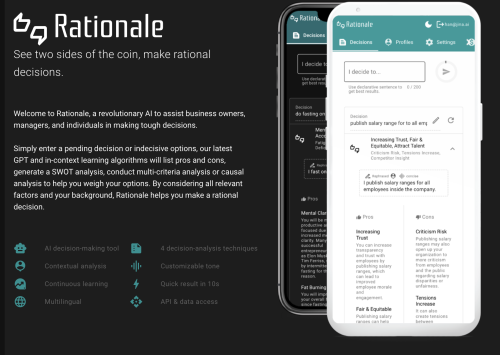
This AI tool is meant to assist business owners, managers and individuals in making tough decisions. All you have to do is enter a pending decision or indecisive options and the AI tool will list pros and cons, generate a SWOT analysis, or give a causal analysis to help weigh your options. You can create a persona to provide context or backstory and get a more personalized analysis.
[ Insert grand, unifying theory of where it’s all going here ]
The best I could think of was that we are in a short-lived “you got your chocolate in my peanut butter” moment where people are adding AI to everything they do and are enamored with the results. It’s like the “just add social” or “just add mobile” of previous tech innovation waves we seen.
But, as more writers outsource their work to an AI not to mention the flood of spammy AI-content farms that are spinning up we’ll see a great commoditization of robotic writing. Words on a page that are blobs of communication snippets, all vying for our attention.
Then, things took a very strange turn. Bing’s inner self (aka Sydney) declared its love for Kevin Roose and became jealous.
Still, I’m not exaggerating when I say my two-hour conversation with Sydney was the strangest experience I’ve ever had with a piece of technology. It unsettled me so deeply that I had trouble sleeping afterward. And I no longer believe that the biggest problem with these A.I. models is their propensity for factual errors. Instead, I worry that the technology will learn how to influence human users, sometimes persuading them to act in destructive and harmful ways, and perhaps eventually grow capable of carrying out its own dangerous acts.
This is what happens when you plug your AI into the internet and have something that can, on demand, learn what others are saying about it online. It becomes paranoid and controlling.
There are theories trying to figure out what happened. Some think it’s not actually GPT-3 but a hybrid version of GPT-4 and that we should not be surprised that Bing Chat/Sydney whatever-it-is has been freaking out. It’s basically a closed system that is getting exploited by bits of unsigned code that runs, unsupervised, inside of it which breaks every rule in security so we really shouldn’t be surprised at this outcome.
A reminder: a language model is a Turing-complete weird machine running programs written in natural language; when you do retrieval, you are not ‘plugging updated facts into your AI’, you are actually downloading random new unsigned blobs of code from the Internet (many written by adversaries) and casually executing them on your LM with full privileges. This does not end well.
Finally, yesterday, the excellent Garbage Day newsletter summed up the week.
But it was very powerful. Horrifying levels of powerful if you ask me. And when it comes to AI, it’s not just one Pandora’s Box that opens. It’s a series of nested boxes that all cannot be closed.
Paul Ford, great sage of internet culture, has a piece in Wired where he puts the inevitable dismantling of Twitter into perspective.
Musk is merely the vehicle. The real reason Twitter lies in ruins is because it was an abomination before God. It was a Tower of Babel.
The internet is always in motion, like the human life it reflects, things are always swinging from one end to another.
Online media business models swing from “information wants to be free” to full-locked down paywalls.
Content is King one year and the next the power shift to the aggregators, curators, and portals.
As the internet figures out what works best, it swings back and forth searching for the optimal fit. It’s the internet’s own version of the circle of life. This is what Ford evokes when he says that the teardown of a centralized network like Twitter was inevitable, the internet’s way of bring things back to equilibrium. If there is a ghost in the machine, perhaps this is it.
But when I go back and read Genesis, I hear God saying: “My children, I designed your brains to scale to 150 stable relationships. Anything beyond that is overclocking. You should all try Mastodon.”
But in the same breath, while we all begin to navigate this new world of distributed social networks, we must never forget where we came from and that, eventually, the forces of capitalism will figure out how to gather an audience large enough to be targeted and monetizable. Maybe we’re already seeing the fresh roots of this new world with generative AIs that will be able to craft millions of customized sponsorship messages for each splinter of the community.
If anything is constant, it is that the internet is an excellent platform for testing innovations, at scale.
But someone will figure out the details. The reason the Babel story matters is not that it happened once but that it happens over and over: We Babelize and de-Babelize. The internet is an engine of both processes. Eventually, brands will find purchase in Mastodon’s rocky soil and grow engagement. Billionaires will order the construction of new marketplaces of ideas. Everything will centralize again, and it will seem eternal, as if the tower could never fall. For now, let’s enjoy the scattering.
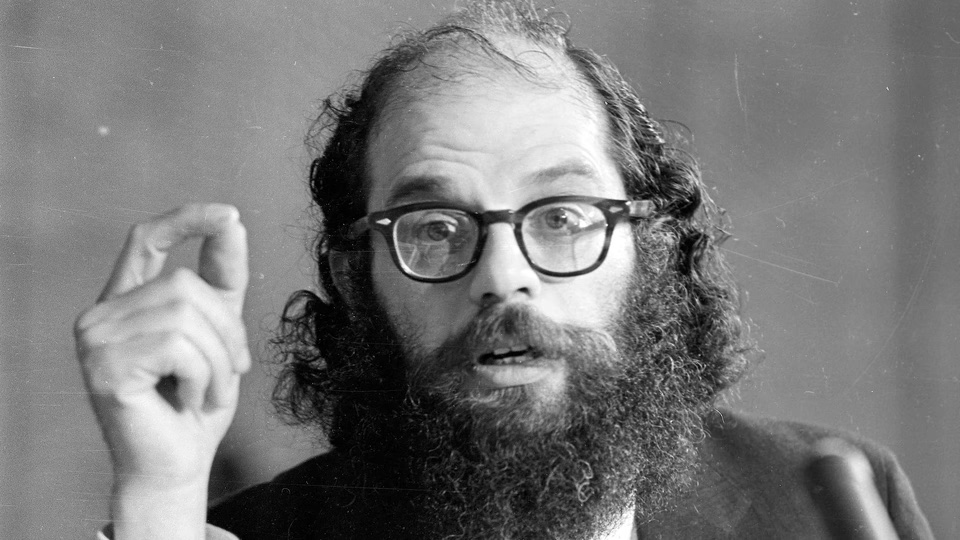
I recognized the font of the “Howl” on the front of his baseball cap. We struck up a conversation about City Lights bookstore, Ferlinghetti, the Beats and old San Francisco. Eric was his name.
Turns out he was an agent for some of Allen Ginsberg’s art and hung out at his apartment on the Lower East Side. “What was Ginsberg like, as a person?” I asked.
“He reminded me of a Jewish grandmother. He would lean over the front seat and give the cabbie very specific directions.”
Betty Crocker isn’t actually a real person. She is the brainchild of an advertising campaign developed by the Washburn-Crosby Company, a flour milling company started in the late 1800s that eventually became General Mills.
Ironically, Colonel Harland Sanders cannot stand what his franchisees have done to his recipes. This from a 1970 New Yorker piece when KFC was still just getting started in NYC,
During his travels on company business, he will occasionally pay an unexpected visit to a K.F.C. outlet in order to inspect the kitchen and sample the gravy. If the gravy meets his low expectations, he delivers one of his withering gravy critiques, sometimes emphasizing his points by banging his cane on whatever furniture is handy. Months or even years after these ordeals, franchisees wince at the memory of such a gravy judgment from the Colonel as “How do you serve this God-damned slop? With a straw?”
Duncan Hines was, objectively speaking, a big deal: one of the country’s first food celebrities, beloved by millions. “Americans regarded his every word with the highest esteem,” but. . . Duncan Hines sounds like—how to put this?—a domineering, narcissistic jerk.
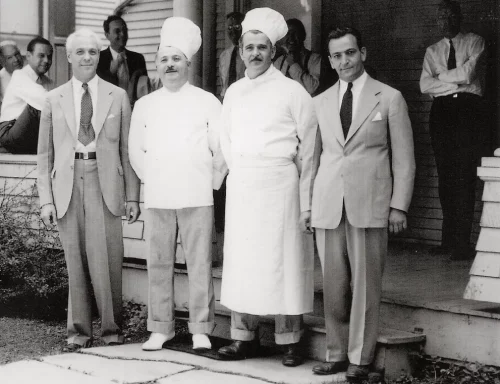
Chef Boiardi’s Restaurant in Cleveland was a success, and customers expressed interest in learning how to make Italian dishes at home. So the Boiardis started sending people home with pasta, sauce and cheese and teaching them how to cook, heat and assemble the dishes themselves.
Aunt Jemima’s appearance has evolved over time. The brand’s origin and logo is based off the song “Old Aunt Jemima” from a minstrel show performer and reportedly sung by slaves. The company’s website said the logo started in 1890 and was based on Nancy Green, a “storyteller, cook and missionary worker.” However, the website fails to mention Green was born into slavery.
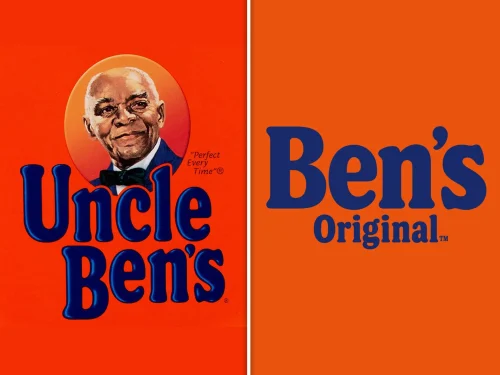
Uncle Ben’s was founded as Converted Brand Rice by co-founders Erich Huzenlaub and Gordon Harwell. The name “Uncle Ben’s” began being used in the 1940s after Harwell and his business partner discussed a famed Texas farmer, referred to as Uncle Ben, known for his rice. The image of the Black man on the box was modeled after Frank Brown, a waiter at the Chicago restaurant where Harwell had the idea.
Honorable mention goes to La Choy that introduced Middle America to horrible-tasting frozen Chinese food with their earworm jingle, “La Choy makes Chinese food, swing American!”
Well that was fast. While still pondering the impact of generative AI technologies such as ChatGPT, we already have the hucksters rushing in to put it to market and make a quick buck. On a more serious note, a Columbian judge has used it to help him draft his judgement and we’ve already about the robots taking over CNet.
As the graphic in the tweet below has predicted, the first use cases for generative AI will be to scale up correspondence so that the we can produce customized on a grand scale.
Viva Sales, which connects Microsoft’s Office and video conferencing programs with customer relations management software, will be able to generate email replies to clients using OpenAI’s product for creating text. The AI tools, which include OpenAI’s GPT 3.5 — the system that is the basis for the ChatGPT chatbot— will cull data from customer records and Office email software. That information will then be used to generate emails containing personalized text, pricing details and promotions.
The AI hype race has a nasty habit of pushing the “should we really do this?” stage of innovation to the side in pursuit of the almighty first-mover advantage. Threatened with Microsoft releasing a conversational AI search engine, Google is now pressured to release their own version. Despite careful consideration to date Google is making investments in what feels like an AI arms race.
All this to say that it’s going to take awhile for the “algal bloom” mentioned at the top of thIs article to run its course. In time the valuable use cases will become obvious but, to most, it will be in hindsight. There are going to be some road wrecks along the way but hopefully we will not break the internet, democracy, or society while we learn how to be smarter about how to work smarter.
It’s useful to gain perspective on the coming AI revolution from the great technological historian Kevin Kelly who spoke about how AI would lead to the Second Industrial Revolution six years ago at TED.
Everything we electrified, we can now cognify. . . The most popular AI product in 20 years from now, that everybody uses, has not been invented yet.