Over the past month, I have been unwinding my life in the San Francisco Bay Area and getting ready to move the family (and dog) over to Helsinki, Finland where Nokia, my employer, is headquartered.
For the past four and half years we have been living in Alameda, an island in the East Bay, about 20 minutes from San Francisco, over the Bay Bridge. We settled here because, Izumi, spotting Alameda on a map noted it’s location in the middle of the Bay, making it most convenient to most locations.
It took two months of intense house hunting (remember, this was 2004, the peak of the housing bubble) but we finally found a place that we could call home. We lucked out and were fortunate to find a neighborhood that we loved on a block surrounded by families with children that really bonded with our kids and grew up together over the years.
Tyler started in kindergarden when we moved in and just finished forth grade, Julia’s finished first grade. Edison School, where we walked our kids to school each day, is the only school that our kids really know. It’s been tough for them to imagine what their life will be like in Finland so it’s been hard for them to leave.
Izumi too has made many friends here and as we walk the island people often wave or honk their horn, it’s that kind of place. Because English is not Izumi’s native language and she didn’t grow up here, she sometimes misses some of the cultural references people make in casual conversation but the community embraced her and Izumi really came to feel like one of the community. It’s been rough for her to uproot herself and get ready for our move and the past few days have seen a lot of teary goodbyes.
It’s sad to leave but it also represents a new beginning, a fork in the road. We’ve had the good fortune to live in Tokyo, Princeton, and Alameda. Now we have a chance to live in Helsinki, in a semi-socialist country with a totally different climate – a place where we’ll live with a built-in sauna, the schools and hospitals are excellent, and when we arrive it will be light out until 10pm. We been given the choice to live day-to-day in Europe and add that to our life experiences. What we do with this experience and what we make of it is up to us.
We’re leaving Alameda today but are making plans for a reunion in Europe next Summer and hope to make it back for a visit the Christmas after next. Thank you Alameda for taking us in and keep in touch!
For the past several years I have hitched my name to the phrase social media. I used it as a handle to describe the mix of blogs, photos, status updates, and other methods of personal broadcasting that I used to get the word out and solicit feedback on new ideas. In the past, there was a clear distinction between media produced this way, collaboratively, often by amateurs, and that which was popularly referred to as mainstream media.
We’ve reached a tipping point. In my mind the lines between social media and other types of media are so blurred that it’s not even useful to distinguish the two, just drop the “social” because all media is now social. Take these examples from just the past few weeks:
Along with others, I first heard about the crash landing of US Airways Flight 1549 in the Hudson via twitter. I was also amazed to see the twitpic photo featured on the network news stations – quality of composition was trumped by a camera phone that was in the right place at the right time. While the first reports were from twitter, more comprehensive coverage was to come later from the professionals but the twitpic and reader comments made up an important part of the overall package.
For the inauguration yesterday, CNN and Facebook shared a single URL. On the left side was a live video stream from CNN while on the right side was a stream of comments from Facebook.
cnn.com with scrolling facebook comments (via Steve Garfield)
While the video was very compelling, I have to confess that the real-time commentary from the peanut gallery on the right was absoultely captivating. If you measure media by the amount of attention given, most of my time was spent on Facebook feed. Mashable’s got more details on the numbers but it would be interesting to see a heat map of where people collectively spent their time on this page.
A couple years ago I asked how to define social media. In that post, Stowe Boyd said that is was defined by the, “annotations or social gestures left behind by active readers, such as comments, tags, bookmarks, and trackbacks.” Based on that definition, what we saw on CNN yesterday, and the ease with which people can create, reference, and annotate all media, it’s no longer useful to segment out something called “social media.”
There is no such thing as social media when all media is social.
I flew back from Denver last night on a plane full of Obama volunteers who were working Colorado to get out the vote. The pilot reported during the flight that McCain had conceded and the entire plane erupted in cheers the same way it did in the hotel bar when CNN called Pennsylvania and at the airport bar when Ohio went for Obama.
The excitement is palpable – electricity in the air stuff. Dan, one of the volunteers on the plane, came down the aisle to get everyone’s email address so he could start a mailing list of those that went through this experience together. When I asked him what it was like to knock on doors for the past few days, he said without any hint of sarcasm, it was a “religious experience.”
You never know what you’re going to get when someone opens up that door. Some give you the brush-off, some you need to tell them to put down their beer. But when you tell them that you travelled 1,000 miles because their vote is more important than yours, they listen.
In the end, there are the ones that can’t make it to the polls, their mother isn’t home from work yet, whatever. To those you say, “You know what, I’m going to make this fun for you, this is going to be a fun night.” In the end, they thank you for looking out for them. I don’t care who they vote for, it’s just the act of bonding with a fellow citizen that made it so worth it.
Two buddies of mine went to Nevada to volunteer and one of them, Jonathan Strauss, made a very good point in a post he did on his Blackberry, before the polls even closed. In a post titled, Why we’ve already won, Jonathan said that Barack Obama, even if he loses, has brought us all together in an important way.
I am so glad that we collectively feel this way – Barack has inherited a mess that is going to take everyone’s help to haul us above water again. To be walking into the Oval Office now is more challenging today that it’s been in a long while. But I can’t think of a better person than Barack to represent us abroad and lead us domestically to make things happen. If anyone can call on us to trust him to while we make individual sacrifices for the greater good, it’s Barack Obama.
I read somewhere that what we’ve done by electing a minority as President is the equivalent of the UK electing a Jamaican to lead their country. In one fell swoop we’ve pulled a rabbit out of the hat and shown the world that we really do stand by our creed that all men are created equal. I’m really proud to be an American today.
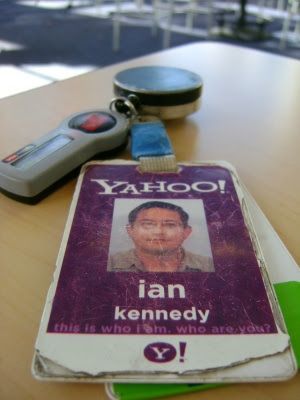
On Friday I’ll hand over my badge, laptop, and Blackberry, finishing up three years at Yahoo. I’m leaving MyBlogLog in the good hands of Todd Sampson to drive the product vision and manage the engineering team and Tilly McLain who will look over the day-to-day care and feeding of the site and community.
My self-proclaimed tag line on the internal company directory is turning Yahoo inside out. This has been my personal mission since I joined Yahoo a little over three years ago. There is great stuff to be shared at Yahoo, as long as you let people get to it in a way that’s useful to them.
I enjoyed working with people who shared my passion to transform Yahoo into to a modern platform. It hasn’t been easy – opening up programmatic access to Yahoo is fraught with many built-in conflicts. Third party content licenses, traffic guarantees, and international legal constraints all make it difficult to let services flow completely free. It’s an industry-wide problem. Much of the way the advertising industry measures the impact of their online campaigns is rooted in the pageview metric which runs counter to providing the best of what you’ve got via an API call. For folks such as ComScore (who help advertisers evaluate rates) an API call doesn’t count as a pageview or roll up into a CPM so it’s a hard to argue letting people get at data without forcing them to come to a pageview to get it.
But consumer demand on the internet is like a natural force. If you don’t go with the flow, the market will route around until it finds what it needs. As with ripped music files, if you don’t provide your data via an API and figure out how to build a business off of that, folks will scrape your pages or go to your competitor. Yahoo gets this and there are many people working to provide a structured way to get at their data in a sustainable way that can guarantee that they will be able to continue to provide it. Pay a visit to the Yahoo Developer Network site to see what’s there and watch this space as there’s more in the queue.
With this as a backdrop, I was invited to take my thinking to a new company and a new industry. In a few weeks I’ll be joining Nokia and working to make their devices more socially aware. The Nokia s60, iPhone, Blackberry and Android (rumored) application stores give us developer ecosystems around each device. What will the world be like when devices can communicate with each other via social networks, across device platforms, across mobile carrier networks? Much the same way the web browser has unified communication across Mac & PC, the mobile web will do the same for “broadband-enabled” cell phones. Add GPS (location), Bluetooth (proximity), integrated camera/video and a voice interface and you’ve got a whole new set of opportunities that are just too good to pass up.
Imagine this use case. Your phone knows your alarm goes off at 6am every morning, that you drive the San Mateo bridge every weekday on your way to work at around 7:30am. It’s entirely possible for your phone to automatically check traffic conditions before you leave sometime after you awake and let you know that there is heavier than normal traffic and suggest an alternate route and read it out to you in a phone call, while you drive. If you’ve got your calendar in there, there is no reason that your phone can’t offer to call ahead and let the people in your first meeting know that you’re running late. All the pieces are in place to make this happen, automatically, right on your device. That’s the kind of service that will enhance your life, that’s the kind of service suite I’m excited to build.
Thank you to everyone who lent an ear to my crazy talk in the early days and pointed me to others who would listen and helped me build a band of believers. A nowhere near complete list of shout outs include:
Toby Coppel, Gerry Horkin, Dave Vockell, Gil Ben-Artzy, and David Katz, who took me under their wing in Corporate Development and helped me refine my message into bite-sized Powerpoint presentations and introduced me to the Harvey Ball.
Sumit Chachra, Aaron Stein, Josh Rangsikitpho, John Lindal, Josh Blatt, Cody Simms and others who fought the good fight down in Burbank.
Finally, thank you to my kids who taught me to look at social networks in a new light and and my wife who kept the family ticking and the home fires burning through it all.
For those interested in peering into a subset of what inspires me, here’s a sample of my OPML file. Keep up the good work Marshall,Louis, and Mark.
I’m going to take a week off to re-charge before the new gig kicks off at the Nokia offices in Mountain View. I’m looking forward to working with one of the original Yahoo bloggers, Russell Beattie. It’s been awhile since I’ve been a regular in the South Bay so if you’re interested in getting together, drop me a line.
One of the best talks at this year’s Web 2.0 Expo was Clay Shirky on Cognitive Surplus. In it he suggests that modern television is a, “cognitive heat sink, dissipating thinking that might otherwise have built up and caused society to overheat.”
He concludes after describing how a child spent a few minutes looking for the mouse connected to her living room television;
Here’s something four-year-olds know: A screen that ships without a mouse ships broken. Here’s something four-year-olds know: Media that’s targeted at you but doesn’t include you may not be worth sitting still for.
The ironic thing is that I was stuck in the hallway and missed this talk. I read Clay’s transcript and was moved. But watching him deliver his talk on video was even more impactful (for instance, listening to the collective, “Ahhh!” from the crowd when he delivers the lines quoted above).
As with many involved in the tech industry, I watch very little television but when I do, it’s mediated by timeshifting technology that lets me watch it on my own terms. It’s either on Tivo or filtered through social pointers such as Jeremy’s blog post which determine which videos I invest time to watch.
“The web is in its infancy,” says Tim Berners-Lee and looking at the tools available to manage information flow it’s easy to see why. We’re shifting from a time of channel surfing to web surfing but the evolution from web portals to something more dynamic and efficient has only just begun. The vast wealth of information is still intoxicating and we constantly jump around afraid we’re going to miss something. What’s going to happen when we wake up from this second, “collective bender” and use our spare time to improve the world around us.
Then we will have the capacity, as Tim O’Reilly challenges us, to “wrestle with angels.”
Back in February, Western Union announced that it would no longer be sending telegrams ending a 150 year tradition of the hushed interruption by the butler of urgent news from lands far, far away.
I’m not a programmer but I love to tinker. Much to the chagrin of my parents, I liked nothing better than taking things apart and seeing how they worked. The thing that made the early web so much fun was the View > Page Source command in the browser which allowed me to take apart any website and figure out how it was put together.
APIs and XML pushed that all into the background for weekend duffers like me. All the parameters that went into building an interactive page were hidden from me. Many sites would expose bits of what was going on in the URL field and I could still play around by swapping out variables that I could see in plain text but the ability to parse out the results and display them in format that I wanted was beyond my basic skills and I could only work on one page at a time, unable to string the output of one page to the input of another.
Today’s release of Yahoo! Pipes is just the product I need to begin to muck around again. Choose any RSS feed as a data source and break down the URL into it’s basic components. Drag in any of the various modules to substitute parameters, filter, join, sort, or otherwise transform the results and harness the output as an RSS feed which you can easily subscribe or embed into your site.
Pipes has embraced the View Source culture. Every published Pipe on the system can be cloned, stripped apart and repurposed for your own use. You can nest pipes inside one another or string them together so that early pipes become the building blocks for more complex routines.
Want to read a mashed up feed of the top autoblogs filtered to specific luxury European autos? No problem.
Looking for the latest flickr photos and weather conditions at Whistler? You got it.
My own itch was trying to figure out if I should buy something off of my local Craigslist, bid for it on eBay, or just buy it outright. Instead of daily searches on a series of sites, I now have one place to go.
Big ol’ caveat. This is not a finished product! Edward, Daniel, Jonathan, Pasha, and Kevin have created a beautiful platform but this is just the first step in an exciting direction which is already generating lots of debate. Pipes levels the playing field and invites the masses into the sandbox. Let’s all play nice together and bend those tubes around and make something wonderful.
Resources:
Jeremy is updating his post with references to the ongoing coverage.
Yahoo! is hosting the next Lunch 2.0 event and the Pipes team will be there.
Various technological shenanigans kept me from live-blogging last week’s Web 2.0 Summit as planned so here’s my run down of the highlights from my notes. Don Tapscott’s workshop and the popular Launchpad session are covered in earlier posts.
The conference has already been covered in depth so I’ll try and add my own personal observations that are hopefully somewhat unique.
At the keynote, Tim O’Reilly mentioned that some 5,000 people were turned away from attending the conference. The standard admission was north of $3,000 so doing the math on that you can imagine why the organizers have announced a sister show, The Web 2.0 Expo in April 2007, which they hope will catch the folks wanting to attend just to see what all the fuss is about. Tickets will be more reasonable and the sessions will be more like the workshop format that you see at something like MacWorld or PubCon.
My prediction is that next year’s Web 2.0 Summit will be much more a deal-making platform for the VCs and tickets will be in the neighborhood of $5k – $10k and will feature a select group of startups and executives invited in by the organizers to talk about the latest trends. Tim said himself that “disruption has happend” and that consolidation was already underway. The Web 2.0 Summit will facilitate this consolidation by bringing the biggest players in behind closed doors to map out the future.
If this is really the case, it’s a double-edged sword. I think pretty much everyone in attendence had pretty much already grokked what Web 2.0 is about and are thinking less about opportunites on the edges and more about how to take over the center. Back in May it was about reaching the 53,651 readers of Techcrunch to launch your product. Today Techcrunch’s Feedburner chicklet is showing 125k readers and what was once a watering hole for early adopters has gravitated towards the center. Getting covered by TC is now a ticket to the adult’s table so it’ll be harder and harder to just play around with something and float it out there to the Web 2.0 watchers to see what happens. The need to scale quickly to keep your audience will require access to funding and the VCs and large internet companies (including Yahoo) are only too happy to step in and help out.
Despite this white hot spotlight on the community, I hope that the easy access to inexpensive hosting, open source software, apis, and rss give startups the right mix to be able to fend off acquisition or funding until they can take it on terms that are right for their business and their audience.
There were a few events during the week that point to a healthy community that exists beyond the glow of chocolate fountain parties. Monday’s Widgetslive conference, Web 2.2, and the Citizen Summit workshop were all enjoyable because they were smaller and more focused on sharing operational best practices than on grander trends. I hope these events can continue to keep the flame alive but I fear the temptation of fame and fortune just around the corner is going to make it hard unless this group can pull themselves together around a new meme that defines a new approach or business model – one we haven’t discovered yet.
It wasn’t exactly the debut on Valleywag I was looking for but I’m on a roster of folks scheduled to be booted from Yahoo next week:
Senior Product Manager in Corporate Development Ian Kennedy [here for another ride (maybe the tilt-a-whirl)]
Heh. They’ve got me in the wrong group, I’m a Product Manager of publisher.yahoo.com putting some of my ideas around Social Media into action. The wifi on my laptop is on the fritz which kept me from live-blogging the Web 2.0 as I planned. I’ll let you know if my ID card stops working!
If you have nothing better to do, I’m sure there’s a betting pool going on somewhere.
Cookie Consent
We use cookies to improve your experience on our site. By using our site, you consent to cookies.
Used to determine whether a user is included in an A / B or Multivariate test.
18 months
_ga
ID used to identify users
2 years
_gali
Used by Google Analytics to determine which links on a page are being clicked
30 seconds
_ga_
ID used to identify users
2 years
_gid
ID used to identify users for 24 hours after last activity
24 hours
_gat
Used to monitor number of Google Analytics server requests when using Google Tag Manager
1 minute
_gac_
Contains information related to marketing campaigns of the user. These are shared with Google AdWords / Google Ads when the Google Ads and Google Analytics accounts are linked together.
90 days
__utma
ID used to identify users and sessions
2 years after last activity
__utmt
Used to monitor number of Google Analytics server requests
10 minutes
__utmb
Used to distinguish new sessions and visits. This cookie is set when the GA.js javascript library is loaded and there is no existing __utmb cookie. The cookie is updated every time data is sent to the Google Analytics server.
30 minutes after last activity
__utmc
Used only with old Urchin versions of Google Analytics and not with GA.js. Was used to distinguish between new sessions and visits at the end of a session.
End of session (browser)
__utmz
Contains information about the traffic source or campaign that directed user to the website. The cookie is set when the GA.js javascript is loaded and updated when data is sent to the Google Anaytics server
6 months after last activity
__utmv
Contains custom information set by the web developer via the _setCustomVar method in Google Analytics. This cookie is updated every time new data is sent to the Google Analytics server.
2 years after last activity
You can find more information in our About Me and .