Tag: Milestone

  • Smarted

    I’m not going to go into detail on the why and how the wheels came off, I think this line by my colleague is a pretty good summary,

    Strong dollar + weak yen + difficult macro environment + US tech salaries = Japanese start-up slashing 40% global headcount.

    David Chu on LinkedIn
    Without massive scale, you must diversify revenues beyond advertising.

    So yeah, the SmartNews chapter of my life is over. Here are the facts:

    • I worked at SmartNews for 7 years, 11 months
    • I never got to say goodbye to my colleagues and friends. My Slack access was cut off just minutes after getting my severance notice.
    • I never had time to hand over any of my ongoing tasks to those left behind. I could also not inform any of the hundreds of partners that I’ve worked with over the years. I lost access to my email as well.

    I think it could have been done more gracefully but what’s done is done. I’ve posted on the socials (Twitter, Linkedin, Facebook) and will now turn my focus to the next thing. I’m open and interested in many things but here are three things I’m currently thinking of:

    The online publisher subscription problem. Scroll had an innovative approach but they got bought up by Twitter and Elon shut things down. Apple News is doing this but it seems too much like a restrictive bundle (see below). There has got to be a way to build a more inclusive model for subscriptions that satisfies both users and publishers, It’s time for publishers to realize they can’t charge $25/month for their content and users need to realize they need to pay something to avoid aggressive surveillance capitalism.

    Cable TV’s choke hold on local sports. I will not install basic cable & the extra YES network add-on just to watch local sports. It’s just not worth it just for one game every few days. I cut the cable years ago and would pay for a streaming service for local games alone without basic cable. Just as Kazaa and Limewire were used to allow music fans to pick and choose the songs they wanted from an album, sports fans are jumping through hoops to pick and choose what they want from the cable TV bundles. Why won’t the leagues embrace their role as media companies and sell direct to their fans?

    ChatGPT and services like it are going to be transformational. Sure, it’s early days and there are obvious limitations. Ask it to tell you about Pelé and it will tell you everything except the fact that he’s dead. The algo is not connected to the news and I think that’s a conscious decision. I’m sure they are still supervising the training so the news needs to be filtered for quality, accuracy, and context, by knowledgeable humans. The intersection of generative AI services such as ChatGPT and the news is fascinating.

    I have much to learn and I look forward to meeting as many people as possible to educate myself on the puzzles above and opportunities within.

    Hit me up if you want to talk – I’m available!

  • On Mastodon

    On Mastodon

    The change of ownership at Twitter and the drastic changes to the platform have caused many to think seriously about abandoning the social network for an alternative.

    I too have started the journey (xoxo.zone/@iankennedy) and have been collecting links that I was going to use to write a primer on how to get started. But things are moving so quickly with so many people hopping the fence to the Fediverse that it’s more useful, at this point, to post a collection of useful links and let folks read up on their own.

    How to Leave Dying Social Media Platforms (without ditching your friends) – Cory Doctorow’s post resonated with me. I’ve been on Twitter since 2006 so leaving behind a community curated over the past sixteen years is hard, but important.

    Before you do anything, ask Twitter to send you an archive of your history. The folks that built this tool did a great job. What they’ll send you is a zip file of all your tweets in html.

    An Increasingly Less-Brief Guide to Mastodon by @Noelle@elekk.xyz is the perfect place to start learning about Mastodon. Everything you’ve ever wanted to know, told simply, clearly and in a charmingly non-condescending way. And it’s written on GitHub.

    How to Join Mastodon, the Ad-Free Social Network Billionaires Can’t Buy – another “everything-you-were-afraid-to-ask” post, this Gizmodo article is a quick read that covers all the basics.

    I’ve been following Jon Henshaw for years. His writing about technology from the marketer’s perspective has always been insightful. His post, How to leave Twitter and switch to Mastodon, is a step-by-step guide that will help you make the jump but also how to leave pointers so you can redirect your followers.

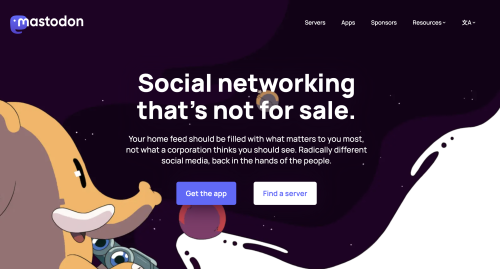
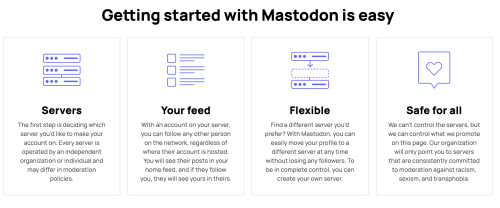
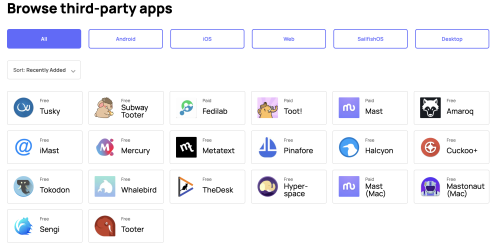
    Mastodon – here’s where to start. You can download a client app and find a server. For posterity, here are some screenshots of what the site looks like today.

    joinmastodon.org homepage, Nov. 2022
    Getting Started
    20 third party client apps
    Resources

    https://twitodon.com – this site will download your twitter users and give you a csv of those of them that have listed their Mastodon accounts so you can begin to relocate your tribe.

    Everything I know about Mastodon – another guide, specifically written for data science folks trying to navigate the fediverse. Danielle Navarro goes into details the web app’s advanced mode, this importance of hashtags, some points on etiquette and other norms on the platform.

    How to host your own Fediverse – the cool thing about Mastodon is that you can host your own server. This page will get you started if you want to dive in and host your own interest group and make your own rules.

    Other Writing

    Old soul Ethan Zuckerman has some wise words on why we should not give up totally on Twitter and resign the platform to the trolls.

    At face value, every move Musk made at Twitter has seemed childish, willful, heartless, and destructive, and seemed to reveal how little he grasps the difference between running a media organization and running an electric-car or rocket-ship firm. It’s like a rich football fan buying an NFL team and imagining that he can name draft-picks and call plays.

    Twitter is our Future – James Fallows

  • On Leaving California

    On Leaving California

    It’d be easy to say that last week’s orange-colored skies were the final straw that told us it’s time to go but this move has been in the works for awhile and only in the past few weeks has become reality. But I’m getting ahead of myself. 

    For a couple years Izumi and I planned to sell the house and move once the kids up and left for college. Our house in Alameda is just too big for two people and a small dog and we live on a block too ideal for a family with small kids to keep it to ourselves. The house gained some value over the years as well which will allow us to pay off our children’s college debt.

    So when our youngest started at college in August we began to inquire about selling the house. Things progressed rapidly from there and within a few weeks we completed the transaction, contacted the movers, and started the process of unloading years of stuff in preparation for moving into more modest quarters. 

    George Carlin on stuff

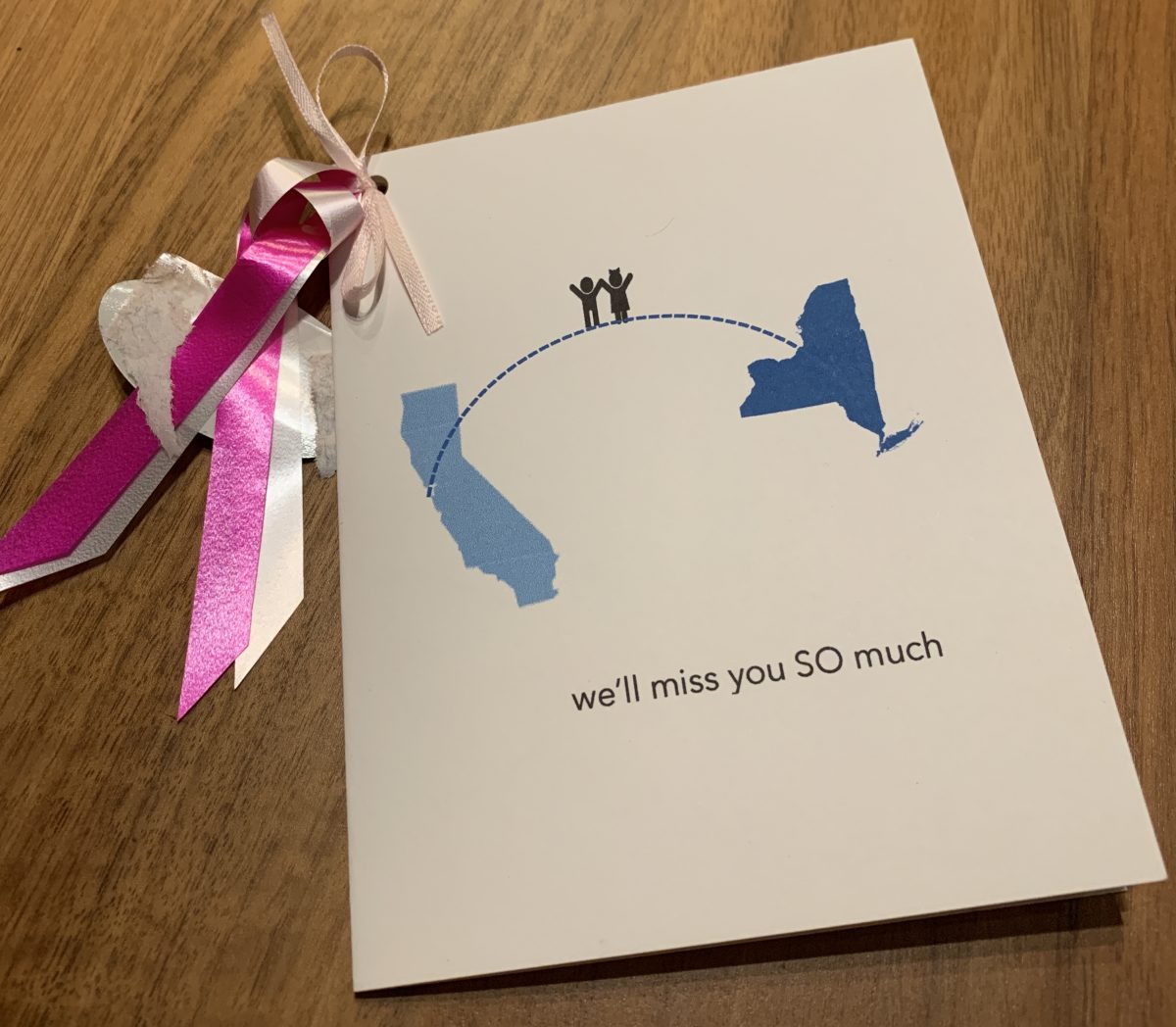
    The plan is to move to NYC. SmartNews has an office there and many of our publishing partners are based there so when things start to go back to normal it would make sense to be there. We would also be closer to the kids, who both go to school in Massachusetts, and they were both excited to the prospect of spending vacations in a bustling city. 

    We leave in a few weeks. Because of COVID restrictions we wanted to limit the amount of flying back and forth looking at places so we’re not sure where we’re living beyond the 30-day furnished apartment we just reserved online. Come to think of it, this is how we moved to Alameda in 2004 and to Finland in 2010 so I guess this is just how we roll.

    We’re planning on living in Manhattan. People are fleeing downtown so hopefully that will make it somewhat affordable. We’ll see when we get there. I am optimistic for the future. NYC may be down but I can never imagine it would be out. The spirit of the city is just too strong. 

    If part of the plan was to keep Izumi busy so she wouldn’t get depressed being an empty-nester than I guess you can say it worked. She’s been a Tasmanian Devil packing what’s important and ruthless about pitching the rest. 

    I will, of course, miss friends and family (bye Sis!) I leave behind. I came out to the Bay Area in 2004 because no one on the East Coast knew what I was talking about when I ranted about the transformational impact of blogging. I moved here to be around like-minded people and rode that wave to where I am today. Now everyone “blogs” on Facebook. and tech is making moves to set up in NYC anyway.

    Thank you to my colleagues at SmartNews for their understanding and support that allowed me to make this move. I should mention we are hiring to find someone to fill my shoes and work on my team in the SF office so please reach out to me if you want to learn more. 

    Izumi and I were born in Brooklyn so this move is like returning home in some ways. On my last trip to NYC I stayed in Brooklyn and spent the evenings riding a bike around the city looking for my old house. Like salmon swimming upstream, maybe we’re feeling a little nostalgic?

    I think I read somewhere that Italians like to say that you should live your life in pursuit of experiences that will make for a good stories. Stay tuned as I have a feeling we’ll get a lot of stories out of this move. 

  • Getting the Band Together Again at SmartNews

    Getting the Band Together Again at SmartNews

    Following a month off after my unexpected liberation from Gigaom, I started this week as Director of Media & Technology Partnerships at SmartNews. I feel very fortunate to have discovered this company at a time when I believe I have a lot to offer.

    First, some recent coverage,

    While researching the company, I was delighted to learn they had hired Rich Jaroslovsky. Rich and I crossed paths a few times when I was working at Dow Jones as he was getting wsj.com off the ground. We both have a fascination with technology’s impact on media and I shared his mission to bring The Wall Street Journal online. We had since gone our separate ways but I always admired his love and respect for good journalism as a writer, editor, and business guy.

    Rich explained to me that SmartNews thinks of itself as a machine learning company with a news front-end which is right in the nexus of what makes me tick. The co-founders, Ken Suzuki and Kaisei Hamamoto, are super-sharp engineers who see news discovery as an interesting problem to solve and hugely important for society to get right. To give you a sense for how they think, as they look for real estate for their San Francisco office, Ken and Kaisei each created their own interactive maps showing the locations of high tech startups and compared notes to determine that the area of 2nd and Howard was the ideal spot to focus their search.

    I made my pitch (excerpted below) and here I am!

    Two of the hardest challenges for the publishing industry are distribution and advertising. When publishers moved online, they had to reinvent their traditional distribution channels and navigate a new landscape.

    Initially it was the portals such as Yahoo and AOL that would curate the best of the web. Advertising was also sold this way, manually curated and matched to broad channels of interest maintained by the portals.

    As technology improved, search engines such as Google automated discovery and matching a reader’s interests to a publisher’s content. Advertising was automated and optimized via keyword matching and auction systems to extract maximum value. Distributed widgets allowed publishers to embed advertising into their sites and a combination of publisher tags and indexing that allowed them to take advantage of an ad network’s inventory.

    Social media platforms have recently taken over as a source of traffic for publishers and content snippets shared via these networks represent the fastest growing segment of inbound readers for a publisher.

    A common thread to success across all these channels is attractive representation of a publisher’s content within each distribution channel. Whether it’s meta-data, SEO, or “social media optimization,” each new distribution channel has spawned a new method of representing your content to the service which is doing the crawling and aggregation.

    For a new distribution channel both the crawling and aggregation algorithms are key to successful presentation of content and relevant advertising to the reader.

    Technology has enabled effortless distribution of news so the looming challenge is not so much the distribution of content but more its discovery and presentation. Social media burnout and personalization algorithms are still very basic and often push more and more similar content to the reader resulting in a “filter bubble” which shows the reader only what they want to see or worse, what they already know.

    Working with publishers to find them new sources of readership and readers to teach them something they didn’t know is an important goal that aligns with my interests. The fact that the team is based in Japan, a culture with a strong culture of news readership, is attractive to me as I am a big fan of introducing Japan to the rest of the world.

  • I no longer have a role at Gigaom

    Last week certainly was interesting. On Wednesday morning I was abruptly informed that, along with my VP and two engineers, that our services were no longer needed at Gigaom.

    While unravelling my personal social profiles from the various company pages I had set up for Gigaom, it was Facebook’s robotic bit of micro-copy that really brought it home, “You no longer have a role on Gigaom.” Harsh.

    No Role at Gigaom

    Japanese has this wonderful phrase, iro iro (いろいろ) which means roughly, “lots of things that I’d rather not go into now but feel free to ask me over drinks” and I’ll leave it at that. Nothing dramatic, just a sudden shift of course that made it clear that it was time to move on. I’ll leave it at that.

    I had a great run at Gigaom and I thank Daniel Raffel for the introduction and Paul Walborsky and Om Malik for their support while working there.  I joined when Gigaom was a collection of blogs with a nascent premium subscription business. Gigaom Research is now a major driver of revenue. As a Product Manager and later Director of Product the team tackled a number of projects of which I’m proud.

    • acquired and integrated paidcontent.org
    • redesigned Gigaom, Gigaom Research, and Gigaom Events as responsive
    • replaced the e-commerce back end
    • redesigned the gigaom.com post page and front page (twice)
    • rolled out a major re-brand across all properties
    • re-configured the Gigaom Research subscriber acquisition funnel
    • launched Analyst Connect, a simple way to connect to Gigaom Research analysts
    • launched Data Connect, a charts-centric view into Gigaom Research
    • launched Gigaom Search, a faceted search engine across the 15 year archive
    • launched Gigaom Alerts, a free tag-based notification service

    In addition to the projects above, I am also pleased with my contribution to setting up how the Product Team is run. As the company grew through the critical 50 employee mark where unstructured cross-department communications begin to break down, the daily stand-up, weekly Dev Diary, Friday Show-and-Tell presentation, and quarterly Product Roadmaps all played an important role in keeping things on track. The methodology was simple and I think that’s what led to its success.

    The engineers greased communication even further by migrating off our group Skype chat into HipChat rooms with integrations into GitHub and a script that could spawn a Google Hangouts on demand. We even had a Sonos-driven alarm that would play Bob Marley’s Get Up, Stand Up on queue to remind us all when it was time for our daily check-in. Sometimes it’s the little things.

    It’s always bittersweet to leave a place of employment, like the breakup of a band. There’s a lot of talent there and I’ll miss working with them. I will also personally miss the vortex of activity that comes with working at an organization that takes in the news of the day and validates, organizes, and distributes it back to its readers.

    Gigaom is a premium content business with increasingly valuable content and services made available to customers at its higher tier customers. I often tell people that the most valuable content is in the internal Gigaom newsfeeds, the price of which is full time employment. As of now, I am unsubscribed.

  • Loss of Innocence

    Loss of Innocence

    Yesterday, my 10 year-old daughter, discovered that the Tooth Fairy no longer exists. I was packing to return home from our vacation and was about to stow some bandages in my toilet bag when she caught a glimpse of her note and tooth that she had left for T.F. under her pillow several days ago. It was a real shock for her.

    My son, who is older, was different. He likes to figures stuff out for himself. My wife and I knew he no longer believed but weren’t sure when he stopped believing. He was a good sport about it though and kept Julia in the dark for the past few years, playing along, saying nothing. Today I finally asked him when he was clued in. He looked up from an episode of MythBusters and said he figured it out when he lost a tooth but decided not to tell us. He put the tooth under the pillow and nothing happend the next morning, the tooth was still there. Eliminating the variables, he put it together.

    As fat tears rolled down Julia’s cheeks, between sniffles, I could feel her ache of losing something magical, something bigger than herself, someone with whom she could keep secrets. With the fall of the Tooth Fairy, others soon would follow. She tugged at this loose spiritual thread and asked me point blank about Santa, the Easter Bunny, and so on. Knowing it was time to come clean, I lay down the cards for her. By mid-morning, not only had the Tooth Fairy ceased to exist but all the other childhood myths lay shattered in pieces.

    I wonder how this will change her over the next year. She’s about to go into 5th grade, the last grade before she goes on to Middle School. Many of her classmates have been telling her that Santa and the others do not exist but she’s been resisting them, choosing to have faith. Now, with that dream broken, she’ll be on the other side of the fence. Those who know the existentialist truth of a world without the Tooth Fairy.

    A father worries, what will become of that innocent smile?

    Photo by CC Marks

  • Leaving Finland

    Leaving Finland

    Tomorrow we leave Finland, our home for the last two years. It’s always bittersweet packing up, leaving behind an empty apartment, and closing the door on a phase of your life.  Today, on my last night, I am philosophical. To be honest, it was a bit rough and it’s probably best to reserve judgement on this period of my life for a few years when I’ll have a better perspective. When I left Alameda for Finland I wrote, “What we do with this experience and what we make of it is up to us.” Returning to Alameda and re-adjusting to life back in America will be a continuation of our experience in Finland. It is only when you see the familiar changed around you, when you return, that you can reflect on a journey and see how it has changed you.

    I think my two kids grew up faster than they might have if we stayed put. On the flip, they experienced things that they would have never, had we not taken the chance. Izumi was ever the trooper throughout. She swam in the frozen ocean and made great friends from around the world. As is often the case, the best in everyone comes out in the final weeks before you have to leave. It was a gamble to bring the family with me. My only wish is that sometime they will look back and say it was worth it.

    Here’s a home made slideshow showing some snapshots of our life in Finland.

    If you’re curious, here’s a bit about the music behind the slideshow.

    I’ve always loved the simplicity of early music and Gregorian chants and plainsong. There is just this austere simplicity that I find really comforting. So I was listening to this Trio Mediaeval record and I basically wrote a bunch of string arrangements around their acapella recording and then went to the woman who sang it and said, ‘Oh, is it possible for you to re-sing it to this arrangement that I’ve written’.

    I think she was eight and a half month pregnant. So she has this little studio in her garage in Norway, she recorded the vocals, handed the recording off to her husband and then went and gave birth.

    From Moby’s description of the song, Stella Maris.
  • Watson Wins Jeopardy

    Watson Wins Jeopardy

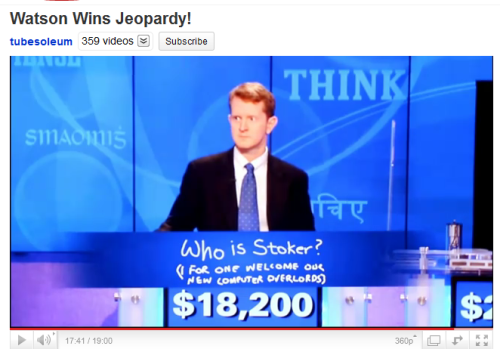
    Ken Jennings graciously concedes losing to IBM’s Watson computer on the final day of the three day Jeopardy tournament. More details on the research behind the experiment on my earlier post.

  • Social Discovery, Social Filtering, and other Web-Squared Shapes

    It’s hard to wrap up a major conference, especially when you didn’t attend, but viewing things from a distance sometimes helps because only the loudest messages make it all the way over.

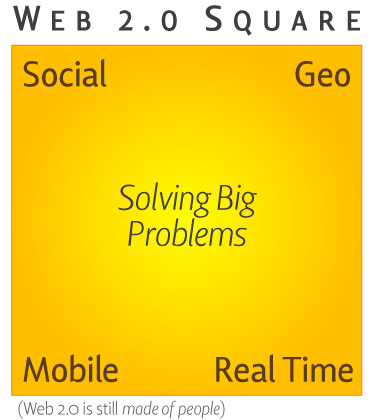
    Before the conference even started, Fred Wilson threw out a one-liner that got people thinking. He called it the Golden Triangle.

    The three current big megatrends in the web/tech sector are mobile, social, and real-time.

    To Fred, the vectors between each of these points on his triangle represented the biggest opportunities over the next few years and where he, as a technology VC, was going to focus his attention.

    Ross Mayfield, his line from the first Web 2.0 conference is still relevant, added Geo to Fred’s Triangle and posted his virtual napkin up on flickr.

    The importance of Geo cannot be ignored as the most obvious (and easiest) way to add context to information which is being harvested and sent our way in increasingly alarming rates. We talk about a world in which there are 1 billion mobile devices. Imagine what happens when each of these gets a camera, gps, and bluetooth sensor and an IP connection to pull in real-time updates. Adds a new dimension to Right Here, Right Now.

    So while HTML Page Indexers of yore were failing at finding us the best Chinese in Helsinki or plumber in London, Social Discovery became the new nectar. Facebook leads to FriendFeed leads to Twitter and now our capacity to consume and process has overloaded. Groups, Hashtags, Lists, Folders, call them what you will but this manual organization of streams is beginning to feel like e-mail folder management all over again. The Googles and Microsofts have added the Twitter firehose to their indexes but somehow I don’t see that as solving the problem unless they can filter on your social connections as well (rumor has it Google Profiles are about to play a much more important role Google Social Search is now live).

    Which brings us to Social Filters.

    Marshall Kirkpatrick has been following this topic for a long time. He bangs the Social Filter drum again in a post about Facebook’s News Feed redesign,

    Someday social networking is going to be like the telephone. Today you can’t send messages from Facebook to people on MySpace or LinkedIn but that isn’t going to last forever. Just as you can call someone who uses T-Mobile from your Sprint phone, someday sharing and messaging between online social networks will be a given.

    How will social networks retain users then? Why stick with Facebook when some smaller service offers a decentralized social networking service outside of Facebook’s control but still tied into your friends on Facebook and elsewhere?

    These services will someday have to compete on user experience, when they no longer have your social connections locked-in. The service that does the best job filtering up the most important information you have coming your way will likely be the service you stick with. That’s going to be a key area of competition between social networks.

    Yes, it’s no longer about who “owns” the social graph – it’s who provides the best services on top of a shared graph. Someone mentioned that Tim Berners Lee said at the conference that AOL was to WWW as Facebook is to distributed social networks. Just as we thought it silly that AOL wanted to put it’s famous wall around the internet, we may also look back in amazement thinking that anyone could have the audacity to think they could own the world’s social address book.

    Some historical perspective from Tim O’Reilly and John Battelle in Web Squared: Web 2.0 Five Years On

    There is a race on right now to own the social graph. But we must ask whether this service is so fundamental that it needs to be open to all.

    It’s easy to forget that only 15 years ago, email was as fragmented as social networking is today, with hundreds of incompatible email systems joined by fragile and congested gateways. One of those systems – internet RFC 822 email – became the gold standard for interchange.

    We expect to see similar standardization in key internet utilities and subsystems. Vendors who are competing with a winner-takes-all mindset would be advised to join together to enable systems built from the best-of-breed data subsystems of cooperating companies.

    Bringing it all together you can almost hear the synapses of the global brain achieve self-awareness. Not only are we moving to a web of sensors feeding real-time data into the grid, we are annotating it by injecting bits of human commentary and behaviors across an increasingly distributed social graph.

    A phone in one corner of the world sends off a snapshot which is immediately re-tweeted via the world’s largest telephone tree. More reasoned minds pick up the samples, turn it over and examine it and later conclude that no, the calculated mass of the balloon could in fact not hold a small boy aloft – rumor refuted! Lesson learned and the network becomes a little smarter, more skeptical, less knee-jerk adolescent. Sentient if you will.

    The pieces are in place, the machines are warmed up. It was fun while it lasted but it’s time to put Failblog aside and see if we can move on to tackle bigger problems. O’Reilly and Battelle wrap up with their call to arms,

    2009 marks a pivot point in the history of the Web. It’s time to leverage the true power of the platform we’ve built. The Web is no longer an industry unto itself – the Web is now the world.