Tag: social media

  • Social Media Marketing

    Social Media Marketing

    I went to a panel yesterday where online retailers spoke about the changes AI has brought to their profession. Ugly Talk: Selling in the World Run by Algorithms. While a well-structured website with lots of meta-data around your catalog have become table-stakes, success or failure can also come from unexpected data layers in your checkout pages. ​Frank Pacheco from Nearly Natural spoke about how one of his SKUs sales dropped 75% overnight because of a shipping issue which extended delivery times beyond the usual Amazon two-day. Your supply chain and logistics is just as important to agentic commerce as your descriptions and prices.

    As AI Agents and atomization of audiences into niche vertical markets will de-emphasize traditional marketing, social media still remains as an important marketing channel. As marketers try and optimize their sites to get mentioned in the AI Answer Engines, social media is one of the last resources to discover broad trends and what people are looking for in your product.

    In this sense, social media marketing has become mainstream and often you’ll see traditional advertising campaigns shot to look like low-budget social media clips to try and emulate the unfiltered and honest perspective of a viral video. It rarely works as audiences can see right through that.

    One of the first rules of social media marketing is that you should have faith in your product such that you can allow the customer to amplify your products and brand and remix and celebrate it.

    There’s a right way

    and a wrong way

    Having your CEO reveal your latest “product” before anyone else can experience it is the antitheses of social media. The bland office, the tiny, tentative bite, not even mentioning that this behemoth has THREE slices of cheese, even the sign over his shoulder that says “petty” – these are all working against him.

    That is, unless the goal is to generate mentions on reddit in which case, they win!

  • Social Then, Social Now

    The more things change, the more they stay the same. Frothy expectations bring out the cringe. Social Media was all the rage during Web 2.0 and at the crest of that wave brought us this little ditty, Let’s Get Social.

    Now it’s crypto. The clip below is a couple years old but I’m putting this here for posterity. Carlos Matos & Bitconnect (which turned out to be a huge scam)

    Looks like the crypto scene is taking off in Miami where the Mayor is talking about accepting tax payments in crypto. More on the Miami scene from Coindesk.

  • Civil Eyes

    Civil Eyes

    I’m not great with words so I’ve been looking for someone else to quote that best expressed my views on the recent moves by social media companies to curate the discussions taking place on their platforms. I did not feel comfortable with the knee jerk reaction to simply get rid of the “bad stuff” as such blanket bans could too easily be misapplied and cause collateral damage. But,  like others, I was impatient with @jack’s intellectual distancing.

    The light bulb finally went off when I read Jeff Jarvis’ piece in The Atlantic, Platforms Are Not Publishers. Jarvis points out that we view the internet through the lens we have for print – a medium where words are published for consumption. Print is broadcast. The internet is, by definition, bi-directional. The internet is not about content, it is about conversations. Conversations are iterative, messy, hard to curate, let alone control. An editorial board is not the solution.

    The banning of Infowars from most major platforms is a sign of that process beginning to work. Civilization is winning, at last. Alex Jones went too far and the public, empowered by the same tools of social media he exploited, told the platforms that his behavior is unacceptable in a civilized society. The platforms—like media and like regulators—might prefer to start with a set of rules that can be enforced by government, by social-media managers, or by algorithms. But that’s not how we negotiate our standards. The breach makes the rule. We know pornography, propaganda, trolling, and spamming when we see it, and then write the rules to prevent it. That progress always seems to take too long, but it is prudent that we ban what we see rather than everything we might fear.

    – Platforms Are Not Publishers

    The norms of acceptable conduct are still being refined. With each new transgression or outrage such as the Infowars example, we collectively define the line between a provocative debate of a contrarian viewpoint and an attention-grabbing, deceitful and malicious commercial enterprise.

    Political discussions used to be along a familiar Liberal – Conservative spectrum in which both sides used agreed upon tools (facts, scientific method) to argue their case. Think of the Federalist Papers or, more recently, the Buckley/Vidal debates during the early days of television.

    Today, agreed upon facts have been discarded and shared decorum has gone out the window, replaced by intimidation and violence. Democracy’s unconditional support of free speech has been weaponized and used to justify the distribution and amplification of the outrageous and untrue. The folks at Pod Save America took to their blog to describe how we got to where we are today.

    The company’s lip-service defense of free speech is in practice a choice to collapse the distinction between disinformation and news-analysis. The right-wing narrative of social-media censorship is dishonest, but it has also been incredibly effective in pressuring platforms into accepting lies as opinion.

    – Facebook Is The World’s Biggest Right-Wing Media Company

    We must return to Jarvis’ framework for the internet as a conversation to better understand how to manage our way forward. “Twitter is not The New York Times. It is Times Square,” says Jarvis. In a public space, no one would tolerate someone screaming and threatening another individual or group with half-baked ideas. To curate a debate that improves our understanding of the world today, we should favor voices that respectfully lay out an argument that is well-researched and moves the debate forward. We have too many hair-raising threats to our existence just over the horizon to waste our time on anything less.

    My 7th grade school bus driver was this amazing woman who managed to keep the 50-odd kids on her bus in line during our 30-minute ride through rural Connecticut to John Winthrop Junior High. She had this enormous, panoramic mirror so she could keep an eye on things. Whenever things started to get out of hand, she’d peer up into the mirror and stared into your soul while bellowing, “KNOCK IT OFF BACK THERE!” Justice was meted out equally, without bias or favor.

    The social networks need to start acting more like that school bus driver, keeping us kids in line, with a modicum of civility and mutual respect, so no one gets hurt and we can move the conversation forward.

  • Wendy’s vs. McDonalds

    The @wendys twitter account is having all sorts of fun making fun of McDonalds frozen beef.

    Tomorrow is International Womens Day and they may have had the last laugh.

    Your turn Wendy’s.

  • Social Media and the Spratly Islands

    Social Media and the Spratly Islands

    The tension around the contested Spratly Islands in the South China Sea continues to ratchet up and forces nations in the region to take sides. One of my favorite books about an earlier crisis, the Cuban Missile crisis, is Thirteen Days, which chronicled how JFK navigated his way to a peaceful resolution of the situation. My impression from the book was that we were able to walk Cuba and Russia back away from the ledge because President Kennedy was able to give Russia and Cuba room and allowed them to save face.

    This will be difficult today where there isn’t such room to maneuver, where the geopolitical standoff is taking place in full view of the world and our tightly bound 24/7, interconnected networks.

    But this new age brings danger as well. Such immediate transparency increases pressure on governments to respond to developments that may have been handled deliberately and privately in the past. For example, both Beijing and Washington made public statements within a day of the exposure of China’s missile deployment to Woody Island. In contrast, during the much more dangerous Cuban Missile Crisis, President Kennedy had six days to plan a response before his first public statement.

    Transparency may undermine stability in a brewing confrontation, as each move and countermove is broadcast worldwide. Thus, transparency may undermine stability in a brewing confrontation, as each move and countermove is broadcast worldwide. Transforming global standoffs into spectator sports will increase public pressure on leaders, reduce the time they have to react, and may foreclose politically sensitive options for de-escalation. Such compressed timelines can only increase the odds of misperception and mistakes, as transparency cannot banish uncertainty or decision makers’ biases.

    Transparency’s Double-Edged Sword

    One can only hope that into this hot house cooler temperaments prevail and we have leaders that are not driven to mouth off half-baked threats.

  • Native Advertising Brilliance

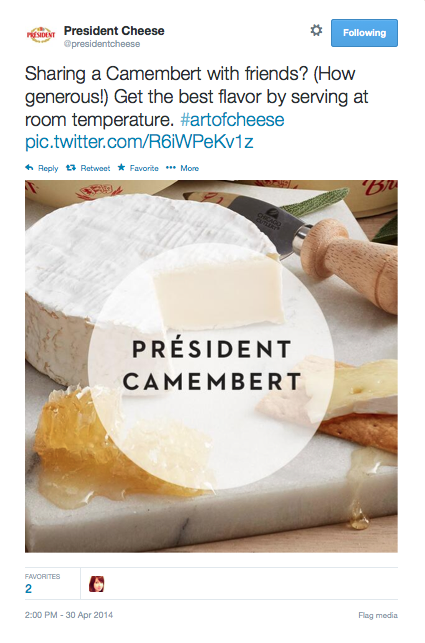
    The folks at Huge are to be commended on a truly brilliant native advertising campaign. Hired by the makers of President Cheese, they were stuck with a way to somehow drum up social media interest in a gooey wheel of stinky cheese. What they came up with will be talked about in hush three-martini lunches up and down Madison Avenue for years.

    The client was nervous, this was their first foray into the wild, wooly world of the twitter. Corporate lawyers were all over them, pouring over every syllable. The head cheese at President Cheese demanded review of all creative, ensuring everything stayed on message. The campaign, carefully honed after months of travel up and down the corporate approval ladder was, “The Art of Cheese”

    Each of the 140 characters were hand-crafted and chiseled to exacting specifications. Plurals and Singulars became the topic of weekend off-sites. Active or passive voice? How do we capture the tone. We want to be friendly but not too casual. @DrFNFurter was studied closely and discussed at length. The result?

    2014-05-23 at 1.40.15 pm

    The brilliance of the mundane. Each part of the tweet and embedded image is engineered to be ignored. This tweet was designed to fail. Two favorites? Perfect! Too much attention and all their hard-earned work would have been wasted.

    Knowing that a twitter account with a less than 300 followers would get lost in the wind, the agency set into motion the crucial second stage of their viral campaign. Buying placement on a visible tech blog, they took out a native advertising placement that would allow them to weave a story of pity and woe that would unleash the full sarcastic fury of the internet wilds.

    Social Media Experts at Work

    The story would talk about how hard people worked to come up with their lonely tweet. People would point and laugh at the lead image showing how serious people can look while staring at rando twitter profiles with a background image screaming, “$450 crack party”

    Choice quotes would get pulled out and shared,

    Social media is definitely perceived like you’re just dicking around on the internet all day, and I do a fair amount of that,

    and

    I think that if people give you a hard time for it, it’s really because they’re more jealous that they don’t have a fun job.

    All this additional attention would turn a boring tweet blipped out to 227 followers into a focal point of conversation. President Cheese and the Art of Cheese would be the hot topic of discussion. Laugh all you want but that tweet screen-captured above that had only two favs? It’s on fire!

  • The story behind the tweet

    What came off as a completely natural off-cuff quip of the moment was actually the product of a well-scripted social media command center prepared to jump on the opportunity. Imagine a room with representation from marketing, creative, legal, and the “VP of Cookies” huddled around a table on Super Bowl Sunday, laptops open, ready to pounce on the latest conversation.

    It’s all about catching the wave before it crests and surfing in on the momentum. One well-timed tweet netted 15,000 retweets and 8,000 new followers of @oreo on twitter and 20,000 likes on Facebook.

  • Ten Types of Facebook Likes

    Ten Types of Facebook Likes

    The Facebook “like” is a simple social action loaded with meaning. The act of Liking something online while sitting alone at the kitchen table in your boxers is, on the face of it, a solipsistic act, but it’s really much more complex. One click on that link causes a complex web of behaviors that ripple outwards across your social graph. By Liking something you are not only pushing a social signal to the author of the post, you are also signaling to all others that view the post that follow.

    Social signals are often misunderstood online so it’s important to remember that a Like is not always just a Like. It could be any one of the following types of Likes.

    I Saw It Like – this is the most basic type of Like. You want to let the author know that you saw their 49 photos of their trip to Costa Brava and therefore do not need to be reminded when you see them next. A simple click here allows you to cut off the conversation with a quick, “Oh yes, I saw them,” so you can move on.

    Pile On Like – we all tend to swarm around causes. The Pile On adds your name to a long list of people as a way to add weight to someone’s mission. A friend posts how she was indignantly treated by the pizza delivery guy. Quel dommage! This is the perfect opportunity to add your name the pile. Satisfyingly non-commital. We feel your pain.

    Like To Remember – we live in a busy world and our newsfeeds are always in motion. How to remember that clever t-shirt folding video that you saw? With this type of Like, it’s more because you want to retrieve it later, not really because you “liked” it. It’s a one-click ReadItLater link.

    Lazy Like – this is another common type of Like. Writing something witty, especially when you’re late to the game and the one snappy comeback you had ready was hidden under the View More link – your wrung out but still want to contribute – it’s late, you’re lazy – Like.

    Shine a Light Like – it doesn’t happen too often but every now and then something drifts across your feed that you just know no one else will see unless you breath some social air onto it by clicking Like. Maybe it’s that brilliant one-liner from your long lost surfer buddy from Chiba who usually only writes in Japanese. You want your friends to know him and his brilliance. You could Share but that feels like robbing him of something so you click Like.

    Ironic Like – sometimes something is so awful that a Like is in order as the online equivalent of the Hardy Har Har. Someone listening to Katy Perry’s Firework Death Metal overdub? Like.

    Like My Shit Like – God Dammit! I was so excited when I finished work on a animated mockumentary takedown of Sean Parker’s Redwood Wedding that I posted it at 3am as soon as it was done. Everyone was asleep so they missed it and now some big sports event is going off so all the conversation has pushed your video even further down somewhere below the copyright notices. It’s a last resort and a real noob move but you’re clicking Like on your own stuff just to put it back into rotation.

    Condolences Like – while most times Facebook seems like a Happiness Competition, sometimes sad things happen and people post about them. Everyone knows you don’t “like” the fact that someone lost their job or didn’t get into their top choice school but you are sending good vibes and “I’m thinking of you’s” their way. That’s a Condolences Like, not to be confused with a . . .

    Mercy Like – remember that loud PR girl you met in Austin that was discovering social media for the first time? She was so into you and was so grateful for all the tips and tricks you were sharing with her. She took out a little notebook and wrote down a bunch of URLs that you told her and she went home and got that dream promotion she told you about. She’s so grateful, a kid who just got the hang of her bike without training wheels. It’s such an *interesting* world out there! Did you know Samsung paid off their settlement to Apple with 30 trucks of nickels? Even though you know it’s not true, it’s easier just to click Like. Go get ’em kid!

    Absence of Like – what does it mean? You know someone saw your post but they didn’t like it when you specifically shared it because you knew they would like it. . .but they didn’t. Existential Cognitive Dissonance.

    Thanks to Adam Kazwell for sparking the conversation over lunch and all the folks on the Dev team at GigaOM for the extended exploration of Katy Perry overdubs during a lull in the action.


  • Information as Entertainment

    OK, so word is out that Solid State Drives (SSD) are not as reliable as they were once thought to be. Essentially, we projected the decades of expertise that have gone into making hard disks reliable onto these new drives and expected more or less the same level of reliability. Of course, as people started to buy these drives in mass and own them over time, we realize that we were not comparing apples to apples.

    In other words, past performance is not a reliable indicator of future performance if you change the fundamental technology underneath.

    Still, folks like Jeff Atwood are willing to give up the occasional, “catastrophic, oh-my-God-what-just-happened-to-all-my-data instant gigafail” because their seek times are so good. Jeff tells the tale of someone who bought eight drives over two years only to have them all fail. Some within 15 days! As long as you plan for failure as a known, then you can enjoy mass storage performance that even your RAM will have a hard time keeping up with.

    To put it in his words, “SSDs are so scorching hot that I’m willing to put up with their craziness.”

    With that behind us, which of the following videos do you think does a better job selling you on the speed and reliability of an SSD?

    This one?

    or this one?

    One video had 673 views, another had over 3.7 million.