Tag: social media

  • Spokeo Repositioned as a Snitch

    While it may be technically true, I’m not a big fan of Spokeo’s new positioning.

    Uncover personal photos, videos, and secrets. . . GUARANTEED
    Uncover personal photos, videos, and secrets. . . GUARANTEED
  • Facebook Business Model – Public Profiles

    With over 175M users, Facebook has famously opened up for distribution of marketing messages from businesses, brands, and celebrities. My wife Tivo’d an appearence by Mark Zuckerberg on Oprah introducing it to its mainstream audience and most surely to any brand marketer interested in reaching Oprah’s audience. If Jason Calcanis puts the value of a slot on twitter’s suggested users at $250,000, then a slot on any Facebook featured user page has got to be multiples of that.

    If you hit Facebook in a logged out state, look for the, “To create a page for a celebrity, band or business, click here.” link and this is what you’ll see. No more fan pages – social influence is now officially reserved and will most likely be for sale.

    Facebook Business Model

  • Do Social Gestures a Business Model Make?

    Is twitter a directory or a utility? This is the question that Charles Hudson raises in his post The Database of Intentions is More Valuable than the Database of Musings. While investigating prospective business models, he raises good questions about the ability of a collection of “accumulated musings” to determine intent which is what is most valuable to advertisers.

    But maybe advertising  is not the great revenue driver of the next generation of startups after all, at least not advertising as we know it. Maybe it’s just me but I feel a need to make sense of all the stuff we share with each other. There seems to be value in tapping into the pulse of the “now web” but the methods of pulling meaning out of the noise seem crude. Keyword searches? Is that the best we can do?

    Something went wrong with the Intense Debate comments on last night’s post on Keywords and Meaning. It’s unfortunate because there were some really thoughtful responses to the post which I’ll repeat in this post because they are worth reading.

    Todd writes:

    Keyword extraction from Twitter could be cool, but may kill of serendipitous discovery, my favorite aspect of Twitter. If keywords or meta-categories are predetermined truly unique hawtness, unprecedented new things ( a Twitter specialty ) will just get deleted? That would be FAIL.

    I wonder if more of a “people with attributes” are really what’s needed. Example, I do want to know what’s going on with the latest developments for Symbian operating system, particularly activity streams and address book stuff. Rather than rely on keyword extraction, I could just assign an attribute to your tweets…

    twitteruser:iankennedy=novi

    …I can be fairly assured news filtered by real humans, THEN assigned an attribute of my choosing will bring me some good results. A tag cloud of all tweets containing “symbian, activity stream, address book” would be noisy ( pollute with people asking each other for tech support? ), difficult to pull meaning from while drinking beer at my favorite bar.

    Jonathan Strauss writes:

    The TechCrunch post you cite was inspired by John Borthwick’s very interesting essay on how Google’s approach to content filtering breaks in the realm of what he calls the ‘Now Web.’ Like you say above: “Google’s PageRank, while valueable in sorting out the reputation and tossing the hucksters, is no good when applied to real-time news which is too fresh to build up a linkmap.”

    In the (relatively) static web, the network nodes are pages and the endorsement actions are the links between them which are effectively permanent as well as public, and thus crawlable. In the Now Web, the network nodes are people and the endorsements are ephemeral share actions, the majority of which are not public or crawlable (i.e. email, IM, Facebook — what I call the ‘Deep Now Web’). And so, authority also takes on a different form from the aggregate view that PageRank provides to the personal measure of how much influence an individual has with her social network on a particular topic at a given moment.

    I agree that we need to have a means of systematically capturing the newly important metadata of share actions and that it needs to be done at the point of sharing (see Jeff Jonas). But, I believe the more easily adopted (and thus ultimately more useful) taxonomy will be one of contextual metadata (i.e. who/what/when/where/why/how) rather than the more personal folksonomy/tagging approach you suggest.

    There was also reactions via twitter from Kevin Marks:

    The act of sharing links, photos, or other metadata on social networks is an action, to a certain extent, that gesture is more interesting than the actual data itself. The fact that my usually dormant cycle racing friends are now extremely active on twitter these past few days as the Tour of California is on is as much an indicator of interest as the actual substance of their conversation.

    Keywords are part of the picture – the complete context around who/when/where/why/how are just as important as the tidbit of data itself. The meta-data contains more clues than the data.

    The cellphone is a rich source of meta-data which can be captured at the source, the moment of sharing. Feeding contexts captured from the cell phone would be a great way to add context to any act of sharing.  There are privacy concerns and ownership questions. There needs to be a real value demonstrated to the potential user before they give up some of this privacy. But that’s a topic for another post.

  • Open ID Design Summit – Links to coverage

    For various reasons I was unable to attend the Open ID Design Summit. Thankfully, the talks were very well covered so it’s possible for anyone see what happened and the current state of discussions around what’s being called the “open stack”

    Live-blogging the openid design summit – John McCrea from Plaxo did a great job of live-blogging the event. This is the best place to start because his post also embeds all the presentations. Thanks John!

    OpenID user experience tackled – by Carsten Pötter links to PuffyPoodles.com, an example of an OpenID pop-up form which uses remote authentication using a Google ID.

    Chris Messina just posted a bunch of video clips:


    OpenID Design Workshop Introductions from Chris Messina on Vimeo.

    More below the fold:

    (more…)

  • It’s not Information Overload. It’s Filter Failure

    It’s not Information Overload. It’s Filter Failure

    Thank you Daniela for pointing me to Clay Shirky’s keynote at Web 2.0 Expo last week in New York. In it, Clay gives a talk on Social Networks, Lifestreaming, and Privacy. It’s a timely talk as lifestreams go mainstream. I’m really happy to see someone like Clay talking about the social impacts of lifestreaming and the crudeness of the tools we have to manage them.

    Some quotes to give context.

    The problem is that “managing” your privacy settings is an unnatural act. It’s not something that anyone is good at setting up or doing. Prior to the present day, the only person any of us could name that had anything you could call privacy preferences was Gretta Garbo. Privacy is a way of managing information flow.

    The inefficiency of information flow wasn’t a bug, it was a feature. The guarantor of privacy was simply that it was difficult to say things in public.

    How do you control what you publish so that simple updates such as the one used in Clay’s talk, that you’ve gone from having a relationship to now being “single” goes to the folks you want to know without being blasted out to everyone connected to you via your lifestream? Clay’s point is that the manual settings to control privacy are not intuitive and all it takes is one slip up to cause irreversible damage.

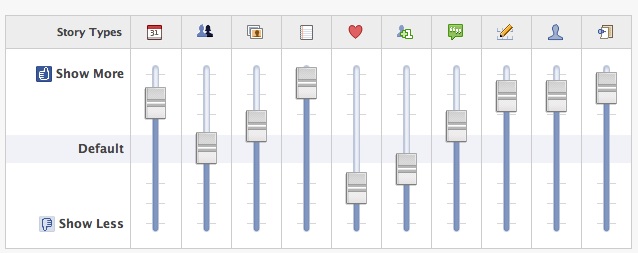
    Facebook’s News Feed Equalizer UI (2007)

    On the flip side, we’ve all heard that everyone is famous for 15 people. It’s now trivial to share your online activity across multiple services so that anyone and everyone can tune into your lifestream and keep up with every bookmark, blog post, photo, and status message you ever make. Keeping up with your friends is as easy as clicking a subscribe or add contact button.

    It’s no longer the effort of publishing that is the filter. First with blogs and now with lifestreaming, publishing is so easy that we now have too much to process. As I said back in April, the new challenge is coming up with the right filter. Once you’ve pulled together all your personal and professional contacts into a single feed, how do you make sense of it all? Just as I used to worry about missing an important post that lay buried in my collected RSS subscriptions, how do you make sure you catch what is going to be important without having to spend time getting distracted by the tangential stuff that comes along for the ride?

    Contexts are going to be the key inputs. Are you at your desk? Are you looking at your feeds via a dedicated client such as a feedreader or are you looking at a thin sliver via something like Gmail webclips? Maybe you’re looking at a particular post and want to see if any of your work colleagues have posted something or left a comment. Are you on a phone with some down time between meetings? Or are you disconnected from the web on a cross-country flight and want to catch up on industry news?

    All these contexts can be accommodated but they need to read from the same source or be synchronized in some way to keep you from reading the same thing twice. Even better, if something comes up more than once in different contexts, that could be a signal telling you that you really should read post you’ve passed by in another context.

    MyBlogLog, Friendfeed, and others are building the master feed – I’d love to hear from others on what types of contextual filters can be built on top of those feeds to goose the relevance.

  • Radar, cool hyper-local service from outside.in

    Image representing Outside.in as depicted in C...Image via CrunchBase

    outside.in, the local news site co-founded by geographer-historian Steven Johnson, launched a service called Radar which claims to feed you news from within 1,000 feet of your stated location. Similar to the other hyper-local services like EveryBlock and Topix, their service parses blogs and other social media for stories tied to a specific location.

    outside.in also added GeoToolkit for publishers that want to geo-tag their feeds and take advantage of outside.in distribution. For users, they’ve synched with Yahoo’s FireEagle platform to automate updating of your location. The “news within 1,000 feet” is a compelling promise and hopefully it will generate enough interest in the service so they can reach critical mass.

    Local news is a hard nut to crack. I still get the best results from a variety of bloggers that cover my home town which I can share via My Yahoo. The winning solution is going to be a hybrid of automated parsing (which has it’s own limitations) and crowd-sourced editorial that brings in the right people with the right set of incentives. Local Newspapers have the institutional clout to invite local participation but I’m still looking for a site that expands on the seemless integration of community blogs at the Lawrence-Journal (work incidentally started by EveryBlock’s founder, Adrian Holovaty).

    Who’s going to write the CMS platform for the local newspaper that wants to go online?

    Reblog this post [with Zemanta]
  • Custom Book Jackets Drive Awareness

    From the folks that brought you the Day in the Life and America 24/7 photo books, comes their latest project which takes a peek inside homes across America. As they have done in the past, they are offering custom book jackets and they have a cool little app where you can upload a photo and preview it. It’s a great way to customize the gift, like engraving the back of an iPod.

    They also let you grab your preview and embed it as I’ve done above. Nice little social media hack that gets the word out.

    Spore is doing something similar with it’s Creature Creator as people share their creations with each other. As of today, there are over 5,400 images uploaded to flickr already, only a few days after the release of the program.

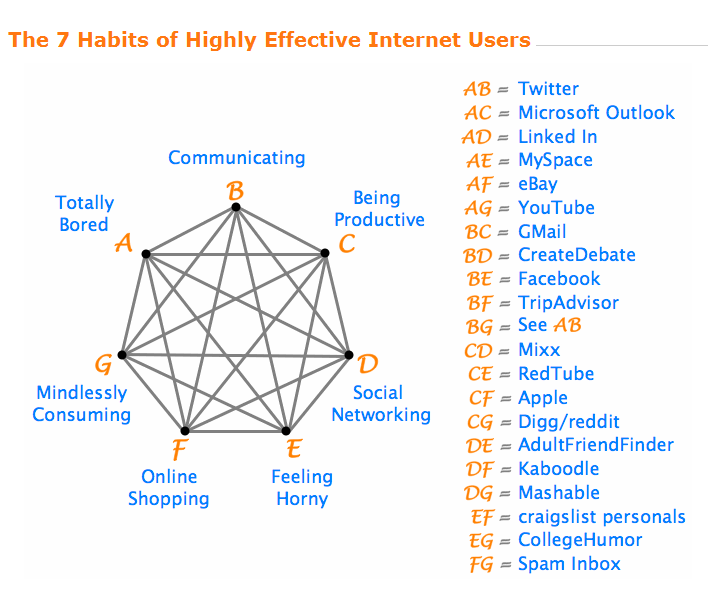
  • Social Media Vectors

    Social Media Vectors

    I’ve run into a few articles by Sarah from sarahintampa.com on ReadWriteWeb and have seen her referenced a few times so I went to check out her site and grabbed this graphic from a post about Create Debate.

    Don’t have time to check out the service she’s talking about but I love the infographic which is brilliant.

  • Cognitive Surplus will free up time to

    One of the best talks at this year’s Web 2.0 Expo was Clay Shirky on Cognitive Surplus. In it he suggests that modern television is a, “cognitive heat sink, dissipating thinking that might otherwise have built up and caused society to overheat.”

    He concludes after describing how a child spent a few minutes looking for the mouse connected to her living room television;

    Here’s something four-year-olds know: A screen that ships without a mouse ships broken. Here’s something four-year-olds know: Media that’s targeted at you but doesn’t include you may not be worth sitting still for. 

    The ironic thing is that I was stuck in the hallway and missed this talk. I read Clay’s transcript and was moved. But watching him deliver his talk on video was even more impactful (for instance, listening to the collective, “Ahhh!” from the crowd when he delivers the lines quoted above).

    As with many involved in the tech industry, I watch very little television but when I do, it’s mediated by timeshifting technology that lets me watch it on my own terms. It’s either on Tivo or filtered through social pointers such as Jeremy’s blog post which determine which videos I invest time to watch.

    “The web is in its infancy,” says Tim Berners-Lee and looking at the tools available to manage information flow it’s easy to see why. We’re shifting from a time of channel surfing to web surfing but the evolution from web portals to something more dynamic and efficient has only just begun. The vast wealth of information is still intoxicating and we constantly jump around afraid we’re going to miss something. What’s going to happen when we wake up from this second, “collective bender” and use our spare time to improve the world around us.

    Then we will have the capacity, as Tim O’Reilly challenges us, to “wrestle with angels.”