Tag: social media

  • Yahoo! acquires MyBlogLog, puts a face to analytics

    Holy crap this year started off with a bang! I’ve been lumbering in a post-holiday daze for the past couple of weeks but a quick succession of events snapped me out of it.

    mybloglog.JPG Yahoo! acquires MyBlogLog – I’ve been using the service for quite some time now and have been singing it’s praises internally. The design leaves a little to be desired but that’s just superficial. At its core, is a gem of a concept. What better way to tap into the ego of your readers than to feature their face on your blogroll? If you’re a MyBlogLog user, you’ll see your face on the Recent Readers “faceroll” on the sidebar. Not seeing your face? Go sign up then. This service has a built-in user acquisition strategy.

    I like the way their stats package is laid out as well. Left to Right you have:

    • Where Readers Came From (referral info)
    • What Readers Viewed (page view info)
    • What Readers Clicked (outgoing link)

    As an added bonus you have a view of what other sites your members visited across the web as well as the other MyBlogLog communities that your members have joined so you get a real sense of your audience.

    But the best part of this service is that it takes a very basic human instinct – curiosity – and spins it into a driver to build community in a very unobtrusive way. Once you join MyBlogLog you’ll find yourself getting automatically added to other MyBlogLog communities. No spamming your friends with yet another social network, no invite requests, it’s all transparent and driven by your behavior. The default is after 10 visits (this can be changed). What this means is that after showing up on someone else’s Faceroll 10 times, it’s assumed that you’re a frequent enough visitor that you don’t throwing your lot in with that community and your face showing up on that blog’s community page.

    As you click around the community pages you’ll see faces you recognize or others that just look interesting. As my 4 year old daughter showed me, sometimes you just click on someone to see what they’re about. “Who’s that!” she said as we clicked on someone named Andi. Lo and behold – this afternoon as I write this, I recognize Andi’s avitar on my Faceroll – she saw that we stopped by and counter-clicked through to my site to see who the hell I was. If you’re reading this Andi, “Hi!”.

    So hands down, the Faceroll thing is much easier to remember than looking at a random IP address or top level domains in your referal logs. It’s a great way to get to know your audience. The other great thing is that your visitors that are coming to you from MyBlogLog all have websites they claimed. You get to not only put a face to a visitor, you also get to see what they write about, what sites they like to visit, and who visits them. Of course this all means that to be an upstanding member of a community, you need to have a website that features MyBlogLog – goodbye inbox, we are now shifting the conversation over to comments & trackbacks. As MySpace taught us, no one sends email anymore, all casual conversation takes place on each other’s friends pages. MyBlogLog enables any website anywhere to become your own friends page – hello inbox 2.0!

    Part of Yahoo’s mission statement is about helping people connect to their passions and communities and MyBlogLog falls right into that line. Welcome aboard Scott and congratulations Bradley and Chad for making this happen.

    The other thing that happened? Apple just reinvented the cellphone. I’m off to Moscone this afternoon to check it out.
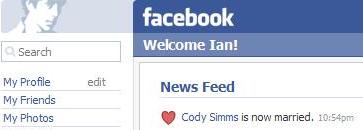
  • Undocumented “spouse-finder” feature in Facebook

    With all the hoohah over Facebook’s mini-feed feature, one new service was exposed that I didn’t see in the documentation anywhere. Rather than setting up a simple match-making service, the folks at Facebook have pushed the envelope with their online, add-a-spouse feature.

    I was about to send off a hearty congratulations to my colleague when I realized that it was an odd hour to hitch up (unless you’re in Vegas) and that this strange, out of context blip on my social news channel was more likely the result of Cody beginning to fiddle with his newly minted profile.

    Intrigued, I decided that I too would like to announce my marriage of eight years in the dark of night just for a laugh. I set out to edit my profile and look for the section where one might identify one’s marital state. There it was, on the under the basic tab, “Married to. . . ” The ellipses drifting off in the distance, just waiting for you to type your spouse’s name. Yet, instead of taking a random string and saying, “Thank you, and good day,” Facebook assumes that your bride, is also on Facebook and that that what you really want to do is find her profile and link to it. So instead of being able to identify my wife’s name and introduce her to my budding community – I’m shunted off to a list of ladies also named Izumi that I might like to, and this is really one of the great moments in interface design, “Add as Spouse”

    I have no doubt Facebook is a great place to meet people but there’s something unsettling about seeing a list of 79 alternative wives that can be “added” with the click of the mouse. I haven’t had the nerve to actually click on any of these links for fear of what would happen at the other end. Would the alternative Izumi get a coldly worded confirmation notice from me asking a few terse questions about how we hooked up and to indeed confirm that we are joined ’til death do us part? Does it send flowers?

    Clearly this is just a glitch in their UI desgin where another feature just got ported over without really thinking about the impact but it does point to another thing that has been bugging me about Facebook, it’s all about feeding stuff in but never letting it out. The ability to add an RSS feed to your profile is a cool trick. I don’t actually hang out in Facebook too often so this is a way to let my off-network vitality drive my Facebook profile. Funny thing is, none of the links drive back to my site which is spawning all this activity! From Facebook’s perspective, it’s all about keeping users tied into a self-referential experience on the Facebook servers.

    This, keep ’em on our servers, perspective is why I’m given a list of Izumi’s to marry from Facebook’s community. It’s about “user lock-in” – a term I’ve come to loath. Heck, I’m given more freedom when I choose my interests on my profile! Here I’m given a blank, white box in which to enter books and music I like – here I could have actually *used* some direction as to what other people are calling things they call “interests.” I just realized, upon review, that identifying “kids” as one of my interests could probably be interpreted differently. A little direction here as to the best way to say you spend a lot of your time hanging out with your offspring would have been welcome a couple of months ago when I set things up. Hope I’m not on any kind of watch list anywhere.

    Ok – keep the, “hey old-timer” comments to a minimum. These UI bugs are still whacked and they’re going to need to get these straight before opening up to the general public which does include people that are married with kids.

    Come on Facebook – you can do better than this!

  • Digg 3.0 – stats and cool visualization

    I missed the Digg 3.0 launch party earlier this week where they previewed a cool new visualization tool that will be launching later this month. I was alerted to it because of the Diggnation podcast and am thankful to the infosthetics.com site for pointing me to a video which shows this new visualization.

    GIF image of long-lost video

    More details on Digg 3.0 with some interesting stats from the TalkCrunch interview with Kevin Rose and Jay Adelson. Notes from the podcast below.

    Digg prototype built back in October 2004 in 2 weeks for $1200.

    Launched December 5th, 2004. First big story on Digg was about Paris Hilton’s cellphone getting hacked. Both Yahoo & Google pointed to Digg as the nubmer one source of information on this story bringing down their servers.

    Digg 2.0 launched in July 2005.

    As of today, 1500 – 2000 new stories submitted each day. Between 30 – 50 stories make it to the front page.

    700-800k unique visitors/day, 8.5 million unique visitors/month, doubling every two months. Adding 1,000 to 1,500 new registered users/day. On the average day, anywhere from 1/5 – 1/3 of the users are active on the site.

    9.5 million pageviews/day – bigger than slashdot, maybe even bigger than the New York Times. A majority (95%) of this traffic is from the US with most of the non-US traffic from the UK and Japan.

    Majority of traffic to TechCrunch come from Digg. More than Google.

    Some interesting perspective of digg v. the new Netscape.com and Reuters’ view of blogs in general and social news sites in particular.

  • eBay completes social media troika, message boards, blogs, now a wiki

    logoebay_150×70.gifEBay recently launched blogs for it’s members as a supplement to its very active forum community. While message boards are useful for loosely classified conversations where anyone can start a thread, blogs are better suited for individuals who want to project a voice around an area of expertise. We’re already seeing examples of this as members share their knowledge of things such as eBay-specific HTML tags.

    Now eBay has added a wiki (powered by JotSpot) to the community area and one hopes that it will become an excellent source of hyper-detailed, domain-specific knowledge about collectibles. Where else (outside the rarified world of Yahoo Groups) can you find a detailed discussion of the net worth of a bag of trolls?

    Richard MacManus has a detailed writeup.

  • Video Advertising – two approaches

    Apple announced today that it will run graphical ads in the lower-left hand corner of the iTunes product as users listen to podcasts on their PC. Advertising Age goes on to write that this will help offset the costs of producing and hosting podcasts. Everyone will be looking at this closely.

    In other news, I’ve been pointed to another version of advertising, one that comes from and is amplified by the community. Here’s the Firefox Flicks community on “other browsers” in Wheee!

  • Video editing fun with Remixer

    ss_main.jpg

    Check out the latest out of Yahoo Research Labs. Save & edit your favorite clips from the SF International Film Festival, re-arrange, lay down a soundtrack and share.

    . . . developed in collaboration with Yahoo! Research Berkeley and the Institute for Next Generation Internet at San Francisco State University. Besides the online gallery, a selection of the best remixes will screen at Edinburgh Castle.

    I really look forward to coming back and seeing what people put together. Totally amazing! Remixer.

  • “Human social networks constitute a habitable environment and a giant playground for memes.”

    UC Berkeley grad student Sean Savage writes about social networks from the perpective of machines, corporations, and memes. Sean’s post pokes fun but is also a useful reminder of how insular and kinda creepy all this talk about "social media" must sound to the person on the street.

  • How do you define “Social Media”

    I joined Havi Hoffman (a Social Media partner in crime here at Yahoo) and Stowe Boyd for coffee in Palo Alto this morning and asked Stowe if he would come up with a two line definition of “social media.” He took a shot at it and came up with a good working definition that I look forward to seeing polished over the next few days.

    Social Media are those forms of publishing that are based on a dynamic interaction, a conversation, between the author and active readers, in contrast with traditional broadcast media where the ‘audience’ is a passive ‘consumer’ of ‘content’. The annotations or social gestures left behind by active readers, such as comments, tags, bookmarks, and trackbacks, create an elaborate topology resting on the foundational blog posts, and this enhanced meta-environment, the blogosphere, is the context for and the realization of a global collaboration to make sense of the world and our place in it.

    I especially liked Stowe’s phrase, “social gestures” that he uses to describe the artifacts of the tools that are used to create social media. I would only suggest expanding this to include things like the aggregate votes of users on ratings and review sites because the collective vote on something is also a form of “user-generated content.”

    What I really like is the phrase, “making sense of the world and our place in it” because it gets to the greater philosophical question of how your content on the web defines who you are. If it’s cogito ergo sum in the physical world, it follows in the digital world that you are defined and understood by the sum total of everything you contribute to the web. Our collective voice on a subject or theme is going to be the digital representation of our world’s understanding of that topic.

    UPDATE: An alternative definition that I learned at ad:tech. Social Media is, “communication and media that doesn’t require interruption.” In other words, media that is used as part of a conversation between two people, media that is personal and relevant to the conversation, not ancillary.

  • Tag Cloud

    I’m playing around with Tag Cloud and put a large chunk of my OPML into it to see what all the blogs that I watch are talking about. Looks like there’s an unhealthy obsession with Google 😉

    I’ve been thinking a lot about how to creatively manage the flow of news that comes across and using ambient technology to aggregate and summarize. Jon Udell talks about a server log that chirps like a cricket if all is well. Extend this to have it bark like a dog if something needs looking at, it would be great to see these same principles on a meta-view of your RSS feeds. My colleague Russell Beattie has done some thinking on a feedback loop for readers to prioritize content and suggest related info. My other colleague Chad Dickerson goes into how Tag Cloud works (and got me into looking at Tag Cloud in the first place) and how it leverages Yahoo’s Term Extraction API to summarize the concepts in what the software has gathered.

    The Tag Cloud image above is a screenshot, the realtime image is here.