Tag: television

  • The $20B Edit

    The $20B Edit

    MediaPost delves into the specifics of what caused the Trump administration to accuse 60 Minutes of manipulating a quote and commit election fraud.

    Face the Nation used the first half of Kamala Harris’ response to a question while 60 Minutes used the second half. Was this really cause for a $20 billion lawsuit that ultimately resulted in the resignation the 37-year veteran Executive Producer of 60 Minutes, Bill Evans?

    You can read Adam Buckman’s details below,

    The question posed by “60 Minutes” correspondent Bill Whitaker in that part of the transcript was a follow-up question to a previous question-and-answer about the relationship between the Biden administration and Israeli Prime Minister Benjamin Netanyahu.

    “But it seems that Prime Minister Netanyahu is not listening,” Whitaker said. “The Wall Street Journal said that he — that your administration has repeatedly been blindsided by Netanyahu and, in fact, he has rebuffed just about all of your administration’s entreaties.”

    To which Harris replied: “Well, Bill, the work that we have done has resulted in a number of movements in that region by Israel that were very much prompted by or a result of many things, including our advocacy for what needs to happen in the region. And we’re not going to stop doing that. We are not going to stop pursuing what is necessary for the United States to be clear about where we stand on the need for this war to end.”

    The first sentence of that answer was used on “Face the Nation”: “Well, Bill, the work that we have done has resulted in a number of movements in that region by Israel that were very much prompted by or a result of many things, including our advocacy for what needs to happen in the region.

    On “60 Minutes,” the final sentence was used instead: “We are not going to stop pursuing what is necessary for the United States to be clear about where we stand on the need for this war to end.

    Revealed: The ’60 Minutes’ Edit That Spawned A $20 Billion Lawsuit

  • Sotetsu Line Tear Jerker

    Sotetsu Line Tear Jerker

    In America, it used to be AT&T that made the nostalgic TV commercials that would bring a tear to your eye. In Japan, a Yokohama train line is pulling on that thread.

    The Sotetsu line was the train I took to my Japanese grandmother’s house in Wadamachi from its terminus in Yokohama. It was the first train I took by myself when visiting Japan when I was 12.

    Their television commercials have gone viral for their nostalgia. 100 Years Train shows various couples missing each through the years before finally getting together at the end. This commercial was made to celebrate the train line’s 100 year anniversary.

    Here’s Dentsu’s write up on the thinking behind the campaign.

    Last month, Sotetsu updated this theme to celebrate the line’s extension to Tokyo. Father & Daughter follows a father and daughter over the years as the father takes his daughter to school. In the beginning, the daughter looks up to her dad and says that it’s so far away. In the end, the daughter stays on the train to go away to university, presumably in Tokyo, which she tells her father is not that far away.

    More background on the story here.

    Be sure to watch the “behind the scenes” video below which is really quite amazing. Instead of using CGI, the entire commercial was shot in one go with identical-looking actors and hand dollys to simulate the movement of the train.

  • Something Different

    Something Different

    Yasumura has been polishing his bit for years back in his native Japan. Now he has taken his act internationally to Britain’s Got Talent, changing his name to Toni Kaku and leaning into his mangled Engrish.

    Don’t worry. . . he’s wearing . . . PANTS!

    Izumi dug up a video of him from eight years ago. It’s a bit rougher and I have no idea why the women are in their underwear either but, you know, Japanese TV.

    Yep, same as it ever was.

  • Underlined or Crossed-out?

    Underlined or Crossed-out?

    Last night’s episode of Succession hung in the balance on the interpretation of a memo left in Logan Roy’s safe and the collective interpretation of a single, wobbly pencil line left by the family patriarch.

    Just when you think it can’t get any murkier, the clouds roll in.

    Sarah Snook sits down with Host Kara Swisher to unpack episode four, “Honeymoon States.” in the HBO Succession podcast.

    UPDATE: Jesse Armstrong points out the obvious thing none of us thought about. “If you were crossing something out, you wouldn’t start underneath.”

  • Succession Riffs on Media

    Succession Riffs on Media

    Season Four of the HBO drama Succession is underway and the writing is so good that I am memorializing some of it so it’s readily available later, especially the dialog around media.

    Episode One: Munsters

    Kendall, Shiv and Roman are off spinning up their own new media startup. As they spitball new concepts, the writers have crafted some cringe-worthy bon mots about what the Logan Roy offspring think is the future of media.

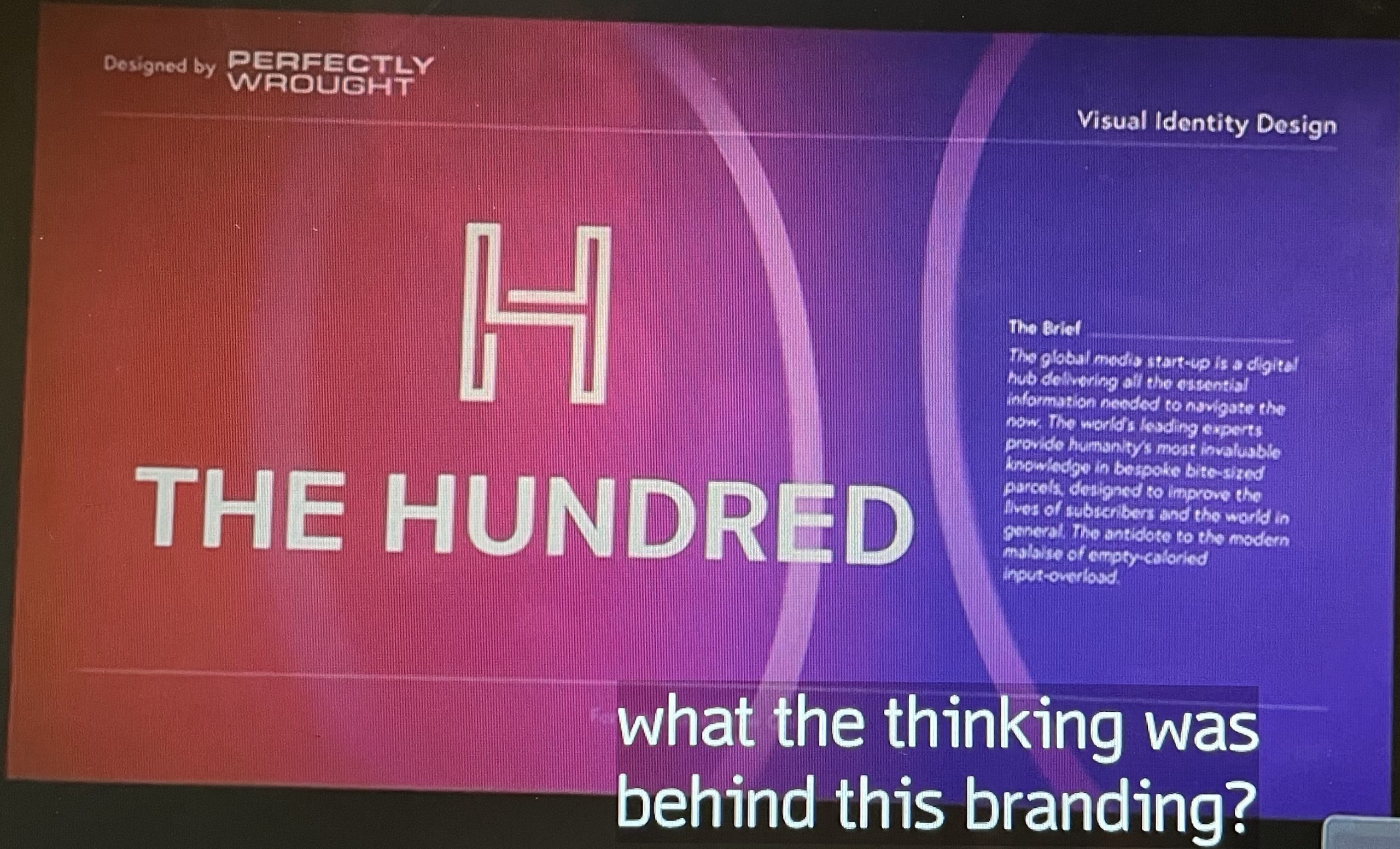
    Branding slide for The Hundred: The global media start-up is a digital hub delivering all the essential information needed to navigate the now. The world’s leading experts provide humanity’s most invaluable knowledge in bespoke bite-sized parcels, designed to improve the lives of subscribers and the world in general. The antidote to the modem malaise of empty-caloried Input-overload.

    Kendall: The Hundred is Substack meets Masterclass meets The Economist meets The New Yorker.

    Roman: I feel like we said iconic, and you guys are leaning ironic.


    Kendall: An independent bespoke information hub with the hundred greatest top writers, experts and minds in every field from Israel-Palestine to A.I. to Michelin restaurants. It’s a one-stop info shop, with high-calorie info-snacks.


    Roman: It’s like a private member’s club, but for everyone. It’s like clickbait but for smart people.

    Kendall: We have the ethos of a non-profit, but a path to crazy margins.


    Logan Roy: What are people? They’re economic units. I’m a hundred feet tall. These people are pygmies. But, together, they form a market. What is a person? It has values and aims but it operates in a market. Marriage market, job market, money market, market for ideas, et cetera, et cetera.

    Episode Two: Rehersal

    Now that Kendal, Shiv, and Roman have made a play for the old media brand, Pierce Media, they bounce around some ideas on how to spiff things up.

    Shiv: I gotta say, the upside is huge if we just broaden out and stop over-indexing to college professors.

    Roman: Sorry, I just can’t seem to tear my eyes away from the bald man talking about NATO. I have a boner.

    Kendall: So, my floaty kinda semi-pitch would be hardcore international news from global-global to hyperlocal. Maybe focus on Africa? Every day, just what is happening in Africa? The Maghreb. Sub-Saharan East, Sub-Saharan West. I would watch that shit.

    Roman: You would not watch that shit.

    Shiv: That sounds like Homework: The Show.

    Kendall: The point is, it’s global reach. It’s a network that teaches you how to watch it.

    Roman: Or, shove all your foreign report melatonin news hour info dumps in the daytime. Primetime, we go full Clockwork Orange, you know?


    So good. Looking forward to what drug-addled craziness awaits this Sunday.

  • There’s More That Unites Us

    CBS Sunday Morning rolled out Ted Koppel last weekend to explore how the United States became so polarized as a nation and if there were things that could mend the divide.

    Twenty-one years ago, in the wake of the 9/11 attacks, may have been the last time that the United States was openly – even defiantly – united, in pain and patriotism. Since then, we have drifted apart, gone to our separate corners, hunkered down in our respective silos.

    Sunday Morning: A Nation Divided?

    There were several segments to the show, each exploring a different aspect of the main theme.

    This first segment looked into a political movement that is suggesting 63% of Eastern Oregon to be merged with Idaho which is closer political and cultural affinity

    Next, Jon Grinspan, a historian who studied how intense partisanship in the 19th century was driven by people feeling isolated and unstable fed into an aggressive and violent political discourse. Sounds familiar doesn’t it?

    We then jump into the present and sit in on a conversation across generational and class divides in Pennsylvania.

    Later we learn about the group Braver Angels, founded by a marriage counselor, who applied his skills to bring people on opposite ends of the political spectrum together, united on their concern (and love) for democracy in America. Braver Angels signature, in-person, Red/Blue workshops bring people together from initial skepticism to a profound and empathetic understanding of each other.

    Finally there’s an interview with the director Norman Lear who produced several controversial TV shows in the Seventies such as All in the Family, The Jeffersons and Maude. The interview asks the 100-year old Lear if he were to explore these issues today, how would he do it,

    If I were to do it today, I would have a 13-year old daughter who represents everything I care about and is a pain in the ass talking about it. And, in her brilliance, would recognize a lot about the foolishness of the human condition and problems they’re parents are living with that even they are not facing.

    Norman Lear on laughing at what ails America

    I had an animated discussion with someone visiting NYC  from Los Angeles on the subway the other day. In the 10 minutes until he got off, we were able to come together and, as cliché as it sounds, find common ground. We lamented how everything was so politicized and agreed that politicians and social media drive us apart (see Enragement Metrics) so they can better engage and target us.

    We talked about how American car culture and modern city planning have isolated people from each other. The only reason we were even having a conversation was because we were sitting across from each other on the New York subway, the great equalizer.

    Before he got off, we shook hands and celebrated our chance connection. Conversations like this give me hope. There’s more that unites us than divides us and time is running out for us to recognize this and address the larger challenges to our existence.

  • Game Show Fails

    Not a good moment for Reed College.
    Surf Clay?
    A classic
    Don’t forget Family Feud
    He’ll never get over this one.
  • Japanese TV News

    Japanese TV News

    Television news programs in Japan are famously entertaining. The sets are more interesting and the hosts are much more physically involved with the story-telling. Below are some screenshots of a lengthy and incredibly detailed explanation of the sport of speedskating.

    Here they are talking about the importance of drafting complete with a huge fan for effect. I can’t imagine Brian Williams or Savannah Guthrie doing this.

    Well, maybe Al Roker.

  • Kasou Taishou

    We spent this morning looking at YouTube videos of Kasou Taishou. These are short skits that re-create special effects using charmingly amateur stage effects. Think of it as a mashup between traditional Japanese kabuki stage-craft and a high school play.

    Add a twist of self-depreciating humor and you’ve got a winner.