Category: Current Events

  • Publishing in an Agentic AI World

    Publishing in an Agentic AI World

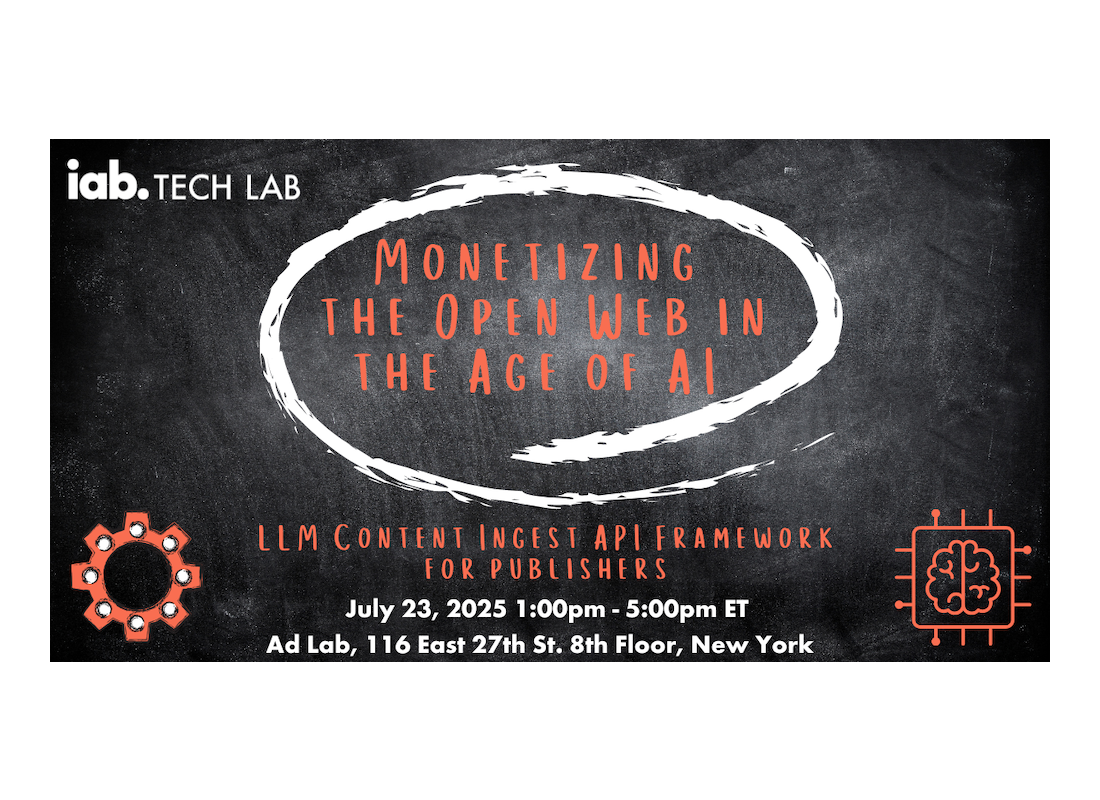
    I was fortunate to be invited last week to the kick off meeting for an IAB Tech Lab task force dedicated to establishing a framework for Monetizing the Open Web in the age of AI.

    The accelerated use of tools such as OpenAI’s Chat GPT, MSN’s CoPilot and Google’s AI Overview has precipitated a re-thinking of how publishers are compensated for their work. While the conversation is only just beginning, this group outlined concrete suggestions to the challenges ahead.

    Publishers must work together to stem the flow of unlicensed content. 

    As long as information is readily available and free, there is no incentive to drive demand. Unless you limit supply, you cannot derive value. Content Delivery Networks (CDN) such as CloudFlare and Fastly are on the front lines as they see the majority of requests & responses across their networks. They have noted the sharp increase in AI-bot traffic and have the expertise in the blocking and tackling of the thousands of bots and spiders.

    TollBit is keeping track of the AI crawlers with their quarterly State of the Bot reports

    Publishers in the room are anticipating a world where the value of a search result on Google is less than the value of licensed access from an AI Agent. In such a world, it would be prudent to default to denying access to all crawlers in favor of direct access by verified, registered readers or licensed partners.

    Old methods such as robots.txt and user-agent/IP address blocking filters are readily ignored or spoofed by long-tail startups scrambling to serve their users. More secure methods are necessary. “Get a better lock on your door.” says Jon Roberts, Chief Innovation Officer at DotDash Meredith.

    Establish a marketplace for publisher information that can scale to serve AI Agents.

    While CloudFlare’s Cost-Per-Crawl implementation redirects crawlers to a 402 HTTP error page to redirect AI developers to licensing information, TollBit and Dappier are building the first marketplaces for publisher libraries as a proof-of-concept as a bridge from the search engine results of the past to the marketplace of the future.

    A search for the past 25 years returned 10 blue links of which a human might read 1 or 2 links. This referral traffic was the currency of the old internet. This attention could be monetized any number of ways.

    Google owned this marketplace.

    Now imagine a world where a query by an AI Agent may spawn 20-50 queries of which *every* article is scanned and synthesized into a single response. Ads and subscription funnels on these pages are ignored. There needs to be a different pricing model for this traffic. Source material will not be a “page” but could be a snippet of video, a schematic blueprint, a sound bite, or a product spec. The pricing model in this “marketplace of everything” needs to recognize and support dynamically pricing requests based on who is requesting it and in what format, all in real-time.

    The programmatic advertising ecosystem which has been the engine driving the growth of online publishing for the past 25 years was subsidized by advertisers bidding for a reader’s attention on a web page. An entire tech-stack was built to serve up the right ad for the right audience at the right time, all in under 500 ms.

    With AI Agents, you have readers paying directly for content with their subscriptions (Chat GPT Pro is $200/month) and the AI Agent is acting as a proxy on their behalf. Once publishers have successfully shut off the free flow of their content, accurate, reliable, and up-to-date information will accrue value. In this world, there will be need for a real time marketplace to handle the access and metering of content and this system will need to be built to the same scale and performance of the programmatic advertising platforms of today.

    No one owns this ecosystem.

    IAB Tech Lab - Content Ingest API

    Tokenization – core components to a market

    The final step, once you have established a way to meter (cost-per-crawl, cost-per-query or some other subscription model) access to a publisher’s library, is to establish a standardized way to track and count content as it travels through the ecosystem from a publisher to the AI platform.

    Tokenization is this final step. Once an AI has asked for something, the response needs to be tokenized in such a way to properly attribute credit as well as track the usage of that content not only to the initial query but in all future derivative uses.

    ProRata has a working implementation of this tracking in their Gist Answers, distributed search widget. “If you can track it, you can charge for it.” they say as their IP is focused on the attribution of AI responses from their network of publishers.

    TollBit has one-time use tokens for access and are setting up a system where an AI Agent can query for information, inquire about pricing, and generate and receive a token to retrieve the information as needed, on demand.

    All these are approaches to the same problem and my company, SimpleFeed, aims to participate in the delivery of publisher content, whether it be tokenized, vectorized (to assist in discovery), or otherwise value-added with filtering and meta-data augmentation as we have been doing for 20+ years.

    I look forward to staying engaged with the individuals and companies that were gathered for this workshop. AI summarization is rapidly tearing down a business model that has worked for decades. Unless there is an agreed upon business model that is accessible to all players including small publishers and long-tail AI startups, we may lose the diversity of opinions and perspectives that have given us the open web we currently enjoy.

    It makes sense that IAB, an industry group that helped establish standards around online advertising, is taking the first steps to establish standards around the AI Agentic web of the future. I thank them for taking this first important step of getting all the players in the room together and publishing the first framework for publisher content monetization and brand content management for LLMs and AI agents.

    Publishers underwrite new projects based on forward-looking financials. If nothing is done to improve the economics of publishing online today, the investigative reporting of the future will not be funded and we will all be poorer for it.

  • Freedom Plaza Updates

    Freedom Plaza Updates

    At 1pm today, there is a kick-off meeting (page has a YouTube link to view remotely) to discuss the mandated public information sessions and other aspects of the Community Advisory Committee (CAC). The six member of the CAC will ultimately recommend the project to the New York Gaming Facility Location Board and help determine which three (out of eight) applicants ultimately receive a casino license.

    If you have any interest in this project, I would encourage you to learn more by viewing the livestream. Work will keep me from watching but I would love to hear what you think.

    I have been curating updates and collecting links to information and resources about the Freedom Plaza project to develop a casino complex on the East River, just down the street from the UN.

    You can find the page here.

  • A casino next to Tudor City? What do the candidates say?

    A casino next to Tudor City? What do the candidates say?

    tl;dr – Applications will be accepted on June 27th. The decision to approve applications will made in September by the six-member Community Advisory Committee nominated by the current administration. Those currently up for election will not be sworn in until January so they may not have influence over these important decisions but their position will be important nonetheless.

    There is a 6.7 acre swampy lot in between Tudor City and East River. It’s the largest empty lot in Manhattan and the site of a former ConEd power plant.

    The developer, The Soloviev Group, bought the plot (quaintly known as the First Avenue Mud Pit) from ConEd back in 2000 for $680 million.

    News that the New York State Gaming Board would be accepting applications for three casino licenses in New York City kicked off a frenzy of competing projects across the city at places such as a lot next to Citi Field, Times Square, and the Bronx.

    A 2023 plan called for an extravagant design which featured a massive Ferris wheel. Later, perhaps responding to local resistance and derision, the plans were scaled back, nixing the Ferris wheel but keeping the garish, gold-mirrored building looking down on the United Nations.

    Final applications are in. The Freedom Plaza (as it is called) has a slick website and the Gaming Commission is expected to award the casino licenses in December.

    To say I’m concerned is an understatement. I live in Tudor City, a rare gem of a neighborhood, that, despite being only a few blocks from Grand Central, is a peaceful eddy from the rush of downtown Manhattan. This is due to the dual dead-end streets of 41st and 43rd that do not punch through to First Avenue. This keeps traffic to a lazy minimum. It’s wonderfully quiet here with two small parks that were designated a Historic District by the Landmarks Preservation Commission in 1988.

    What do those running for City Council say?

    If you live in the area, you know all of the above and know that the democratic primary election is on June 24th. As I was researching each candidate running for City Council District 4, which has jurisdiction of the area, I was looking for any statement on the candidate’s website about their position on the casino. None of them had a position so I took it upon myself to email each one and share responses below to help my neighbors cast their ballots.

    First, here’s what I asked:

    Thank you for running for City Council. I’m trying to help residents of Tudor City understand your position on an issue very important to our community.

    Can you share your position on the proposed Freedom Plaza Casino proposal on the East Side next to the UN? I live in Tudor City and am not a fan of having a casino in my neighborhood. What can you do to arrive at a compromise that will prevent a casino in our neighborhood while also allowing the Soloviev Group a return on their investment?

    Here are the replies I have received, updated in the order received;

    Ben Wetzler

    Vanessa Aronson

    Virginia Maloney

    I am against the proposed casino at Freedom Plaza. Our community is deeply in need of affordable housing, and green spaces. I’d like to prioritize investment in those areas over a casino in Manhattan. 

    Rachael Storch

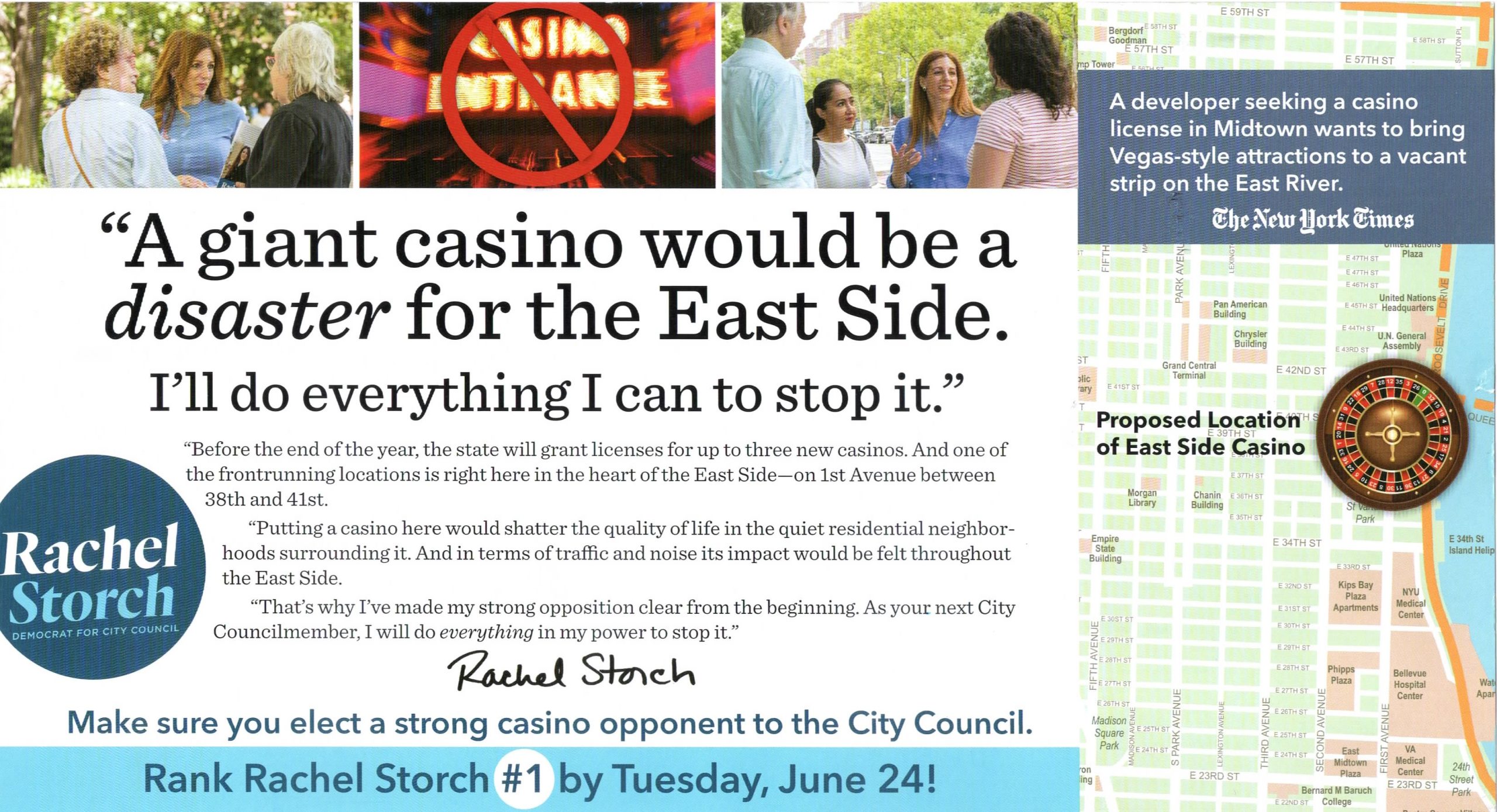
    All residents in the neighborhood received the flyer below and Rachel called me personally to discuss my concerns stating the area could be put to much better use for housing, open space, and expansion of the green way.

    Mailer sent to the neighborhood is pretty clearly against the casino.

    Luke Florczak

    I am against the casino but would be more than willing to at least view any proposal which would be beneficial for the community. So far nothing has been submitted and the Soloviev Group refuses to compromise on the casino.

    No reply from candidate Faith Bondy.

    Thanks to Vanessa Aronson, I now know that it’s really Keith Powers, the current District 4 City Council Member, that is in a position to push back on the Freedom Plaza casino project at this stage. He has not, pushing the final decision to the Community Advisory Committee that will be put together to asses community support.

    The six-member Community Advisory Committee (CAC) needs to approve the license by a two thirds majority. The CAC members will be appointed soon after June 27th which is when applications for licenses are submitted.

    Other dates to watch,

    Applicants must complete all entitlement processes (land-use/zoning, State Environmental Quality Review Act, etc.) before September 30, 2025.  

    CACs must vote on their respective project by September 30, 2025. Those Applicants approved by their CAC will then submit supplemental application material – including a proposed tax rate – to the Board for evaluation and consideration.

    The Board expects to make decisions by December 1, 2025, followed by Commission licensure by December 31, 2025. This ensures that New York State will collect the already-booked casino license fee(s) ahead of schedule.

    Watching for who is appointed to our district’s CAC in the next few weeks and attending their open meetings and hearings is key. Watch the Gaming Facility Location Board page for updates.

    But input from the next District City Councilmember and Manhattan Borough president will be important. Powers debated with his opponents on May 30th and the casino issue came up right as things got started. Holyman-Sigal came down firmly against Powers deferred taking a side and Sun seemed to indicate he welcomes the potential influx of funding.

    Click the video below to jump to the topic.

  • What I Learned at #nytechweek

    What I Learned at #nytechweek

    Last week NYC erupted with over 1,000 small pop-up events across the city, loosely curated by the NY Tech Week team on this calendar. I would describe this as a decentralized SXSW where the events are hosted without much central control which results in an explosion of activity and an opportunity for participants to expose themselves to a wide range of ideas while visiting workspaces all across the city.

    The events begin to come together in the months leading up to the annual event. Most of them are invite-only so you need to sign up in advance. Sign-up forms on Partiful ask you to add your LinkedIn profile so the organizers can vet & curate who attends.

    I only had time in my schedule to make a few afternoon or evening events but it was nice to sample a few, meet some new people and check out some cool spaces.

    Here’s what I learned.

    “Influencers are toast” said someone after seeing the demo of Mirage Studio an “AI-powered video generation platform that allows you to create lifelike talking-head videos without traditional production.”

    Part of me is happy to bid goodbye to social media influencers shilling products they didn’t truly like, understand, or appreciate. The founder made the argument that their platform would open up access to imaginary personalities to help explain or position their product and would level the playing field for all companies allowing for smaller companies to punch above their weight.

    I’m still not sure how I feel about this development, especially after seeing what people are doing with Google’s Veo 3. Further, if the key to communicating to create a sense of empathy, what happens when we give the keys to this rich protocol to a series of APIs? What becomes of human dialog and communication or, more philosophically, what is real?

    Then someone leaned over to tell me about Nucleus Embryo. In their words,

    When undergoing IVF, couples typically have several viable embryos to choose from.

    Nucleus Embryo provides information on the disease risks and traits of each of these embryos, helping parents make an informed choice on which embryo they want to implant.

    On the way to the next event, strange new world thoughts spinning in my head, David J’s song, Stop this City was playing on repeat.

    Thankfully, my last event of the day was about the power of community and face-to-face collaboration at a shared workspace in an old factory in Tribeca at Fabrik.

    The next day, at the Axios AI + NY Summit I saw Jeffrey Katzenberg paraphrase NVIDIA CEO Jensen Huang, “AI isn’t going to replace people. It’s going to replace people that don’t use AI,” as he drew parallels between the influx of AI technology to the arrival of Pixar’s computer animation at Disney’s studios.

    Later, New York Governor Kathy Hochul sat down to speak about state initiatives such as Empire AI but also, about what was on everyone’s mind, the challenges of dealing with the Trump administration.

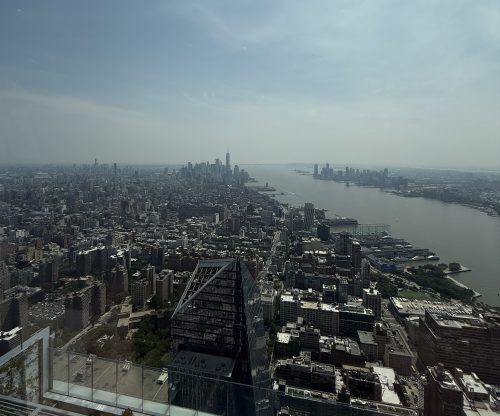
    The next day, on the 82nd floor of 30 Hudson Yards, Brand Strategist George Scribner, shared his perspective of Branding in the Age of AI.

    The outlook for Google is not great as they had neglected to evolve its brand beyond a functional search utility. Scribner’s view is that there is not enough brand loyalty and that people will flock to a better tool as the new conversational search experiences of the AI platforms have leveled the playing field. I would have to agree but user lock in is a powerful thing and Google’s recent push with AI Mode will work even better for those with lots of data and history stored with Google.

    View of Manhattan from the 82nd Floor thanks to Innovation Norway

    I also dropped by a mixer for Japanese businesses and sat in on a presentation by a representative from the City of Yokohama that has a local NY office to woo startups to Japan.

    On Thursday, I dropped in on a round table with several SEO people talking about Generative AI chatbots and the future of discovery in this new world. There’s enough there for another post which will follow.

  • The Real Debate in NYC

    My favorite part of the NYC Democratic Mayoral Debate. Where in the five boroughs to get the best slice.

    Traditionally, whomever wins the democratic primary wins the Mayor’s race in NYC so it’s a crowded field with nine candidates qualifying to take the stage Wednesday night (the second debate is on Thursday, June 12th at 7pm).

    The debate was the first time for many to see Zorhan Mamdani for the first time. He is hoping to win over New Yorker’s with his progressive agenda to freeze stabilized rent, make buses free, and a Department of Community Safety to free up police to policing. It was a chance for me to see some of the other candidates such as Michael Blake who came across as a strong candidate as well.

    Standing up to Trump and defending NYC is major a part of everyone’s platform. The June 24th election will be closely watched across the country for green shoots of activism as a preview to the midterms.

    It’ll be a ranked-choice voting election. You can grab a sample ballot and find your where to vote on vote411.org.

    If you’re in NYC District 4, and against the proposal to build a casino just down the street from the UN, vote for Rachel Storch who has said she’s a “hard no” on the proposal.

  • The $20B Edit

    The $20B Edit

    MediaPost delves into the specifics of what caused the Trump administration to accuse 60 Minutes of manipulating a quote and commit election fraud.

    Face the Nation used the first half of Kamala Harris’ response to a question while 60 Minutes used the second half. Was this really cause for a $20 billion lawsuit that ultimately resulted in the resignation the 37-year veteran Executive Producer of 60 Minutes, Bill Evans?

    You can read Adam Buckman’s details below,

    The question posed by “60 Minutes” correspondent Bill Whitaker in that part of the transcript was a follow-up question to a previous question-and-answer about the relationship between the Biden administration and Israeli Prime Minister Benjamin Netanyahu.

    “But it seems that Prime Minister Netanyahu is not listening,” Whitaker said. “The Wall Street Journal said that he — that your administration has repeatedly been blindsided by Netanyahu and, in fact, he has rebuffed just about all of your administration’s entreaties.”

    To which Harris replied: “Well, Bill, the work that we have done has resulted in a number of movements in that region by Israel that were very much prompted by or a result of many things, including our advocacy for what needs to happen in the region. And we’re not going to stop doing that. We are not going to stop pursuing what is necessary for the United States to be clear about where we stand on the need for this war to end.”

    The first sentence of that answer was used on “Face the Nation”: “Well, Bill, the work that we have done has resulted in a number of movements in that region by Israel that were very much prompted by or a result of many things, including our advocacy for what needs to happen in the region.

    On “60 Minutes,” the final sentence was used instead: “We are not going to stop pursuing what is necessary for the United States to be clear about where we stand on the need for this war to end.

    Revealed: The ’60 Minutes’ Edit That Spawned A $20 Billion Lawsuit

  • Dave Chappelle and Hope

    Dave Chappelle and Hope

    Dave Chappelle hosted Saturday Night Live last night on the eve of Donald Trump’s second inauguration. I did not expect I’d be sharing a message of hope and inspiration from Dave Chappelle but here we are.

    He took inspiration from the late-Jimmy Carter who he saw walk into Gaza to witness the scenes of suffering firsthand.

    “I will never forget the images of a former American president walking with little to no security while thousands of Palestinians were cheering him on. When I saw that picture, it brought tears to my eyes,” said Chappelle. “I don’t know if that’s a good president but that right there, I am sure, is a great man.”

    Chappelle went on to urge Donald Trump to rise above his selfish concerns and do better for the nation and the world. For all of us to put our differences aside and empathize with each other’s struggles.

    “The presidency is no place for petty people … remember, whether people voted for you or not, they’re all counting on you. Whether they like you or not, they’re all counting on you. The whole world is counting on you. I mean this when I say this, good luck. Please, do better next time. Please, all of us, do better next time. Do not forget your humanity and please have empathy for displaced people whether they’re in the Palisades or Palestine.”

  • Eradicating Disease with Love & Respect

    Eradicating Disease with Love & Respect

    Jason Carter, grandson of President Jimmy Carter gave a eulogy to the late-President that was quite moving, portraying him as a humble and modest man who never forgot his roots.

  • Don’t Do It

    Don’t Do It

    We’re now down to the final days and it’s still really close. For those that think another President Trump can’t be that bad or just want to send a message to the political establishment, here’s a rundown of what happened the last time Trump was in office and what awaits if he’s re-elected.


    Remember all the crazy turnover at the White House? For awhile, I was keeping track.

    January 2017 – Remember the Muslim Ban and how BART had to tweet that “those of foreign national origin are welcome on BART.”

    March 2017 – “We have to understand that the alternative to facts is not alternative facts. It’s fiction.” Marty Baron, then editor of the Washington Post

    September 2017 – Hillary Clinton on Trump, “So when I say that he doesn’t just like Putin, that he wants to be Putin. I’m not saying he’s going to start killing journalists but I am saying he likes the idea of unaccountable, unchecked power.”

    August 2018 – Remember when Trump was just a “unindicted co-conspirator”

    June 2019 – an all-star cast of actors gathered together in New York to perform a dramatic reading of the 448-page Mueller Report

    November 2019 – Remember Marie Yovanovitch, the former US Ambassador to Ukraine and how Trump threatened her, as she was testifying to congress? What about when her replacement,

    October 2020 – The venerable and respected New England Journal of Medicine broke with tradition and published a political editorial lambasting the current administration’s response to Covid-19.

    November 2020 – Was there a Quid Pro Quo? “As I testified previously, with regard to the requested White House call and White House meeting, the answer is yes.”

    And that’s just stuff that I wrote about.

    “Mr. Trump’s first term was a warning,” says The New York Times did put together a timeline setting the record straight. (gift link

    Not that this should be any indication of a candidate’s qualifications for the job, it does give you insight to their web dev team and it’s something I did before. Interesting to see that Trump’s team is still running a 404 jabbing at the last guy.

    As Michelle Obama said at a recent rally in Michigan, “This is not just the obligation of what we should say no to, it’s about the opportunity for what we can say yes to.”

    And just to put a point on it . . .