Super Bowl 56 featured ads from many car companies introducing their Electronic Vehicles (EV) as well as a few crypto companies.
The failed attempt at the most innovative ad was goes to Coinbase which featured 60-seconds of a floating QR code (for those that were in the know, that graphic was an homage to an episode of The Office) Unfortunately their site crashed so the $14 million the company spent to hopefully acquire new users went to waste and Coinbase will forever be associated with the QR code that crashed their website.
A personal favorite of mine was from the FTX which featured Larry David (who has never featured in an ad spot until now) as the ever-present skeptic who misses out on all the great inventions of history. The ad’s theme plays right into the older generation’s FOMO and played in the premium spot right before the Super Bowl’s halftime show.
The tear jerker of the night was from Toyota which ran before the game even got under way. The spot told the story of the McKeever brothers from Canada who worked together to achieve greatness in Nordic Paralympic skiing. Brothers is a moving 60-seconds worth watching if you haven’t seen it. Here’s the backstory.
Of all the EV commercials trotted out over the course of the game, Polestar’s anti-ad was most effective for me. Taking aim at the market leaders VW (“no dieselgate”) and Tesla (“no conquering Mars”) Polestar’s spot doesn’t even show you much of their car which immediately piques your interest in who they might be?
Jonathan Pie is a fictional broadcast reporter created and performed by British comedian Tom Walker. The New York Times invited Jonathan for an in-character interview to explain why the British are fed up with Boris Johnson. But when Mr. Pie turned his sights on the “entitled arseholes” that make up the British government, what spilled out was a wonderful string of expletives that matched some of Captain Haddock’s best.
Cannibals. Self-serving parasites. Tapeworms in tiaras, swimming through the intestines of the state sucking all the goodness out of it for their own repugnant gratification.
Quite an image, eh?
The video was embedded the Op-Ed section of the New York Times (h/t @robertodevido) into which the paper felt it necessary to add the following disclaimer,
The video contains strong language and adult humor you wouldn’t normally see in The Times, but after being taken for fools, the British public is through being polite.
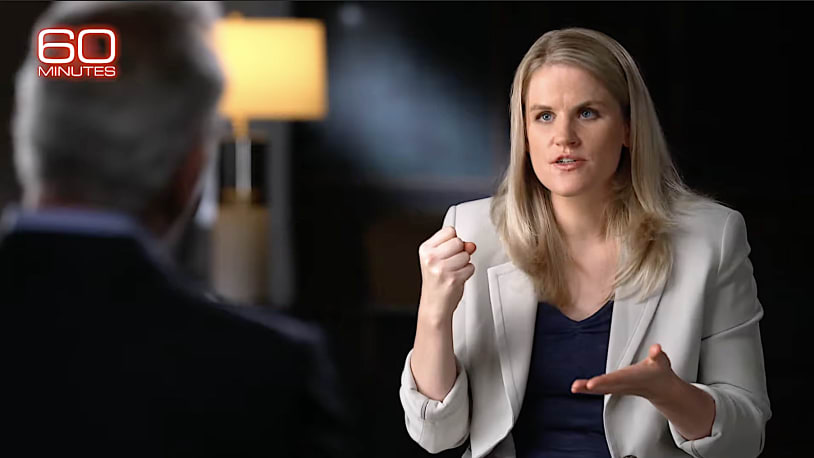
Last night 60 Minutes scored an interview with Frances Haugen, the Facebook whistleblower behind the document leak that led to last month’s “bombshell” Facebook Files investigation. She shared internal research that confirms what we’ve known all along. Feeding users polarizing content works great at engaging people and converting them into repeat visitors and that the revenue from those engaged users is intoxicating.
For a humorous TL;DR, check out this 2018 clip from The Daily Show.
What if Facebook were a Real Place?
Engagement is a metric used by social networks to measure how often someone uses your app or visits your website. Each service counts an engaged user in different ways, new user or old, daily visitor or monthly, but it all boils down to repeat visits. An engaged user is someone who comes back, repeatedly.
If your service is ad-supported, repeat visits generate cumulative ad impressions and revenue. If you track your users and personalize your ads, the more engaged a user is, the higher their value to advertisers. It’s the old “eyeballs” metric of Web 1.0 but with higher definition. In the mobile app world, it’s called ARPU, Average Revenue Per User.
The thing I saw at Facebook over and over again was there were conflicts of interest between what was good for the public and what was good for Facebook. And Facebook, over and over again, chose to optimize for its own interests, like making more money.
If your company’s “true north” metric is engagement, what happens if you optimize for that and run a business that, above all else, keeps your users coming back and staying longer? If you discover that inflammatory content is the nectar that keeps users coming back aren’t you then measuring the level of a post’s ability to provoke a reaction? This is what I call Enragement Metrics.
Add the quarterly pressure for a trillion dollar public company to meet and exceed revenue targets and corporate incentives can get distorted. Responsibility is foggy in a large company of distributed teams with a shared ethos of “move fast and break things.”
The pursuit of engagement and the momentum of a market that rewards it created a Faustian Bargain that distracted the leadership at Facebook from the impact it was having on not only its users but, as a source of traffic and revenue for its publishing partners, the entire media ecosystem.
“There is a perfect reverse correlation where the angrier you are, the more traffic leaves Facebook and goes to your publishing site.”
Haugen will testify before Congress where she is hoping they will regulate Facebook because, in her view, Facebook is unable to regulate themselves.
“Facebook, over and over again, has shown it chooses profit over safety,” she said. Haugen, who will testify before Congress this week, said she hopes that by coming forward the government will put regulations in place to govern the company’s activities.
The tech and media world will be watching. As with newspapers, radio, and television, before it, a touch of regulation can build trust and improve a technology and balance the pursuit of profit with the benefit for the public good. But if there is stumbling and uninformed regulation, it will either hobble innovation or, in the worst case, favor those with deep pockets for lobbyists that will lock in their client’s dominance.
When the Haugen testimony picks up on Tuesday and they haul in someone from Facebook to explain themselves, I hope there is substantive discussion on a way forward and not the brow-beating grandstanding we so often see on Capitol Hill. I optimistically believe that no one at Facebook set out to poison the public well on purpose but that runaway algorithms and market forces drove them there.
Just as the publication of Silent Spring helped lead to the establishment of the Environmental Protection Agency in 1970, I hope these hearings on the adverse effects of social networks will lead to intelligent discussion of the role these products and the algorithms that power them in our society.
Environmental and safety regulations give businesses a framework against which to justify expenditures that take away from profits. We need an EPA-like independent organization for social networks and machine learning algorithms to regulate an industry and create best practices and guidelines for what they can and cannot do.
Social Networks and machine learning algorithms are powerful tools that can stimulate, motivate and transform society. As with all new technology, they can be put to good use or bad. It’s up to all of us, working together to understand their power and harness it for good.
Together we can create social media that brings out the best in us. We solve problems together – we don’t solve them alone.
Now that both Olympic and Paralympic Games have closed, all eyes look to the next Olympic Games, Paris 2024. During the closing ceremonies they played a hype video to get you excited for France and it did not disappoint.
Due to the drought, the Northern California town of Mendocino is running out of water and is considering bringing it in via a tanker train. Greenville, another NorCal town, was reduced to ashes by the Dixie fire, the third largest in the state’s history.
65,000 rubber ducks were dumped into the Chicago River to raise money for the Special Olympics.
Quick-thinking trash workers in Ohio reunited a grandmother with $25,000 in cash that was thrown out by her grandchildren who were clearing out expired items from the refrigerator. Why was grandma storing hard currency in the freezer? Maybe you should ask my grandmother who stored her manuscripts in the oven.
Somebody thought it would be fun to post a cover of rapper Flo Rida’s Low, also known as “Apple Bottom Jeans. ” They invited others to post their versions as well. The internet delivered.
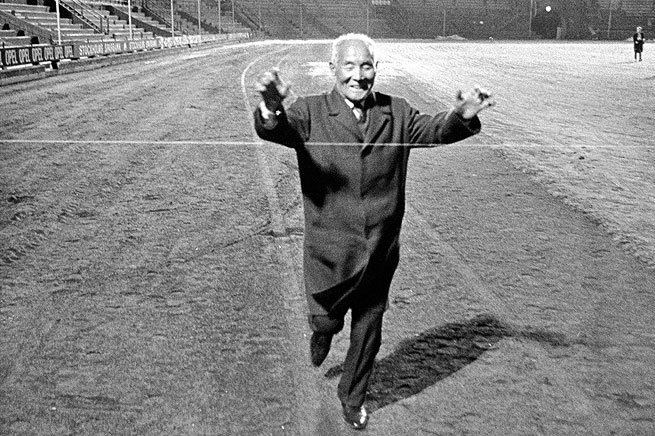
On March 20, 1967 Japanese runner Shizo Kanakuri crossed the finish line on a marathon he started over 50 years prior with a time of 54 years, 246 days, 5 hours, 32 minutes, and 20.3 seconds. Guinness World Records recognizes this as the longest time to complete a marathon.
But I’m getting ahead of myself.
In 1912 Japan sent its first team to the Olympics, held that year in Stockholm, Sweden. Japan’s team consisted of only two athletes, a sprinter named Yahiko Mishima and Shizo (this year Japan’s squad has 552 athletes).
Back then, the road from Japan to Sweden took weeks. First on a boat then aboard an arduous weeks-long train trip across the steppes of Siberia. By the time Shizo and his teammate arrived in Sweden, they were not only exhausted but also out of training. The only time they could workout was by running around station buildings during brief stops along the way.
When race day arrived in Stockholm on July 14, 1912 it was an unseasonably warm 32°C (89.6°F). Long distance running as a sport had not evolved to where it is today so the preparations were, shall we say, unorthodox. Nike’s famous waffle sole had not yet been invented. Shizo wore Japanese tabi on his feet and the cloth was all that protected him from the gravel path. And because it was thought that perspiration contributed to fatigue, he refused to drink any water while running.
As you can imagine, Shizo passed out from heatstroke and took refuge at a nearby villa to recover. After spending some time recuperating there, he decided to drop out of the race and caught a train back to his hotel and eventually returned back to Japan.
Because he never informed race officials that he dropped out of the race, Olympic officials marked him down as missing.
Meanwhile, back in Japan, Shizo went on to run in the 1920 and 1924 Olympics, established the famous Tokyo-Hakone-Tokyo College Ekiden race and is known as the father of the Japanese marathon.
Fast-forward to 1962 when a Swedish journalist happened upon Shizo and informed a very surprised Swedish National Olympic Committee that the missing marathoner was very much alive. As a marketing promotion, several Swedish businessmen invited Shizo to Sweden in 1967 to finish his marathon at 76 years of age. That’s the photo above.
Upon Swedish Olympic Committee representatives reading out his official finish time to the gathered press- 54 years, 8 months, 6 days, 5 hours, 32 minutes and 20.3 seconds- Kanakuri was asked if he’d like to say a few words about breaking a world record for slowest marathon ever run. Thinking for a moment, the elderly athlete shuffled to the microphone and said,
“It was a long trip. Along the way, I got married, had six children and 10 grandchildren.”
Looking back at the human pictograms used to illustrate 50 Olympic sports in 5 minutes I realized the inspiration is from an Japanese game show I wrote about earlier, Kasou Taishou.
Much has been written about Simone Biles’ decision to withdraw from the team and individual all-round competition at the Tokyo Olympics. Despite the negative coverage accusing her of quitting it is instructive to look at her (and her team’s) responses in the press conference.
When reporters trained their questions on Biles’s emotional state, she spoke just as comfortably, talking about mental health in the same terms as fitness and recovery programs—another variable in the champion’s pursuit. She described the danger of pressing through and competing in her state, saying she didn’t want to “do something silly” and hurt herself. She called Osaka—another sport-defining Black woman—a source of inspiration. “I say put mental health first,” Biles said in response to a query about how she’d advise other athletes in similar circumstances. “Because if you don’t, you’re not going to enjoy your sport and you’re not going to succeed as much as you want to.”
Two versions for you. One a dystopian robot beehive and the other, a thin veneer of joyful play hiding a powerful and increasingly sophisticated machine.
Exhibit One the Ocado beehive
Robots used by the UK online-grocer Ocado zip back and forth across “the grid” delivering good to human packers who box everything up for shipment to the customers. Each robot is about the size of a washing machine and are optimized to run back and forth at great speed, missing each other by the thinnest of margins. Of course, when they don’t which causes all sorts of problems.
Exhibit Two Boston Dynamics dancers
Two videos, the first from January where the Boston Dynamics Atlas machines run thru a number of dance moves to the 1962 hit Do You Love Me? It’s a slick PR stunt to make these machines more lovable but it also had the practical benefit of pushing the team to improve their robot.
Now that Boston Dynamics is part of Hyundai, they have been put to use dancing to the likes of K-Pop boy band BTS. Here’s their most recent video where a group of Spot robots are dancing in unison.
Again, these robots can do much more than just dance. As Google Image search queries have, over time, taught the algorithm what a cat or dog looks like – teaching Atlas and Spot to dance and move with grace will help it integrate seamlessly with humans further down the road.
Are we witnessing the first steps towards Westworld?