Category: Work

  • Web 2.0 Summit – Launchpad

    The Launchpad session last year was one of the more exciting sessions at the Web 2.0 show. This year they had a panel filter through hundreds of candidates to arrive at the “baker’s dozen” below:

    inthechair.com – music practice as a video game. Play along to background music and get realtime feedback on how you’re doing. Like Guitar Hero but you play with real instruments.

    instructables.com – like Make Magazine for the web (O’Reilly, publisher of Make, is an investor). A collection of rainy day projects with community features built in. 30k members.

    Klostu – Their other product, boardtracker.com, tracks 300 million bbs members posting 50 billion posts/day. Klostu ties all of this together and works like a Trillian that manages your identity across all the systems. Simplifies signing up for an account, let’s you cross post messages and search across bulletin boards easily.

    Sharpcast – their product, Hummingbird, syncs files across mac, pc, web, and cell phone.

    Stikkit – Rael Dornfest’s first product, universal input for short notes that parses unstructured data and tries to make sense of it and organize it for you. Type something in manually into their post-it like interface or email your notes off to a stikkit-specific email address tied to your account. “Simple, not simplistic. Clever, not smart. As close to paper as you can get without involving trees.”

    Turn – applies searchlike technology to advertising. No keywords, bidded cost-per-action (CPA). Turn is network neutral and can optimize across graphical and text ads. 1000 advertisers, 5M ads, 21M unique page views.

    Sphere – launching contextually related features. Added as a footer to articles on Marketwatch, TechCrunch, GigaOm and others. The results page is a pop-up (that somehow gets by my popup blocker) which brings together results from Sphere, the publisher’s site, and contextually matched advertising. Downplays links for matching looking at content on page. Installs with just one line of javascript on your template.

    Omnidrive – a “storage aggregator” that pulls together all your online storage capacity. Drag & drop simplicity.

    Adify – a platform for publishers to self-organize. Matchbin is aggregating small town newspapers who group together to land national advertising accounts. Ready to Rare, a comic book collection network. Washington Post is using adify for it’s sponsored blogs initiative. Has a community element because ad networks are, to an extent, communities.

    3B.net – 3d browsing and chat, browsing becomes like walking through a mall or trade show. Works great for flickr and shopping sites.

    oDesk – free to post jobs, free tests for certification, profile histories of potential contractors look like World of Warcraft profiles (number of missions, levels, talents, etc). Includes teamroom software to help you manage your relationship with your remote team. Work Diary is a way to track your provider with real time snapshots (at the interval of your choosing) of your remote contractor’s desktop. The snapshot feature was met with groans from the crowd but it’s important to overcome very real problem of trust.

    Venyo – solves problem of “lack of trust” of blogs. Developed universal reputation management tool . Once registerd, adds little rating chicklet to your blog – users can than tag and rate a blogger. In some ways it’s like a mybloglog for reputation.

    Timebridge – syncs calendars across systems – allows you to peer into people’s schedules to find out when they are free – get’s rid of the back and forth of trying to schedule meetings.
  • Widgets Live

    Put together in just a couple of weeks by Niall Kennedy and Om Malik, the Widgets Live conference was a timely event that capitalized on the catchphrase of the day and the fact that a lot of folks are in town for the Web 2.0 conference. The sold out crowd of 200 leaned towards the developer crowd which many of the sponsors said were just the type of people they were looking to reach.

    Arlo Rose of Yahoo! Widgets traced his inspiration for the desktop widgets ecosystem he created to his early work on a product called Kaleidoscope which allowed people to “skin” (there wasn’t a word for it back then) their Mac OS environment. He reminded me that I didn’t really become aware of the concept of plug-ins to extend functionality of a product until the advent of the Mac OS Control Strip which, if you think of it, are the first instance of a widget as a small, graphical control for installed software.

    Fox Interactive Media announced the launch of the SpringWidgets community (which I’m told will become a marketplace in a few weeks) and a partnership with Feedburner which will make it easy to turn your feeds into self-contained mini-readers that you can place on a web page as well as drag onto your Windows desktop. Very cool.

    Photobucket’s Peter Pham shared some of their metrics on their growth (28M registered users, 80k new registrations/day) and how important widget developers have been to the widespred adoption of their photo hosting services. Most telling was a blip in their uptake which coincided with their renaming of Slideshow to Widget. We have to remember that the rest of the world has no idea what a “widget” is and that sometimes the more descriptive (but less trendy) names are better. Once they renamed it back to Slideshow, their growth recovered it’s old momentum.

    The afternoon sessions featured panel discussions which explored each of the major instances of widgets. Desktop Widgets, Ajax Homepages (which are made up of widgets), Blog sidebar widgets, and widget aggregator services (such as Widgetbox).

    Monetization was only touched upon but it was telling to hear that both Microsoft and Google are not really concerned with direct monetization and see the distribution of bits and pieces of their content as a way of spreading their reach and driving traffic back to their site. Affiliate models as well as a marketplace for premium widgets were discussed but it’s still too early to tell. Kevin Burton mistook the Google AdSense Gadget for a desktop widget that runs Ad Sense contextual ads on your desktop (it’s not) to which the room erupted in laughter wondering why anyone would want to give up desktop space to such a thing. In the Photobucket presentation, they mentioned that you need to be careful of running advertising on your web-based widgets because users that install them on hosted blogs may end up violating Terms of Service agreements for some services which do not allow for third party monetization.

    A recurring theme for many was the prospect of widgets interacting with each other. The example I think of is taken from the old intranet portal days when you could drag a stock quote from one module onto a news module and run a news search using that stock’s ticker symbol. The Microsoft Sidebar team is thinking about this the most as they seem to have the deepest penetration into the stack to make this a reality but doing this on with third party information sources brings up all sorts of security problems which need to be resolved.

    Sessions on Mobile and Hardware widgets rounded out the afternoon with a look at the devices that can serve as important endpoints for widget consumption. Cellphones are obvious so long as the syncronization and context problems are solved. I only want to look at a subset of my information on the cellphone and want to do it in a way that’s not only optimized for the mobile experience but also takes advantage of the features of my handset. The Chumby “squeezable interface” is my new favorite design idea.

    Finally came a round of lightining sessions where several folks got up to announce things they were working on. I put in a plug for YPN’s new enhance page which we will continue to update as a publisher-focused catalog of the latest and greatest that Yahoo has to offer and loaned my laptop out to the Zazzle guy whos battery was dead. I found KlipFolio’s demonstration of their integration of desktop and mobile a compelling way to drag things into your cellphone a compelling way to move data around.

    All told, a worthwhile way to spend the day if just to underscore the point that we’ve only just begun. The endpoints are beginning to define themselves (desktop, homepage, blog sidebar, cellphone) but, as someone mentioned, the most popular widgets are the same calendars, weather, and stock quotes. The real killler app is some totally rad social media app, “sitting on someone’s cellphone in South Korea that no one has discovered yet.” The platform is ready and waiting to pull such an app in and redefine the concept of a widget and how we use them.

  • Download and Recharge

    So I’m off to a series of conferences this week and next which I hope to treat as my own version of think week to kick off my planning for things I want to tackle for 2007. I’ve had a year with Yahoo and a few months working with the team behind the Yahoo Publisher Network portal. Now it’s time to hold up my understanding of the business against the bright light of opportuntiy coming from the Web 2.0 movement and publisher marketplace at a series of shows over the next two weeks.

    I was at Widgets Live today and Web 2.0 through the rest of the week. Next week I’m off to Las Vegas to get a feel for the search engine & contextual advertising marketplace at Webmaster World. The two weeks should serve as nice bookends for a holistic view of an online publisher’s needs.

    I’ll post bits and pieces when I can get through on the wifi which is bound to be spotty. I tried to prepare by trying to figure out how to turn my Blackberry into a broadband modem but I am told that Cingular has blocked this feature in the Yahoo-issued handset that I have.

  • Once we can address the past, we have time travel

    Excerpts from an IM conversation with a colleague in which we figured out how we will eventually be able to time travel.

    It’s Friday. 

    [13:15] jonathanhstrauss: as or more disruptive than web 2.0
    [13:15] jonathanhstrauss: which i define as the disaggregation of the back end services from the front end uis
    [13:16] finduseshare: didn’t apis and xml do that?
    [13:16] jonathanhstrauss: yes
    [13:16] jonathanhstrauss: thus enabling web 2.0
    [13:16] jonathanhstrauss: which is when the basis of competition switched from who could afford the most bandwidth or storage space to who could create the most personalized UI
    …
    [13:17] finduseshare: next step is ubiquitous internet dialtone (tcp everywhere)
    [13:17] jonathanhstrauss: exactly
    [13:17] jonathanhstrauss: and device optimized experiences built on top of it
    [13:17] finduseshare: ip6 is supposed to give us enough addresses so we can (if we want) assign unique IP addresses to every grain of sand on every beach
    [13:17] finduseshare: i think i read that in wired
    [13:17] jonathanhstrauss: and we will find a way in 10 years that even that won’t be enough
    [13:18] finduseshare: because of historical
    [13:18] finduseshare: need ip address for every state (new, used, trashed)
    [13:18] jonathanhstrauss: yeah, time will become a dimension, like a Wiki
    [13:19] jonathanhstrauss: awesome….
    [13:19] finduseshare: once we’ve given an ip address for every object as it goes from new – used – trashed, we will have figured out how to travel through time
    [13:19] finduseshare: you can ping your past
    [13:19] finduseshare: ok, my mind just got blown
    [13:19] jonathanhstrauss: lol!!!
    [13:19] finduseshare: it’s friday
    [13:20] jonathanhstrauss: alright, ive gotta get some food
    [13:20] finduseshare: i need to ping saturday
    [13:20] jonathanhstrauss: lol

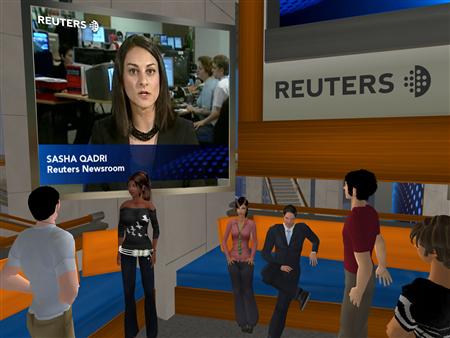
  • Reuters opens up bureau in Second Life

    Reuters opens up bureau in Second Life

    The 200 year old news service which transmitted its first dispatches via homing pigeons has opened up a news bureau in the virtual world of Linden Labs’ Second Life.

    Adam Pasick, who goes by “Adam Reuters” in Second Life is the wire services sole correspondent, editor, and bureau chief.

    Being a financial news service, reporting is focused on news of economic interest with stories and interviews of some of the characters and entities that keep the Linden economy humming.

    The Reuters Second Life News Center also keeps track of the Linden Dollar vs US Dollar exchange rate and total USD spend in Second Life over the previous 24 hours ($436,291 as of 9:00pm yesterday!)

    Reuters has also built an in-world Atrium (Second Life s/w required) which you can visit and Adam has posted his hours on the site so you can visit with him and pass on your scoop.

    Markets are, to a certain extent, a shared hallucination. It only makes sense for Reuters to follow this story to its logical extreme and explore the edge of value creation into the virtual economy. The lead story on the site today, US Congress launches probe into virtual economies, is the strongest indication yet that what is virtual today will be real (and taxable) tomorrow.

  • If Doritos are your thing. . .

    If beaming messages of Hope and Beauty are not your thing – through December 4th you can try your hand at creating the next advertisement for Doritos. Win prizes (cash and a trip to Miami for the Superbowl, having your video shown on TV during one of the coveted million dollar ad spots).

    More info on the Crash the Superbowl site which gives you access to high quality graphics, music, and video clips that you can mix into your home movies using Jumpcut, the online video editing tool recently acquired by Yahoo.

    Maybe we should beam this stuff into space as well.

  • The Internet as a Ball of Thread

    timecapsule.JPG
    The concept is simple. Provide an easy interface so that people from around the world can upload photos, drawings, movies, sounds, and writings to a time capsule. The inbox is open until November 8th and after that will entrusted to the Smithsonian as a snapshot of our time until it’s opened up again in 2020.

    The project organizers are calling it a “digital anthropology project.” In terms of sheer volume, I’ve often thought that future civilizations will look back upon this period as one of the most richly documented times in history (where else are you going to find 500+ photos of insects having sex?). The cost of capturing events has dropped to the point where the biggest problem is going to be sifting through everything to pull out some kind of meaning.

    Since the Yahoo! Time Capsule was opened on October 10th, over 27,000 submissions have been published and categorized with the most popular theme being Love (7,988) and the least popular being Anger (391). Other interesting stats on the Facts page.

    For highlights of the most interesting submissions, visit the timecapsule blog.

    From the artist behind the Time Capsule, Jonathan Harris, on the About page.

    The aesthetic of the Time Capsule is that of a ball of thread, spinning like a globe, its shifting surface entirely composed of words and pictures submitted by people around the world. The thread ball concept relates to threads of memory and threads of time, where threads are taken to be any continuous and self-consistent narrative strand. When the Time Capsule opens, it displays the 100 most recent contributions, which form the spinning globe. The ten themes orbit the globe in a pinwheel pattern. At any moment, any individual tile can be clicked, causing the globe to fall away and the selected tile to expand, revealing detailed information about the tile and the person who created it. Using a search interface, viewers can specify the population they wish to see, exploring such demographics as “men in their 20s from New York City”, and “Iraqi women who submitted drawings in response to the question: What do you love?”. There are an infinite number of ways to slice the data, and each resulting slice then becomes its own thread, which can be browsed independently, tile by tile, like a filmstrip.

    Oh, and keep your contributions to just the good stuff because we’re going to beam this stuff off into space just to see if anyone’s listening.

  • “We can’t control the puppets”

    “We can’t control the puppets”

    Success on the internet is not a zero sum game. New activity can come from any corner and audience and attention often expands to meet this demand. Much has to do with the spirit of “giving back” which is one of the principles upon which the internet is founded. Take what you need and when you can, give something back to make the online world a better place for the rest of us.

    This same spirit is what drives the Hack Day efforts at Yahoo. “Mash up or Shut Up” was one of the early mottos for Hack Day. It encapsulated the idea that grumbling about a shortcoming or missing feature is a waste of bandwidth. Tackle the problem yourself and lead the way. Be resourceful, lead by example, show us how it works. Sell your idea with a prototype, not a powerpoint.

    This past weekend Yahoo opened its doors to outside developers, invited them to pitch tents on the grassy commons. We showed them the knobs and levers they could use to make the world a better place. Many Yahoos cleared out their busy schedules to welcome people from all over and show them around. I was working the tables at registration and it was really great to meet people from as far away as Canada, Chicago, Florida, and New Jersey. No one really knew what to expect when the weekend started but we were all pleasantly suprised.

    When Beck was first pitched to play at Yahoo (through a skateboarding connection!) the organizers were thinking it’d be cool to have him play a few tunes on acoustic guitar while sitting on a stool in our cafeteria. Not only did Beck say he’d be happy to play to a crowd of Yahoo hackers, he countered that he wanted to bring his full stage show. Another pleasant suprise.

    Wonderful things happen when you let your audience participate. Yahoo understands that we are defined by the people that use our services. If we give them the tools to participate, both with Yahoo and with each other, we will all be pleasantly suprised by what they give back. The world will be a better place and audience attention will expand to support what gets created.

    Hack Day was started to let Yahoo engineers in the search group scratch an itch and show off their coding chops to their colleagues. With each successive Hack Day, the group of participants grew so now anyone, regardless of location or business unit can be part of it. It only made sense to continue this inclusive trend and open it up to outsiders. Expand the pool and raise the bar. Isn’t that how evolution works? I am so proud that Chad, Bradley, and the executives at Yahoo followed through on their intuition and made this event happen. It was a risk that they didn’t have to take. The standard developer’s conference is usually more structured and shys away from marshmallow guns.

    We do things a little differently at Yahoo and I think our approach will pay us back in many unexpected ways for years to come. The barriers to participation are lower than they’ve ever been, the only thing holding you back is your creativity. Come on by and help define the world you live in.

    Selected Coverage:

  • How to Create a Thumbnail Blogroll, a 20-minute hack

    Yahoo! had one of its internal hack days [1] today and while work kept me from devoting enough time to work on an effort on the scale of last time, an email at 9am this morning did give me the chance to show at least something at today’s show-n-tell.

    I’ve been thinking of picture-in-picture badges for a while now and like the concept of a blog’s sidebar acting as a portal to your editorial view of the world. Match this navigational concept to the fact that badges are becoming more and more like the online equivalent of wearing a branded t-shirt and colleague Cody Simms thought was there’s an opportunity for a badge which showed a collection of websites you liked.

    So when I got an email from FavoriteThingz (no longer in service) that they have opened up their service to allow you to create multiple badges of just about anything you could think of, neurons fired off on a way to update the tired-looking plain text blogroll.

    Faces of people you read like those you see on MyBlogLog (which is totally rad for its own reasons) don’t really work in the context of a blogroll when it’s faces of people you don’t really know. Japanese salarymen have a saying that your business card is your “face” and in much the same way, your blog is “your face” on the internet.

    It’s not really a hack (more like a “hand-cranked mashup”) but it’s a cool concept just dying for a little scripting. So here it is, in five easy steps:

    1. Go to the webpage thumbnail creation service, webshotspro.com, and enter the URL of a blog on your blogroll into the form on the page.

    2. Right click on the 400×300 pixel image and save the image file locally.

    3. Go to favoritethingz.com (no longer in service) and create a new badge. Click “add thingz” and “add items manually” on the next page.

    4. Select “custom” from the dropdown and enter the blog’s title, URL, and “browse” to select the image file you just saved. Click “save & add another”

    5. Repeat.

    There you have it! Generate the code for the badge and copy it into your sidebar or anywhere else on your page for a cool looking interactive widget which is way more interesting than a long list of text links. For an example, check out how it looks on my blogroll page. (Favoritethingz, the service that hosted this hack is no longer in service.)

    [1] Thank you Leonard & Chris Plasser for organizing a bang up Hack Day. I think I’m safe in saying that my hack was by far the least technically spectacular of the bunch. I had to leave early but did get the watch a few of the demos via the live feed and have to say that the hacks (over 100 by my count) this time around were even more impressive than before. The theme seemed to be, “simple yet revolutionary” – it’s amazing what you can do with a few lines of code these days.