After watching the HBO documentary about Elizabeth Holmes and Theranos, I’m all in everything about how she pulled the wool over so many eyes and got so many people (mostly older men points out my wife) to hand over their wallets. It’s a cautionary tale for the fast & loose culture of Silicon Valley that is starting to bump up against more traditional and heavily regulated industries such as medicine, banking, and transportation. Think of CRISPR, cryptocurrency, Space-X and Tesla as examples of projects that need to take extra care as they innovate so as not to lose the public’s trust.
Here’s my reading list:
Bad Blood – by John Carreyrou – the book by the guy that broke the story
It’s been twelve years since I last was at SXSW – time flies – I wroteaboutitthen so for continuity’s sake I might as well share some highlights from this year.
What I learned
Following the success of the New York Times’ The Daily podcast, the Grey Lady will dip its toe into broadcast TV with a weekly show called, you guessed it, The Weekly. Following the same formula, The Weekly will go deep on one story and, in 30 minutes, bring viewers the broader picture of how a news article comes together and convey things via video that cannot be expressed in print. The Weekly will air sometime in June on FX.
I saw Senator Amy Klobuchar expertly deflect a pointed question about her comb/salad incident, brushing it off as, a mom thing and moving on to a broader point about expecting the best from herself and her staff.
I saw the intersection of two writing cultures in the The New Yorker but Make it Internet panel. I learned that while you “post” something online, you “close” it in print. The young writers who post regularly online shared their experiencing getting edited for longer pieces in print where they still use words such as “teen-ager” and “web site” is written with two words.
Lots of talk about Artificial Intelligence and how it will impact journalism and storytelling (film). Sony demonstrated software that can write music. Many media outlets admitted to deploying AI to write summaries of high school sports or financial earnings reports and some are using AI to look for anomalies in large datasets for primary investigation. Several funny stories shared of flat-footed AI recommendation systems, “You’re here for the parenting, stay for Iraq!” and how one-dimensional AI can be (intense interest in how to raise a baby does not evolve into how to raise a child).
This reminds me of what Kathy Sierra said about apps in 2007 at my first SXSW,
All apps have a Asperger’s Syndrome. They cannot pick up on visual queues from their users such as when someone is angry, frustrated, or confused. If a user has these reactions to software, they quickly fall below the suck threshold.
Kathy Sierra, SXSW Keynote, 2007
We must always remember that any Artificial Intelligence was born in the mind of someone, somewhere and has the biases of that person or team of people baked right into it and remains static, not taking in the inexplicit contexts of its environment,
SXSW is much bigger than it was 12 years ago. While I was last in Austin for the annual Online News Association meeting which took over the JW Marriott, SXSW sprawled over not only the JW Marriott but also the Austin Convention Center and Fairmont Hotels with pavilion and bar takeovers all across town. I don’t think Rainy Street was a thing back in 2007. It is not only the Interactive festival but also gathering for music and new film releases which I was somehow oblivious of the last time. I thought I could plan ahead and pick and chose what I wanted to see but soon realized that would be an exercise in frustration and that it was better to just have a rough idea of a few things you wanted to seek out and then let the winds of chance take you from one thing to the next.
Using Foursquare in Austin during SXSW unlocked a preview of their Hypertrending map
I wandered into the Japan pavilion where the Japanese comedian, Yuriyan Retriever (ゆりやんレトリィバァ) narrated a guy who was creating a stop-motion video on his iPad in front of the most-patient audience I had ever seen. I’ve written about her before, she’s got a great bit on the Oscar’s acceptance speech.
Framed “covefefe” tweet at The Daily Show’s Presidential Twitter Library
Tyler had the week off from college so I suggested he come down from Boston to Austin and take advantage of the hotel room and get to know the city and take in the festival. Unfortunately he came down with a nasty cold for the first two days but we did get a chance to walk (and scooter) around a bit on Monday and Tuesday. I loved just walking around and experiencing things through his eyes.
SXSW Hacks
While Twitter and Foursquare famously launched at SXSW – this year was the coming out party for electric scooters. The grab-and-go rentals were everywhere with competing pods from Uber/Jump, Lyft, Bird, Lime, and others. In my unofficial survey, the late-model Lyft scooters had the most “umph” to them.
The Interactive badge got me into all the media sessions that I wanted to attend and they had this new SXXPress system that, like a Disneyland FastPass, let you jump the line and grab a guaranteed seat. Also discovered a hack to get into the more popular talks was to attend the talk in the time slot prior and squat in a seat and make small talk with your neighbors. This hack probably won’t work next year as many were catching on to this as the festival went on.
Be sure to check out a film or band in the evenings. While the Interactive lanyard will not give you first dibs or get you into the big name premiers, it will get you in for free if space is available. I caught the premier of the excellent documentary, Mr. Jimmy and the Welsh band Novo Amor.
I booked my hotel very late but was able to score a room at the Marriott Residence Inn at The Domain which has a Costco-sized Whole Foods which is a wonder to behold. The Domain is way out of town and costs $20+ in a Lyft but discovered a tram station 10-minute’s walk away that only costs $3 and takes you right into town, next to the Convention Center. Riding the tram I learned:
West Austin is where rich housewives gather for yoga sessions an Kombucha exchange parties,
People in Austin get discounted passes to SXSW, many also volunteer which gives them access to events when they’re not working,
The Domain is a soulless retail development and signaled to many locals the end of Austin
Yeah the BBQ is awesome. Iron Works, Coopers and all the other places – there are tons of places to eat. If you’re looking for something else, Gus’s Chicken (it’s world famous ya know) is good for lunch and the Texas Chili Parlor is a must do when finishing out a night on the town.
Kevin Kelly is the master of optimistic projection. Drawing a line Just as VR and AR start their decent into the trough of disillusionment, Kevin Kelly and Wired comes out with a cover story that looks beyond the immediate applications and imagines the opportunities in the great beyond.
The first big technology platform was the web, which digitized information, subjecting knowledge to the power of algorithms; it came to be dominated by Google. The second great platform was social media, running primarily on mobile phones. It digitized people and subjected human behavior and relationships to the power of algorithms, and it is ruled by Facebook and WeChat.
We are now at the dawn of the third platform, which will digitize the rest of the world. On this platform, all things and places will be machine-readable, subject to the power of algorithms. Whoever dominates this grand third platform will become among the wealthiest and most powerful people and companies in history, just as those who now dominate the first two platforms have. Also, like its predecessors, this new platform will unleash the prosperity of thousands more companies in its ecosystem, and a million new ideas—and problems—that weren’t possible before machines could read the world.
Information – People – Places & Objects. Who is going to figure out search on the mirrorworld? The social graph was the innovation that organized the social web. What will be the innovation to organize the world of places and objects? Voice UI?
When asked what we’re trying to build at SmartNews, I sometimes explain it with a department store metaphor. When algorithms are applied to online shopping, they are optimized to show you exactly what you are looking for. Amazon and Netflix are famous for perfecting the “others-that-bought-what-you-bought-also-bought-this” algorithm to great effect.
If you’re looking for a red sweater, they will show you the best red sweater. But that only works if you’re looking for a red sweater.
What if you are just browsing around? What if you are wandering around, looking for inspiration, not sure what exactly you want? Japan has a some of the world’s best department stores. They are wonderful at curating interesting things from around the world and introducing them to the sophisticated urban consumer. They have a long tradition of doing this.
Marvis toothpaste from Italy comes in Aquatic Mint, Cinnamon Mint, Classic Mint, Ginger Mint, Jasmine Mint, and Amarelli Licorice
Ginza has a new department store called Ginza Six that opened a couple years ago. Besides these wonderfully packaged $20 tubes of toothpaste from Italy (above) you can also check out the completely impractical spiked boots (below). It’s a curious browser’s delight.
Totally impractical but cool, nonetheless
What I’m getting at is that SmartNews is trying to re-create the Japanese Department Store experience online with news. I keep talking about “hidden gems” and this is what I mean. You never know what you’re going to find but we’ll do our best to make an algorithm which is optimized for finding something serendipitously, interesting.
Anyway, more on this in this interview with my boss, Rich Jaroslovsky, below as he describes the concept of “personalized discovery.”
The key is personalized discovery. Of course that also means sometimes users will see stories they don’t like. I’m generalizing, but a conservative might see a Mother Jones story, or a liberal might see something from Fox News.
That’s probably the biggest complaint we get: That the stories are all “left wing,” or “right wing.” But when we look at studies about user engagement in news apps, our audience is far more engaged than that of any other news app.
My argument is that those are two sides of the same coin. As a 40-year journalist, when all you see is stuff you already know or already think you’re interested in… news gets boring. There’s no serendipity. You don’t get to learn anything new. You don’t get to discover.
That’s the textbook definition of a filter bubble.
As a commuter, I have two blocks of time going to and from the office when I am not able to read. During these times, I listen to podcasts as a way to get a deeper perspective on the news of the day or learn something new.
Most podcast apps ask you to subscribe or follow podcasts you like and push new episodes to you each time you open the app. As you add new shows to your “feed” you inevitably get overwhelmed with a backlog of unlistened episodes which discourages you from finding new episodes.
SmartNews adds podcasts from Breaker
Breaker was the first app I found that solved this problem by adding a social network to the platform. Breaker pays attention to their users’ behavior of listening, liking, and commenting to determine how to rank the best episodes. Instead of subscribing to shows, you listen to episodes. The selection is more granular and has more variety. As with other social networks, because you get a daily feed which you graze through, the pressure to clear your queue is removed.
I believe podcasts are an important component of the media diet of anyone that is interested in current events. The intimacy of hearing a primary source tell their story is unique to audio and I have been eager to find a way to add podcasts in a meaningful way to the SmartNews app. My initial attempt was to leverage SmartNews’ algorithm to locate and feature podcasts in a single channel but the results were never quite right.
The SmartNews algorithm is optimized for text so the selection and ranking of stories didn’t work well.
Sometimes the audio would stop when you put the app into the background or your phone went into standby mode.
Each episode’s page featured a play button in a different location on the page so the user had to hunt around to find it.
The Breaker app solved all these problems and I was eager to find a way to introduce elements of what Breaker had to offer to SmartNews users.
The Podcast channel on SmartNews
I met with Erik Berlin, co-founder of Breaker, and we talked about how SmartNews might be able to integrate Breaker’s social ranking of stories to create a channel that would feature the best episodes to SmartNews users in a way they could sample what they had to offer easily, within the SmartNews app.
The Breaker team worked on a feed of popular stories on their network that we could integrate into SmartNews. They built an episode page with a built in player that continued to play in the background and featured a prominent play button that was placed in a consistent location for quick and easy access. The idea was to give SmartNews iOS and Android users a place to go to discover the best audio stories of the day to introduce them to this new aspect of story-telling.
I hope you enjoy the new Podcast channel on SmartNews (if you’re on mobile and don’t have SmartNews, you can download it here). If you find yourself embracing podcasts as I do, download the Breaker app to unlock extra features where you can share and discuss your favorite episodes on their social network.
Oh, and if you’re curious about what I’m listening to and enjoy, follow me on Breaker at @iankennedy
The Citizen app is available in NYC and the SF Bay Area. The app is designed to alert you when crime happens nearby with location-based push notifications. But, because the platform is crowdsourced, it exposes all the idiosyncratic definitions of “crime” that you would expect from its voyeuristic users.
Here are some of my favorites. If you have a good one, send it my way and I’ll add it.
We used to have Florida Man stories. Now we have Citizen.
Don’t believe everything you see online. Good on Jordan Peele for making this PSA which uses some readily available software literally put words in Obama’s mouth. You can read more about it on Buzzfeed.
We’re about to enter into an intense period of “he said/she said” with the Cohen trial and Comey’s book tour that is going to put a premium on verified evidence and face-to-face interactions.
Who do you trust when everything can be fake? News brands built up their reputation on continually telling the truth, as best as they could. Photography, television, and the internet helped chip away at that dependency as people were able to view the raw materials on their own and make their own judgement. As the sophistication of counterfeiting technology improves such as in the example above, the value of a trusted source that can verify and corroborate videos such as the one above will increase.
I’m calling it here. We’ll be hearing more about technically-savvy forensic journalists in the very near-future.
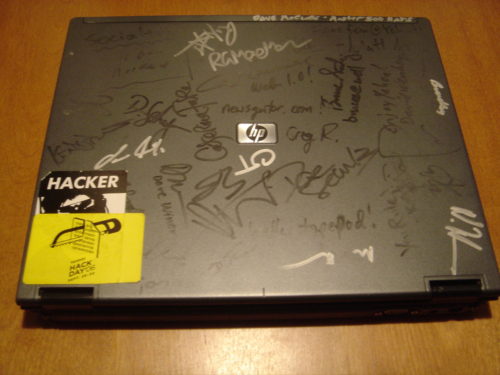
When I worked at Yahoo it was at the height of a cultural trend called Web 2.0. The fashion was to put stickers of various startups all over the front of your laptop so people could see how hip you were. I was running into many interesting people so I took a different approach and asked them to sign my laptop with a sharpie instead.
When the laptop started to give out, before handing it back Yahoo IT and took a snapshot for posterity.
My web 2.0 laptop
Here are some of the names. Click on the photo above to go to the Flickr page that has them tagged.
Rafat Ali Stowe Boyd Nick Denton Caterina Fake David Filo David Jacobs Bradley Horowitz Guy Kawasaki Ross Mayfield Richard MacManus Dave McClure Matt Mullenweg Ray Ozzie Greg Reinacker Doc Searls Deborah Schultz Kathy Sierra Bruce Sterling Chris Tolles David Weinberger Dave Winer Niklas Zennström
Cookie Consent
We use cookies to improve your experience on our site. By using our site, you consent to cookies.
Contains information related to marketing campaigns of the user. These are shared with Google AdWords / Google Ads when the Google Ads and Google Analytics accounts are linked together.
90 days
__utma
ID used to identify users and sessions
2 years after last activity
__utmt
Used to monitor number of Google Analytics server requests
10 minutes
__utmb
Used to distinguish new sessions and visits. This cookie is set when the GA.js javascript library is loaded and there is no existing __utmb cookie. The cookie is updated every time data is sent to the Google Analytics server.
30 minutes after last activity
__utmc
Used only with old Urchin versions of Google Analytics and not with GA.js. Was used to distinguish between new sessions and visits at the end of a session.
End of session (browser)
__utmz
Contains information about the traffic source or campaign that directed user to the website. The cookie is set when the GA.js javascript is loaded and updated when data is sent to the Google Anaytics server
6 months after last activity
__utmv
Contains custom information set by the web developer via the _setCustomVar method in Google Analytics. This cookie is updated every time new data is sent to the Google Analytics server.
2 years after last activity
__utmx
Used to determine whether a user is included in an A / B or Multivariate test.
18 months
_ga
ID used to identify users
2 years
_gali
Used by Google Analytics to determine which links on a page are being clicked
30 seconds
_ga_
ID used to identify users
2 years
_gid
ID used to identify users for 24 hours after last activity
24 hours
_gat
Used to monitor number of Google Analytics server requests when using Google Tag Manager
1 minute
You can find more information in our About Me and .