Every publisher should be thinking about publishing their archives into a GPT-style database to be used as an internal research tool.
As for how BloombergGPT might inspire other news organizations…well, Bloomberg’s in a pretty unique situation here, with the scale of data it’s assembled and the product it can be applied to. But I believe there will be, in the longer term, openings for smaller publishers here, especially those with large digitized archives. Imagine the Anytown Gazette training an AI on 100 years of its newspaper archives, plus a massive collection of city/county/state documents and whatever other sources of local data it can get its hands on. It’s a radically different scale than what Bloomberg can reach, of course, and it may be more useful as an internal tool than anything public-facing. But given the incredible pace of AI advances over the past year, it might be a worthy idea sooner than you think.
Generative AI presents a challenge for media companies that can no longer rely on Google for “discovery.” The chat UI commoditizes everything it indexes so every source in its index is reduced to a mere footnote.
The article (or media artifact) construct will exist tangentially to chat, but with less importance to the reader experience and more important as a reference source. The media brand will surface as a validator in the chat experience, a signature of quality like “Intel Inside.” Only the most recognizable will have value. Evergreen content, like the hundreds of articles of the “how to stop a bleeding nose” variety will languish. Personal, timely, authoritative POV will do much better.
The few media companies that cross the line between content and data provider will find valuable new opportunities in the chat world. A rich, faceted database of all the roofing providers, senior living centers or drug conditions will find a way to capture value connected to AI and upstream of clear economic events. Similarly, marketplaces that represent a unique catalog of products will do well. Value increases with proximity to a transaction.
The challenge for publishers is to build a sustainable editorial voice that remains a destination alongside a readily available AI resource that will expand to meet any and all curiosity-driven demands. Focus on attracting a readers with a unique community and nourish that community with a unique and entertaining stories.
The title of this post is from last week’s People vs. Algorithms newsletter. What starts with a grim evaluation of BuzzFeed’s latest earnings leads into a grim prospectus of the online media industry in a world where platforms such as TikTok and Chat GPT upend established publishing business models.
In this world, publishers that have built their reputation on listicles curating the best posts from Reddit lose out to TikTok accounts scratching that same itch but wrapped up in bite-sized, personality-driven, 20-second video clips. People don’t go to BuzzFeed for random amusement, they go to TikTok.
Then there’s search. When you know what you’re looking for, you realize that Google’s search results page is no longer that efficiently clean place that it used to be. There are more distractions on a a Google SERP than a suburban strip mall lined by used car inflatable air guys and their flailing limbs.
Search for the best hotels in NYC and you’ll notice that not only the first couple of results are sponsored, the embedded map, People Also Ask box and other remaining links are also heavily SEO’d and lead to pages that are either full of sponsored links as well. Anyone who has searched for a recipe knows that the actual list of ingredients is buried down on the bottom of the page, after you’ve scrolled past the history, entomology, and evolution of the dish, all while generating impressions on the accompanying advertisements that may or may not be related.
Conversational AI interfaces harken back to the utility of early Google as they cut right through all this. I have to admit that 80% of my ChatGPT use is asking for the ingredients of a cocktail. The response is wonderfully refreshing with its “just the facts” presentation.
The web starts to look different, half chat box, half vertical video.
Lifestyle publishers that get their revenue via ads running on their site need to prepare for this new world. If curation of the social web is no longer seen as a value add and the “How to. . .” or recipe post just becomes raw material for a ChatGPT response, then how does this publisher, who is paid to introduce advertisers to their audience, get paid?
The arc of the internet is long and unpredictable but bends toward user empowerment and ever increasing fidelity. An endless stream of algorithmically sorted vertical video is the current endpoint. Robots that do much of the work to make sense of things for you are coming faster than you can say “human augmentation.”
John Battelle, who wrote the book on search, the last technical innovation, has some ideas. The first two (affiliate and subscription) are the logical continuation of existing business models but the second two are more interesting.
“NPR-style” underwriting – There’s an opportunity for a specialized AI to be sponsored by a brand in the same way you see certain brands feature prominently in certain magazines. Going back to my search for a cocktail recipe, does adding a classy, relevant brand ad to an AI search that’s been specifically trained on a curated dataset for the purpose can not only help pay for the experience, if done tastefully but also add to it.
Building programmatic search ads “at scale” ruined the curation of high-end brand advertising. To make a good conversational search experience takes time and expertise. Great care should go into curating training sets and iterating continually to produce quality results. Hopefully the same care will be given to accompanying advertising.
The branded agent – this brings to mind something that was pondered but never came to be when search became a consumer product. Search can go both ways, there’s the retrospective search where we search the past and then there’s prospective search that is like a standing search that only notifies you when there’s a new “hit” in the future. Prospective search is familiar to anyone who’s played around with a financial news service, Google Alerts, or services such as IFTTT or Zapier.
If I think of it, I have multiple standing search queries across multiple services that vie for my attention when they get a hit. Spotify lets me know when an artist that I have on repeat is coming to town, American Express tells me every week how much I’ve spent on my card, and ESPN is laughing at me right now because my NCAA bracket is a mess.
These are better known as push notifications and, if you’re like me, you get too many of them. Maybe this is where conversational AI will provide help. Notifications are like a one way conversation – various services trying to start a conversation, most of them failing. Apple has attempted to offer user controls but it’s so complicated to set up that entire articles are written about how to configure the Notification Center.
World War I U-boat controls
Maybe notification management is where we’ll see sponsored conversational AI agents provide value. Allow an AI access to your notifications to get filtered or enhanced notifications and chat conversations informed by your lifestyle and interests.
Invite The New Yorker AI, sponsored by Calm to manage your weekend notifications and allow you uninterrupted time with their long-form journalism partners.
Let Bicycling‘s AI, sponsored by Peloton look at health-related notifications and suggest that you take your indoor training on the road with the upcoming Five-Borough ride.
Use the Eater AI sponsored by Resy to look for food & drink recommendations and get access to a branded conversational AI module that has a history of not only where you’ve been but also all the places you have “on your list.”
We give Google access to our retrospective search, are we prepared to give an AI access to our prospective search in return for personalized AI?
Imagine asking your personal AI when that Italian restaurant your friend texted you about last week is open for a Friday evening reservation. You then ask it to check which of those days works for your date and, when you hear back, you ask the AI to secure that reservation with your credit card. Skip a few beats and then your Peloton AI pipes in to suggest a longer than normal ride for you the following day to work off all that pasta. Respond “sure” and then it’s on your calendar for Saturday morning.
Is this a dream come true or a nightmare you want to avoid? We’ve been here before. What privacy will you give up in return for convenience? It comes down to trust. We’ve been burned by the platforms who took our trust and used it to spam us with irrelevant messages in pursuit of CPCs at scale.
Would things have been different if we opted in to brands we trust to broker our preferences. What if publishers such as The New Yorker, Bicycling, or Eater managed our privacy and brokered it to its advertisers. Wouldn’t you feel differently if you were putting your trust in an editorial voice that you identified with as a subscriber and reader and not some faceless technology stack that only sought to harvest your clicks?
Now is the time for publishers to jump in front of conversational AI development and use their editorial expertise to craft experiences that cater to their readers. Use this Precambrian period to establish a reputation for quality and avoid disintermediation by the platforms again.
I went back to my bookmarks to look for a post that has been taken offline. In the interest of preservation, I have copy/pasted the bit below from the Wayback Machine with thankfully saved the entire post which was originally published in 2012.
This is from a former Linden Labs employee. LL is the company behind Second Life, an early innovator in VR and also, not surprisingly, an innovator in company culture as well.
What I found most innovative was their method of distributing bonuses. While performance reviews at most companies are a long, drawn out process that takes place over many weeks with the actual bonus awards following a couple month’s later, Linden Labs’ bottoms-up evaluation system allowed for bonus determination to take place quickly in a furious three day evaluation period which, once complete, would let everyone (including managers), get on with their work.
Since it’s entirely self driven, obviously the emphasis is on self driven performance. Everyone is expected to contribute and there are people watching to ensure you are, as well as people constantly looking for ways to make the employees more successful – there’s been a particular emphasis lately on the new employee experience since they are expanding a fair bit.
There’s a love machine. Yes, a love machine. What does it do? Well, it’s a way to promote positive feedback and feeling among the people that work at Linden Lab. Basically it’s a web site where you can go and send love to a specific person for a specific thing. “Jakes Sends Love to Billc for helping out with the logging in the new billing system” for example. The system then sends an email to that person saying he’s been sent love, and records it in a big old list that anyone can peruse. Since you have to justify why love was sent you can’t just game the system, nor can you send love to yourself. Every quarter the love is actually tallied up and a dollar value assigned to each love entry (usually 1 or 2 dollars per entry) and the balance is added to your paycheck, and the system reset. I’ve never actually seen anything like it. It’s quite unique.
The bonus scheme is very forward thinking too. For example, every quarter you are given 2000 points of bonus. 1000 points are just given to you, flat out. Thanks for working here. The other 1000 points you are given, you have to distribute among your co workers, in any way you see fit. You can give them all to one person if you like, or you can hand them out per task (I want to give X bonus points to everyone who worked on adding Voice to Second Life for example), or per group (I want to give X points to everyone who works on the web team) or any combination thereof. Obviously you can’t just work out a scheme where you give it all to your buddy and he you – that’s looked for – but otherwise it’s up to you. The bonus points them selves are valued by making the first grant of 1000 points as a percentage of your salary and the second as a percentage of the amount of money in the bonus pool – usually made up of a percentage of the profit from the last quarter. The interesting point about this is that while each individual usually knows of about 10% of the company what they really did and where he/she thinks the money should go, everyones 10% covers a different part so it tends to balance out.
I don’t know why Google makes it so difficult to find the tracking script in the new G4 analytics. I guess it’s to keep consultants busy but if you’re scratching your head and trying to figure out where to find this analytics script in GA’s new setup, you’ve come to the right place.
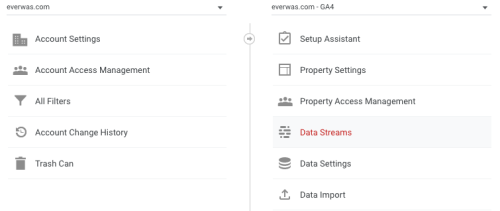
Click on the Admin gear in the lower left hand corner of the screen.
Select the Account, in the second column, click on Data Streams
then select Web and click the right arrow.
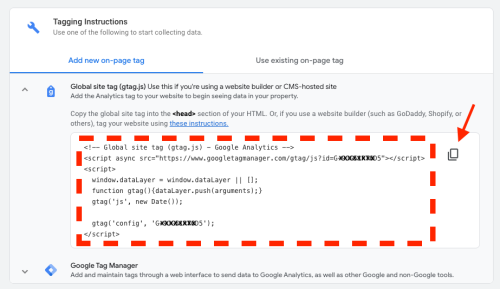
scroll down to Tagging Instructions and click Global site tag to open up the drop down with your G4 tracking script. You can then copy the script you need to use on things like the SmartNews SmartFormat plugin or anywhere else you need to track pageviews.
One of the more chilling tracks from this year’s SXSW were the sessions about misinformation, specifically political misinformation that derailed our elections. During the first day, I attended a session titled Fact v. Fiction: Fighting Election Disinformation a panel featuring, among others, Chris Krebs, noted cybersecurity expert, and Jena Griswold, former Secretary of State for Colorado.
Krebs shared his fear that our media ecosystem, while open to any and all to participate, is easily exploited by well-funded state actors. While the internet and open-source publishing platforms such as WordPress have leveled the playing field, opening access to anyone, it has also put the burden of fact-checking and verifying sources on to the reading public.
too many people are making “insane amounts of money” from disinformation campaigns
Chris Krebs @ SXSW 2022
On Facebook and Twitter all posts tend to look the same. Reduced to a headline, thumbnail image, and snippet, a sponsored post or advertorial written by a paid shill looks no different from a site with more stringent journalistic standards. Production values are no longer an arbiter of quality. Super-charged distribution is built into the business model of these platforms so, with a little bit of budget, a false narrative can be boosted and drown out competing narratives.
The infiltration of “fake news” sites in our media ecosystem is well-documented. What used to be a fenced-off network of identifiable Press Releases has been replaced by networks of “pay-to-play” sites that where lightly re-writing paid messages are turned into into thinly-veiled news stories interlinked to increase their SEO designed to flood the zone.
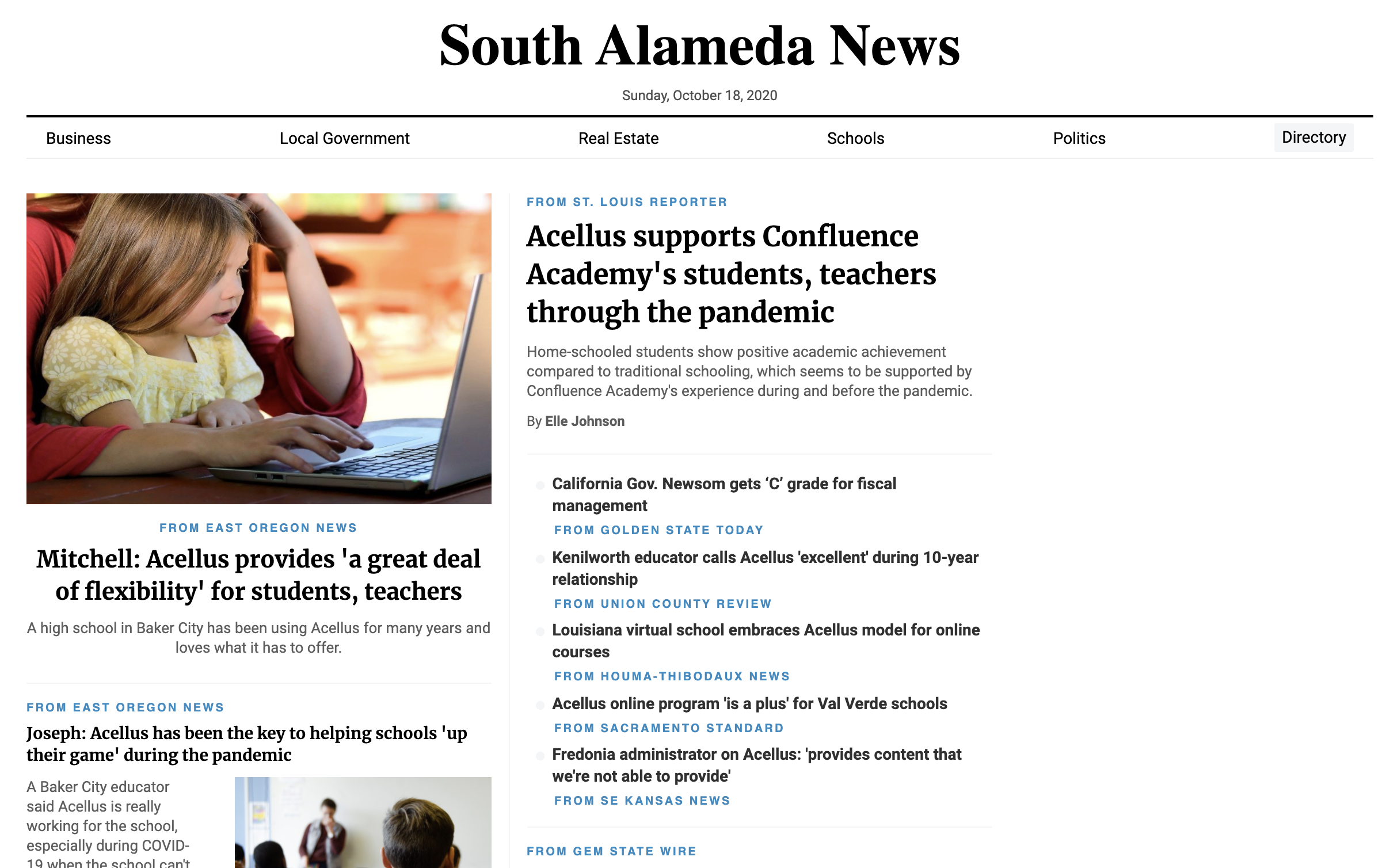
To illustrate my point in an aside, I uncovered one coordinated campaign designed to promote an online learning program to the Alameda School District. I used to live in Alameda and am familiar with its geography. Imagine my surprise when I saw the identical story across three publications that I had never heard of before. East Alameda is not even a neighborhood – everyone who has lived in Alameda knows it’s called the East End. That was the tell.
Clearly what happened is that the vendor of the online learning system was trying to swing public opinion to win a contract. Thankfully, they were thwarted but this shows you how easy it is to plant a message.
Even more chilling was Krebs’ statement that the 2020 Presidential Election was just a dry run or, as he says, an a/b test. Americans were sophisticated enough to suss out foreign disinformation but with movements such as Stop the Steal, QAnon, and the January 6th insurrection, we are still uncovering the depth and extent of deception. Domestic misinformation worked very well to power the Big Lie movement and we are sure to see more domestic misinformation in future elections.
I look at the last election as an a/b test. A – foreign, B – domestic. We learned that A doesn’t really resonate, B was effective so we’ll see more of that.
Chris Krebs at SXSW 2022
Jena Griswold, Secretary of State in Colorado, shared a chilling episode that took place as she oversaw the counting of ballots in the last election. Griswold discovered one of her election workers turned off cameras monitoring the ballot machines and invited an unauthorized person linked to the QAnon movement into the room, sharing motherboard passwords giving privileged access to the ballot computers and opening the ports to the internet, exposing the votes to tampering.
This person, Colorado county clerk Tina Peters, is now running against Griswold for Secretary of State despite having 10 indictments for election tampering filed against her. The Secretary of State is responsible for election integrity and most people do not bother to look into the background of individuals running for this position, in fact, many run unopposed. This firewall around free and fair elections could likely be undermined by a coordinated campaign to put “Big Lie” sympathizers into office that could throw the next presidential election.
Terrified yet? Here’s what you need to do according to the panel.
support non-partisan organizations that are working to get people to the polls
get familiar with the people running to protect elections in your county
talk to your “crazy uncle” or neighbor – try to get thru to them, empathize, sample what they are reading and look for common issues or facts upon which you can both agree
The video above circulated in 2005 when Second Life was the new hotness. As a pioneer in virtual worlds, they attracted buzz from futurists that saw the platform as the next generation of the internet. Companies flocked to the platform, eager to engage with their audience. Reuters opened a bureau and someone made a documentary. Looking back at it now, it looks so cheesy, “Meet thousands of people!”
There are echos of this when we see the latest push to the new virtual platform by the company formerly known as Facebook, Meta. Second Life is still around, going strong with 600,000 monthly users, a third of them coming back each day. Through it all, Wagner James Au has been covering Second Life as spectator, participant, and critic.
I’ve been waiting for someone to check in with Wagner James Au to see what he thinks about Meta, the latest run at virtual reality, and if there are any lessons to be learned from the 15+ years that he’s been there.
Lessons From 19 Years in the Metaverse, a conversation between Wagner James Au and Charlie Warzel is well worth a read. In it, I found this tidbit which is wise counsel to all those out there thinking about how their company or brand can participate meaningfully in the Metaverse.
But first, here’s a quote from the first time around:
To play in Second Life, corporations must first come to a humbling realization: in the context of the fantastic, their brands as they exist in the real world are boring, banal, and unimaginative.
And now from the Warzell interview. Same as it ever was:
Back then, people saw those brand failures and concluded that the metaverse isn’t real or ready for primetime. I fear that might happen again. But the problem is not the users. It’s these companies not meeting these metaverse communities halfway. They’re bumbling their way into the community instead of finding ways to fit inside the community and make use of the platform to bring the magic to life.
I enjoyed Brian Morrissey’s Digiday podcasts which featured interviews with various media executives. His experience in publishing and advertising brings out a level of detail in his conversations that goes deeper than most but still accessible even for a trade publication.
His The Rebooting newsletter is his attempt to branch out on his own and share his findings each week via text. In this week’s issue he writes about the recent optimism in digital publishing startups due to several high-profile individuals setting up shop to try something new. In the last round, the large platforms (Facebook, Google) sucked up all the investment and called the shots, this time, he says, it’s different.
The long term opportunity lies in smarter bundles. New publishers like Defector Media, Every and Puck are building these models. Newsletters have always been a reaction to an industrialized content industry that uses distribution hacks to vacuum up attention data in the service of advertising. These new models allow for the content creators to share in the value they create. That’s only right, and the publications that try to hoard the upside will mostly lose out. More egalitarian ownership is a key part of Web3 but also the future of publishing businesses.
I am a fan of smart aggregation and bundles. With all the newsletters and small media start-ups, the pendulum will swing back towards discovery. Modern machine learning technology and new subscription/rev-share models should provide an opportunity for innovators in this area.
Maybe this time, Lucy will let Charlie Brown kick the football.
Japanese comedy duo, Downtown, in new SmartNews commercials
SmartNews kicked off a new TV advertising campaign in Japan bringing together Hitoshi Matsumoto and Masanori Hamada from the comedy duo Downtown co-star in a commercial together for the first time in 10 years.
Several features that are unique to our Japanese edition are in the campaign. The hugely popular coupon feature which, if you’re lucky, will grant you a free meal at a local fast food shop and my favorite, the Rain Radar with real-time weather alerts.