Year: 2007

  • Tango, the world’s fastest (and thinnest) urban car

    Tango, the world’s fastest (and thinnest) urban car

    So I was at Maker Faire this past weekend which I cannot recommend highly enough. There were so many cool things to see and a really wish I hadn’t lost my camera at the Web 2.0 Expo otherwise I would have been posting tons of pictures of all the wild and crazy things I saw today. If you’ve never been, go next year and if you have kids, bring them along for sure. I went when the gates opened at 10 in the morning thinking we’d pop by for a couple of hours and poke around but ended up having to drag them out at 3pm while they were both in the middle of creating their own board game. My 5 year old daughter left decked out in a tin foil cap with Mickey Mouse ears, a crumpled sheet of mylar strapped to her back as makeshift fairy wings, along with a wand of rolled up magazine paper and lace and tinsel fixings – it was a day well spent!

    I could write about the fantastic Neverwas Here Victorian landship, the 200 lbs. battling robots, the standup acoustic bass made from the fuel tank of a Triumph motorcycle, or the dude who was teaching my son the art of hydroponic farming but it is hard without photos to capture the image.

    I saw the Wrightspeed electric car but what caught my eye was the Tango. Made by an outfit in Spokane, Washington, this electric car is so thin and short that it can park between cars making it the ultimate urban car. Seating two (one behind the other) it can get from 0-60 in 4 seconds and, because of the weight of batteries in the floor, can turn corners as smartly as a sports car.

    Check out the image below taken from the Commuter Cars website – no, that’s not a distortion!

  • How to lose friends and influence competitors

    Gamers are sniggering behind Sony’s back as they roll out an advertising campaign for the Playstation that uses game images from Project Gotham Racing 3, a game made exclusively for Microsoft’s Xbox 360.

    On their website

    On their partner’s website, Kia

    Then in print.

  • Bebo’s “Invite Your Friends” a tad aggressive

    bebo.png
    As competing social networks vie for my attention, I notice that the email outreach campaigns have kicked into gear. Maybe they want to catch the kids before they head out for Summer vacation but it seems like all the services I signed up for back when I was doing some research are reaching out for some love.

    I just received Issue 1 of Bebo’s email newsletter, Spotlight. Among a couple other new features including a Facebook Status clone, they also are promoting an “invite your friends” feature. I’ve seen this on a number of services including LinkedIn and it is often included in the sign up flow as a way to quickly bring along all your friends (and so on, and so on, just like the old shampoo commercial).

    Basically the service uses your Yahoo, AOL, Hotmail, or GMail address book and compares it to their membership database to see if they’ve got a match and prompts you to connect with people you already may know. Bebo takes this one step further by then listing up all of the friends of people in your address book.

    In my mind this is going a little bit too far. I don’t really want to know about all the people I *might* want to connect to because they happen to be friends with people that happen to be in my online address book. It’s a bit shocking to see who some of these second degree characters are and I feel like I’m taking a quick peek and rifling through someone’s black book.

    I know, you could get at this information anyway by browsing their profile and checking out their friends but it somehow doesn’t seem as bad if you’re browsing around. When it’s one huge data dump with a “check all” box, it just feels wrong.

  • David Weinberger on the Miscellaneous

    One of the great things about working at Yahoo is that on any given week there’s a brown bag lunch with someone interesting or provocative. Posters around campus promote these bigger draws and I subscribe to an internal mailing list which lets me know of the others. I try and make it to as many of these talks as I can or, if I’m remote, will at least try and tune in via an internal streaming server they have set up.

    For David Weinberger’s chat with Bradley Horowitz last week I made a special trip down to Sunnyvale to see him and I’m glad I did – the talk was fantastic.

    He’s on a speaking tour for his new book, Everything is Miscellaneous so if you get the opportunity to catch him speak, do try and make it. I’ve read The Cluetrain Manefesto and was deeply influenced by Small Pieces Loosly Joined which I picked up after seeing David speak at an early BloggerCon in Cambridge. I confess that I have not yet picked up a copy of but am looking forward to digging into it soon.

    David of course talked about his book, the central argument being that as we move information from a physical world (books on a shelf) to a digital realm (bits striped onto a raid drive) the very nature of how we store information is strained. Dewey’s Decimal system worked fine when there was only one place to put a book but when you need to classify data and could support multiple tags that pointed to the data, traditional hierarchical taxonomies break down. Pointing to shifts such as how people used to organize their CD collection to today when we create playlists of our digitized music on the fly and the recent hand-wringing over the question of Pluto and the qualities that make up a planet are shaking our very core understanding of knowledge.

    David gave the example of The Library of Congress, the bastion of this old world order as perfectly tuned for the world of print. 7,000 books arrive each day and are cataloged and assigned their place in the great category tree which is our modern library system. Meetings are held when anomalies occur but are quickly resolved at weekly meetings.

    Yet, this method quickly breaks down when we try and apply it to the internet. First there’s just the scale of it all. Over 100,000 blogs are created each day and Technorati’s latest stats show over 15 posts uploaded each second. Not only is it impossible to categorize something that is growing at this rate, it’s also a lost cause to try and filter it for quality. Instead of catching things on the way in as the Library of Congress is doing, in this day of cheap storage and bandwidth, it’s better just to chuck it all into the digital equivalent of a shoebox and let the algorithms sort it out later.

    As the grand index of everything we know grows larger, it’s going to be vital that we build better tools around this data to help us find what we need. In the world of photos and music we already know the importance of good metadata. Geo-tagging, date-stamps, EXIM, and BPM data are useful in helping us make sense of what we have. Social interactions with data also add valuable insight. Tagging add a layer of intelligence that a simple algo cannot.

    David also believes that your social network will also add an important filter on a generic dataset to help you locate something relevent or interesting. The news this week that Facebook is adding classifieds is important because something for sale by your Facebook friend is an order of magnitude more compelling that a generic Craigslist listing by someone you don’t know.

    Our schools are not very well equipped to deal with how we need to work in this new world. Testing in schools is still a, “face forward, solipsitic experience” which doesn’t take into account how we learn things today. A more appropriate test of your child’s understanding of Roman History would be a collaborative project. David suggested that the teacher work with the class on creating a wiki on their topic. The process of hunting, gathering, verifying, and collating information from across the web would prepare them much better than any multiple choice test could today.

    What was most interesting in David’s talk was that he also tempered what he said with warnings not to jump too far in one direction. Sometimes, especially in Silicon Valley, we get all wrapped up in the new and shiny and too quickly leave behind the tried and true. There is value in a top down taxonomy on which to hang your folksonomic tags. The examples of Amazon suggesting books on “adoption” for those searching “abortion” and the more recent Google’s autosuggest snafu kicking over “she invented” and suggesting “he invented” as a more appropriate are examples of what happens when you let the ants design the castle. A blended approach is more sensible in the long run.

    He also touched on the value of mediated experience. There is a great filtering process that takes place when a book is published. Thoughts are collected, sentences are composed. The investment in putting words to print is an important quality filter. As we move to the digital world where it becomes possible to record every waking moment of your life, it’s important to hang onto that filtering process. Despite it’s banality, Twitter is still compelling because there is ultimately someone at the other end; it is, “mediated by human meaning.” JustinTV, on the other hand is just a pure stream without edits, a capture device at best and one that requires 1:1 time and attention to extract meaning from what is captured.

    I obviously need to read his book. After I read Small Pieces, I was sufficiently inspired to quit my job at Dow Jones to join the blogging revolution at Six Apart. Lord knows what will happen after I read Miscellaneous.

    Further Reading :

    • Great review by Ethan Zuckerman
    • The entire talk is available on video on the YUI blog (where I snagged the book cover image, thanks Eric!)

  • YouTube Active Sharing

    YouTube Active Sharing


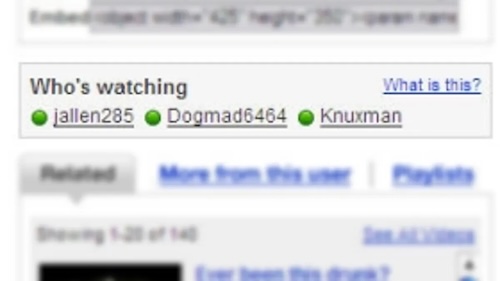
    First time I noticed this but there’s an icon up by your profile next to “History” that lets you know about YouTube’s Active Sharing feature.
    First time I noticed this but there’s an icon up by your profile next to “History” that lets you know about YouTube’s Active Sharing feature.

    When you start Active Sharing, your username will appear to other users on the videos you watch. A list of videos you’ve recently watched will also appear on your profile page.

    Is this new?

  • Mike Nolet on Ad Exchanges, a great primer

    If you’re coming up to speed on Ad Exchanges and how they are fundementally different from Ad Networks, Mike Nolet of Right Media has a great soup-to-nuts primer across three posts.

    Mike’s only been blogging for a couple of months but he’s got a ton of really interesting posts that I look forward to digging into when I have a bit more time. 

    To my readers that work in the financial markets, tell me where you see Ad Exchanges in the next five years and do you think that ad units and the attention that they represent become a traded commodity such as stocks, bonds, and indexed futures? Heady stuff.

  • FlipFrames launches


    Congratulations Dave, Aaron, and Josh!

  • Online Advertising in an IP-Enabled World

    With word out about Yahoo’s acquisition of Right Media I want to publish a post that’s been sitting in my drafts folder for a good couple of weeks. Think about where online advertising is going and how the internet is expanding and what that means and why an open ad exchange makes the best sense for getting the right message to the right person at the right time.

    First the internet. In the past we had IPSs (AOL, Earthlink, Comcast) and portals (Yahoo, MSN) serving as the on-ramp to the internet. The concept was that you would “log-on” to the internet and have the portal act as your guide. Microsoft had a marketing slogan that asked, “Where do you want to go today?” as if the internet was another world which required a guide.

    In the past few years search engines, notably Google, have taken over the role of guide and have become the most popular starting point, serving as an index for the internet. People became more savvy and a few well-placed keywords are all you need to drill deep into a site, by-passing front doors, jumping directly to the page with the information you seek. With always-on broadband and multiple computers in each home, search engines have became touchpoints that people would turn to many times each day to vector out and ferret out a specific piece of information.

    Cell phones are the next frontier and there’s already pressure on the cellphone carriers to breakdown their walled garden directories and search engines are re-engineering their sites to adopt themselves to the mobile context.

    On the bleeding edge we’re seeing the internet experience fade away as a separate experience as more and more objects around us are connected to “the cloud” and are “internet-enabled.” Much has been written about Second Life and other alternate reality environments that are infiltrating our everyday experience of the world around us. But the cloud is seeping into our First World life and data and experience on the internet is more and more inter-mingled into the real world.

    • The SanDisk music player is wifi-enabled and will pull the latest music down based on your listening profile for your drive to work.
    • The Nokia N800 wifi-tablet has media player software so you can stream your music collection anywhere. It’ll run Skype so you can save on your cellphone minutes and with GPS software, it’ll keep track of where you go or give you directions.
    • Smart Signs Media has technology which enables a billboard to pick up the FM radio signal of passing cars and flash messages customized to the demographic of the radio station to which
    • you’re listening.

    I even joked to colleagues about a scenario where internet-enabled signs on the bathroom wall would replace the sports pages tacked up in front of the men’s room urinals at your local sports bar. The content on the page would be swapped out based on behavioral cookies left on your cellphone browser which it would pick up via Bluetooth. At a recent Stirr Mixer, a version of this was starring me in the face!

    To me this says that there is no longer an separate experience called the internet. It is becoming an integral part of the world around us. On the one hand we struggle to apply relevance to Web 2.0 and what that means for the average Joe but on the other hand, we see bits and pieces of this new web popping up all around us everyday infecting everyday objects with connected intelligence.

    How will advertising work in this new world of IP-enabled objects? The current landscape of online advertising consists of a myriad of networks and business models that are experimenting with different ways of getting your attention. We have text ads, banner ads, flash animations, affiliate networks, CPM, CPC, CPA, Branded MySpace profiles, microsites, in-game advertising, the list goes on. Each method talks to its own collection of partner sites where content is blended with messages to varied degrees of context and integration. If you were to compare this landscape to financial markets, it would look like disparate stock exchanges without a currency market to normalize and determine value.

    Right Media is unique because it normalizes monetization across multiple ad networks. A single line of javascript on your site can now optimize across multiple ad networks in realtime so that the best offer is served up, dynamically, to your audience.

    To me, an open and transparent ad exchange is to the online advertising market as the global currency markets are to the global economy. By allowing markets to compete with each other on an open exchange, advertisers and publishers can optimize their sites against the maximum opportunity and let their audiences determine which messages resonate the best and adjust accordingly. An exchange is best able to integrate new publishing platforms (including toilet billboards!), new advertising units, and optimization mechanisms.

    An open market trumps a closed exchange everytime so I give a big ol’ high-five welcome to the folks at Right Media. If you run ads on your site, check out Direct Media Exchange for a glimpse of the future. They’ve integrated delicious, youtube, and flickr as learning tools and have a vibrant community around their product. They even held a recent hack day which shows that their heart is in the right place for innovation. Congratulations and welcome to Yahoo!

    UPDATE : Charline Li at Forrester has a great post on the Right Media ad exchange model and the benefits for Advertisers and Publishers.

  • All Things Digital launches

    allthingsd.jpg

    Walt Mossberg & Kara Swisher have joined up with my favorite headline writer, John Paczkowski from Good Morning Silicon Valley on a new site run by Dow Jones. All Things Digital is a place where Walt and Kara can stretch out a bit and write in a way that the column inches in The Wall Street Journal would constrain.

    All of Mossberg’s reviews from the past two years are now out from behind the subscription wall in an experiment to see if they monetize better out in the open but they’re going to need to tune the Ad Sense placement a bit better because I don’t think people are going to be interested in the “Mossberg on eBay” links they point to right now. House ads for other Dow Jones properties are running tonight but I’m sure you’ll see others ads rotate in as things get rolling.

    Each writer has a lengthy ethics statement which is as much a primer on their individual style as it is a full frontal of any potential conflicts of interest.

    I don’t own a single share of stock in any of the companies whose products I cover, or any shares in technology-oriented mutual funds. Because of this, I completely missed the giant run-up in tech stocks a few years back, and looked like an idiot. However, when the tech stocks crashed, I looked like a genius. Neither was true.

    – Walt Mossberg

    So, if Yahoo makes a smarter move than Google, or if I agree with Microsoft’s position on some issue, rather than Google’s, you’ll read it here whether Megan (her spouse) agrees with it or not. If Ask.com buys a small, smart company that Google was also pursuing or declined to buy, I will report it and praise such a deal, even if Megan was involved on the Google side. This may result in some arguments at home, but it won’t affect the coverage here.

    – Kara Swisher

    I should disclose right at the start that seven years ago, at my request, a former employee of Digiscents procured for me an “iSmell” t-shirt which I wore to the gym for a number of years.

    – John Paczkowski

    As far as I can tell, the whole thing is running on WordPress. Great job folks! Subscribed!