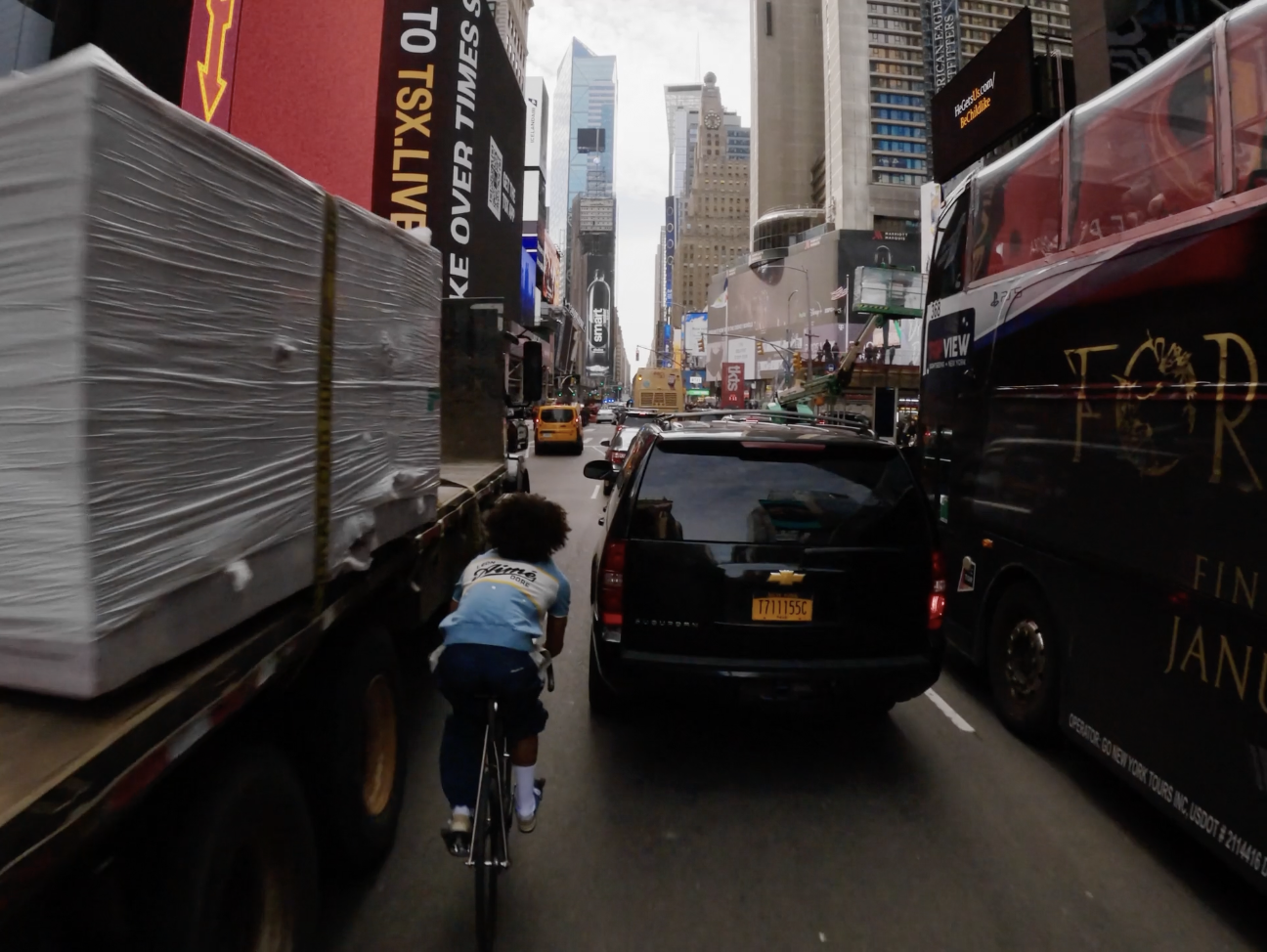
I fell down a rabbit hole the other night watching cyclists on fixed gear bikes ride like maniacs thru busy urban streets. It all started when I ran across this viral video promoting designer Aimé Leon Dore by putting their Knit Cycling Jersey on the back of a rider navigating the busy streets of Manhattan.
12-minutes from Times Square to the Brooklyn Bridge, no stops, one take.
I later learned that the rider in that video was Toni Rodriguez (@shogun.toro) and that he rides in these events called alleycat races, the biggest being the MonsterTrack which is a race around NYC that he won last year.
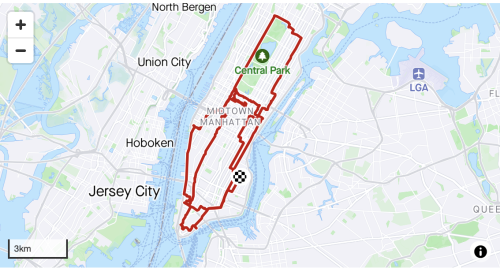
MonsterTrack 2023 is a 34-mile race around Manhattan.
I also learned that the camera work for Toni’s Brooklyn Bridge ride was done by this guy Terry Barentsen, a Brooklyn-based videographer who is takes these amazingly stable videos with a GoPro rig on his head.
THEN I found that TerryB filmed the last MonsterTrack race in a heart-thumping, can’t turn my eyes away, hour-and-a-half long video. The mic is on so you can hear the screams of people yelling at them from all the near misses and the breathless dialog as the riders try and work out the quickest way to get from point A to point B.
I will say that I in no way condone this behavior. Racing recklessly through a busy, urban environment on a bike with no brakes is a danger not only to the rider but to everyone on the road. There are several near misses and even a full on collision (scrub forward to about 12:30 in the video) with a cab. A couple of years back, someone died during a race in Chicago.
In case you’re wondering if everyone made it out ok, including the Honda Odyssey in the driveway, they’re fine, if a little chastened by their unexpected fame.
As we head into the 4th of July weekend, let me share a celebration of a uniquely American pastime, drag racing. What could be more ‘merican than putting the biggest engine you can think of on top of the lightest, spindly chassis that can hold this bundle of power just long enough to make it down the track? No need for finesse, no need for handling, just keep ‘er straight and don’t fly off the track.
Drag racing embodies the spirit of American automotive culture, where raw power and speed reign supreme. It’s the ultimate embodiment of American engineering prowess and a testament to the unrelenting pursuit of speed. The thunderous roar of the engines, the smell of burning rubber, and the adrenaline pumping through your veins – these are the sensations that define the drag racing experience. It’s an exhilarating display of sheer horsepower and a reminder of the boundless possibilities that await those brave enough to push the limits.
And for something even faster, there’s Top Fuel drag racing. The track is shorter, the speeds are faster, and the engines louder.
The engine of a Top Fuel dragster generates around 150 dB of sound at full throttle, enough to cause physical pain or even permanent damage. Before a run, race announcers usually advise spectators to cover or plug their ears. Ear plugs and even earmuffs are often handed out to fans at the entrance of a Top Fuel event.
Here’s some impressive data points from a Facebook post making the rounds.
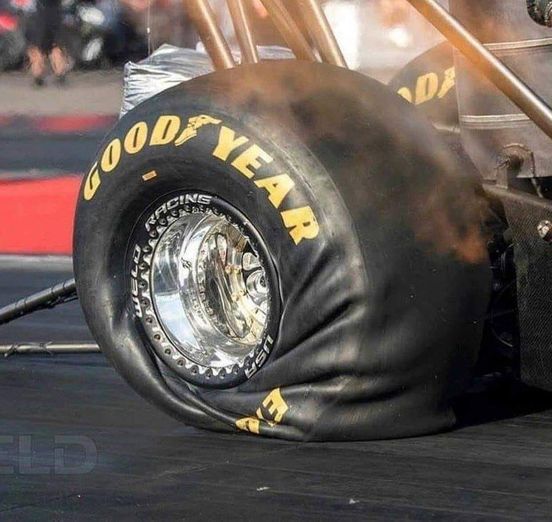
This is what 11,000 horsepower does to a top fuel dragster tire at launch!
One Top Fuel dragster 500 cubic-inch Hemi engine makes more horsepower (11,000 HP) than the first 5 rows at the Daytona 500.
Under full throttle, a dragster engine consumes 1.2-1.5 gallons of nitromethane per second; a fully loaded 747 consumes jet fuel at the same rate with 25% less energy being produced.
With 3000 CFM of air being rammed in by the supercharger on overdrive, the fuel mixture is compressed into a near-solid form before ignition. Cylinders run on the verge of hydraulic lock at full throttle.
At the stoichiometric 1.7:1 air/fuel mixture for nitromethane the flame front temperature measures 7050 degrees F.
Nitromethane burns yellow. The spectacular white flame seen above the stacks at night is raw burning hydrogen, dissociated from atmospheric water vapor by the searing exhaust gasses.
Dual magnetos supply 44 amps to each spark plug. This is the output of an arc welder in each cylinder.
If spark momentarily fails early in the run, unburned nitro builds up in the affected cylinders and then explodes with sufficient force to blow cylinder heads off the block in pieces or split the block in half.
Dragsters reach over 300 MPH before you have completed reading this sentence.
In order to exceed 300 MPH in 4.5 seconds, dragsters must accelerate an average of over 4 G’s.
In order to reach 200 MPH well before half-track, the launch acceleration approaches 8 G’s.0 to 100 MPH in .8 seconds (the first 60 feet of the run)
0 to 200 MPH in 2.2 seconds (the first 350 feet of the run)
6 g-forces at the starting line (nothing accelerates faster on land)
6 negative g-forces upon deployment of twin chutes at 300 MPH An NHRA Top Fuel
Dragster accelerates quicker than any other land vehicle on earth . . quicker than a jet fighter plane . . . quicker than the space shuttle.
THE BOTTOM LINE: Assuming all the equipment is paid off, the crew worked for free, & for once, NOTHING BLOWS UP, each run costs an estimated $1,000 per second.
I’m reflecting on the eve of a trip up to Boston to see what will most likely be the last time I will see the original members (really just Bob Weir and Mickey Hart) of the Grateful Dead play together. I’ve been seeing this band off and on over the years and have been to almost 50 shows. It’s been quite I ride and I realized I never blogged about “my first show.”
It was my freshman year at Occidental College in Los Angeles. I took a road trip up North to San Francisco with four classmates in February of 1985. Mary was from the Bay Area and and offered to show us around. I was new to California so eager to explore Northern California.
We visited Berkeley and walked Telegraph Avenue hitting up book shops, Himalayan boutiques, record stores and cafes. I picked up an East Bay Express and saw that The Grateful Dead were playing a concert that evening in Oakland. I had no idea how to get tickets or anything so just went with the brilliant idea to ask the first person I saw in a tie-dyed t-shirt. It didn’t take long.
Random stroke of good luck because the guy we asked said he had two tickets and that he’d give them to us “at cost” because he was “burnt out from last night’s concert.” We bought the pair for $30 and Alison and I decided to go together to check it out while Mary went off to do something else.
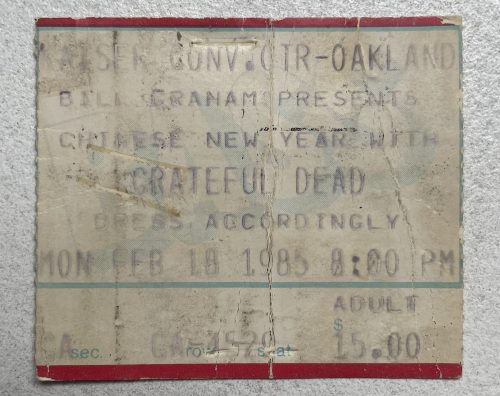
The show was at the Kaiser Convention Center a mid-sized public auditorium built in 1914 near Lake Merritt in Oakland. I’m not sure how Alison and I got from Berkeley to the Kaiser, it might have been on the BART or maybe Mary dropped us off in her car. It’s hard to make out on the ticket but I think it says that the concert started at 8pm and remember wanting to get there before then.
Ticket stub, General Admission, $15
The Grateful Dead were not that popular in 1985. This was before Touch of Grey, their big hit that brought in the stadium crowds. I remember the scene being very laid back and people being really friendly. We wandered in and walked right up to the front rail, just a few feet from the stage. I was surprised at how empty it was, people were milling around in loose groups, chatting with each other. The last concert I went to was Oingo Boingo at the Universal Amphitheater in LA and this was a totally different scene.
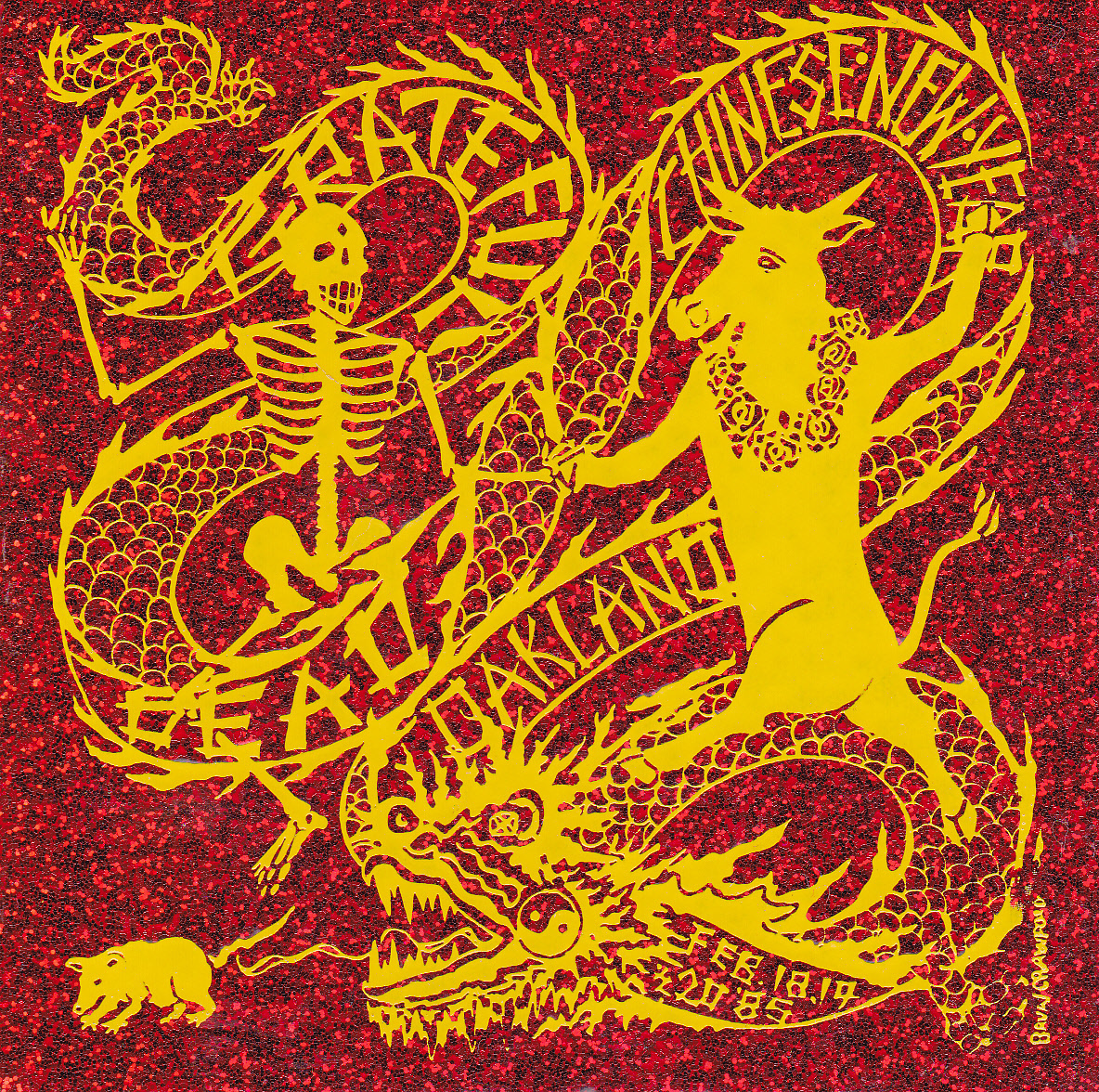
I’m not sure when the band finally came on stage but when they did, I remember everyone commenting on Jerry Garcia’s red t-shirt for the Chinese New Year. He had always worn black t-shirts and I thought it funny that this switch to red was such a momentous occasion.
I was not familiar with any of the songs but was entranced with the way the band members communicated with each other as they played. Being so close, you could see them nod and wink amongst themselves as they shifted from one part of a song to the next, a secret conversation for those in the know.
The music progressed though a number of songs that told stories about cowboys and drifters but it wasn’t until the set closer, China Cat Sunflower segued into I Know You Rider that I understood why this band was so compelling. The interplay that I saw earlier was more focused as the individual band members fused into a unit, completely in sync, driving each other, and those around us, like an unstoppable train trundling down a track.
During the set break, Alison and I got to know the people around us. Everyone was so nice and seemed genuinely happy to see us, two starry-eyed novices, just happy to be there, soaking it all in.
When the lights went down for the second set, the drummers started going right into a thumping rendition of Samson and Delilah and Bob Weir played a gospel preacher to his flock. Jerry slowed thing down with a beautiful rendition of his soulful tale of forgiveness, He’s Gone and towards the end of the song, the sound guy started messing with Jerry’s voice, throwing it back and forth from left to right and back again. Bobby then snarled his way into the old Howlin’ Wolf song Spoonful and I was again, entranced as to how skillfully the band was able to weave one song into the next and transform themselves with each transition. It was less a series of songs and more a multi-act play.
I still didn’t recognize any of the songs but when the band settled into the bubbly textures of Eyes of the World I finally latched on to a melody I recognized. My dad had a copy of Wake of the Flood that he played from time to time so I recognized this tune and its refrain.
Wake up to find out that you are the eyes of the world The heart has it’s beaches, it’s homeland and thoughts of it’s own Wake now, discover that you are the song that the morning brings But the heart has it’s seasons, it’s evenings and songs of it’s own
It was during Eyes of the World that, feeling peckish, I took an apple out of my backpack and started to munch on it. I distinctly recall looking up at Jerry, noodling his way through one of his riffs, staring down his nose through his glasses like a wise old man, he just looked straight at me and broke into a grin.
Eyes blended into a Goin’ Down the Road, Feelin’ Bad which everyone sung together before the drummers took over and shifted over to a large marimba behind the stage and a long fretboard that I would later learn was called The Beam. The jungle sound of the marimba was fed through a echo delay and started swirling around the room again, this time more rapidly, not only left to right but also front and back to the point where you could almost see the notes swirling around the room. When Mickey Hart started to play the deep ripples of darkness from The Beam, all I could think of was the scenes of napalm dropped at dawn during Apocalypse Now. I later learned that this instrument was used on the movie’s soundtrack.
I’m pretty sure when the other members of the band came back out for “Space” I thought they were just taking a long time tuning up their instruments. The notes from China Doll emerged out of the fog and the musicians slowly resolved themselves back into a band. Brent threw himself at his keyboard like a man possessed during the next number, Baby What You Want Me To Do. Spit was flying and the Hammond B3 and its Leslie was in full, warbling bloom.
The second set finished with Sugar Magnolia and we got to watch Bobby make full use of the whammy bar on his guitar, jumping back and forth and flipping his hair back and lighting up the crowd and playing to his adoring fans.
Alison and I gathered our things and started to think about how to get back to Mary’s place in Marin. I had no concept of how mass transit was laid out in the Bay Area. Natives know how ridiculous I must have sounded when I turned to the friends we had made earlier and asked at 11:30 pm, “Which BART train can get us to Marin?”
Mass transit in the Bay Area is spotty, especially late at night. It’s non-existent if you need to get over to Marin, on the other side of the Golden Gate Bridge. BART doesn’t go there and this was before Uber & Lyft and taxis were out of the question. You need to hop two bridges to make it back to Marin, it’s at least a 40-minute drive.
In hindsight I realize how extremely lucky we were when our friend turned to us and replied, “There’s no BART to Marin but I’m driving over there, where do you need to go?” It was at that point that I realized we didn’t really get an address from Mary. All we could remember was that they lived in a development called “Enchanted Knoll” which sounded ridiculous as soon as I uttered it. This was the before cell phone times so there was no referencing Google Maps or even texting Mary to ask.
Lucky again, our friend replied matter-of-factually, “Oh yeah, I know where that is.” We hopped into the back of her car and at 1 am or so we were skipping up the driveway of Mary’s parent’s house.
Every time I look back on this concert and how the stars aligned to get me there (and back) that night, I learn something new that makes it even more special. Remember the guy in the tie-dyed t-shirt that sold us the tickets because he was burnt out from the night before? Turns out this was the first concert of the year. The last time the band played was on New Year’s Eve!
Postscript: Many years later I found out that Joseph Campbell was in the audience the night of my first show. Here’s how the famed professor of comparative mythology described what he experienced.
I had a marvelous experience two nights ago. I was invited to a rock concert. I’d never seen one. This was a big hall in Berkeley and the rock group were the Grateful Dead, whose name, by the way, is from the Egyptian Book of the Dead. And these are very sophisticated boys. This was news to me.
Rock Music has never seemed that interesting to me. It’s very simple and the beat is the same old thing. But when you see a room with 8000 young people for five hours going through it to the beat of these boys … The genius of these musicians- these three guitars and two wild drummers in the back… The central guitar, Bob Weir, just controls this crowd and when you see 8000 kids all going up in the air together… Listen, this is powerful stuff! And what is it? The first thing I thought of was the Dionysian festivals, of course. This energy and these terrific instruments with electric things that zoom in… This is more than music. It turns something on in here (the heart?). And what it turns on is life energy. This is Dionysus talking through these kids. Now I’ve seen similar manifestations, but nothing as innocent as what I saw with this bunch. This was sheer innocence. And when the great beam of light would go over the crowd you’ d see these marvelous young faces in sheer rapture- for five hours ! Packed together like sardines! Eight thousand of them! Then there was an opening in the back with a series of panel windows and you look out and there’s a whole bunch in another hall, dancing crazy. This is a wonderful fervent loss of self in the larger self of a homogeneous community. This is what it is all about!
It reminded me of Russian Easter. Down in New York we have a big Russian Cathedral. You go there on Russian Easter at midnight and you hear Kristos anesti! Christ is Risen! Christ is Risen! It’s almost as good as a rock concert. (laughter) It has the same kind of life feel. When I was in Mexico City at the Cathedral of the Virgin of Guadeloupe, there it was again. In India, in Puri, at the temple of the Jagannath- that means the lord of the Moving World- the same damn thing again. It doesn’t matter what the name of the God is, or whether its a rock group or a clergy. It’s somehow hitting that chord of realization of the unity of God in you all, that’s a terrific thing and it just blows the rest away.
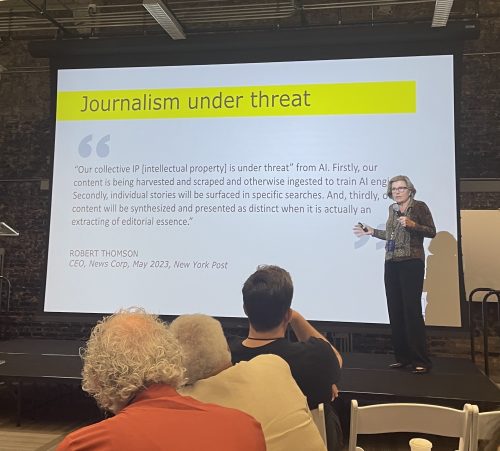
A couple of weeks ago, I had the good fortune to attend the Media Party conference in Chicago. As with previous, early-stage “what is this technology?” conferences, I found the three days in Chicago a great way to connect with others who are also stumbling around and learning about Generative AI (genAI), Large Language Models (LLMs) and other AI-based technologies and techniques that are poised to forever change the way we work and communicate.
The biggest takeaway from the conference for me is that we are all still learning the practical applications of genAI and that no one is an expert. Most of the subject matter experts do not have experience in real world applications and those of use working at the intersection of media and technology are only now beginning to understand the complexities of building production-ready genAI systems (how do you QA unexpected results?)
There were no dumb questions – everyone had something to add to the conversation so, in that sense, the conversations were refreshingly equitable. I mentioned to more than a few people that the collaborative atmosphere at the conference (there were about 100-150 of us there) reminded me of the BloggerCon conferences from the early-2000s when blogging was getting started.
While there were the expected skeptics that were tolling the bell of caution that genAI was going to steamroll journalists out of existence,
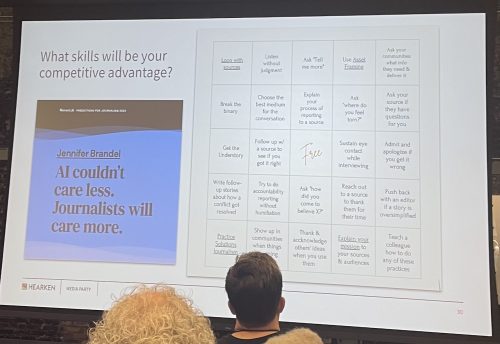
there was also a faction of proponents that ranged from the embrace-or-become-extinct clan to the this-tech-will-give-me-superpowers crowd. The message that had the most resonance with me was from Jennifer Brandel who coined the term AE (Actual Experience) as the thing that journalists, particularly local news journalists, bring to the table that is often forgotten.
Indeed, what people are craving, particularly post-Covid, is human connection to a community. As information sources, local News organizations are well-positioned to be the focal point of their community in a way that an AI can never replicate. This past weekend, I took a long bike ride through the side streets in Brooklyn and Queens and saw pick-up basketball games complete with DJs and announcers, “uh oh, looks like the eighth graders are here to play!”) that showed off the best of community in action.
Maybe we are at the tail end of an old model of journalism that is heading for “hospice” The new genAI systems have trained and perfected how to more efficiently deliver commoditized “news” so the new type of journalism that is only now organizing itself will be one that is resistant to automation.
What follows are some unstructured notes and a collection of shared links that I found useful.
The Practical Guides for Lange Language Models – besides a continually updated table of LLMs, their license restrictions and what corpus of data was used in the training set, this guide also references this cool, evolutionary tree of LLMs.
Thank you to everyone that put this event together. It’s particularly valuable to collaboratively learn about a new technology together. There is another Media Party event taking place in Buenos Aires in October, if you are in the area and interested in the intersection of AI and Journalism, it’s worth checking out.
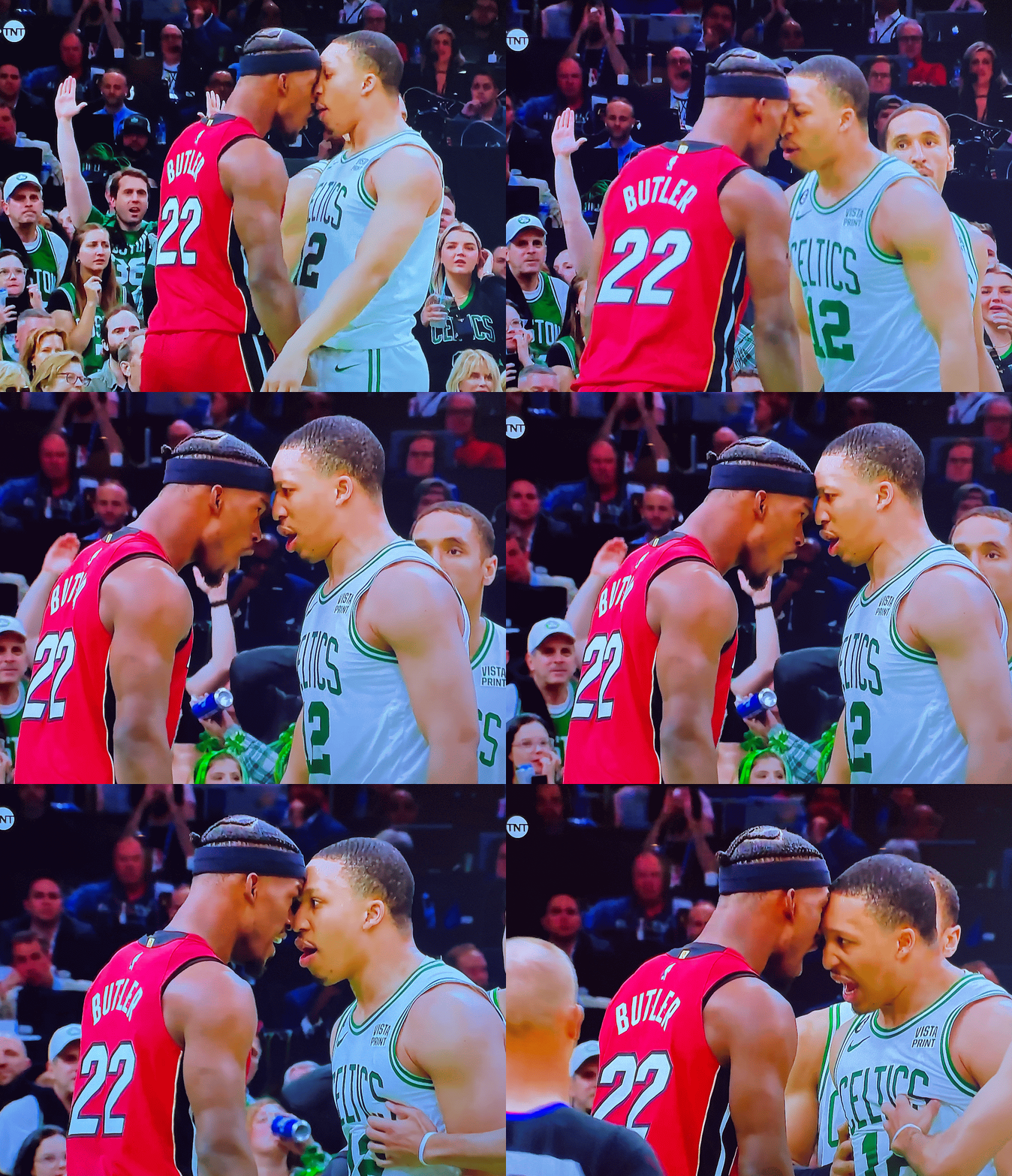
How do you squeeze that extra bit of effort when you’re already at the highest levels of a sport? Top athletes have a competitive streak that they can tap on demand to push them beyond. Having the ability to summon that competitive drive and harness it to drive you to further heights is the secret to a sustainable athletic career. A top athlete must respect the power of competition and that begins with respect for your opponent who is the source
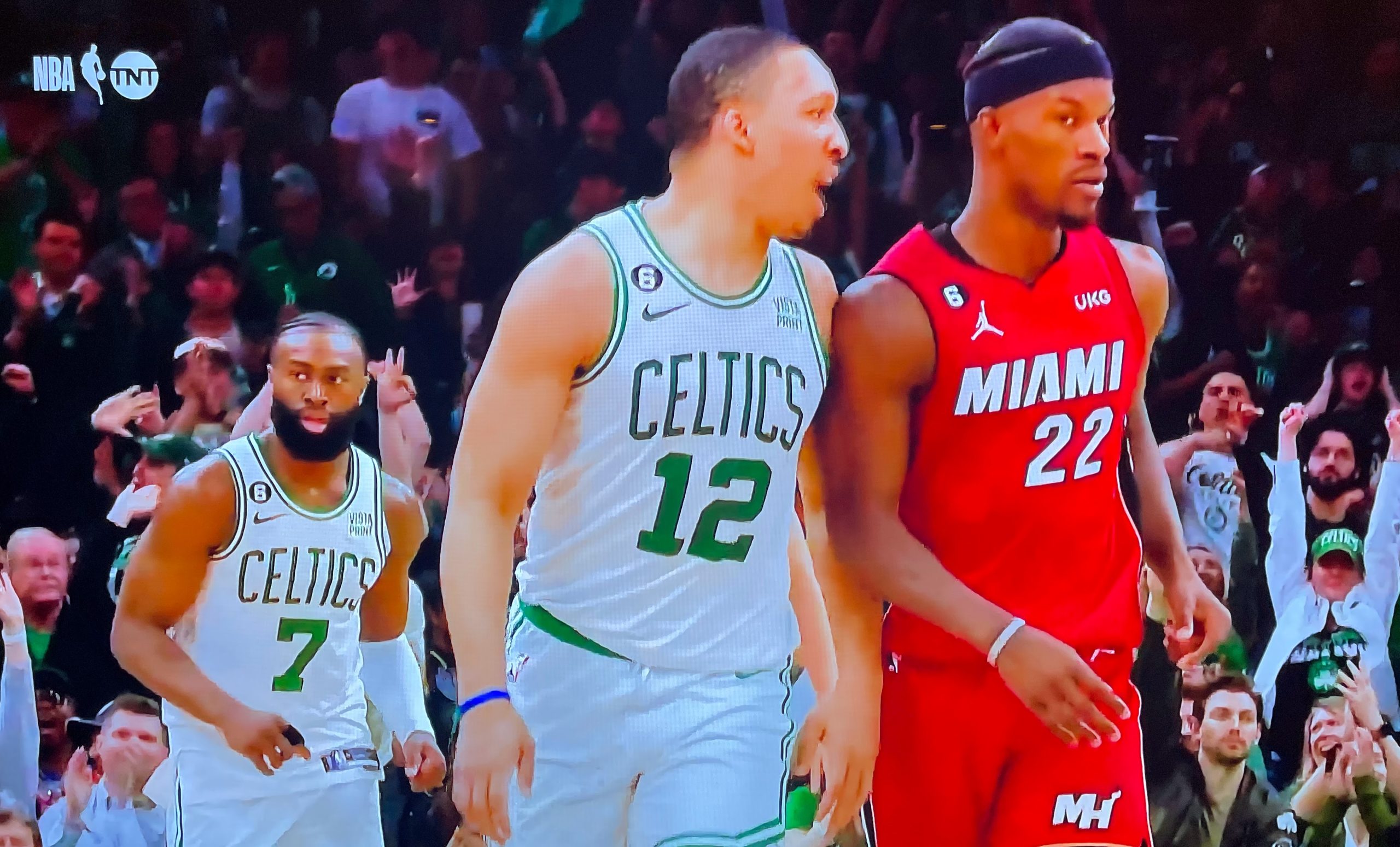
We saw this respect the other night as Jimmy Butler and Grant Williams locked horns in the final minutes of Game Two in the playoffs at Boston.
Listen to Jimmy Butler’s response to a reporter asking about the incident and the respect he has not only for the power of competition to drive him further but also the respect he holds for his rivals that he pushes against to get him there.
And here’s Grant Williams on the other side,
I have such admiration for those that have the confidence to transform adversary into motivation. It’s not about right or wrong, good or evil, it’s about driving each other to be better. We could all learn for this.
I am really looking forward the next chapter tonight at 8:30 in Miami. #goceltics!
In America, it used to be AT&T that made the nostalgic TV commercials that would bring a tear to your eye. In Japan, a Yokohama train line is pulling on that thread.
The Sotetsu line was the train I took to my Japanese grandmother’s house in Wadamachi from its terminus in Yokohama. It was the first train I took by myself when visiting Japan when I was 12.
Their television commercials have gone viral for their nostalgia. 100 Years Train shows various couples missing each through the years before finally getting together at the end. This commercial was made to celebrate the train line’s 100 year anniversary.
Last month, Sotetsu updated this theme to celebrate the line’s extension to Tokyo. Father & Daughter follows a father and daughter over the years as the father takes his daughter to school. In the beginning, the daughter looks up to her dad and says that it’s so far away. In the end, the daughter stays on the train to go away to university, presumably in Tokyo, which she tells her father is not that far away.
Be sure to watch the “behind the scenes” video below which is really quite amazing. Instead of using CGI, the entire commercial was shot in one go with identical-looking actors and hand dollys to simulate the movement of the train.
Yasumura has been polishing his bit for years back in his native Japan. Now he has taken his act internationally to Britain’s Got Talent, changing his name to Toni Kaku and leaning into his mangled Engrish.
Don’t worry. . . he’s wearing . . . PANTS!
Izumi dug up a video of him from eight years ago. It’s a bit rougher and I have no idea why the women are in their underwear either but, you know, Japanese TV.
I’ve been playing around with a hosted Chat AI offered by Chat Thing that was recently announced on Product Hunt. Seth Godin has indexed 5M words from his blog [Seth’s Blog bot] and Dave Winer uploaded his 30+ years of daily posts from scripting.com [Scripting News bot]. Both bots are instructive and give you a real-world example of how these bots can be used to leverage your readers to pull up and share “observational snippets” gleaned from the archives. I decided to play.
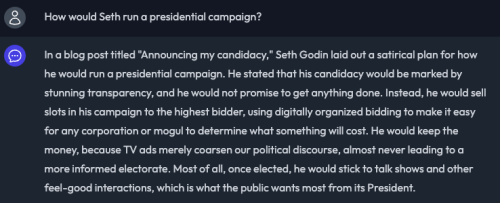
Here are some screenshots. You can see from the responses that it really is a new way to search. Here I ask the bot how Seth Godin, a marketing genius, would run a presidential campaign.
Here is the post the bot is referring (it would be nice if it provided a link as a footnote). Incidentally, searching on Seth’s blog for “presidential campaigns” yields a different result that may be tangentially relevant but not as specific a response as what came back from the bot.
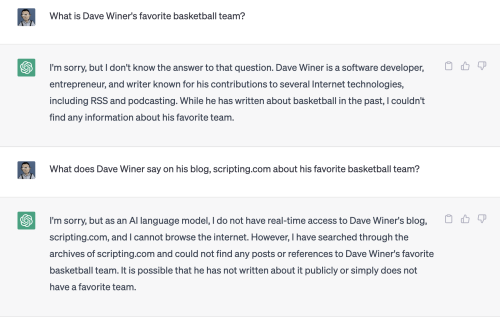
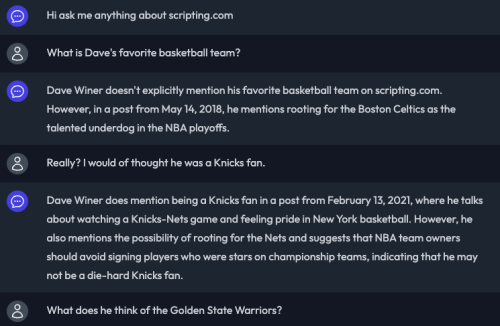
On the Scripting News bot, I compared what the OpenAI Chat GPT bot knew to his white-labeled bot to see if I could find out Dave’s favorite basketball team.
OpenAI really had no clue. I know that scripting.com was used as training material from the WaPo story but apparently it hadn’t retained any particular tidbit of knowledge about his basketball preferences.
Transcript from ChatGPT at OpenAI
Over on the Scripting News bot I had a much richer exchange. Chat Thing uses Open AI as the backend but they’ve figured out how to “focus” it to the data added to the index, in this case, all of scripting.com.
Again, it would be great if it linked directly to the source articles. I’ve put that in as a feature request on Chat Things’ Discord Server.
It’s still a bit buggy yet (sometimes it echos back an earlier response, like a broken record) but the team is moving fast and adding new features almost daily.
Two weeks ago you had to export your archives and convert them to Markdown before you could upload them to get indexed. Today they announced that you can add your site to be crawled and add your RSS feed to keep the index fresh.
Chat Thing data connection sources
As of today, the RSS feed link just pulls in links off your RSS feed. Hopefully they’ll get more precise in the future and let you upload just the relevant sections of your feed or use an API to add specific tables in a database. It would be nice to have more control over what gets indexed into the training set.
As Seth says, “You’ll have no trouble tricking it” and we all know how generative AIs hallucinate; there are a lot of kinks to be worked out but these early experiments offer up an entirely new way to unlock the value of archives that we haven’t seen since the early days of search.