Tag: Facebook

  • Ten Types of Facebook Likes

    Ten Types of Facebook Likes

    The Facebook “like” is a simple social action loaded with meaning. The act of Liking something online while sitting alone at the kitchen table in your boxers is, on the face of it, a solipsistic act, but it’s really much more complex. One click on that link causes a complex web of behaviors that ripple outwards across your social graph. By Liking something you are not only pushing a social signal to the author of the post, you are also signaling to all others that view the post that follow.

    Social signals are often misunderstood online so it’s important to remember that a Like is not always just a Like. It could be any one of the following types of Likes.

    I Saw It Like – this is the most basic type of Like. You want to let the author know that you saw their 49 photos of their trip to Costa Brava and therefore do not need to be reminded when you see them next. A simple click here allows you to cut off the conversation with a quick, “Oh yes, I saw them,” so you can move on.

    Pile On Like – we all tend to swarm around causes. The Pile On adds your name to a long list of people as a way to add weight to someone’s mission. A friend posts how she was indignantly treated by the pizza delivery guy. Quel dommage! This is the perfect opportunity to add your name the pile. Satisfyingly non-commital. We feel your pain.

    Like To Remember – we live in a busy world and our newsfeeds are always in motion. How to remember that clever t-shirt folding video that you saw? With this type of Like, it’s more because you want to retrieve it later, not really because you “liked” it. It’s a one-click ReadItLater link.

    Lazy Like – this is another common type of Like. Writing something witty, especially when you’re late to the game and the one snappy comeback you had ready was hidden under the View More link – your wrung out but still want to contribute – it’s late, you’re lazy – Like.

    Shine a Light Like – it doesn’t happen too often but every now and then something drifts across your feed that you just know no one else will see unless you breath some social air onto it by clicking Like. Maybe it’s that brilliant one-liner from your long lost surfer buddy from Chiba who usually only writes in Japanese. You want your friends to know him and his brilliance. You could Share but that feels like robbing him of something so you click Like.

    Ironic Like – sometimes something is so awful that a Like is in order as the online equivalent of the Hardy Har Har. Someone listening to Katy Perry’s Firework Death Metal overdub? Like.

    Like My Shit Like – God Dammit! I was so excited when I finished work on a animated mockumentary takedown of Sean Parker’s Redwood Wedding that I posted it at 3am as soon as it was done. Everyone was asleep so they missed it and now some big sports event is going off so all the conversation has pushed your video even further down somewhere below the copyright notices. It’s a last resort and a real noob move but you’re clicking Like on your own stuff just to put it back into rotation.

    Condolences Like – while most times Facebook seems like a Happiness Competition, sometimes sad things happen and people post about them. Everyone knows you don’t “like” the fact that someone lost their job or didn’t get into their top choice school but you are sending good vibes and “I’m thinking of you’s” their way. That’s a Condolences Like, not to be confused with a . . .

    Mercy Like – remember that loud PR girl you met in Austin that was discovering social media for the first time? She was so into you and was so grateful for all the tips and tricks you were sharing with her. She took out a little notebook and wrote down a bunch of URLs that you told her and she went home and got that dream promotion she told you about. She’s so grateful, a kid who just got the hang of her bike without training wheels. It’s such an *interesting* world out there! Did you know Samsung paid off their settlement to Apple with 30 trucks of nickels? Even though you know it’s not true, it’s easier just to click Like. Go get ’em kid!

    Absence of Like – what does it mean? You know someone saw your post but they didn’t like it when you specifically shared it because you knew they would like it. . .but they didn’t. Existential Cognitive Dissonance.

    Thanks to Adam Kazwell for sparking the conversation over lunch and all the folks on the Dev team at GigaOM for the extended exploration of Katy Perry overdubs during a lull in the action.
  • Data Mining the Electorate

    Data Mining the Electorate

    Obama Data Mining Team

    The New York Times Magazine had a cover piece on the Obama data mining team that used modern data-mining techniques to more efficiently target the undecided voters that they needed to bring across the fence to win the election. Check out the last line (emphasis mine) on their clever use of Facebook photo tags as a way to further refine their targeting to determine who your real friends were. If they identified any of your close friends as potential voters that were on their “undecided” list, they would then put them on a list of friends for you to ask to vote for Obama.

    They started with a list that grew to a million people who had signed into the campaign Web site through Facebook. When people opted to do so, they were met with a prompt asking to grant the campaign permission to scan their Facebook friends lists, their photos and other personal information. In another prompt, the campaign asked for access to the users’ Facebook news feeds, which 25 percent declined, St. Clair said.

    Once permission was granted, the campaign had access to millions of names and faces they could match against their lists of persuadable voters, potential donors, unregistered voters and so on. “It would take us 5 to 10 seconds to get a friends list and match it against the voter list,” St. Clair said. They found matches about 50 percent of the time, he said. But the campaign’s ultimate goal was to deputize the closest Obama-supporting friends of voters who were wavering in their affections for the president. “We would grab the top 50 you were most active with and then crawl their wall” to figure out who were most likely to be their real-life friends, not just casual Facebook acquaintances. St. Clair, a former high-school marching-band member who now wears a leather Diesel jacket, explained: “We asked to see photos but really we were looking for who were tagged in photos with you, which was a really great way to dredge up old college friends — and ex-girlfriends,” he said.

    Data You Can Believe In

  • Wolfram | Alpha Personal Analytics. Quantified-self on demand

    Wolfram | Alpha Personal Analytics. Quantified-self on demand

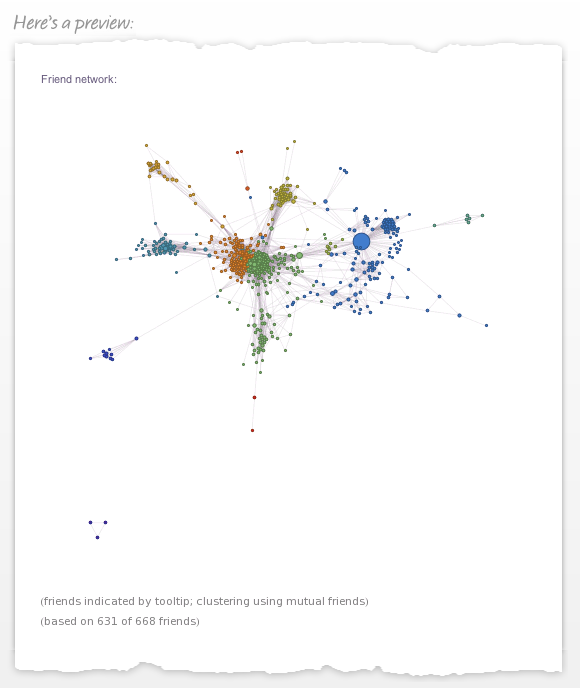
    Wolfram | Alpha posted about a self-analysis tool, the Personal Analytics for Facebook. All you need to do is go to their site and register with Wolfram | Alpha and connect it to your Facebook ID (giving them permission to read your friend lists) and then they’ll run all sorts of analytics on your social graph. Just type “facebook report” on wolframalpha.com to get started.

    The graph above shows your Facebook friends on hover so you can figure out all the outliers and what connects them to the others. The chart below shows you how you access Facebook. There’s another, not pictured, that will show you which apps you use and when.

    All in all it’s a beautiful report and a clever way towards user acquisition. It reminds me of Nicholas Felton’s beautiful Year in Review reports. Mr. Felton, who now works at, ironically, Facebook.

  • Facebook Find Friends Nearby

    Facebook Find Friends Nearby

    UPDATE: Looks like the feature got pulled offline. Wonder if the legal department got involved.

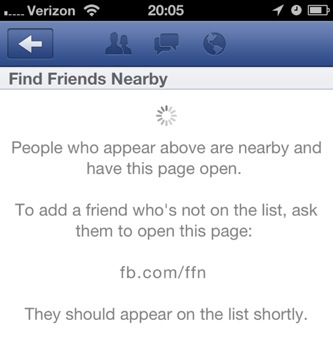
    Some are calling Facebook’s new Find Friends Nearby feature (turned on just this weekend) as a Highlight-killer. Maybe so but that’s only if you keep the app on the FFN page at all times. It doesn’t track your location in the background.


    The real feature is that it helps tighten up your social graph, turning those chance friendships into Facebook friends.

    The feature is incredibly convenient if you happen to be chatting with someone in person and want to add him as a Facebook friend. Rather than tapping out his name and wasting minutes scrolling through a list of similarly named individuals, you can just ask your new pal to open up the Find Friends Nearby page and add him with a quick tap.

    Rosa Golijan

    To find this new feature on Facebook’s iOS and Android apps,  go to the main menu > apps > find friends > other tools > Find Friends Nearby. You can also find it on the mobile website, m.facebook.com

  • Speed of Execution

    The Instagram deal came together in record time: A call late last week from Mr. Zuckerberg to Instagram Chief Executive Kevin Systrom led to a weekend powwow at Mr. Zuckerberg’s Palo Alto home and ended in a handshake Sunday night, people familiar with the matter said.

    The Wall Street Journal on the $1 billion Facebook acquisition of Instagram

  • Push Button Social Networking

    HTC announced two phones with dedicated buttons for Facebook. The touchscreen Salsa and ChaCha (pictured below).

    Running Android Gingerbread 2.3.3, HTC modified the Sense UI to integrate the Facebook into the experience. According to the HTC press release,

    The Facebook button on HTC ChaCha and HTC Salsa is context-aware, gently pulsing with light whenever there is an opportunity to share content or updates through Facebook. With a single press of the button, you can update your status, upload a photo, share a Website, post what song you are listening to, ‘check in’ to a location and more. For example, you can take a photograph of friends on your phone and upload it instantly to Facebook by simply pressing the button. Or let your friends know what song you’re listening to by pressing the button while listening to music on the phone. The track is automatically identified and shared on Facebook.

    Dedicated hardware keys are nothing new (see Yahoo button on Japanese feature phone below) but HTC has taken advantage of the phone sensors and software to give this button multiple uses, as long as your preferred social network is Facebook.

    Shipping in Q2 2011 across Europe and Asia and launching exclusively with AT&T “later this year.”

  • Facebook and your Contact Info, a Proposal

    Facebook just announced that they are suspending a previously announced expansion of their API allowing third party developers to request access to a user’s address and phone number. Some history and a modest suggestion follow.

    When Facebook announced Facebook Connect in 2008, Dave Morin wrote about a concept he called Dynamic Privacy. Facebook Connect would let developers to access your profile but data retention policies required developers to flush this cache of data and refresh it every 24 hours. This way, Facebook could  guarantee your data would not only be current but also deleted if you decided to revoke an application’s permission to access your profile.

    Since then, Facebook’s data caching policies have been relaxed. With every Facebook platform developer hitting their servers for a data refresh every 24-hours you can imagine the impact this had on the Facebook infrastructure. In April 2010, Facebook announced that the 24-hour data caching policy would be removed. Developers rejoiced. Facebook operations could relax again. But, for users, the promise of Dynamic Privacy was no more.

    Fast forward to last Friday’s announcement that Facebook would allow developers to ask for access to your profile Contact information such as home address and phone number. Without Dynamic Privacy, an application could ask for access to your contact information and keep it. One stray click could give out some very personal data.  There’s no way to opt out of giving out this information in error. No way to put your phone number or address into a special bucket that is locked down to all but a handful of mobile or shopping applications that would be greatly enhanced with access to your phone number.

    Rules-based Privacy

    Is there a way for Facebook (or any service) to grant access to information provided the conditions under which I grant this access are maintained? How can Facebook ensure that anytime I delete my information it will also be removed from any sites that ever had access to this info? What if I store my private information with a site such as threewords.me which, after only a few weeks in play, is auctioned off to the highest bidder? Is there a way to require the eventual new owner to re-acquire permissions to my contact data. The Facebook Platform Policy currently states:

    You will not sell any data. If you are acquired by or merge with a third party, you can continue to use user data within your application, but you cannot transfer data outside your application.

    My reading of this is that the new owner of threewords.me can use the data as long as it is used in conjunction with the operation of threewords.me. This includes any future features added should they improve the site to meet their needs. In 2008, the passage of 24-hours required a data refresh, in 2011, at a minimum, legal change of control should do the same. The Platform Policy further states,

    You must not give your secret key to another party, unless that party is an agent acting on your behalf as an operator of your application. You are responsible for all activities that occur under your account identifiers.

    What if the statement was re-written so that an application’s secret key can never be transferred? Any new owner of an application could run it using their own secret key but it would kick off a refresh of all requested user data. This request could be sent out as via a notification on Facebook Messaging or an alert that would appear the next time the user tries to use the application or web site. Maybe this is already the case but it would be better to state this clearly.

    So my modest proposal to bring back the original intent of Dynamic Privacy is,

    1. Revision of the Facebook Platform Policy to clearly state that change in ownership would require re-authorization of grated user permissions.
    2. Enforcing limitations on transferring application secret keys by tying each key to verified named accounts only. An example of this is how domain names are tied to an administrative and technical contact who are legally and technically responsible for activity on that domain.
    3. Requiring all applications to support the Deauthorization Callback and extending it with an API call that is authorized to overwrite or remove data on the 3rd party server. All domain-name root servers are given the ability to update the hosts file information on their downstream servers. Might a similar root server role be appropriate for Facebook as the provider for your private data stored on all downstream applications?
    4. The option for users to place personal data into a more secure area which would require more than a single click to grant access.  Something that requires two step authorization and sends me a confirmation email informing me that this access has been granted.

    The best way to build up trust is to put in place features that give users control and the option to take something back. These are the post-lunch ramblings of an observer. Please correct me if what I’m suggested is crazy talk!

  • Re-Skinning Facebook

    Re-Skinning Facebook

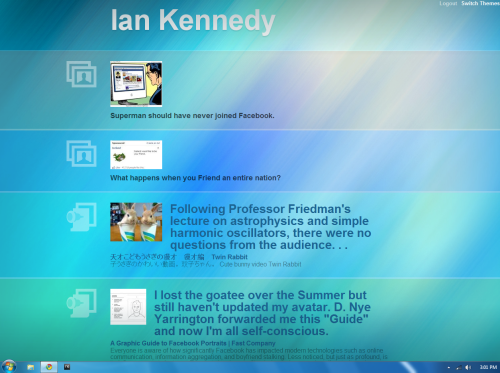
    Stumbled across a quick and dirty side project that uses Facebook’s social graph api to pull your newsfeed and present an alternate display. Try it yourself at Facebook-me.com.

  • Facebook virtual currency now real

    Facebook virtual currency now real

    USA Today reports that Facebook Credits will be available as gift cards at Target.

    The new Facebook gift cards will be available in values of $15, $25 and $50 at all of Target’s 1,750 retail stores and at Target.com. Two or three more national retailers will start selling the cards in coming months.

    The article goes on to report that cards for online games such as Farmville are already available and that the overall market for gift cards was $80.6 billion last year.

    I wonder how the gift card economy works. Does facebook get to book revenues for gift card sales before they are re-deemed? How are gift card sales classified for taxes? If you sell gift cards in other currencies, does the gift card revenue get counted towards the US GDP?